
Contemporary Dance for Beginners: A Gentle Start
So, you’re thinking about trying contemporary dance? That's fantastic. It’s an incredibly expressive and fluid style, making it a perfect starting point for beginners. Unlike more rigid forms, contemporary dance really values personal interpretation, blending techniques from modern, jazz, and even classical ballet to focus on telling a story through movement. It's a welcoming and deeply creative outlet for anyone ready to begin their dance journey, whether you're in Bluffdale or coming from nearby Lehi.
Unpacking the World of Contemporary Dance
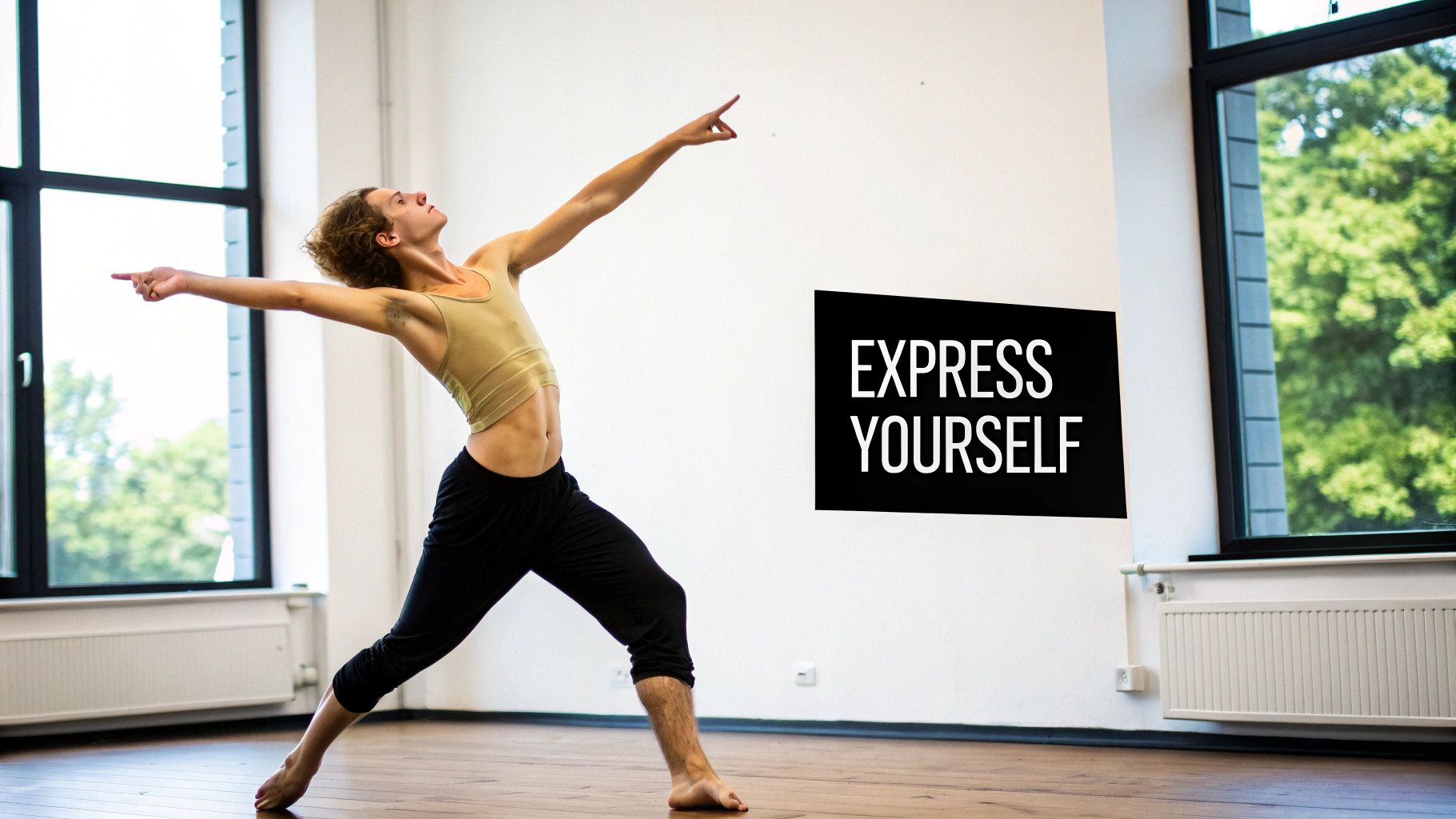
Have you ever watched a performance that felt less about perfect pirouettes and more about pure, raw emotion? That’s the soul of contemporary dance. It’s an art form that intentionally broke away from the strict, codified world of classical ballet to explore a much broader, more human range of movement and expression.
Instead of fighting gravity to stay upright with perfectly pointed toes, contemporary dance embraces it. We use the floor, we work with our body's natural mechanics, and we breathe into the movement. Think of it as a physical conversation between you and the space around you. It’s a style where your personal story and feelings can truly take center stage, which makes it an incredibly empowering choice for newcomers.
What Makes Contemporary Dance Unique?
Contemporary dance is a beautiful mosaic, pulling inspiration from various styles to create something entirely new and constantly evolving. It isn't just one thing.
Here are a few of its defining characteristics:
- Storytelling is Key: Every movement is there to convey a narrative, an idea, or a feeling. The "why" behind a movement is just as important as the "how."
- Working with Breath and Gravity: You'll learn to work with gravity, not against it. Your breath becomes a powerful tool, initiating movement and creating an organic, natural quality.
- Freedom to Express Yourself: While there are foundational techniques to learn, contemporary heavily encourages individual interpretation and improvisation. This freedom can be especially liberating when you're just starting out.
- Dynamic and Versatile Movement: The vocabulary is huge. One moment you might be making sharp, angular gestures, and the next you’ll be flowing through soft, lyrical phrases or grounding yourself with powerful floorwork.
The appeal of this expressive style has skyrocketed. Today, about 25 million Americans participate in dance classes each year, and a huge part of that growth comes from contemporary. A major reason is the focus on improvisation—with 60% of dance instruction using it as a core teaching tool. This approach lets you explore movement without the pressure of getting every single step "right."
To help you see where contemporary fits in, here’s a quick look at how it stacks up against other popular styles.
Key Differences for Aspiring Dancers
Understand how contemporary stands apart from other dance styles to see if it's the right fit for your goals.
| Core Philosophy | Expression and storytelling through fluid, natural movement. | Codified technique, grace, and precision. Focus on defying gravity. | Rhythmic, energetic, and performative. Often tied to popular music. |
|---|---|---|---|
| Posture & Alignment | Varied. Embraces curves, off-center shapes, and groundedness. | Upright, lifted torso with strict alignment and turnout. | Strong core, but can be stylized. Low center of gravity is common. |
| Footwear | Often barefoot, but can use socks or half-soles (turners). | Pointe shoes or soft ballet slippers. | Jazz shoes or character heels. |
| Use of Music | Diverse. Can be lyrical, abstract, percussive, or even silent. | Primarily classical music. | Pop, funk, Broadway, and upbeat, rhythm-driven music. |
| Improvisation | Highly encouraged and often a central part of training. | Rarely used in performance; focus is on set choreography. | Included, especially in certain sub-styles like lyrical jazz. |
Seeing the differences laid out like this can make it easier to decide which path excites you the most. Contemporary is truly for those who want to blend athleticism with artistry.
Is This the Right Style for You?
Deciding if contemporary dance is the right fit really comes down to what you’re looking for. If you want a creative outlet that also happens to be a fantastic full-body workout, you've found it.
Contemporary dance is like a painting; but rather than using a paint brush, we just use our bodies instead. And while a painting could live forever, our dance is only temporary so embrace it while it lives.
This art form is perfect for anyone who wants to connect with their body in a new way, build incredible core strength and flexibility, and tell stories without saying a single word. Many of our students from nearby cities like Riverton and Herriman find the short trip to our Bluffdale studio is more than worth it for this unique blend of athleticism and artistry.
Ultimately, it’s less about achieving a perfect "look" and more about discovering your own unique movement language. If that sounds exciting, you're in the right place. To see all the options we offer, feel free to explore our diverse dance programs .
What to Expect in Your First Contemporary Dance Class
Stepping into a contemporary dance class for the first time is a huge step—it’s totally normal to feel a mix of excitement and a few butterflies. A little prep can make all the difference, helping you shake off those nerves so you can focus on the movement from the moment you walk through the door.
When you know what’s coming, you can stop worrying and start experiencing. The goal is to connect with the music, explore how your body wants to move, and have a great time. Let's walk through everything you need to know to feel confident and ready, whether you're joining us from right here in Bluffdale or making the quick drive from Draper.
Dress for Success (and Comfort)
What you wear to contemporary class is all about function, not fashion. You need clothes that move with you, not against you, so you can stretch, leap, and roll on the floor without a second thought.
The key is form-fitting but not restrictive. Here’s a quick rundown of what usually works best:
- Tops: A fitted tank top, t-shirt, or leotard is perfect. This helps your instructor see your alignment—your spine, your shoulders, your core—so they can give you helpful feedback.
- Bottoms: Leggings, dance tights, or even fitted joggers are great options. It’s best to avoid baggy sweatpants or shorts that can get tangled up or ride up during floorwork.
- Footwear: We often dance barefoot in contemporary to really feel the floor. Some dancers prefer socks with grips or half-sole shoes (often called "turners") to help with pivots and turns. Feel free to ask your instructor what they recommend.
Ultimately, your comfort is what matters most. For a full breakdown of our studio's specific guidelines, you can always check out the complete Encore Academy dress code .
The Flow of a Typical Beginner Class
Every teacher has their own unique flair, but most beginner classes follow a predictable and logical structure. Knowing the general rhythm of the class can make it feel familiar right away.
Classes are usually built around three main segments:
The Warm-Up: This is non-negotiable. We start here to get your body ready for bigger movements. Think gentle stretches, deep breathing to get you centered, and exercises to wake up your spine. The intensity will build slowly with basics like pliés, tendus, and core work.
Center & Across-the-Floor: Once you’re warm, the real work begins. You'll tackle exercises in the center of the room that focus on balance and coordination. Then, you’ll move "across the floor," practicing traveling movements like walks, chassés, leaps, and turns. This is all about learning to move through space with control and grace.
The Choreography: This is everyone’s favorite part! Your instructor will teach a short dance combination, breaking it down into manageable pieces. It’s your chance to put all the technical elements together, play with musicality, and let your own unique artistry shine through.
Remember, your first class is a space for discovery, not a performance. Don't stress about perfection. Just focus on how the movement feels and enjoy the process of learning something new.
Studio Etiquette: The Unspoken Rules
A positive attitude is the best thing you can bring to class. Dance studios are shared creative spaces, and a few simple courtesies help make it a welcoming environment for everyone.
Try to arrive a few minutes early to get settled. Find a spot on the floor where you have a clear view of the instructor and aren't blocking anyone else.
Most importantly, leave your inner critic at the door. Everyone feels a bit clumsy when they're starting out—it's a rite of passage! Every single person in that room, including your teacher, was a beginner once. Embrace the awkward moments, ask questions, and be kind to yourself. We have so many students from Lehi and Sandy who will tell you that the supportive community here makes the journey incredible.
Getting to Know Contemporary Dance's Core Movements
Stepping into a contemporary dance class for the first time is a bit like learning a new language—one your whole body gets to speak. The vocabulary can feel a little strange initially, but you'll quickly realize that every movement is rooted in principles that are surprisingly intuitive. This isn't about hitting rigid, perfect poses; it's about feeling and understanding the why behind each action.
Let's demystify some of the essential ideas you'll meet on the dance floor. We’ll look at the cornerstone techniques from dance legends, the central role your breath plays, and the grounded, dynamic floorwork that makes contemporary so unique. Getting a handle on these fundamentals gives you a solid foundation to build from.
The Heartbeat of Movement: Contraction and Release
One of the very first concepts you'll likely explore is contraction and release, a technique gifted to the dance world by the legendary Martha Graham. The best way to think of it is as the dance equivalent of a heartbeat—a powerful, rhythmic pulse that drives movement straight from your core.
A contraction is a deep, active hollowing of your abdominal muscles, which curves the spine forward into a "C" shape. It’s an exhale, a moment of focused tension and internal energy. The release is its natural counterpoint. As you inhale, the spine lengthens and returns to a neutral or slightly arched position, sending that coiled energy outward. This dynamic duo isn't just a physical exercise; it's a profound tool for expressing everything from struggle to pure joy.
Embracing Gravity: Fall and Recovery
Another game-changing idea is fall and recovery, which comes from pioneer Doris Humphrey. This entire principle revolves around the fascinating dance between balance and imbalance. Humphrey saw all movement as existing on an arc between what she called "two deaths": perfect, static balance on one end and a complete surrender to gravity on the other.
The "fall" is the moment you give in to gravity, intentionally letting your body go off-balance. The "recovery" is the rebound—the powerful resistance against that fall that brings you back to a state of equilibrium. It's this beautiful, constant negotiation with gravity that creates that sense of momentum, suspension, and breathtaking fluidity you see in contemporary dance. It's the secret behind those effortlessly sweeping motions.
"A dancer and a good choreographer master only one language. The language of Dance. All other 'formulas' of expression are not worth mentioning when referring to Dance."
This insight is a great reminder that these techniques aren't just academic concepts; they are the very words of the physical language you're learning to speak.
Your Breath as the Initiator
In contemporary dance, your breath is so much more than an automatic function—it's the engine that powers every single gesture. Forget holding your breath through a tough sequence. Here, you learn to use it to kickstart and shape your movements.
A deep inhale can lift and expand your entire body, making a leap feel weightless. A full exhale can ground you, adding power and intention to your floorwork. When you connect your breath to your movement, you unlock a natural, organic quality that feels completely authentic. This focus is a huge reason why so many of our students from Sandy tell us they find contemporary dance to be both a physical challenge and a mindful practice.
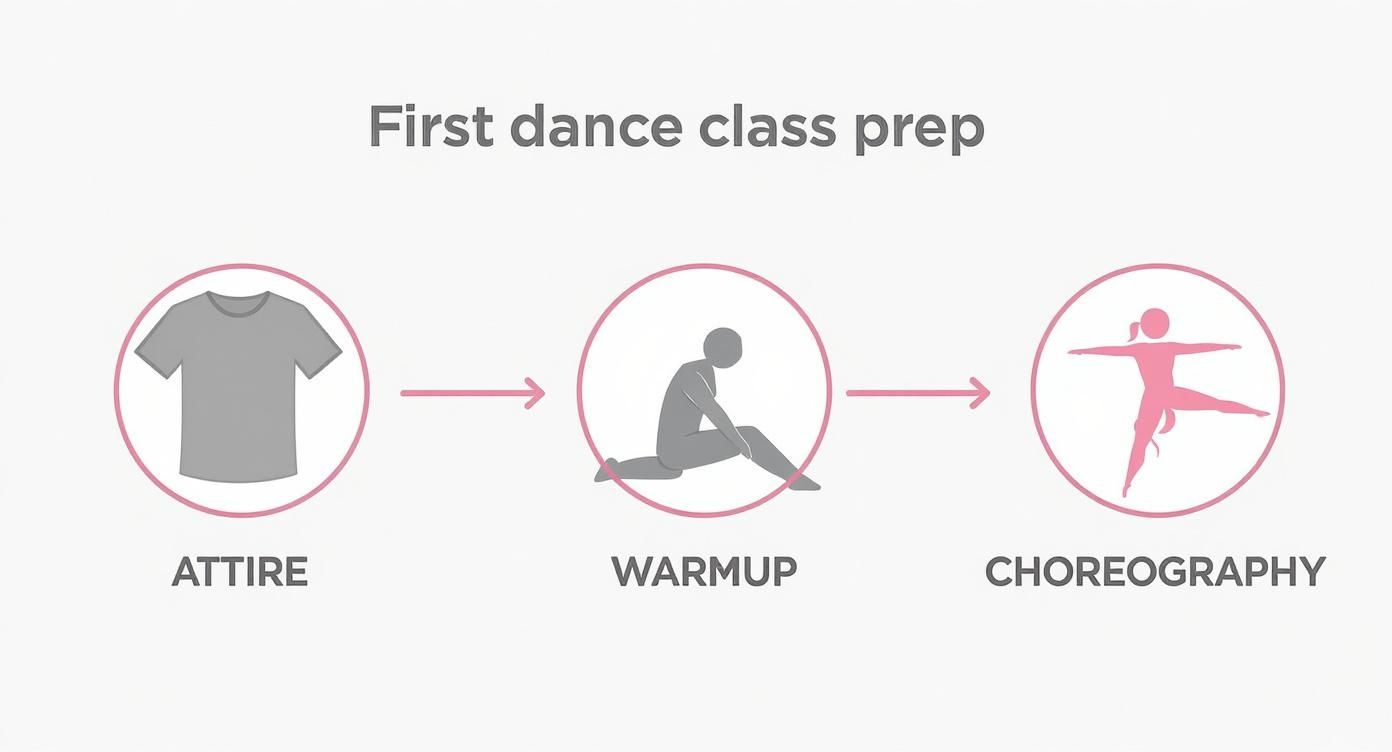
This simple flow breaks down how to get ready. It's a good reminder that being prepared is about your mindset just as much as it is about what you wear.
Getting Grounded With Foundational Floorwork
Floorwork is a signature element of contemporary, and it’s where you truly learn to make gravity your partner. It’s an incredible way to build core and upper body strength while teaching you how to move seamlessly from standing to the floor and back up again.
As a beginner, you'll start with the basics:
- Simple Rolls: Learning to roll smoothly across the floor—forwards, backwards, sideways—is all about building body awareness and control. The trick is to keep your core engaged to guide the movement, rather than just collapsing.
- Leg Swings and Slides: From a seated or lying position, you’ll practice sweeping your legs in wide arcs or sliding your body across the floor. These exercises teach you to power movement from your hips and center, creating those beautiful, long, uninterrupted lines.
- Transitions to Standing: A key skill is getting from the floor to your feet with fluidity. This often involves using a spiral through the spine or harnessing the momentum from a leg swing to propel yourself up.
These skills are your building blocks. They might feel simple at first, but mastering them is crucial for tackling more complex choreography down the road. If you're curious about where these movements came from, you can learn more about how modern dance evolved into the contemporary style we practice today. Knowing the history adds a whole new layer of appreciation for every contraction, release, and roll you do in class.
How To Practice and Improve Outside of Class
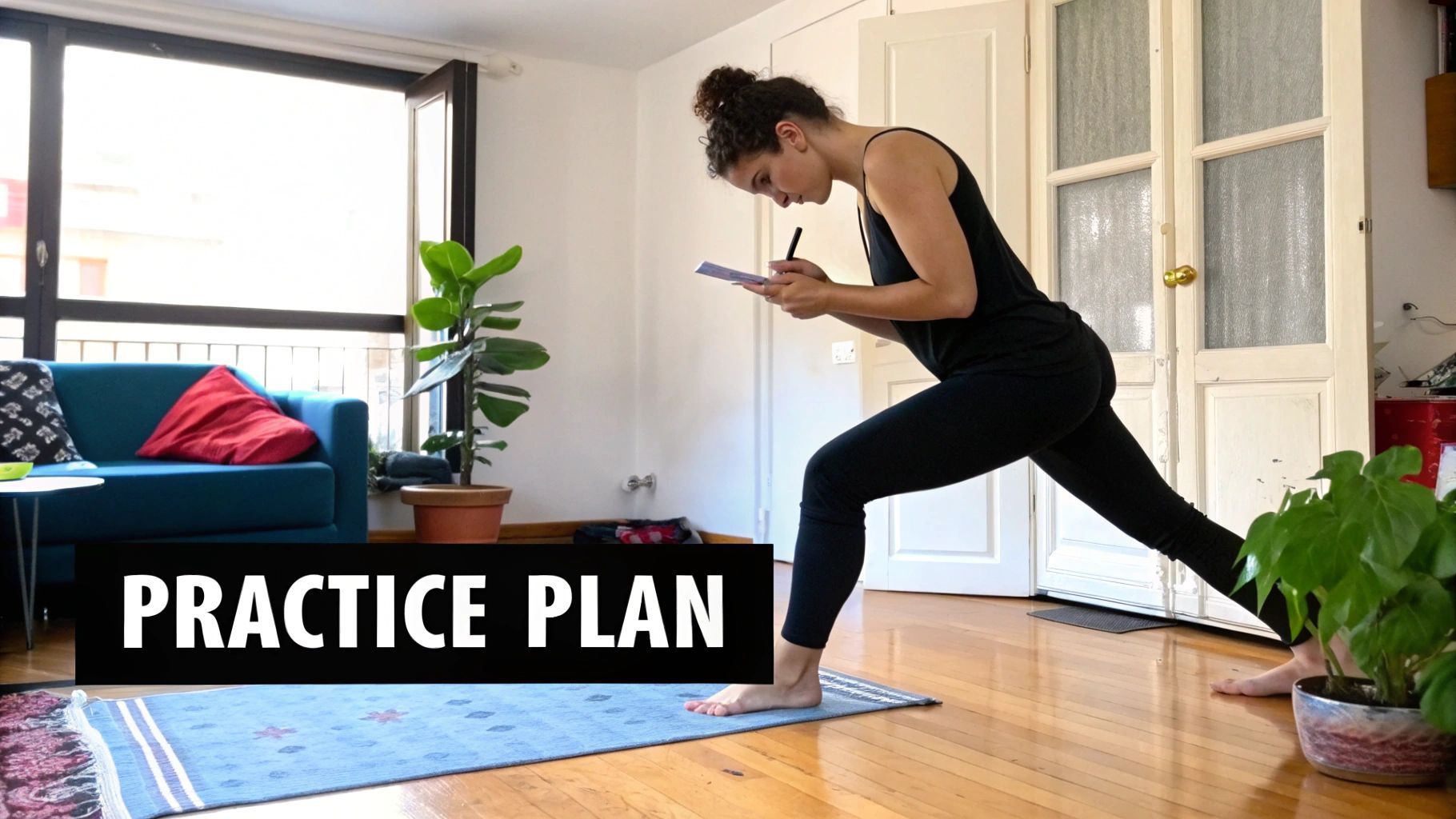
The real magic in your dance journey happens between classes. That time you spend on your own is where new movements click, confidence grows, and awkward steps start to feel natural. Carving out a little time for a consistent home practice can truly supercharge your progress.
You don't need a professional studio in your living room, either. All it takes is a clear patch of floor and a bit of focus to build on what you learn at Encore. Whether you're local to Bluffdale or coming from Herriman, a smart practice plan is the secret to getting more out of every class.
Building Your At-Home Practice Routine
When you're starting out, consistency beats intensity every time. Forget about long, grueling sessions—aim for a few short, focused practices each week. This is the best way to build muscle memory without burning yourself out.
A solid routine should hit on three key areas:
- Technical Review: Run through the specific exercises or combinations from your last class.
- Conditioning: Spend time building the strength and flexibility contemporary dance relies on.
- Creative Play: This is crucial! Give yourself permission to just move and improvise. It’s the heart of the art form.
This simple structure helps you lock in the technique you've learned while also nurturing your own unique artistic voice. It’s all about creating a personal practice that’s both productive and genuinely enjoyable.
"A dancer and a good choreographer master only one language. The language of Dance. All other 'formulas' of expression are not worth mentioning when referring to Dance."
This quote is a powerful reminder that practice isn't just about repeating steps. It's about learning to speak a physical language until it becomes your own.
Essential Conditioning Exercises For Beginners
Strong, controlled movement starts with a solid foundation of physical strength and flexibility. Weaving some targeted conditioning into your week will make those challenging moves in class feel so much more achievable.
Core Strength
A strong core is your anchor for everything, from intricate floorwork to powerful leaps.
- Plank Variations: Hold a standard plank, then challenge yourself with side planks to hit your obliques. Try holding for 30-60 seconds.
- Leg Lifts: Lie on your back and slowly raise and lower your legs, keeping your lower back connected to the floor. This builds that deep core strength you need for control.
Balance and Stability
Improving your balance is key for holding beautiful shapes and executing clean turns.
- Single-Leg Balances: Simply stand on one leg and hold for 30 seconds. Ready for a challenge? Try closing your eyes or adding gentle arm movements.
Flexibility
Increasing your flexibility not only expands your range of motion but also helps prevent injuries.
- Dynamic Stretches: Before you start, warm up with dynamic movements like leg swings and torso twists.
- Static Stretches: After your practice, hold static stretches (like a hamstring or hip flexor stretch) for 30 seconds each to lengthen your muscles.
For more ideas, our guide on flexibility training for dancers has specialized routines to help you progress safely.
The U.S. dance studio industry has exploded into a $5.0 billion market, and a lot of that growth comes from making dance more accessible. A huge part of this is how dancers are blending in-studio and at-home work. In fact, 62% of learners now take online dance classes weekly, a massive jump from just 35% in 2020. This trend shows how powerful it is to combine formal instruction with personal practice.
A Beginner's Weekly Practice Framework
Here’s a flexible schedule you can use to build strength, flexibility, and creativity between classes. Just 20-30 minutes a few times a week is all you need to see a real difference.
| Day 1 | Technique Review | Rehearse choreography from your last class. Break it down into small sections, first without music, then with it. |
|---|---|---|
| Day 2 | Strength & Conditioning | Complete a circuit of core work like planks, bird-dog, and hollow body holds. Finish with your balance exercises. |
| Day 3 | Active Rest | Go for a walk or do some gentle yoga. The goal is light movement and listening to what your body needs. |
| Day 4 | Flexibility & Flow | Dedicate the whole session to a deep, mindful stretch. Focus on areas that feel tight, like your hips and hamstrings. |
| Day 5 | Improvisation & Play | Put on a song you love and just move. Give yourself a simple prompt, like "move like water" or "explore jagged movements." |
Sticking to a balanced plan like this ensures you’re building a well-rounded skill set, which will have you walking into every new class ready to tackle whatever comes next.
Navigating Common Beginner Challenges
https://www.youtube.com/embed/cOFpLrbdefg
Every new dancer hits a few bumps in the road. That’s just part of the process. Whether it’s your first class or your tenth, you’re going to run into challenges that feel both mental and physical. Honestly, recognizing them is half the battle.
The good news? You’re not alone. That inner critic whispering that you’re not getting it fast enough, the hesitation before you fully commit to a movement, the sheer frustration when a step just feels wrong—we’ve all been there. Let’s talk about these common hurdles and how to move past them.
The Comparison Trap
You walk into the studio, and your eyes immediately lock onto that one person who seems to be floating through the choreography effortlessly. Suddenly, your own progress feels slow, clumsy, and a little embarrassing. This is the comparison trap, and it’s the fastest way to steal your own joy.
Here’s the thing: everyone in that room has a different story. Some might have years of ballet or jazz under their belt. Others might just have a natural knack for certain movements. Their journey has nothing to do with yours. Your goal isn’t to dance like them; it’s to discover how the movement feels in your own body.
Your only benchmark should be who you were yesterday. Focus on your personal growth—the small wins, the lightbulb moments, and the new strength you feel building.
Instead of comparing, try observing. Get curious. What can you learn from watching them? Let their movement inspire you, but don't let it become a standard you feel pressured to meet. Shifting your mindset from comparison to curiosity changes everything.
Overcoming the Fear of Mistakes
The fear of looking silly can be paralyzing. It makes you dance smaller than you’re capable of or hold back from even trying that tricky new step. But in a beginner contemporary class, mistakes aren't just expected—they're essential.
Think of every "wrong" move as a piece of information. It's telling you something. Do you need to engage your core more? Was your weight in the wrong place? Was your timing just a little off? Mistakes are your most direct teachers.
- Embrace the Mess: Give yourself permission to be imperfect. The studio is your lab, not a stage for a flawless final performance.
- Celebrate the Attempt: Be proud of yourself for just going for it, no matter how it turns out. The effort is what builds the skill.
- Ask for Help: If you’re really stuck on something, grab your instructor. A tiny correction from them can often make a huge difference.
Every single dancer in our Bluffdale studio, whether they live down the street or drive over from Riverton, is on a learning curve. We work hard to create a space where trying, and even "failing," is a safe and celebrated part of the dance.
Moving from Your Head to Your Body
It’s so easy to get stuck in your head. You’re trying to remember the sequence—"left arm up, turn, then slide"—and you completely forget to actually dance. When your brain is working that hard, your movement gets stiff and robotic. You lose the connection to the music.
The goal is to shift from thinking about the moves to truly feeling them. This just takes time and repetition, letting the choreography settle into your muscle memory.
Here’s a tip I give to all my new students: Once you have the basic structure down, stop thinking about the steps and start focusing on a feeling. What’s the emotion behind the movement? Is it sharp and angry? Soft and flowing? Is it joyful? Connecting to an intention like that helps you get past the technical details and into a much more authentic performance. It’s about finding the story inside the steps.
Understanding the different options available can also help you find the right fit for your learning style. Exploring our class levels and descriptions can give you insight into which class will best support your journey from thinking to feeling.
Still Have Questions About Starting Contemporary Dance?
It's completely normal to have a few hesitations before trying something new. Taking that first step into a dance studio can feel like a big deal, and we want to clear up any of those last-minute questions so you can walk in feeling ready and excited.
Let's tackle some of the most common things we hear from people who are thinking about joining us.
Do I Need Any Dance Experience to Start?
Not at all. In fact, our beginner contemporary classes are built for people with absolutely zero previous dance training. We start with the absolute basics—how to move your body, how to feel the music, and how to express yourself. There's no secret handshake or special knowledge required.
Our instructors at Encore Academy in Bluffdale are brilliant at making everyone feel comfortable. They create a supportive, no-pressure vibe where you can learn at your own speed. You’ll probably find most of your classmates are in the exact same boat as you.
What's the Real Difference Between Contemporary and Modern Dance?
This is a great question because even seasoned dancers can get these two mixed up. Think of it this way: Modern dance was the original rebellion. It kicked off in the early 20th century as a direct response to the rigid structure of classical ballet, aiming for something more grounded and emotionally raw.
Contemporary dance came later, building on what modern dance started. It's more of a melting pot, freely borrowing from modern, ballet, jazz, and even street styles. While modern often follows specific techniques (like Graham or Limón), contemporary is much more fluid and less about sticking to one set of rules. It’s the current, ever-evolving chapter in the story of dance.
Just How Physically Tough Is It for a Beginner?
Contemporary dance will definitely get you moving and work your whole body, but a good beginner class is designed to ease you into it. You'll wake up muscles you didn't know you had, especially in your core, legs, and upper body.
Yes, you'll likely feel a little sore after your first few classes—that's totally normal! But the focus is always on moving safely. Our instructors offer plenty of modifications, reminding everyone to listen to their own body. It’s a fantastic way to build strength and get fit without feeling like you're just grinding through a workout.
It's never too late to start dancing! Contemporary dance is one of the most accessible styles for adults because it values individual expression and life experience over rigid physical ideals.
Am I Too Old to Start?
We hear this one all the time, and the answer is a huge, emphatic NO. Unlike some dance forms that are best started young, contemporary dance actually celebrates maturity. The life experience you bring into the studio adds depth and honesty to your movement.
This style is all about individual artistry and emotional expression—things that only get richer with age. Our beginner classes are filled with people from all walks of life and every age group. Whether you're coming from Riverton, Draper, or right here in Bluffdale, you'll find a welcoming spot on the floor.
Ready to stop thinking about it and start moving? At Encore Academy for the Performing Arts, we believe dance is for everyone. The best way to see if it's for you is to give it a try.
Book a trial class and discover the joy of contemporary dance for yourself.