
How to Dance Hip Pop: A Beginner's Guide - how to dance hip pop
Ready to learn how to dance hip hop? It's all about feeling the music, letting loose, and getting a handle on a few core grooves. Honestly, all you need to get started is some comfortable clothes, good sneakers, a bit of space, and the right playlist. That's it. From there, you can start building confidence and finding your own rhythm.
Your First Steps into the World of Hip Hop
Before you jump into your first eight-count, it’s worth knowing that hip hop is so much more than a list of moves. It's a whole culture built on expression, community, and swagger. This incredible art form has a rich history that really gives meaning to every step you'll learn.
The Roots of the Movement
Hip hop dance wasn't born in a polished studio with floor-to-ceiling mirrors. It started at a block party.
Imagine the raw energy in the Bronx on August 11, 1973, when DJ Kool Herc spun records at 1520 Sedgwick Avenue. That day, he basically invented hip hop by extending the instrumental breaks in songs, giving dancers more time to get down and "break"—the very origin of hip hop dance. In the mid-1970s, when over 60% of buildings in the South Bronx were abandoned, kids used cardboard as their dance floor, turning raw talent into pure, powerful expression.
That same energy eventually spread from the streets to studios all over the world, including right here in Bluffdale. Whether you’re a parent in Draper looking for a class for your teen or an adult in Lehi wanting to try something new, knowing where it all came from adds a layer of respect to your movements. If you’re an adult just starting, you can read more about the benefits of joining hip hop dance lessons .
Your Hip Hop Dance Starter Kit
Getting started is way less intimidating than you might think. You don't need fancy, expensive gear—just a few essentials to make sure you're comfortable and ready to move.
Before we dive into the moves, let's get you kitted out. Here’s a quick rundown of what you’ll need to feel prepared and focus on the fun part: the dancing.
| Comfortable Clothes | You need a full range of motion. Restrictive clothing will hold you back. | Think sweatpants, joggers, leggings, or basketball shorts and a loose t-shirt or tank top. |
|---|---|---|
| Supportive Sneakers | Good shoes protect your feet and joints from impact. | Flat-soled sneakers (like classic skate shoes or basketball shoes) offer great stability. |
| An Open Space | You need room to move your arms and legs without hitting anything. | Clear a spot in your living room or garage. Even a 5x5 foot area is enough to start. |
| A Great Playlist | The right music is your biggest motivator! It sets the vibe and inspires movement. | Start with classic 90s hip hop or find a beginner-friendly dance playlist on a streaming service. |
Think of this as your friendly entry point. Having the right setup helps you shake off any self-consciousness and just get moving, whether you're practicing at home in Herriman or walking into one of our classes for the very first time.
Hip hop dance isn't about perfection; it's about personality. The goal is to find your own style within the rhythm, so don’t be afraid to let go and have fun with the process.
Building Your Foundation with Core Grooves
Every incredible hip hop dancer you've ever seen, from backup dancers on a world tour to the kids killing it in a Riverton dance class, has one thing in common: they started with the groove. The groove is the absolute soul of hip hop. It's that rhythmic pulse, that feeling that connects every single move you make directly to the music.
Think of it as the engine of your dancing. Without a solid groove, you’re just going through the motions. But once you find it, you start to actually express the beat with your whole body. We're going to break down the core grooves that are the true backbone of the style, focusing on feeling the movement instead of just memorizing steps.
Finding Your Bounce
The most essential groove in all of hip hop is the Bounce. It's that simple, continuous up-and-down motion that keeps your body loose and ready for anything. This isn't some stiff, robotic bobbing—it's a relaxed, deep bend in your knees that locks into the beat of the music.
So, how do you find it? Stand with your feet about shoulder-width apart and really soften your knees. Throw on a track and just let your body drop naturally on the downbeat, then come back up. The whole motion should feel like you're gently bouncing a basketball, with all the energy coming from your legs and core, not just your head and shoulders.
The most important thing here is to feel the beat, not to get the technique perfect right away. Try closing your eyes for a minute and focus on feeling the bass in your chest. Let that vibration guide your bounce instead of overthinking the counts.
Once you’ve got that basic bounce feeling good, start playing with it. You can add little variations, like shifting your weight from side to side with each bounce. That tiny shift is the very beginning of more complex footwork and transitions, turning a simple motion into a dynamic foundation for bigger moves.
Mastering the Two-Step
Alright, once you're comfortable with the bounce, the next core groove to get down is the Two-Step. It’s exactly what it sounds like: a basic step-touch from one side to the other. The real secret to making a simple two-step look clean and feel right is to keep your bounce going through the entire movement.
Start by stepping out to your right on count one, and then bring your left foot to touch right next to it on count two. Now, just reverse it. Step to your left on three, and touch with your right foot on four. While you’re doing this, make sure you maintain that relaxed bounce in your knees the whole time. Don’t let your body get stiff.
The two-step is what teaches you how to travel across the floor while staying locked into the rhythm. A great tip for practicing at home, whether you're in Sandy or Herriman, is to use a mirror. Check your posture—are your shoulders relaxed? Are your knees staying bent? As your body gets used to these new movements, a proper warm-up becomes critical. To make sure your muscles are prepped and safe, check out our guide on flexibility training for dancers .
Practice Tips for Building Groove Memory
Developing a natural-feeling groove is all about practice and repetition. You're trying to build muscle memory so your body just reacts to the music without you having to consciously think about every little thing.
Here are a few practical tips to help you build that solid foundation:
- Film Yourself: It might feel weird at first, but setting up your phone and recording your practice is a game-changer. Watching yourself back gives you an honest look at your posture, timing, and flow that you just can't see while you're in the moment.
- Drill to Different Tempos: Don't get stuck practicing to just one song. Try grooving to slow jams, mid-tempo tracks, and faster beats. This will seriously challenge your internal rhythm and make you a more adaptable dancer.
- Focus on Feeling, Not Perfection: The number one mistake beginners make is tensing up because they're trying so hard to "do it right." Hip hop is all about feeling loose, confident, and free. Just let go and have fun with it!
These foundational grooves are your ticket into the world of hip hop dance. When you master the bounce and the two-step, you're not just learning moves—you're learning how to speak the language of the music.
Mastering Foundational Hip Hop Moves
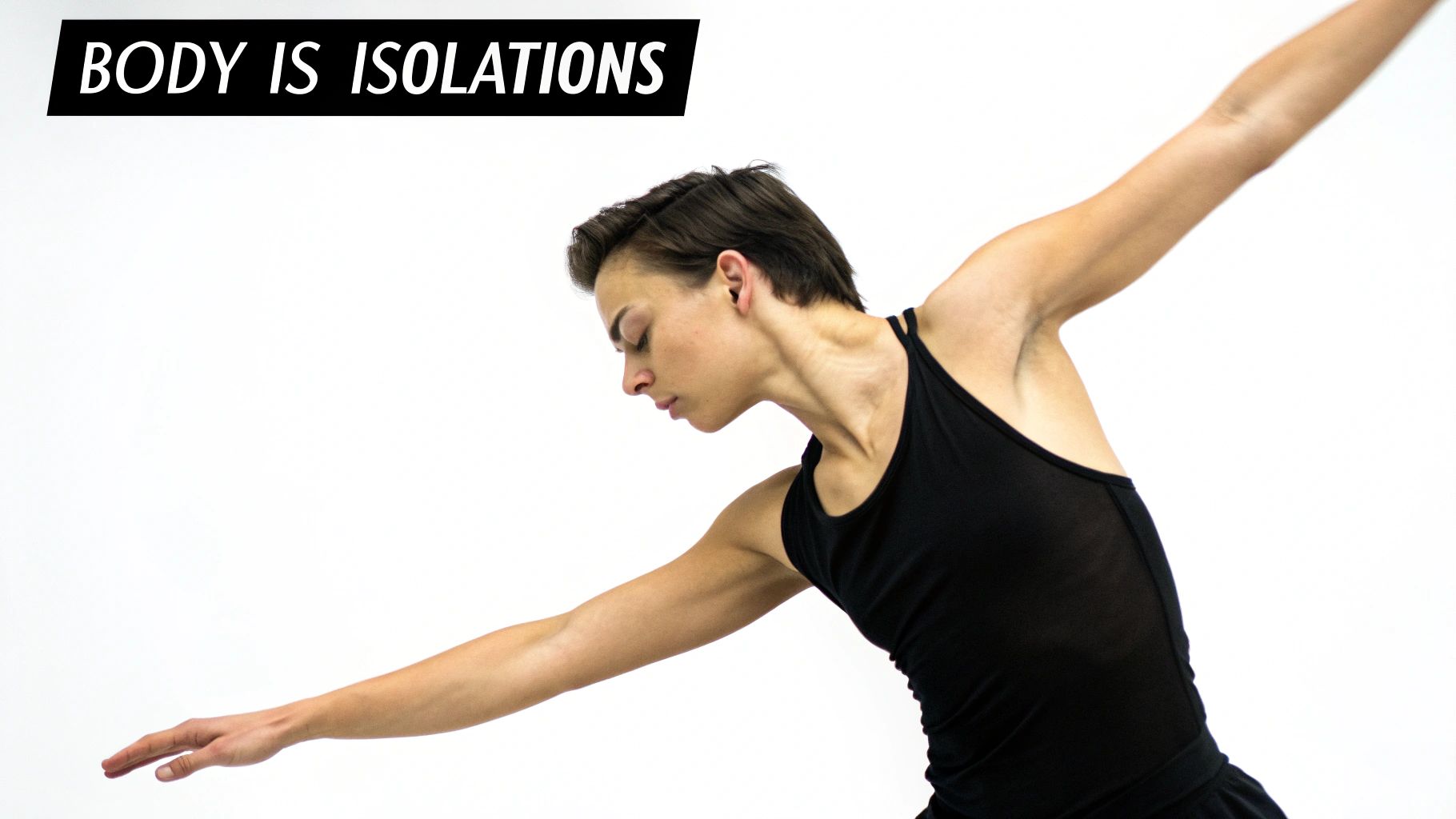
Alright, so you’ve got your bounce and two-step feeling good. That groove is the engine. Now, it's time to add the details that make hip hop so incredible to watch. We’re moving beyond just feeling the rhythm and into the craft of controlling it.
This next phase is all about learning to move different parts of your body independently. We'll get into the mechanics of isolations, popping, and locking—transforming that basic bounce into a launchpad for sharper, more defined movements. The goal is to weave these techniques into your groove so they feel natural, not like you're just tacking on a separate, stiff-looking trick.
Learning to Isolate Your Body
Body isolation is a game-changer in dance, but it's absolutely essential in hip hop. It’s the art of moving one single part of your body while keeping everything else locked in place. This is what creates those clean, sharp, almost robotic effects that look so impressive.
Think of your body as a set of individual pieces—your head, shoulders, chest, and hips can all move to their own beat. A great place to start is with a simple head isolation. Stand in front of a mirror, plant your feet, and tighten your core. Now, try to slide your head from side to side without letting your shoulders move an inch. Then try forward and back. It feels weird at first, but that’s how you build the muscle memory for more advanced moves.
Once you get the hang of that, you can apply the same idea to other parts of your body:
- Shoulder Rolls: Roll one shoulder forward, then backward. The real test is making sure your torso doesn't twist along with it.
- Chest Pops: Push your chest straight out and pull it back in a sharp motion. Your hips and shoulders should stay put.
- Hip Circles: This one's classic. Rotate your hips in a smooth circle while your upper body remains perfectly still.
The secret to clean isolations is tension and release. You have to actively engage your core to stabilize the parts of your body that aren't moving. It’s a full-body effort, even when it looks like only one part is in motion.
The Basics of Popping
Popping is one of the most recognizable styles in the hip hop world. It’s all about quickly contracting and then relaxing your muscles to create a "pop" or a jerk in your body. This isn’t about big, flowing movements; it’s about creating a hard-hitting, staccato effect that lines up perfectly with the snares and kicks in the music.
To get the feel for it, try a basic arm pop. Flex every muscle in your arm—bicep, tricep, forearm—for just a split second, then immediately let it go. That sudden jolt is the pop. Once you can do that on command, try "hitting" on different beats of a song. Imagine a pulse of energy shooting through your arm; you can pop your shoulder, then your elbow, then your wrist. This is the seed for more complex techniques like waving.
What Is Locking?
While people often group it with popping, locking is its own distinct style with a completely different vibe. Locking is defined by freezing from a fast movement and "locking" into a solid position. You hold it for a beat, then continue with the same energy as before. It’s a cool mix of sharp pauses and funky, fluid motion.
A classic "lock" involves throwing your arms out, then quickly rotating your forearms and locking them in place with your elbows bent. The movements are generally bigger and more character-driven than in popping. Dancers from Sandy to Lehi learning how to dance hip hop often discover that locking is one of the most expressive styles because it feels like a blend of dancing and acting.
For younger dancers who are just starting out, we have a helpful list of other popular hip hop dance moves for kids that are super fun and a bit easier to pick up.
Feeling the Music and Finding Your Flow
Hip hop isn't just a set of moves; it's a conversation with the music. You can drill steps all day, but to really dance hip hop, you have to develop your musicality. Think of it as learning to express the sound you hear with your body. This is where you stop just copying your instructor and start finding your own authentic style.
The secret is to listen with your whole body. Don't just hear the main beat—try to pick the track apart. Feel that deep bass in your chest. Notice the sharp crack of the snare and the skittering hi-hats. Listen to the story in the lyrics. Every single layer of the song is a potential source of inspiration for how you move.
A heavy, rolling bassline might make you want to get low and grounded, while a quick little synth melody could inspire some faster, lighter footwork. That deep connection to the sound is what makes a dancer truly captivating to watch.
How to Listen Like a Dancer
Building this skill takes practice. You have to train your ear to catch the nuances that most people miss. This is a non-negotiable step for any dancer, whether you're in a class here in Herriman or watching a cypher in the Bronx.
Here are a few drills I give my students to sharpen their musicality:
- Deconstruct the Track: Pop on a song and listen to it three or four times. The first time through, only focus on the main drum beat. On the second pass, listen just for the bass. Next, try to follow the melody or the rapper's lyrical cadence.
- Play with Tempo: Take your basic grooves and try them with different kinds of music. Do your two-step to a slow, smooth R&B jam, then immediately switch it up with a high-energy trap beat. This exercise forces you to adjust your energy and timing on the fly.
- Dance the Lyrics: What is the artist actually saying? If they're talking about feeling powerful, how can you show that with your chest and posture? If the song is all about having a good time, let that energy shine through your movement.
This is how you move from just doing the steps correctly to actually expressing something real. It’s the foundation of developing a personal style that feels like you.
Musicality isn't about hitting every single sound in the song. It's about deciding which parts to ride, which to accent, and which to let go. The choices you make are what create your style.
Tapping into Hip Hop's History for Inspiration
Hip hop dance isn't just one thing. It's a massive, sprawling culture with tons of different sounds and vibes, and exploring them is the best way to expand your movement vocabulary.
The dance has come a long way since DJ Kool Herc's famous "Back to School Jam" back in 1973. What started with a handful of street crews is now a global phenomenon, projected to include over 10 million dancers worldwide by 2025. That growth, including a mind-blowing 450% jump in U.S. dance studio enrollment since 2000, proves just how much this style continues to evolve and connect with people. You can dive deeper into the incredible legacy of hip hop dance on danzversity.com .
So, get curious and experiment! Put on some old-school funk and feel that fun, party-rocking bounce. Try grooving to a silky-smooth 90s track and see how it softens your flow. Then, throw on some modern drill music and play with those sharp, aggressive rhythms.
Every genre will pull something different out of you, helping you build a richer, more dynamic personal style. This is your permission to stop worrying about getting it "right" and start discovering what makes you unique.
Alright, you've been putting in the work, drilling the grooves, and getting comfortable with the basics. Now it's time for the fun part: putting it all together into your very first routine.
This is where individual steps start to feel like actual dancing. Don't aim for a masterpiece right out of the gate. The goal here is to string a few moves together, build some muscle memory, and give yourself a tangible win. This is your choreography, something you can own.
How to Build a Routine: The Magic of the 8-Count
In the dance world, we live by the 8-count. It’s how we break down music and choreography into bite-sized, manageable pieces. Thinking in sets of eight makes learning feel less intimidating and keeps everything organized.
Let’s build a quick routine using the foundational moves you've already practiced. We'll start with a simple 8-count phrase. Try this out:
- Counts 1-2: Kick things off with a Two-Step to your right. Step out on beat 1, and bring your left foot to meet it on beat 2.
- Counts 3-4: Now, take that Two-Step to the left. Step out on 3, and bring your right foot in on 4.
- Counts 5-6: Time for some isolation. Roll your right shoulder back on beat 5, then your left shoulder on beat 6. Keep it smooth.
- Counts 7-8: Finish strong with two sharp Chest Pops. Hit the beat on 7, and hit it again on 8.
Go ahead and run through that sequence a few times. Once you've got it down, try doing it twice in a row. Just like that, you have a 16-count routine! This is the exact process choreographers use to build longer, more complex dances—one 8-count at a time.
To help you visualize this, we've put together a table breaking down that simple 8-count routine.
Beginner Routine Breakdown (8-Count Example)
This table shows how each count connects to a specific movement, making the sequence easier to remember.
| 1-2 | Two-Step to the Right | Keep your knees bent and stay low in your bounce. |
|---|---|---|
| 3-4 | Two-Step to the Left | Shift your weight fully with each step. |
| 5-6 | Shoulder Roll (R, L) | Isolate the movement—keep your hips still. |
| 7-8 | Double Chest Pop | Make it sharp! Contract and release your chest. |
This structured approach is your best friend when learning any new choreography.
Connecting these moves to the music is what truly brings a routine to life. It’s all about listening to the beat, feeling the rhythm in your body, and then expressing it through your movement.
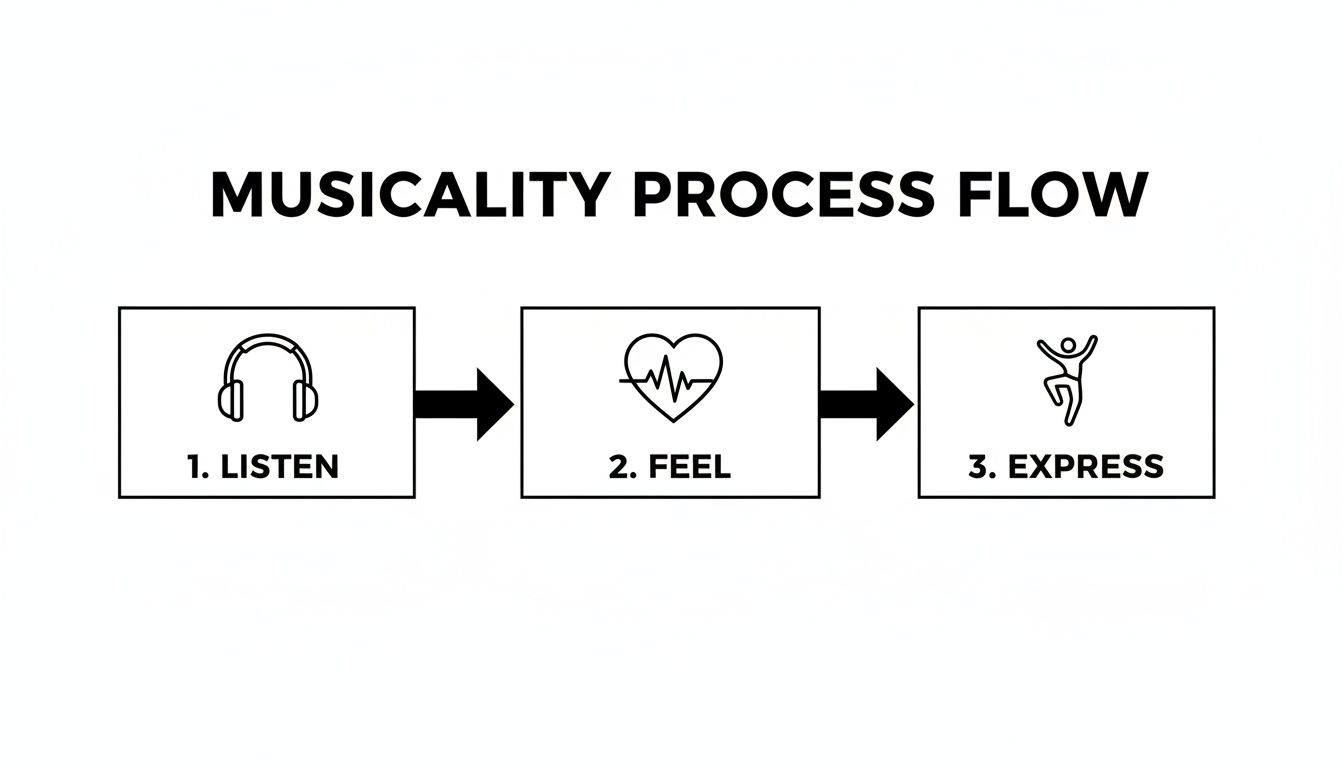
As the chart shows, it starts with your ears, travels to your core, and comes out through your body.
Pro Tips for Making It Stick
Memorizing choreography is a skill, and just like any other, it gets much easier with practice. Dancers all over Utah use these exact techniques to lock in their routines before hitting the stage.
My number one tip? Slow it down. Seriously. Practice your new routine at half-speed, or even slower, without music at first. This gives your brain a chance to build the pathways to your muscles without the pressure of keeping up with the tempo.
Once the sequence feels comfortable, you can gradually speed it up. Drill it over and over until you don't have to think about the next step—your body just knows.
It’s also a great idea to film yourself. Seeing what you’re actually doing is a game-changer for spotting mistakes and cleaning up your moves. Nailing your first routine is a huge confidence booster, and you'll be even more hyped to keep learning after seeing what’s possible at a top-tier Utah dance showcase for some inspiration.
Got Questions About Starting Hip Hop? Let's Talk.
It's totally normal to have a bunch of questions when you're thinking about jumping into something new. Whether you’re trying to learn from videos at home or considering signing up for a class, a few common worries tend to pop up. Let's tackle them head-on so you can start your hip hop journey feeling great.
The biggest question I hear is always about age or fitness level. "Am I too old for this?" or "Do I need to be in better shape?" The answer is a huge, resounding NO. Hip hop is for everyone, regardless of your age, body type, or how often you hit the gym.
The trick is to just start where you are. Listen to your body and move at your own pace. The foundational grooves we teach are actually low-impact and super easy to modify, which makes hip hop a fantastic and genuinely fun way for anyone in communities like Draper and Riverton to get moving.
Side-Stepping Common Beginner Mistakes
Another huge mental block for beginners is the fear of making mistakes. I get it. But let me tell you, the number one thing that holds new dancers back is stiffness.
People get so caught up in trying to get the moves "perfect" that they forget to just relax and feel the music. This leads to that robotic, unnatural look. The solution? Always, always start with a good warm-up, focus on finding that natural bounce to stay loose, and please, don't be afraid to look a little silly at first. It’s all part of the process of finding your own flow.
Here's something to remember: hip hop is about self-expression, not a rigid set of rules. The dancers everyone looks up to are the ones who inject their own personality into the movement. So go ahead and embrace your unique style from the very beginning.
So, How Long Does It Take to Get Good?
This one's all about how much you put into it. If you're practicing consistently—say, two or three times a week—you'll start feeling way more comfortable with the basic grooves within just a few weeks. Becoming a truly skilled dancer can take years of dedication, but the real reward is found in the day-to-day progress and the fun you have along the way.
Of course, a structured class can really accelerate your learning. Getting direct feedback from an instructor in a high-energy, motivating environment makes a world of difference. For anyone from Lehi to Herriman looking for that kind of guidance, our Bluffdale studio is the perfect place to start. You can learn more about what makes studio learning so powerful by reading about different dance classes in Utah .
Ready to trade the questions for some movement? At Encore Academy for the Performing Arts, we’ve built a supportive, fun environment where you can build real skills and find your confidence.