

How to Write a Theater Script From Idea to Opening Night
Every great play starts with a single, foundational idea. It's not about finding the perfect line of dialogue right away. Instead, it begins with that one fleeting thought you just can't shake—a fascinating "what if" scenario, a complex character who won't leave your head, or a theme that you're passionate about.
This is where you find the seed of your story. Inspiration is all around you.
Even in our own communities like Bluffdale or Riverton, there's powerful drama waiting to be discovered in local history, current events, or shared experiences. When you ground your story in a world your audience recognizes, it becomes instantly relatable.
Sharpening Your Core Concept
Once you've caught that spark, the real work begins: sharpening it into something you can build on. You need to distill that broad idea into a concise, powerful statement that will guide your entire writing process. We call this a logline. Think of it as a one-sentence summary of your play that gets right to the central conflict.
For instance, a vague idea like "a story about family secrets" doesn't give you much to work with. But you can sharpen it into a logline: "After their estranged father’s death, two sisters must uncover a hidden family secret in his will before they lose their childhood home forever." Now you have a clear direction, protagonists, a goal, and real stakes.
A strong logline is your story's north star. Whenever you get lost in the weeds of a scene or a character's journey, you can come back to it to reorient yourself and make sure every element is serving the core narrative.
This initial process is all about bringing an idea into focus, moving from a raw concept to a structured one.
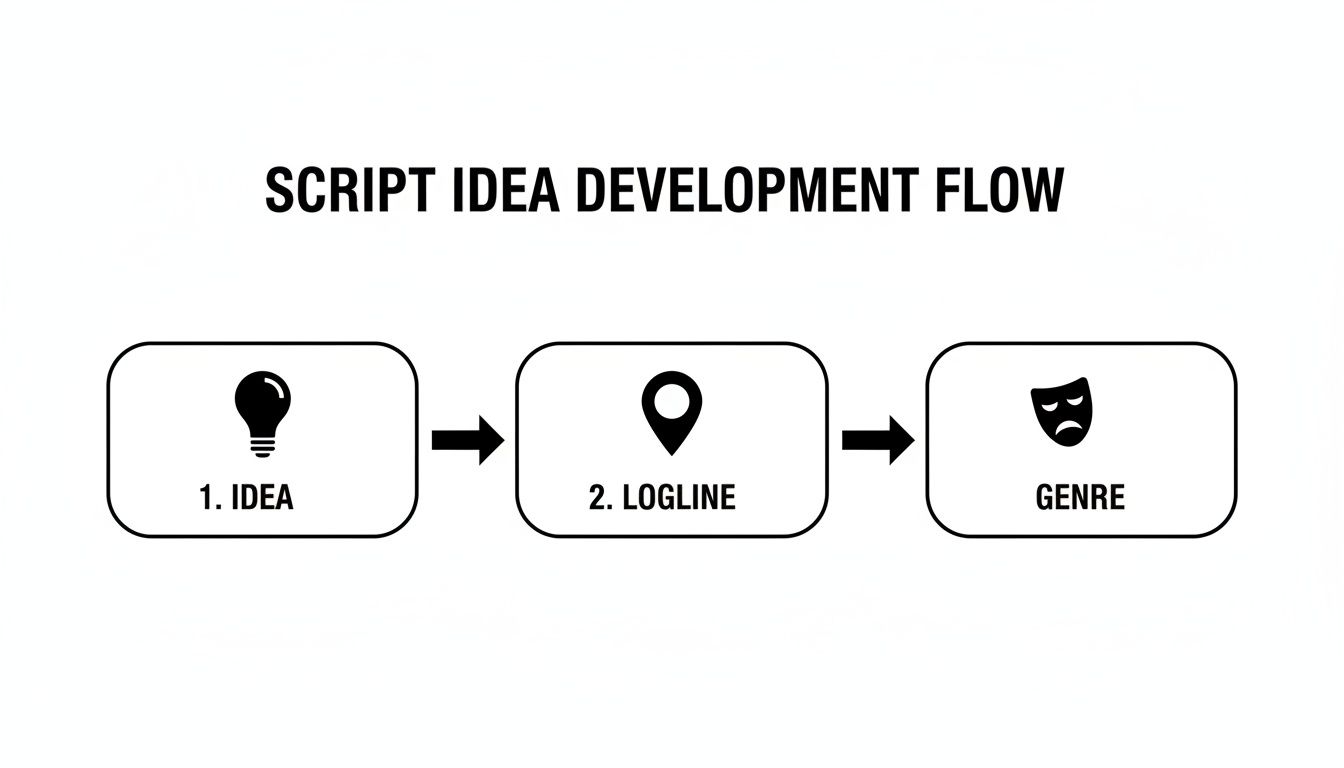
As you can see, a nebulous thought gains clarity and purpose as it moves through these development stages, eventually becoming a solid foundation for your script.
Defining Genre and Tone
At the same time you're crafting your logline, you need to decide on your play's genre and tone. Is this story a gut-wrenching drama? A lighthearted comedy? A gripping thriller? Maybe it’s a mix. This choice is critical because it will shape every decision you make from here on out, from character voices to the story's pacing.
- Genre: This is the category your play fits into (comedy, tragedy, musical, farce). It sets audience expectations and gives you a familiar structural framework to work within—or against.
- Tone: This is the specific mood or feeling of the play (satirical, somber, whimsical, suspenseful). You create tone through your writing style, dialogue, and even stage directions.
Making these big-picture choices early on keeps your script from feeling disjointed. A clear genre and tone ensure that every scene and character feels like they belong to the same cohesive world. Mastering these fundamentals is a huge part of your development as a playwright, much like the foundational training we emphasize in our youth theater programs .
This is a craft with staying power. The creative workforce is projected to include about 151,300 writers and authors in the United States by 2032. For those just learning how to write a theater script, this points to a real, sustained need for trained dramatists, a need that's also driving the rise of scriptwriting tools .
With these core elements in place—a strong idea, a clear logline, and a defined genre—you’re ready to start building your world.
Creating Characters Who Drive the Story

Sure, a killer plot gives your script a skeleton, but your characters are its beating heart. They are the engine. Their wants, their fears, and their choices are what push the story from one moment to the next. A script with flat characters just falls apart, no matter how exciting the plot is. If you want to write a play that connects with people, you have to start by creating characters an audience can actually believe in.
And let’s be clear: great characters are never perfect. They’re a messy collection of good intentions and bad habits, strengths and weaknesses. That complexity is what makes them feel real.
Building From the Inside Out
To get beyond simple stereotypes, you need to dig deep and find your character’s core motivation. What does this person want more than anything else? And maybe more importantly, what are they willing to do to get it? This central desire is the fuel for every single thing they do on stage.
But one big want isn't enough. You have to give them a backstory, even if 90% of it never makes it into the script. Where did they come from? What was their family like? What are their biggest triumphs and deepest traumas? This internal work is what helps you develop authentic reactions and a voice that is uniquely theirs.
For instance, think about how someone who grew up in the quiet, suburban community of Herriman would see the world differently than someone from the more established, affluent neighborhoods of Draper. Their ambitions, their anxieties, and even the way they talk will be shaped by those unique places, adding texture to your world.
Crafting Believable Flaws and Voices
Here’s a secret: flaws are what make characters interesting. A hero who is always right is boring. A character who is fiercely loyal but also dangerously stubborn? Now you’ve got instant tension.
Think about these key ingredients for giving your characters some real depth:
- A Defining Flaw: What’s their biggest weakness? It could be pride, fear, indecisiveness, or greed. Whatever it is, it should get in the way of them achieving their goal.
- A Unique Voice: How do they talk? A character's rhythm, vocabulary, and sentence structure should be all their own. One might speak in short, punchy phrases, while another loves long, winding sentences.
- Contradictions: Real people are walking contradictions. A tough exterior might be hiding a massive insecurity. A seemingly silly character might drop a line of profound wisdom. These paradoxes make them feel less like puppets and more like people.
Developing these skills on the page is surprisingly similar to the work actors do on stage. Many of these techniques are the same ones explored in dedicated acting classes , where performers learn to uncover motivation and backstory to build a powerful performance.
The most memorable characters aren't the most heroic; they're the most human. An audience connects with their struggles, their mistakes, and their small wins on a gut level.
Once you really get that, you can start creating people who will stick with the audience long after the curtain falls.
Mapping the Character Arc
At its core, a story is about change, and your protagonist is ground zero for that change. A character arc is the transformation they go through over the course of the play. This journey is never a straight line—it’s full of screw-ups, breakthroughs, and tough choices.
To map out a compelling arc, you need a clear starting point. Who is your character in Act One? What do they believe about the world and their place in it?
Then, the events of your plot need to smash up against those beliefs, forcing your character to confront their flaws and adapt. By the end, they must be fundamentally different. Maybe they’ve gained some hard-won wisdom, finally overcome a fear, or had their entire worldview turned upside down. That transformation is the emotional payoff for your audience.
Building a Powerful Dramatic Structure

A great idea and compelling characters are a fantastic start, but they need a sturdy frame to hang on. Without one, even the most brilliant story will just fall apart on stage. That frame is your dramatic structure.
Think of it as the invisible architecture of your play. It's what shapes the narrative, builds momentum, and ultimately delivers that emotional punch you're aiming for. It guides your audience from the very first line to the final curtain call, making sure they stay with you for the entire journey.
For centuries, the most reliable blueprint for telling a powerful story has been the classic three-act structure. There's a reason it has stuck around for so long—it just works.
Unpacking the Three-Act Structure
Don’t let the term "structure" intimidate you. At its core, it's just a simple, logical way to organize your story into a satisfying beginning, middle, and end.
To make it even simpler, let's look at a quick breakdown of how these three acts function together.
The Three-Act Structure at a Glance
| Main Goal | Introduce the world, characters, and the central problem. | Escalate the conflict and raise the stakes. | Bring the conflict to a head and show the aftermath. |
|---|---|---|---|
| Key Event | The inciting incident kicks off the main story. | A series of rising actions and obstacles test the protagonist. | The climax, followed by falling action. |
| Audience Feels | Curiosity and connection to the protagonist's normal world. | Tension, suspense, and empathy for the struggle. | Catharsis, satisfaction, and a sense of closure. |
This framework gives you a clear and dependable map to follow, especially for young writers from communities like Lehi or Sandy just learning how to write a theater script. It provides the guardrails so you can focus on being creative.
Building Scenes That Serve the Story
With your three acts mapped out, it's time to zoom in on the individual building blocks: your scenes. A common trap for new writers is crafting scenes that are fun or interesting in isolation but don't actually push the story forward.
Every single scene needs to earn its place in the script. It must accomplish at least one of these two things (and the best scenes do both):
Advance the Plot: Does something happen that changes the game? A key decision is made, new information comes to light, or a character takes an action that moves the story one step closer to the end.
Reveal Character: Do we learn something new about who these people are? We need to see their motivations, their flaws, or how their relationships evolve, especially when they're under pressure.
A great scene is really a mini-story with its own beginning, middle, and end. One character should walk into a scene wanting something. The drama comes from whether or not they get it.
Always ask yourself: "What does my character want at the start of this scene, and what's standing in their way?" Answering that question is the secret to building tension, even in a quiet, two-person conversation.
Outlining Your Path to Success
Before you dive headfirst into writing dialogue, take a moment to outline. Your outline is your roadmap; it keeps you from getting lost in the woods on your way to "The End." It doesn't have to be a rigid, intimidating document. It can be as loose or as detailed as you need it to be.
We explore all kinds of script development techniques in our programs, and you can find more creative writing tips by exploring our blog .
For now, here are a few outlining methods that playwrights swear by:
- The Bullet-Point Outline: This is a simple, chronological list of your main plot points. It's perfect for getting a bird's-eye view of your entire story from start to finish.
- The Scene-by-Scene Outline: A bit more detailed, this is where you jot down a one- or two-sentence summary for every scene. This is fantastic for checking your pacing and making sure each scene has a clear purpose.
- The Mind Map: A more visual approach. Start with your central idea in the middle of a page and draw branches for characters, plot twists, and themes. It’s a great fit for writers who think in a less linear way.
Whichever method you pick, the goal is the same: to build a solid foundation before you start laying the bricks. A little prep work now will save you from massive structural headaches later and make the whole process feel much less daunting.
Writing Dialogue That Speaks Volumes

Dialogue is the engine of your play. It's so much more than characters just talking—it's how they fight, hide, reveal their deepest secrets, and chase their biggest dreams. Great dialogue is never static; it's pure action.
The real challenge is making it all sound authentic without being mind-numbingly dull. Real conversations are littered with "ums," "ahs," and small talk that would send an audience running for the doors. Your job is to create the illusion of realism while ensuring every single line is pulling its weight and moving the story forward.
Giving Each Character a Unique Voice
Nobody talks exactly like anyone else, and your characters shouldn't either. Their vocabulary, the rhythm of their speech, and even how they structure a sentence are all windows into their personality, background, and current emotional state. A character's voice is their verbal fingerprint.
To get this right, you have to resist the urge to make everyone sound like you. You need to get inside their heads.
- A confident CEO might speak in sharp, declarative statements.
- A nervous teenager could use fragmented sentences and deflect with questions.
- An academic might use more complex words and craft longer, more formal sentences.
This is where the real craft comes in. Think about how a high school student from a fast-growing city like Lehi might use different slang than a retiree from a quiet, established neighborhood. Their voices should feel distinct and true to their world. Getting this down is a crucial step when learning how to write a theater script.
"The most important thing in a play is what is not being said."
— Tennessee Williams
This brilliant insight from Tennessee Williams gets right to the heart of subtext—the real meaning simmering just beneath the surface.
The Power of Subtext
What characters don't say is often far more revealing than what they do. Subtext is the tangle of unspoken thoughts, feelings, and intentions that truly drive the conversation. It’s the gap between the words spoken and what’s actually meant.
For example, a character might say, "It's getting cold in here," but the subtext could be anything from, "I'm deeply uncomfortable with this topic and want to leave," to "You're shutting me out emotionally again." Mastering subtext creates rich, layered scenes that keep the audience leaning in, trying to figure out what's really going on.
Making Every Word Count
Exposition—the background info your audience needs—can be a real killer if handled poorly. It’s tempting to fall into the "exposition dump," where characters awkwardly tell each other things they already know just so the audience can catch up. This feels clunky and brings the story to a screeching halt.
A much better approach is to weave exposition directly into the conflict.
- Show, Don't Tell: Instead of having a character say, "My brother Bob is always angry," write a scene where Bob absolutely loses it over something minor.
- Let Them Argue: People reveal all sorts of information when they're fighting. Secrets have a way of spilling out when emotions are high.
- Spread It Out: Don't unload all the backstory at once. Sprinkle key details throughout the script to build mystery and keep the audience engaged.
This skill takes practice, much like an actor honing their craft. In fact, many writers find it incredibly helpful to think like a performer. Learning about the fundamentals of vocal performance and control can offer amazing insight into how rhythm, pitch, and pacing can completely change the meaning of a line.
Writing Effective Stage Directions
Your script is more than dialogue; it’s a blueprint for the entire creative team. Stage directions are your instructions for the action on stage, but they require a light touch. The goal is to be clear and evocative without micromanaging the actors and director.
Keep stage directions concise and focused on only the most essential actions. Instead of writing, "She walks slowly and sadly over to the window, thinking about her lost love," try something more direct and playable, like: "She crosses to the window. Stares out." This gives the actor the core blocking and leaves the emotional heavy lifting to them.
Always remember that your stage directions should guide, not dictate.
Getting Professional Script Formatting Right
Think of proper formatting as the universal language of theater. It’s not just a bunch of stuffy, arbitrary rules—it’s the blueprint that allows directors, actors, and designers to turn your words into a living, breathing performance. A script that looks the part immediately tells people you’re serious about your craft.
Honestly, a script with wonky formatting is often the first to hit the rejection pile. Whether you're submitting to a local festival in Bluffdale or a national competition, getting this right shows you respect the process and the professionals who might bring your story to life.
The Nuts and Bolts of Formatting
While you might see slight variations, the core standards for a stage play are pretty much set in stone. Nail these, and you're golden. This consistency is practical, too—it helps a director estimate runtime (a properly formatted page is roughly one minute of stage time) and makes rehearsals flow smoothly.
Let's walk through the essential building blocks.
Character Names
Simple enough: The character's name goes above their lines. It should be centered and in ALL CAPS.
ANNAI don't think that's what he meant.
Dialogue
This is what the character says. The text sits directly below their name, and while it's left-aligned, it's indented about 2.5 inches from the left edge of the page.
Stage Directions (Action)
Here's where you describe what's happening on stage—movements, gestures, or critical visual cues. These are always in italics, wrapped in parentheses, and indented a bit further than the dialogue.
MARCOI'm not going back there. Not ever.(He turns away from her, crossing to the window.)It’s finished.
Parentheticals
A parenthetical is a tiny stage direction that gives a quick insight into how a line is delivered. It gets its own line, nestled between the character name and the dialogue, and is also in parentheses. A word of caution: use these sparingly. A well-written line of dialogue should already imply the tone. Let your actors act!
LIAM(Sarcastically)Oh, this is going to be fun.
Software vs. Word Processors: Choosing Your Tool
So, how do you actually put all this on the page? You've got two main options: a good old-fashioned word processor or specialized scriptwriting software.
| Cost | Usually free or part of a suite you already own. | Often requires a one-time purchase or a subscription. |
|---|---|---|
| Formatting | You have to set it up manually with templates and styles. | Does all the formatting for you automatically. |
| Ease of Use | Can be a real headache. You'll spend time fiddling with margins. | Built for one purpose, so it's incredibly intuitive. |
| Collaboration | Easy enough with cloud-based documents. | Often has better built-in tools for notes and sharing. |
For a young writer in Sandy just starting out, grabbing a free template for Google Docs or Word is a fantastic, no-cost way to learn the ropes. But once you start writing more, software like Final Draft or Celtx will save you an incredible amount of time and frustration.
A clean, professionally formatted script doesn't just look good—it functions as a clear and efficient tool for the entire production team. It removes ambiguity and allows the creative work to take center stage.
Let's be real: using these tools is now standard practice. The market for screen and script writing software has exploded, which just shows how much modern playwrights rely on them. The numbers are pretty staggering; some analyses valued the broader market at USD 126.70 billion in 2022 and project it to hit USD 327.4 billion by 2030. Other reports point to consistent double-digit growth, proving there's a huge demand for software that makes formatting and collaboration easier. You can learn more about the growth of these drama script generation tools on futuredatastats.com . For anyone figuring out how to write a theater script today, getting comfortable with this software is simply part of learning the craft.
Rewriting: Where the Real Work Begins
Finishing that first draft is a fantastic feeling, a real milestone. But the journey isn't over—in many ways, it's just begun. Think of it this way: the first draft is for you, where you tell yourself the story. The next draft is for the audience. This is where the real magic happens, where a good idea transforms into a great play.
The rewriting process can feel daunting, but breaking it down into manageable steps makes all the difference. It's all about learning to look at your own work with a critical, objective eye and not being afraid to make tough cuts for the sake of the story.
Switch from Creator to Critic
Before you dive back in, you need some distance. Seriously, put the script away for at least a week, maybe two. This little break gives you the space you need to come back with fresh eyes.
When you're ready, read the entire play in one sitting. Don't read it like the writer who agonized over every word. Read it like someone who just bought a ticket to the show. Resist the urge to fix a typo or tweak a line of dialogue. Your only job right now is to look at the big picture.
- Pacing and Flow: Does the story have a pulse? Does the energy build, or are there scenes that just drag everything to a halt?
- Character Journeys: Does your main character actually change? Are their decisions believable, or do they feel like puppets being moved around?
- The Big Idea: Is the core theme you wanted to explore actually coming through?
Jot down your big-picture notes. Once you've identified the major issues, you can create a game plan. Always tackle the big structural problems first. There’s no point polishing dialogue in a scene you might end up cutting anyway.
The Power of Hearing Your Words Aloud
A script isn't a novel; it’s a blueprint for something that will be spoken and heard. The single most valuable tool you have for figuring out what works is a table read. This is simply getting a group of friends or actors together to read your script out loud.
You will be amazed at what you discover. Lines that looked brilliant on the page suddenly sound clunky and unnatural. Characters that felt distinct in your head all start to sound the same. The rhythm, the jokes, the emotional beats—you’ll hear immediately what lands and what falls flat. Whether you’re workshopping a script with a local group in Bluffdale or just gathering friends in your living room in Riverton, this step is non-negotiable.
A table read is your script's first audition. It’s where you discover what works, what doesn't, and where the heart of your story truly lies. Hearing actors breathe life into your characters will give you invaluable insight into what needs to be fixed.
After the read, your job is to listen. Ask specific, open-ended questions. "Where were you confused?" is a much better question than "Did you like it?"
Getting and Using Feedback
Sharing your work is vulnerable, but feedback is the fuel that will make your script better. Find a few trusted readers—maybe a mentor, a fellow writer, or a dramaturg—and ask for their honest thoughts.
Be prepared: not all feedback will be helpful, and that's okay. Your task is to look for patterns. If one person doesn't like a certain character, it could just be their personal taste. But if three people tell you the ending feels rushed, you've probably got an ending problem.
This back-and-forth of writing and revising is completely normal. Most professional scripts go through anywhere from 3 to 12 drafts before they’re considered stage-ready. Industry analysis shows that the rewriting phase can easily take up 30–60% of the entire pre-production timeline. That’s why learning to manage this process is so critical. For more on professional workflows, you can explore script development industry workflows on fortunebusinessinsights.com .
Ultimately, rewriting is an act of "re-seeing" your work. It's your chance to find what's great, fix what isn't, and shape a promising draft into a powerful play ready for the stage. To see what our students have created, check out the schedule for our upcoming student productions and events .
At Encore Academy for the Performing Arts, we guide students through the entire creative process, from the first spark of an idea to the final performance. If you're ready to find your voice and tell your story, we invite you to book a trial class and see how we can help you grow. Learn more at https://www.encoreacademyut.com .