
8 Fun Music and Movement Games for Preschoolers to Try in 2025
Welcome, parents! Are you searching for ways to channel your preschooler's boundless energy into something fun, creative, and beneficial for their development? You've come to the right place. Music and movement games for preschoolers are more than just a way to burn off steam; they are foundational activities that build crucial neural pathways for learning, coordination, emotional expression, and social skills.
For families in and around Bluffdale, from Riverton and Herriman to Draper and Sandy, finding quality enrichment activities is a top priority. This guide provides a comprehensive roundup of eight fantastic music and movement games that you can easily adapt for your home. Each game is designed to be engaging and packed with developmental benefits that lay the groundwork for a lifelong love of the performing arts.
This article offers a practical resource filled with actionable ideas. We will break down the 'why' behind each activity, offering clear, step-by-step instructions, lists of simple materials, and variations to keep the fun going. You will discover how to transform your living room into a dynamic space for learning and play.
Let's dive in and discover how these simple, joyful games can unlock your child's potential, one beat at a time. This is about creating powerful moments of connection and growth, whether you're playing together in your Lehi home or preparing your child for their first structured class at a studio like Encore Academy. Get ready to explore activities that nurture both body and mind.
1. Musical Freeze Dance
Musical Freeze Dance is a cornerstone of music and movement games for preschoolers for a good reason: it’s simple, endlessly fun, and packed with developmental benefits. The premise is straightforward: children dance and move freely while music plays, and as soon as the music stops, they must "freeze" in whatever position they find themselves.
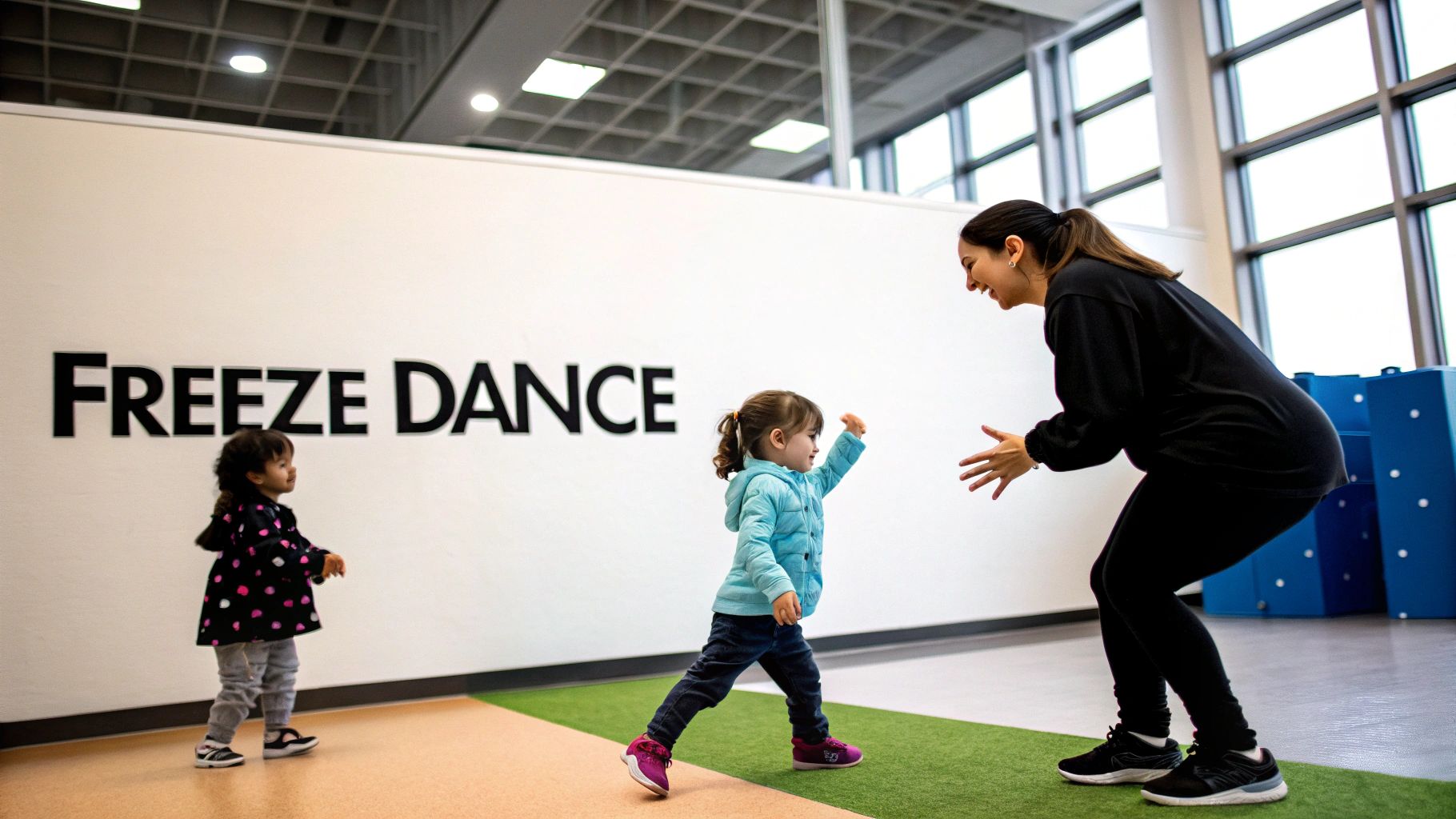
This classic game is a powerhouse for building essential preschool skills. It sharpens listening abilities and auditory processing as children learn to respond instantly to the change from sound to silence. On a physical level, it hones gross motor skills, balance, and body awareness, all while requiring significant self-regulation and impulse control to stop moving on cue.
How to Play and Adapt
Setting up is easy. All you need is a music source and some open space, making it a perfect activity for families in Herriman or a classroom in Bluffdale. To ensure success, start by practicing the "freeze" concept a few times without music.
Here are some tips to keep the game engaging and effective:
- Vary the Music: Switch between fast and slow songs, and explore different genres from classical to pop. This not only keeps kids engaged but also expands their musical horizons.
- Encourage Creativity: Praise unique and silly frozen poses. The goal is joyful expression, not perfect statues.
- Add a Twist: For an extra challenge, call out specific ways to move during the music, like "hop like a bunny" or "stomp like a dinosaur."
Key Insight: Musical Freeze Dance is more than just a game; it's a foundational exercise in active listening and body control. It prepares children for more structured activities by teaching them to respond to auditory signals and manage their physical impulses in a playful, low-pressure environment.
This activity serves as an excellent warm-up, priming children’s minds and bodies for learning. It's a fantastic way to burn off excess energy before circle time at home or as a lead-in to more formal classes, such as our beginner dance programs at Encore Academy. If your child loves the creative movement in Freeze Dance, they might also enjoy exploring some foundational hip-hop moves designed for kids .
2. Follow the Leader Movement Sequence
Follow the Leader Movement Sequence elevates the classic playground game into a structured learning activity that bridges the gap between free expression and choreographed dance. The premise is simple: an instructor or a child leader demonstrates a series of movements synchronized to music, and the other children observe and copy the sequence. This game is a fantastic way to introduce more complex motor patterns in a fun, accessible format.
This powerful game is fundamental for developing motor planning, a crucial skill that involves conceiving, planning, and carrying out a new motor action. It sharpens observational skills, memory, and sequencing as children watch, remember, and replicate movements. Physically, it improves coordination, rhythm, and body awareness, laying the groundwork for more formal dance and music education.
How to Play and Adapt
To begin, you only need a music source with a clear beat and some space for movement, making it an easy choice for a classroom in Riverton or a living room in Lehi. Start with very short, simple sequences and demonstrate them clearly before asking the children to join in.
Here are some tips to keep the game engaging and effective:
- Start Simple: Begin with a short sequence of 2-3 movements, such as "stomp, clap, and spin." Repeat it several times to the music before adding more steps.
- Use Rhythmic Music: Choose songs with a strong, consistent beat that makes it easier for children to time their movements.
- Empower Child Leaders: Let different children take turns being the leader. This builds confidence, encourages creativity, and gives them a sense of ownership over the game.
- Incorporate Props: Add scarves, ribbons, or beanbags to the sequences to enhance sensory engagement and work on fine motor skills.
Key Insight: Follow the Leader Movement Sequence is an essential tool for teaching memory and motor planning. It moves beyond simple mimicry, requiring children to process and recall a sequence of actions, which is a foundational skill for learning choreography, following multi-step instructions, and even developing early literacy skills.
This activity is perfect for developing focus and preparing children for structured learning. The skills built here are directly applicable to formal dance training, where students learn to execute specific steps and combinations. If your child enjoys the challenge of remembering and performing sequences, they will thrive in the structured yet creative environment of our preschool dance classes .
3. Instrument Exploration and Sound Matching
Instrument Exploration and Sound Matching is a multi-sensory game that connects hearing with doing. Children are given various simple instruments and encouraged to create movements that match the sounds they produce. A loud, booming drum might inspire stomping, while the light jingle of a tambourine could lead to tiptoeing and wiggling fingers.
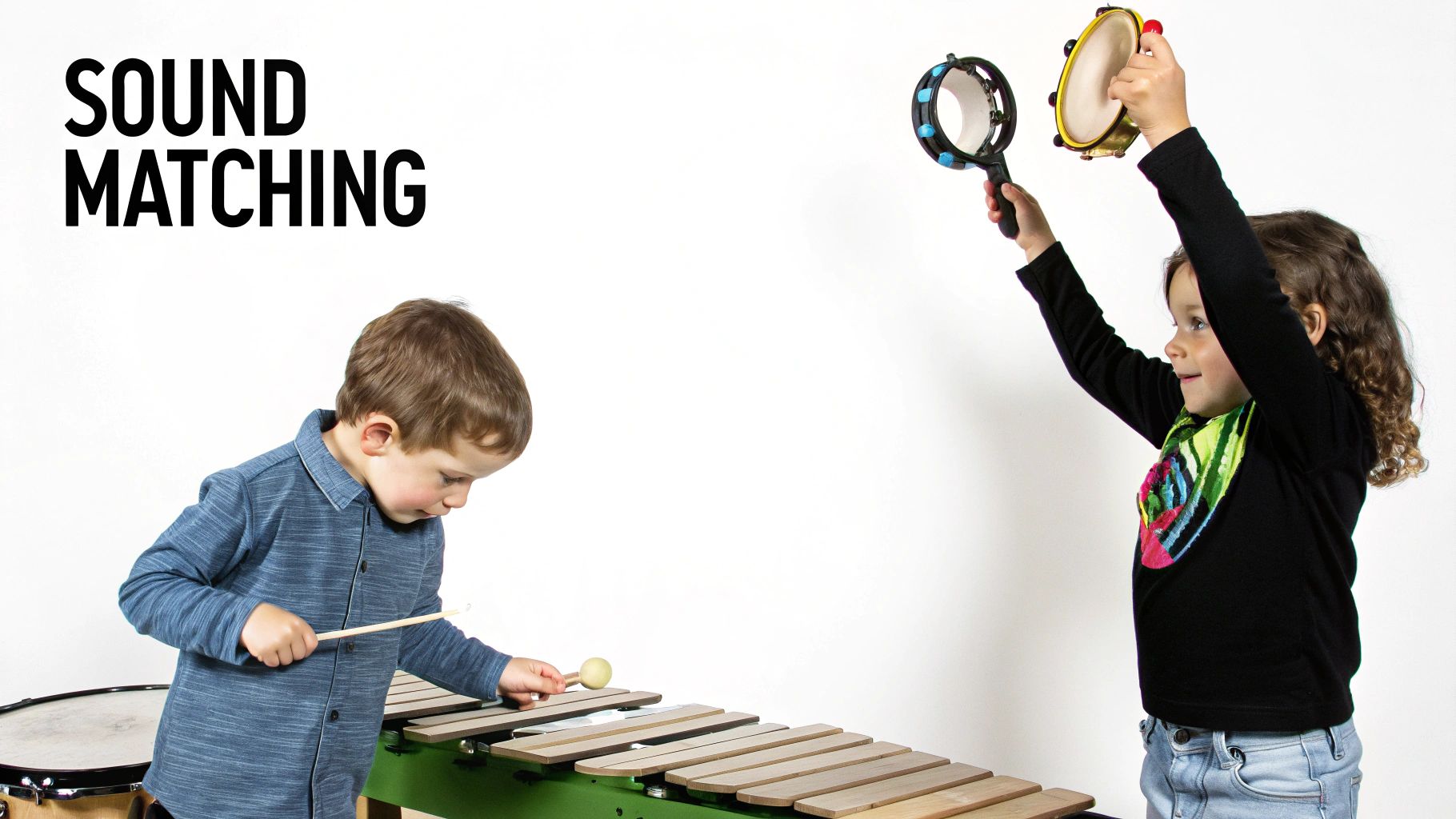
This activity is foundational for developing auditory discrimination, as kids learn to differentiate between pitch, tempo, and volume. It also reinforces cause-and-effect understanding ("When I shake this, it makes a sound") and boosts creative expression by linking an abstract concept like sound to a concrete action like movement. It’s a playful introduction to the core concepts taught in early music education.
How to Play and Adapt
To begin, you only need a small collection of child-safe instruments like shakers, drums, bells, and xylophones. This game is easily adapted for a living room in Riverton or a preschool classroom in Draper. Start by demonstrating one instrument and moving in a way that reflects its sound before letting the children try.
Here are some tips to make the experience rich and educational:
- Use Descriptive Language: Guide movement with evocative words. Ask, "Does the xylophone sound tinkly or booming? How can we move our bodies in a tinkly way?"
- Introduce Instruments Gradually: Start with one or two contrasting instruments, such as a drum and a shaker, to make the sound-movement connection clear before adding more complex options.
- Model Safe Handling: Show children how to hold and play each instrument gently. Using soft mallets and durable instruments is key to a safe and successful activity.
- Create a Movement Vocabulary: Establish simple connections to start, like fast sounds mean running on the spot, slow sounds mean walking in slow motion, and high-pitched sounds mean stretching up tall.
Key Insight: This game is more than just making noise; it’s about making connections. By physically interpreting music, children build a deeper, more intuitive understanding of musical elements like rhythm and dynamics, setting the stage for more formal instruction.
This hands-on exploration builds a fantastic foundation for future learning. It nurtures the curiosity and auditory skills essential for students who may later pursue piano, violin, or voice. If your child shows a keen interest in how different instruments create unique sounds, you can discover more about our structured music programs at Encore Academy .
4. Color and Emotion Movement Expression
Color and Emotion Movement Expression is an introspective and creative game that helps children connect their inner feelings to their physical movements. The concept involves associating different colors or emotions with specific types of movement, guided by music. For instance, children might spin to represent the color yellow or move slowly and gracefully to express calmness.
This powerful activity is one of the most enriching music and movement games for preschoolers because it builds a bridge between abstract concepts (emotions) and concrete actions (movement). It fosters emotional intelligence, self-awareness, and symbolic thinking. Physically, it enhances creativity in movement, body control, and the ability to interpret and respond to musical cues that evoke specific feelings.
How to Play and Adapt
To begin, you only need a music source and some colorful props like scarves or cards, though they are not essential. The key is creating a safe, non-judgmental space where children feel free to explore. This game is easily adaptable for a living room in Sandy or a classroom setting in Bluffdale.
Here are some tips to guide this expressive activity:
- Use Evocative Music: Select music that clearly conveys different emotions. Contrast upbeat, major-key songs for "happy" with slow, minor-key pieces for "sad" or "calm."
- Incorporate Visual Aids: Use colored scarves, construction paper, or cards with emotion faces on them. Hold up a color or emotion and ask, "What does this feel like in your body?"
- Validate All Expressions: Emphasize that there are no "right" or "wrong" movements. Praise their unique interpretations, reinforcing that everyone experiences and expresses feelings differently.
Key Insight: This activity teaches children that emotions are a normal part of life and that movement can be a healthy and powerful tool for understanding and processing them. It lays a crucial foundation for emotional regulation and empathetic understanding.
Color and Emotion Movement Expression is an excellent way to transition into more focused creative activities. The skills of portraying emotion through physicality are central to the performing arts. If your child is fascinated by storytelling through movement, they will thrive in our Musical Theater program at Encore Academy, where we teach young performers how to channel emotions into compelling characters.
5. Rhythm Pattern Clapping and Body Percussion Games
Rhythm Pattern Clapping and Body Percussion Games transform a child’s own body into their first musical instrument. These activities teach preschoolers to feel and replicate rhythmic patterns through clapping, stomping, tapping, and snapping. This approach, central to music education methods like Orff-Schulwerk and Dalcroze, makes complex musical concepts like beat, rhythm, and tempo accessible and incredibly fun.
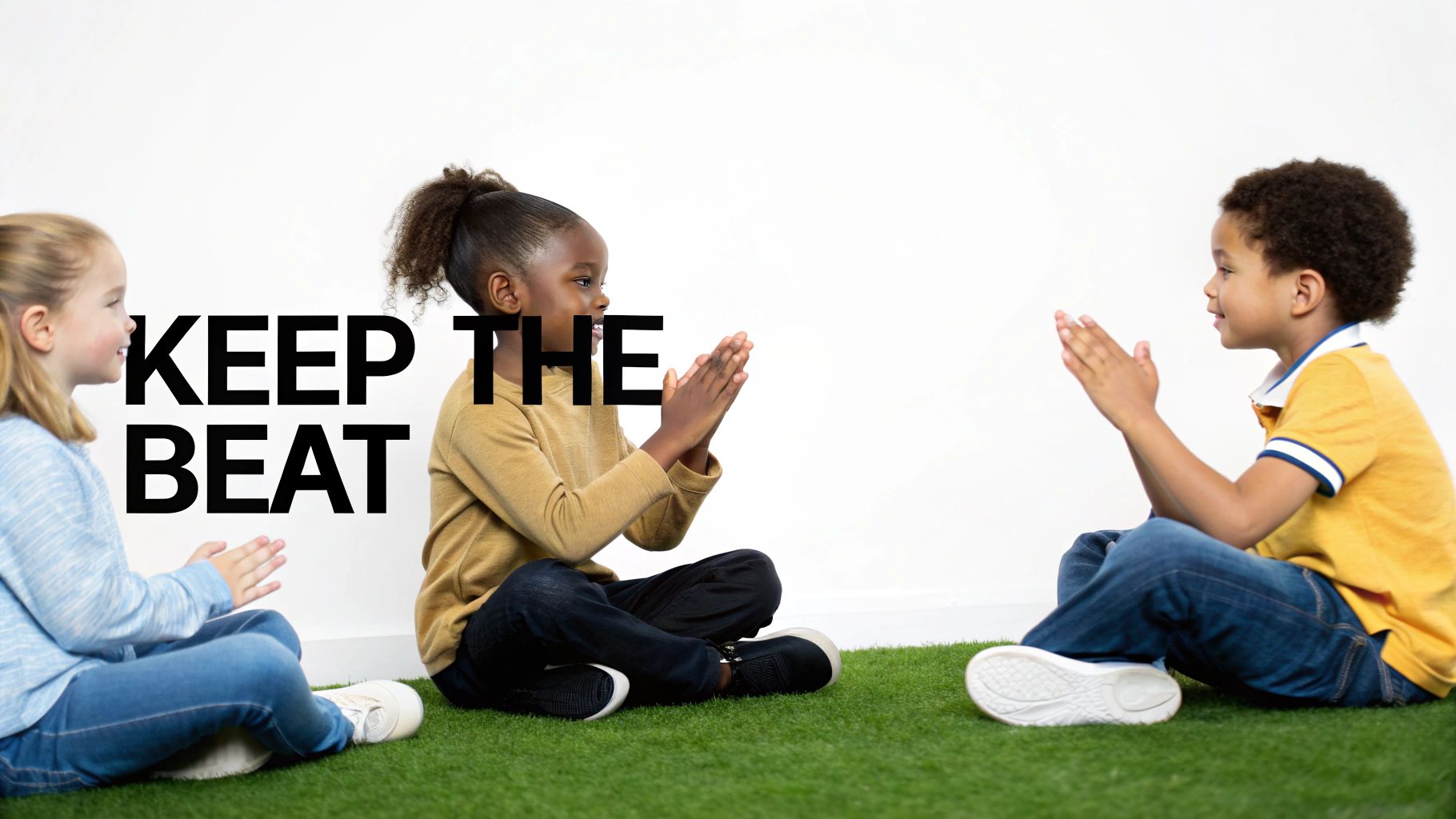
This game is a foundational pillar for developing musicality and coordination. By internalizing a steady beat, children build a framework for understanding all music. It enhances auditory memory, sequencing skills, and fine and gross motor control. The physical act of creating rhythms also promotes focus, listening skills, and a deeper connection between movement and sound.
How to Play and Adapt
The beauty of body percussion is its simplicity; you only need yourselves and a little space, making it an easy activity for a family in Lehi or a preschool classroom in Riverton. Start by establishing a simple, steady beat together by clapping or patting your knees. Once the child is comfortable, you can introduce more complex patterns.
Here are some tips to keep the game engaging and effective:
- Use a Call-and-Response Format: You clap a simple pattern, and your child echoes it back. This keeps them focused and turns learning into a playful conversation.
- Connect Rhythm to Language: Use the rhythm of familiar words or names. For example, clap out the syllables in "hel-lo-Mad-i-son" (ta-ta-TA-ti-ta). This links linguistic patterns with musical ones.
- Combine Sounds and Movement: Create a sequence like "clap-clap-stomp" or "pat knees-pat knees-snap." As they master it, combine these patterns with walking or marching to integrate full-body coordination.
- Start Slow: Introduce new patterns at a slow tempo, gradually increasing the speed only after the child shows confidence and accuracy.
Key Insight: Body percussion is not just about making noise; it's about internalizing rhythm and understanding music from the inside out. This hands-on experience builds the rhythmic foundation essential for learning any instrument, from piano to violin.
This activity is an excellent way to introduce core musical concepts without the pressure of a formal instrument. It builds the rhythmic competence that is crucial for students in our music programs at Encore Academy. If your child enjoys creating their own beats, exploring the structured rhythmic training in our classes could be the perfect next step.
6. Scarves and Ribbons Movement Choreography
Scarves and Ribbons Movement Choreography introduces a captivating visual and tactile element to music and movement games for preschoolers. In this activity, children use lightweight, flowing props like scarves, ribbons, or streamers to paint patterns in the air as they move to music. This simple addition transforms movement into a vibrant, expressive art form, allowing children to physically manifest the flow and rhythm they hear.
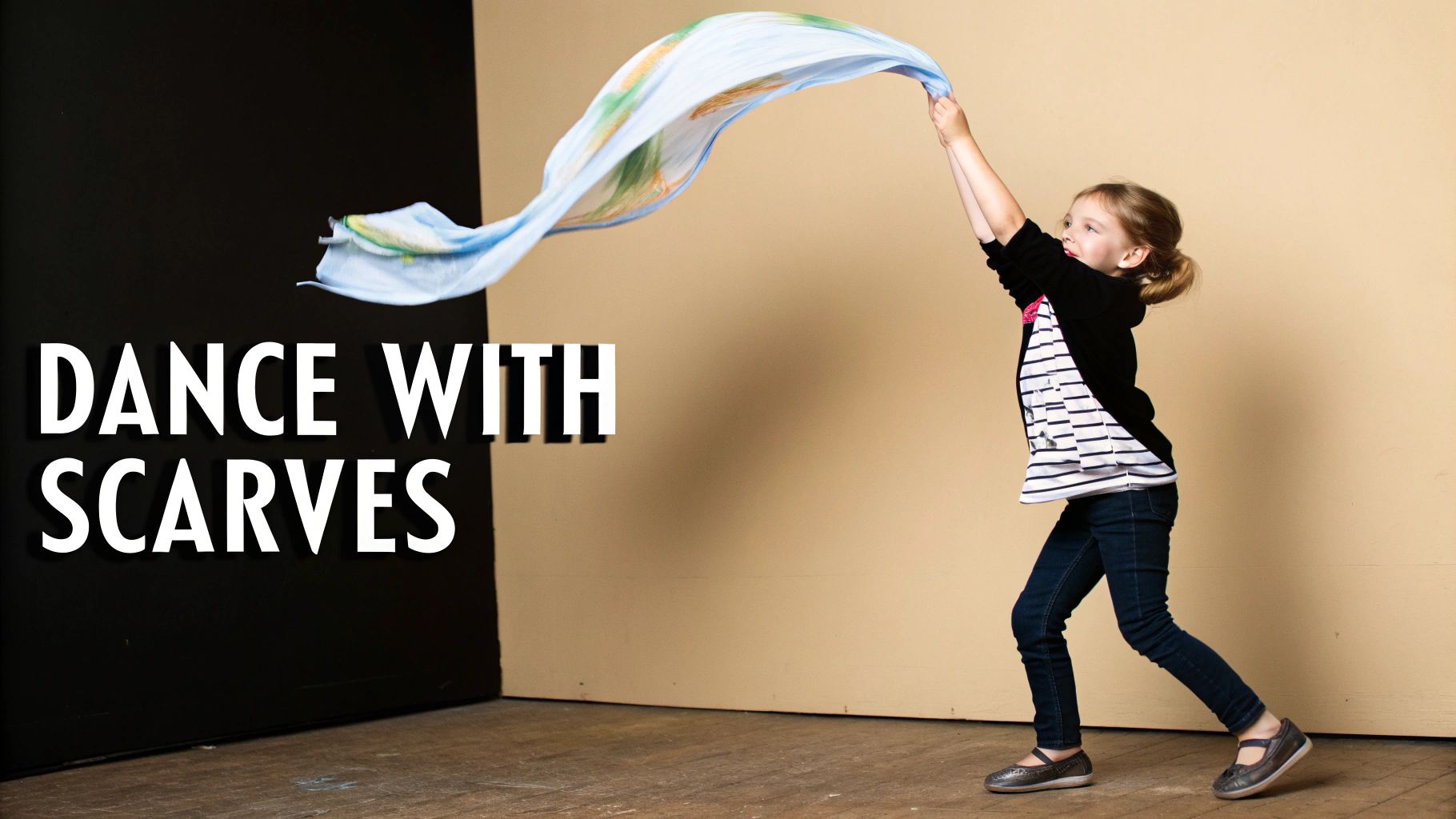
This game beautifully merges fine and gross motor skill development. Holding and manipulating the scarves strengthens hand-eye coordination and grip, while large movements like waving them high and low engage the whole body. The visual feedback from the props encourages children to extend their movements, explore spatial awareness, and connect their actions directly to the music’s tempo and mood. It’s a foundational activity seen in everything from Kindermusik programs to early rhythmic gymnastics training.
How to Play and Adapt
To begin, you only need some lightweight scarves or ribbons and a music player. This makes it a wonderful and colorful activity for families from Herriman to Riverton. Before handing out the props, demonstrate a few simple ways to move them to avoid tangled messes.
Keep the activity fresh and beneficial with these tips:
- Teach Prop Care: Start by establishing clear rules for using the props safely. Teach children to handle them gently and show them where to return them after the activity.
- Guide with Movements: Suggest simple motions to start, such as making circles, waves, or figure-eights in the air. As they get comfortable, encourage them to invent their own movements.
- Vary the Music: Use a mix of musical styles. Slow, classical music might inspire long, flowing movements, while upbeat pop could lead to quick, energetic zig-zags.
- Incorporate Colors: Use scarves of different colors to introduce concepts like sorting or to call out "everyone with a blue scarf, dance in the middle!"
Key Insight: Using props like scarves and ribbons gives preschoolers a tangible tool to express abstract musical concepts. It helps them "see" the music, making the connection between auditory input and physical output more concrete, which boosts both creativity and kinesthetic intelligence.
This activity is perfect for developing the grace and body awareness fundamental to formal dance. If you see your child’s imagination take flight with a ribbon wand, they may be ready to explore the structured creativity of dance. You can find out more about the best dance classes for toddlers and see how these foundational skills translate into disciplines like ballet and contemporary at Encore Academy.
7. Pass the Beat and Rhythm Circle Games
Pass the Beat and Rhythm Circle Games turn a simple circle of children into a collaborative musical ensemble. The concept is beautifully cooperative: children sit or stand in a circle and pass a steady beat or rhythmic pattern from one person to the next using claps, taps, or simple movements. One child starts a pattern, and it travels around the group, creating a shared, continuous rhythm.
This powerful group activity is a cornerstone of music education methods like the Kodály method. It’s designed to develop crucial skills such as active listening, turn-taking, and group synchronization. Children learn to focus not only on their own part but also on how it connects to the person before and after them, fostering a sense of teamwork, patience, and rhythmic precision.
How to Play and Adapt
To begin, simply gather the children in a circle in a clear space, whether it's a living room in Riverton or a classroom in Lehi. The only requirement is the ability to see and hear one another clearly. Start by explaining that you will be passing a sound around the circle like a ball.
Here are some tips to make your rhythm circle a success:
- Start Simple: Begin by passing a single, steady clap (a quarter note beat) around the circle. Once they master this, you can introduce more complex rhythmic patterns.
- Clarify the Action: Use clear, audible sounds like hand claps or knee pats. Clearly demonstrate the "pass" and establish the direction (e.g., "We will pass the beat to our friend on the left").
- Vary the Pattern: Keep children engaged by changing the beat. Try a "clap-clap-pat" or a "stomp-clap" pattern. You can also use a call-and-response format where the leader creates a rhythm and the next person copies it before passing it on.
- Build Confidence: Allow for multiple rounds so every child feels comfortable and successful. The goal is collaboration, not perfection.
Key Insight: Rhythm circle games are fundamentally about connection and community. They teach children that their individual contribution is vital to the group's success, building essential social-emotional skills like cooperation and attentive listening in a musical context.
This activity is exceptional for building the ensemble skills necessary for group performance. It lays the groundwork for understanding how individual parts fit together to create a whole, a key concept in our choir and group music programs at Encore Academy. If your child enjoys creating and sharing rhythms, they are developing the core abilities needed for more advanced musical training.
8. Animal Movement and Sound Storytelling
Animal Movement and Sound Storytelling taps into a preschooler's natural love for animals and make-believe. This imaginative game invites children to interpret animal characteristics through movement while connecting those actions to corresponding sounds or music. For instance, children might stomp heavily like an elephant to the sound of a low drum or flutter lightly like a butterfly to the tinkling of a triangle.
This activity is a rich fusion of gross motor skills, creativity, and auditory discrimination. As children embody different animals, they explore a wide range of movements, from big, powerful stomps to small, delicate hops, enhancing their body awareness and coordination. Simultaneously, they learn to associate specific sounds, rhythms, and musical tones with characters and actions, a foundational concept in music and storytelling, famously used in Prokofiev's "Peter and the Wolf."
How to Play and Adapt
To begin, you only need some space and a way to make sounds, whether with simple instruments, your voice, or a playlist. This makes it an ideal activity for a living room in Draper or a preschool classroom in Herriman. Start with familiar animals to build confidence before introducing new ones.
Here are some tips to keep the game engaging and effective:
- Create a Simple Narrative: Frame the movements within a story, like "A Day at the Farm" or "A Walk Through the Jungle," to guide the activity and transitions between animals.
- Use Varied Music: Match musical qualities to animal movements. Play slow, low-pitched music for a lumbering bear and fast, high-pitched music for a scurrying mouse.
- Model and Encourage: Demonstrate the movements and sounds first, but always praise a child’s unique interpretation. The goal is creative expression, not perfect imitation.
- Incorporate Props: Simple props like scarves for wings or paper plate masks can deepen the imaginative experience and help hesitant children feel more comfortable.
Key Insight: This game is a powerful introduction to character development and narrative expression. By connecting movement to sound and story, children learn that music can tell a story and that their bodies are instruments for creative expression, a core principle in both dance and theater.
This activity beautifully lays the groundwork for more structured performing arts. It nurtures the ability to interpret music and convey emotion through movement, which is essential in our musical theater and contemporary dance classes. If your child loves bringing stories to life, exploring performing arts classes in the Bluffdale area can be a wonderful next step.
Music & Movement: 8-Game Comparison
| Musical Freeze Dance | Low 🔄 — simple rules, easy to run | Minimal ⚡ — no equipment, small clear space | Improves listening, gross motor control, self‑regulation; very engaging ⭐⭐⭐ | Warm-ups, Parent & Me classes, indoor energy burn | Start slow, practice "freeze", vary genres |
|---|---|---|---|---|---|
| Follow the Leader Movement Sequence | Medium 🔄🔄 — requires sequencing and modeling | Low ⚡ — instructor-led, no props | Builds motor planning, rhythm, basic choreography skills; prepares for formal dance ⭐⭐⭐ | Ballet/contemporary classes, choreography transition | Start with 3–4 moves, break sequences, rotate leaders |
| Instrument Exploration & Sound Matching | Medium 🔄🔄 — needs supervision and modeling | Moderate ⚡⚡ — collection of child-safe instruments | Enhances auditory discrimination, cause‑and‑effect, multi‑sensory engagement; leads to instrument readiness ⭐⭐⭐ | Music readiness, multi‑sensory lessons, early intervention | Use safe instruments, introduce one family at a time |
| Color & Emotion Movement Expression | Medium 🔄🔄 — sensitive facilitation required | Minimal ⚡ — optional visual aids (scarves, cards) | Develops emotional intelligence, expressive movement, vocabulary; supports interpretive skills ⭐⭐ | SEL programs, theater, contemporary/ballet expression work | Keep associations simple, validate all expressions |
| Rhythm Pattern Clapping & Body Percussion | Low–Medium 🔄🔄 — scalable complexity | Minimal ⚡ — no props needed | Strengthens rhythm, coordination, auditory‑motor links; foundational for music literacy ⭐⭐⭐ | Early music classes, ensemble prep, piano/voice rhythm work | Start steady beat, use call‑and‑response, add visuals |
| Scarves & Ribbons Movement Choreography | Low 🔄 — straightforward with demonstration | Moderate ⚡⚡ — props, storage, adequate space | Builds fine + gross motor control, spatial awareness, strong visual engagement; performance‑friendly ⭐⭐ | Ballet/contemporary warm-ups, recitals, creative choreography | Use lightweight safe props, teach handling and boundaries |
| Pass the Beat & Rhythm Circle Games | Medium 🔄🔄 — requires group management | Minimal ⚡ — no equipment, clear circle space | Improves ensemble listening, turn‑taking, steady beat internalization; builds group cohesion ⭐⭐ | Choir/ensemble, team‑building, social-emotional activities | Start simple, practice pass direction, keep spacing comfortable |
| Animal Movement & Sound Storytelling | Low–Medium 🔄🔄 — narrative control needed | Minimal ⚡ — optional props (masks, percussion) | Encourages imagination, movement qualities, language development; highly motivating ⭐⭐ | Story‑based classes, character work in theater/dance | Choose familiar animals, model movements, match music to characters |
From Living Room Fun to Stage-Ready Skills
As we've explored, the journey through music and movement games for preschoolers is far more than just a way to burn off energy. It’s a foundational process of discovery, learning, and connection. From the simple joy of Musical Freeze Dance to the expressive creativity of Scarves and Ribbons Movement Choreography, each activity is a building block for your child's holistic development. These games are not isolated moments of fun; they are the first steps in a lifelong appreciation for rhythm, expression, and self-confidence.
You’ve seen how Follow the Leader Movement Sequences build crucial listening and sequencing skills, and how Rhythm Pattern Clapping teaches the fundamentals of musical structure. Through Animal Movement Storytelling, your child doesn't just pretend to be a lion; they learn to embody a character, express emotions non-verbally, and connect movement to narrative. These are the very seeds of theatrical and dance performance, planted right in your living room.
The Power of Play and a Pathway to Passion
The beauty of these games lies in their accessibility. Whether you're in a Herriman backyard, a Sandy living room, or a Draper playroom, you have everything you need to foster this growth. The core takeaway is that consistent, joyful engagement with music and movement creates a powerful learning environment. It builds neural pathways, enhances gross motor skills, and nurtures emotional intelligence.
Key Insight: The skills developed through these simple games-rhythmic timing, spatial awareness, creative expression, and group collaboration-are the direct precursors to formal training in dance, music, and theatre.
By actively participating, you are not just a parent; you are your child's first teacher and dance partner. You are showing them that movement is a language, music is a friend, and self-expression is something to be celebrated. As they master passing a beat in a circle or matching a sound to an instrument, you're witnessing the blossoming of cognitive and physical coordination that will serve them in every aspect of their lives.
Nurturing the Next Step in Their Creative Journey
As your preschooler’s enthusiasm grows, you may notice a budding passion that goes beyond casual play. They might start creating their own dances, asking for specific songs, or showing a keen interest in how instruments work. This is the perfect moment to consider how to channel that energy into a more structured, yet equally joyful, learning experience. The transition from home-based play to a supportive classroom environment can amplify their skills and confidence exponentially.
For families in Bluffdale and our neighboring communities like Riverton and Lehi, this next step is closer than you think. A dedicated space with experienced instructors can help your child refine their natural talents, learn alongside peers, and discover the thrill of performance. It’s about taking the wonderful foundation you’ve built with these music and movement games for preschoolers and giving it a stage on which to shine. We believe every child’s creative spark deserves to be nurtured, guided, and celebrated.
Ready to transform your child's playful energy into polished skills? Discover how the foundational principles of these games are expertly woven into our curriculum at Encore Academy for the Performing Arts. We invite families from across the Salt Lake Valley to visit our Bluffdale studio for a trial class and see how we can help your little star find their rhythm and voice.