
Music Theory Lessons for Beginners A Practical Guide
The best music theory lessons for beginners aren't about memorizing dry, rigid rules. They're about learning the language of music so you can start playing the songs you love, faster. It all starts with a few key ingredients: understanding rhythm, basic notation, and major scales. These are the true building blocks of your musical journey.
Why Music Theory Is Easier Than You Think

Let's be honest, "music theory" sounds pretty intimidating. For many people, it brings to mind dusty textbooks and complicated charts. But what if I told you it’s less about abstract formulas and more about understanding the patterns your favorite artists are already using?
Think of it like getting a map before a road trip. Music theory shows you the simple, repeating patterns that are hiding in plain sight in almost every song you've ever heard. This guide is here to cut through the noise and show you how theory can actually unlock your creativity, not hold it back.
Your Path to Musical Fluency
Instead of seeing it as a roadblock, think of theory as your secret weapon. I've seen it time and time again—a little bit of theory knowledge dramatically speeds up a student's progress, no matter their instrument. It’s the "aha!" moment that connects the dots, helping you play with more confidence and really feel the music.
This isn't just a local secret for our students traveling from Riverton to our Bluffdale studio, either. It’s a globally recognized principle. In fact, somewhere between 70-80% of formal music programs build theory right into their beginner lessons. Why? Because it works. It directly boosts essential skills like sight-reading, improvising, and even writing your own music.
The goal isn't just to play the right notes. It's to understand why those notes sound so good together. That's the "why" that music theory gives you, turning robotic practice into real, expressive playing.
What Really Matters for Beginners
Here's the good news: you don't need to swallow the entire textbook on day one. A handful of core concepts will give you the most bang for your buck right away. This is exactly what we tell our students who travel from Herriman and Lehi to our Bluffdale studio—start with the essentials. When you build a strong foundation, everything else you learn later just clicks into place.
This table gives you a quick roadmap of the fundamental building blocks we'll explore together in this guide.
| Core Music Theory Concepts for Beginners |
| :--- | :--- | :--- |
| Concept | What It Is | Why It Matters |
| Rhythm & Meter | The heartbeat of music—how we organize sound in time using note lengths and time signatures. | It's what makes you tap your foot. Without rhythm, music is just a random collection of sounds. |
| Notation | The system of symbols (like notes on a staff) used to write down music so others can play it. | Learning to read music opens up a world of songs and lets you communicate with other musicians. |
| Scales & Keys | The specific sets of notes that form the melodic and harmonic foundation of a song. | Scales are the "color palette" for a song. Understanding them helps you play melodies and improvise. |
| Intervals | The distance between any two notes. | This is the basis of melody and harmony. Recognizing intervals by ear is a crucial skill. |
| Chords & Harmony | The sound of two or more notes played at the same time, and how they progress from one to the next. | Chords create the emotional backdrop for a song—they make it sound happy, sad, or tense. |
By approaching theory this way, we've seen countless students find their confidence and fall in love with the process. The most important thing is having a clear path and a positive mindset. You can explore the different types of music instruction available at Encore Academy to see how we put these ideas into practice every day.
Learning to Read the Language of Music
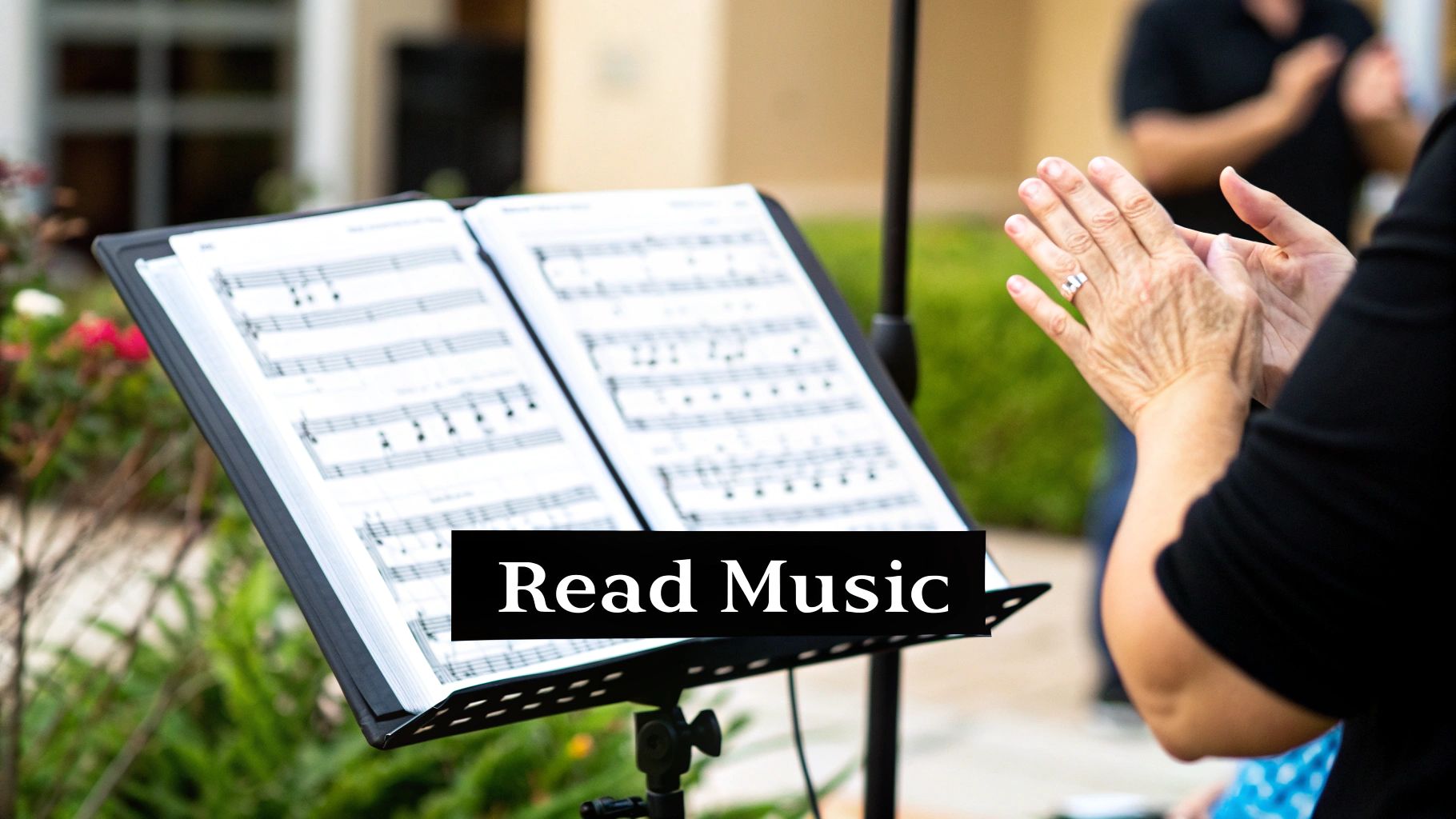
Before you can play a song, you have to know what the sheet music is trying to tell you. That’s what musical notation is all about—it's the written language that translates sound into symbols you can read. Don't worry, nobody expects you to become a master sight-reader overnight. The real goal is to build that foundational literacy, one small concept at a time.
We’ll begin with the absolute basics of rhythm and notation, breaking them down into simple, practical pieces. The first thing to get comfortable with is the musical staff, which is just the set of five lines and four spaces where all the action happens.
The Musical Staff and Clefs
Think of the staff as a map for the notes. But to read any map, you need a key. In music, that key is the clef. The two clefs you’ll see almost everywhere are the treble and bass clefs. They’re the symbols at the very beginning of the staff that tell you which notes fall on which lines and spaces.
- Treble Clef (G-Clef): This is that familiar squiggly symbol you probably picture when you think of sheet music. It's generally used for higher-pitched instruments—think violins, flutes, or a singer’s melody. For pianists, this clef typically shows what you'll be playing with your right hand.
- Bass Clef (F-Clef): This one looks a bit like a backwards 'C' with two dots. It’s for the lower-pitched instruments like the cello, tuba, or bass guitar. On the piano, it usually covers the notes for the left hand. Many students in our Bluffdale studio taking piano lessons get the hang of one clef first before putting them together.
You don't need to memorize every note at once. A great trick is to learn a few "landmark" notes on each clef, which makes figuring out the others much easier. Little acronyms like Every Good Boy Does Fine for the lines of the treble clef are a classic for a reason—they really work!
Getting a Feel for Rhythm and Time
Once you can name a note, the next question is: how long do you hold it? That's the essence of rhythm. Different types of notes have different values, and these durations create the pulse and groove that make you want to tap your foot.
Here are the first few note values you'll run into:
| Whole Note | Four beats | An open, hollow oval |
|---|---|---|
| Half Note | Two beats | A hollow oval with a stem |
| Quarter Note | One beat | A filled-in circle with a stem |
| Eighth Note | Half a beat | A filled-in circle with a flagged stem |
So, how do you keep it all organized? That's the job of the time signature. It looks like a fraction at the start of the music. The most common one you'll see is 4/4 time, often called "common time." It's simple: it means there are four beats in every measure, and a quarter note gets one beat. This signature is the backbone of almost all pop, rock, and country music, so it’s the perfect place to start.
A simple exercise we recommend for all our students, whether they live right here in Bluffdale or drive in from Sandy, is to put on a favorite song and just clap a steady quarter-note pulse. It's a fantastic way to train your internal clock and makes reading rhythms on a page feel much more intuitive.
How Notes Create Melodies and Moods
So, you can now pick out individual notes on the staff. That's a huge first step! But how do those dots on a page come together to create the melodies that get stuck in your head all day? This is where the real fun begins, as we dive into scales, intervals, and key signatures.
These are the concepts that explain why some note combinations sound so satisfying and resolved, while others leave you hanging with a sense of tension. Think of it like this: you've learned the alphabet (the notes), and now you're learning how to build words and sentences (the melodies). It's a fundamental part of music education, whether you're in Draper or a conservatory halfway around the world.
Unlocking Melodies with the Major Scale
Ever wonder why so many songs just sound... happy? The major scale is often the secret ingredient. It’s a specific pattern of seven notes that gives musicians a reliable palette to create bright, upbeat melodies. Instead of guessing which notes will work, you can simply pull from the scale.
The great thing is, the pattern is the same no matter what note you start on. It’s built from a simple sequence of whole steps (W) and half steps (H). A half step is just the very next key on the piano (black or white), and a whole step is simply two half steps.
The universal formula for a major scale is: Whole-Whole-Half-Whole-Whole-Whole-Half (or W-W-H-W-W-W-H).
Try it out on C. Following the pattern, you get C-D-E-F-G-A-B. That's the C Major scale. You can play those notes in any order, and they'll almost always sound like they belong together.
The Emotional Power of Intervals
An interval is just the distance between any two notes. It’s this spacing that packs a melody with character and emotion. A small, tight interval like a "second" often feels smooth and gentle, while a big leap like an "octave" can feel dramatic and powerful.
- Melodic Intervals: These are notes played one after the other, creating the tune you hum.
- Harmonic Intervals: These are notes played at the same time, which is how we start building harmony.
Getting a feel for intervals is the key to training your ear. Before you know it, you'll start to hear the space between notes in your favorite songs, which is a massive leap in your musical journey. This skill is especially crucial for singers, which is why we put a strong emphasis on ear training in our voice lessons at Encore Academy .
The ability to recognize the sound of different intervals is what separates a beginner from an intermediate musician. It's the skill that allows you to play by ear, improvise, and understand harmony on a deeper level.
Finding Your Musical Home Base
Finally, let's talk about the key signature. Think of it as a song’s home base or center of gravity. You'll find it at the very beginning of the staff, right after the clef. It uses sharps (♯) or flats (♭) to tell you which notes need to be altered for the entire piece.
This instantly establishes the main scale the song is based on, creating that satisfying sense of arrival when the melody returns to its starting note (the tonic).
This isn't just some abstract rule; it’s a core part of music education that has stood the test of time. For example, the Malta School of Music has woven theory into their lessons since 1975, using familiar songs to show students how key signatures work in practice. It’s a great reminder that theory isn't just homework—it's the very DNA of the music we all know and love. You can read about their curriculum's success on Tandfonline.
Building Harmony with Chords and Progressions
If melody is the story of a song, then harmony is the emotional backdrop that brings it to life. This is where we get to discover the magic of chords—multiple notes played together that create a richer, fuller sound. We’re about to move beyond single notes and start building the real harmonic foundation of music.
The great news is that you already have the tools you need. Chords are built directly from the scales you've just learned. Instead of playing notes one by one, you’ll start grouping them in specific ways to create powerful emotional textures.
From Scales to Simple Chords
The most fundamental chords you'll encounter in Western music are triads. Just as the name suggests, they’re built using three notes. For any major scale, you can create a basic major or minor chord by simply stacking notes in a specific pattern. It's a formula that works every time.
To build a major chord, you start with the first note of a scale (the root), then you add the third note and finish with the fifth.
- Let's try it in C Major:
- The C Major scale is C-D-E-F-G-A-B.
- The 1st note is C.
- The 3rd note is E.
- The 5th note is G.
- Play C, E, and G together, and you have a C Major chord!
To create a minor chord, you just lower that middle note (the third) by one half step. It’s this simple change that often gives a chord its "sadder" or more serious sound. This method of creating chords from scales is a core part of modern music education, shaped by decades of standardized teaching. Since academic groups like the Society for Music Theory were founded in 1977, the approach to teaching beginners has become much more structured and practical.
Unlocking Hit Songs with Chord Progressions
Once you know a few chords, the real fun begins: stringing them together to create a chord progression. A progression is simply the order in which chords appear in a song, and it's the engine that drives the music forward. You’ll be amazed to learn that thousands of hit songs—across pop, rock, and country—are built on the exact same handful of progressions.
Think of chord progressions like common phrases in a language. Once you learn to recognize them, you start hearing them everywhere, from The Beatles to Taylor Swift. It's a skill that helps you start playing along with your favorite songs almost immediately.
The most common progression in popular music uses the chords built on the first, fourth, fifth, and sixth notes of a major scale. We use Roman numerals to label this the I-V-vi-IV progression.
In the key of C Major, this translates to:
- I: C Major
- V: G Major
- vi: A minor
- IV: F Major
Play those four chords in that order—C, G, Am, F—and you've just performed the harmonic backbone of countless chart-topping hits. This foundational knowledge doesn't just help you play songs; it's the very first step toward writing your own. For anyone interested in creating their own music, understanding these patterns is essential, and you can learn more about how our composition program builds on these concepts .
A Practical 10-Week Music Theory Plan
Learning music theory is one thing, but actually using it is where the magic happens. Knowing what a major scale is on paper doesn't do you much good if you can't hear it or play it. So, let's build a practical, week-by-week roadmap to take these ideas off the page and onto your instrument.
Think of this as a training plan, not a homework assignment. It’s designed with specific, realistic goals for each week to build momentum. This is the exact kind of step-by-step guidance we use to help our students in Herriman and Bluffdale see real, tangible progress from day one.
The First Five Weeks: Building Your Foundation
The first few weeks are all about laying a solid groundwork. It's tempting to rush ahead, but I promise, taking the time to truly master these core concepts will make everything that follows feel so much easier.
- Week 1: Rhythm and Pulse. Before you even think about notes, let's talk about the beat. Put on your favorite songs and just clap along. Your main job is to find the downbeat—that strong "one" you feel in a standard 4/4 time signature. The goal here is simple but crucial: clap a steady quarter-note pulse for an entire song without speeding up or slowing down.
- Weeks 2-3: Note Recognition. Now it's time to get friendly with the staff. I recommend dedicating week two entirely to the treble clef and week three to the bass clef. Grab some flashcards or find a note-naming app and spend just five minutes a day on it. You're not aiming for perfection, but you should be able to confidently identify at least 80% of the notes on each clef by the end of its week.
- Weeks 4-5: The C Major Scale and Intervals. Let's make some music! Spend these two weeks getting the C Major scale under your fingers on your instrument until it feels second nature. From there, start training your ear to identify the sound of basic intervals starting from C, like a Major Third (C to E) and a Perfect Fifth (C to G).
One of the biggest mistakes I see beginners make is trying to learn everything all at once. My advice? Focus on one small, achievable goal per week. Consistent, focused practice is always more effective than long, infrequent cram sessions.
The Next Five Weeks: Creating Music
With the fundamentals in place, we can start putting the pieces together to create harmony and play actual music. This is when the concepts really start to click and feel real.
This diagram perfectly illustrates how harmony flows logically from the scales you've already learned. It’s not some random, mysterious process.
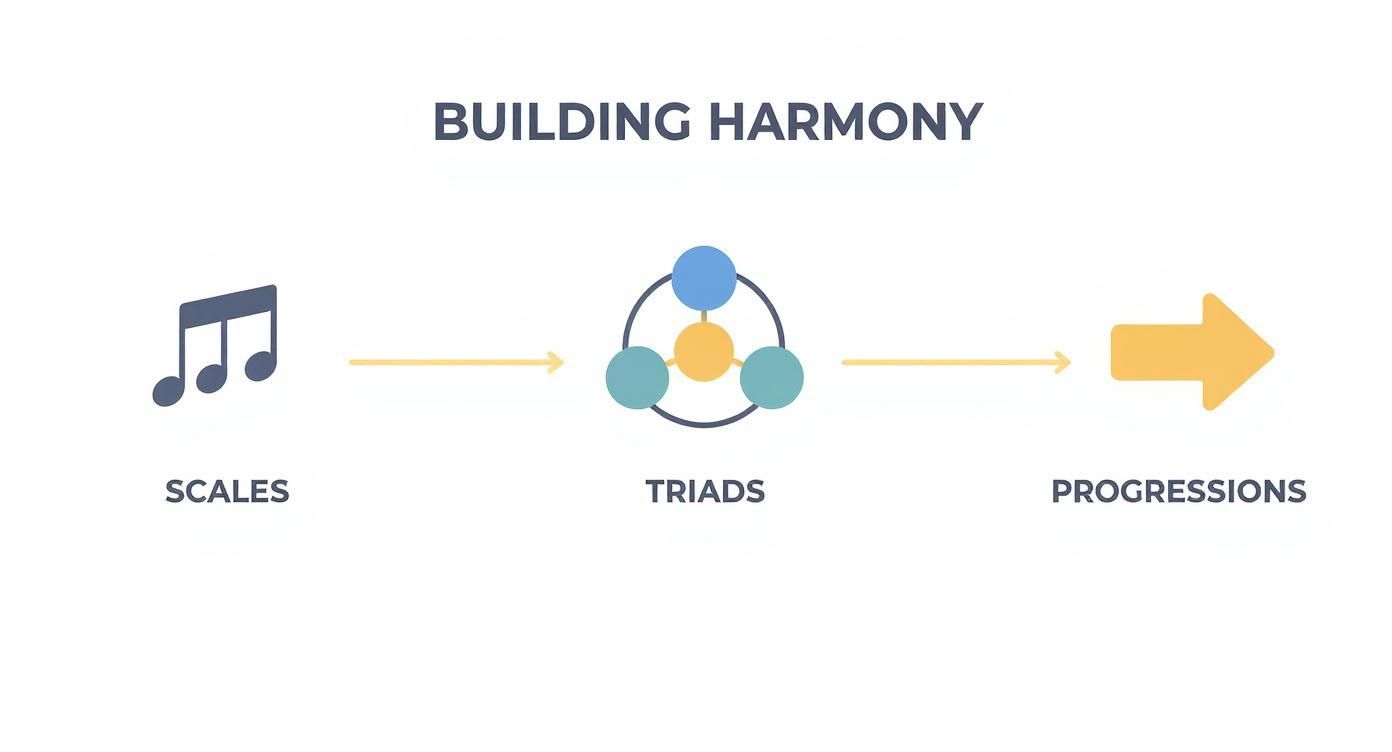
Seeing this progression helps you understand that chords and progressions are just the next natural step from the scales you already know.
- Weeks 6-7: Building Basic Triads. Using the C Major scale as your home base, build the three most important chords in the key: C Major (I), F Major (IV), and G Major (V). Your focus should be on switching between them smoothly on your instrument without any long, awkward pauses.
- Weeks 8-9: The I-IV-V Progression. Now, let's string those chords together. Play them in sequence: C-F-G-C. This is the legendary I-IV-V progression, the backbone of countless songs in blues, folk, and rock. Find a simple song that uses this structure and try playing along.
- Week 10: Adding the Minor Chord. Time to add a little more emotional color. Introduce the A minor (vi) chord into the mix. Practice playing the most popular chord progression in modern music: C-G-Am-F (I-V-vi-IV). You'll be amazed at how many songs you suddenly recognize. It's a hugely rewarding moment that our students from Lehi to Riverton absolutely love.
This plan offers a clear path to get you started. Below is a more structured look at how these topics build on one another over 10 weeks.
Sample 10-Week Beginner Music Theory Plan
| 1 | Rhythm & Pulse | Clap a steady quarter-note beat to 3-4 different songs. |
|---|---|---|
| 2 | Treble Clef Notes | Identify all notes on the treble clef staff with 80% accuracy. |
| 3 | Bass Clef Notes | Identify all notes on the bass clef staff with 80% accuracy. |
| 4 | C Major Scale | Play the C Major scale (one octave) smoothly up and down. |
| 5 | Basic Intervals | Aurally identify Major 3rds and Perfect 5ths from the root C. |
| 6 | Major Triads (I, IV, V) | Build and play the C, F, and G major triads. |
| 7 | Chord Transitions | Switch between the I, IV, and V chords without stopping. |
| 8 | The I-IV-V Progression | Play the C-F-G-C progression in time with a metronome. |
| 9 | The Minor (vi) Chord | Build and play the A minor triad. |
| 10 | The I-V-vi-IV Progression | Play the C-G-Am-F progression and find a song that uses it. |
While this 10-week plan is a fantastic starting point for self-starters, every musician learns a little differently. If you thrive with personalized guidance and real-time feedback, exploring structured adult music classes can provide the support and accountability to take your skills to the next level.
Still Have Questions About Music Theory? Let's Clear Things Up
It's totally normal to feel a bit swamped when you first dip your toes into music theory. It’s a big world, but don't worry—most beginners have the exact same questions. Let’s tackle some of the most common ones I hear from new students.
"Do I Really Need Music Theory to Be a Good Musician?"
Honestly, you don't. Some phenomenal musicians play entirely by ear. But think of it this way: playing without theory is like exploring a new city without a map. You can get around, but you'll probably get lost, and you'll miss a lot of cool stuff.
Theory is the map. It gives you the "why" behind the notes, which dramatically speeds up your progress. It helps you talk to other musicians in a shared language and opens up doors to things like improvising, composing, and arranging music. Our students at the Bluffdale studio often have that "aha!" moment where theory makes their instrument suddenly feel more intuitive, not less.
"How Long Will It Take to Learn the Basics?"
This is probably the number one question I get. If you put in a consistent 2-3 hours per week of focused practice, you can get a really solid grasp of the fundamentals in about three months. The 10-week plan we laid out is designed to do just that—get you reading music, building chords, and understanding scales without feeling overwhelmed.
Mastery, of course, is a lifelong adventure. But getting a strong foundation happens way faster than people expect. It's all about consistency, not cramming.
"Is Music Theory Different for Guitar Than for Piano?"
Nope! The foundational rules of music—rhythm, harmony, scales, chords—are the same for every instrument. It's a universal language. The only thing that changes is how those concepts look and feel on your specific instrument.
- On a piano, the keyboard is laid out in a straight line, which makes it super easy to visually see things like half-steps and whole-steps.
- On a guitar, the fretboard is all about patterns. Guitarists tend to think in terms of movable "shapes" that they can slide up and down the neck.
A great teacher will show you how to apply those universal principles directly to the unique layout of the instrument you love to play.
"Okay, I'm In. What's the Best Way to Start Today?"
Start small and stay consistent. That's it. Trying to swallow the entire theory ocean in one gulp is the fastest way to get discouraged.
Following a structured guide like this is a fantastic starting point. But if you want to sidestep the common frustrations and really make progress, nothing beats getting feedback from an experienced teacher. They can provide music theory lessons for beginners that are built around how you learn, connecting the dots in a way that just clicks.
Ready to stop wondering and start playing? At Encore Academy for the Performing Arts, we specialize in making music theory click for students of all ages. Book a trial class today and let's start your musical journey on the right note.