
Musical Theater Auditions vs Beginner Classes: What to Know
Beginner musical theater classes usually do not require an audition, while advanced cohorts or specific productions may use auditions to decide who's ready for the room. In one reported university example, more than 1,400 students submitted prescreening auditions, about 600 to 650 were invited in person, and only 20 to 22 were chosen, which came out to roughly 1.4% to 1.6% from the original pool ( study guide reference ).
A lot of parents in Bluffdale, Riverton, and Herriman get stuck on the same question. Their child wants to sing, act, or dance, but the family can't tell whether they need a first class or a first audition.
Audition Anxiety and the Beginner Question
A parent from Draper or Lehi often sees the same moment happen at home. A student comes back from a school show or church performance glowing with excitement, then freezes when they hear the word “audition.” That hesitation is normal, because an audition asks a child to be judged against limited openings, while a beginner class only asks them to show up and learn.

The confusion gets sharper when families think in all-or-nothing terms. Either the child is “ready,” or they're not. In reality, many students are ready for a class long before they're ready for a casting process, and that gap matters for confidence as much as for technique.
A beginner class can be the safest first step when a student is excited but unsure how to handle evaluation.
The hardest part is that performance anxiety doesn't always look dramatic. A student may still smile, still practice, and still say they want theater, but avoid auditions entirely because the pressure feels too high. That's why the first decision isn't “Can they perform?” It's “What kind of setting will help them keep going?” For families who want help with that emotional side, Encore Academy's performance anxiety resource is a useful place to start.
Defining Auditions and Beginner Musical Theater Classes
An audition is a selective assessment. It compares a performer with other candidates for a role, an advanced cohort, or a specific production, and the performer usually has to show readiness quickly. Beginner classes work differently, because they build skill before selection ever enters the picture.
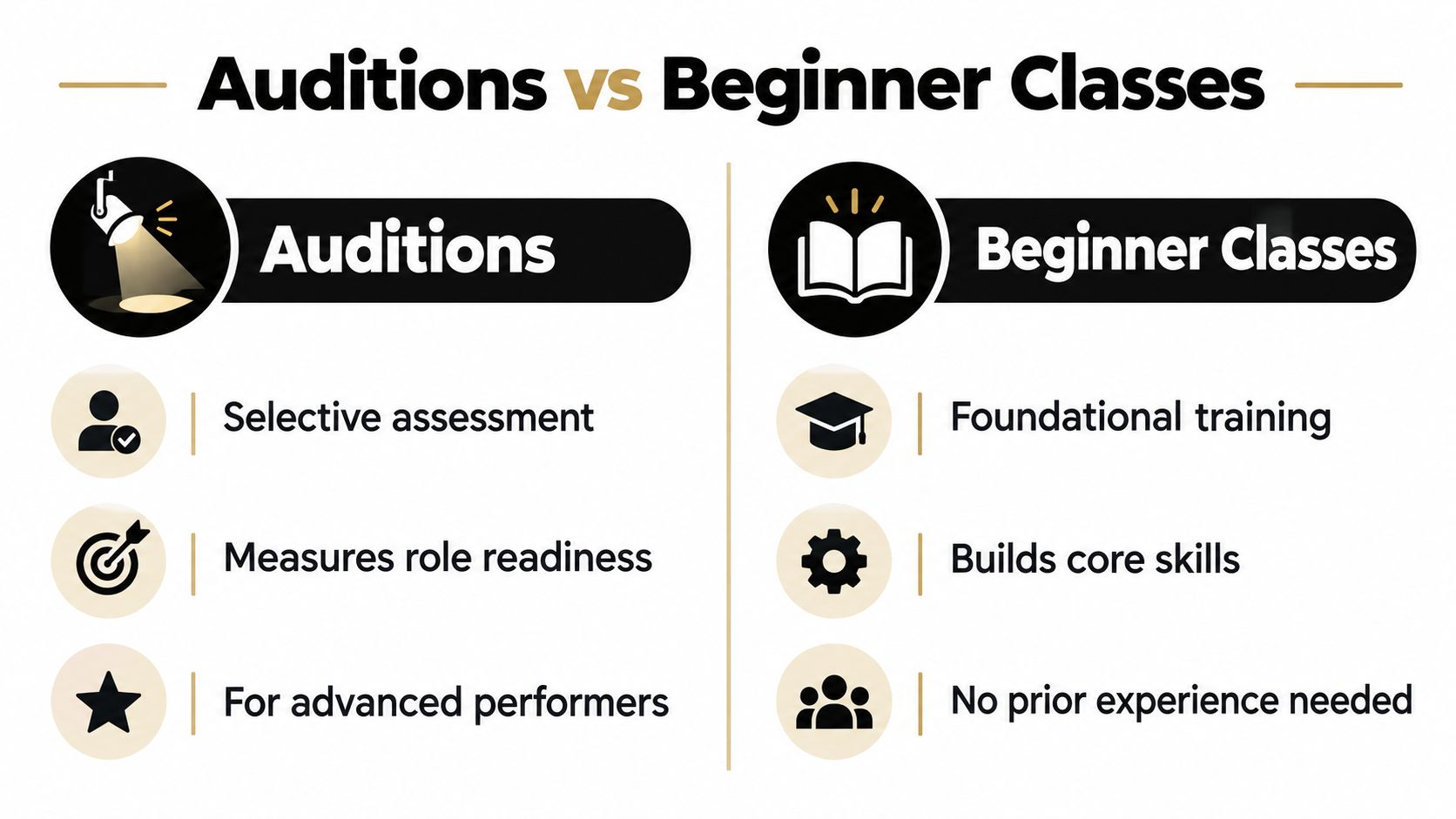
High-level auditions can ask for contrasting songs, monologues, dance demonstrations, and prescreen materials instead of one polished performance. A common audition package may include a memorized monologue, a short vocal cut, and a fast learning test in choreography, because the evaluator is checking whether the performer can combine acting, singing, and movement under pressure ( audition guidance ).
Beginner classes are built for the opposite purpose. They use repetition, low-pressure exposure, and one skill at a time so the student can learn breath control, pitch matching, rhythm, alignment, safe movement, and basic stage vocabulary before they are asked to do all of it at once ( musical theatre training overview ). A parent who wants a clearer sense of the first class experience can also read Encore Academy's acting classes for beginners , which explains how early instruction is structured for new students.
Auditions are a snapshot of readiness. Classes are the training that builds it over time. For families comparing options in Bluffdale, Riverton, and Sandy, that difference often decides whether the next step should be a placement conversation or a casting call. Encore Academy's theater offerings place new students in a first-day group within 15 minutes of arrival, so parents can see what fits before committing.
What To Expect During an Audition Day
Audition days are usually brief, concentrated, and a little impersonal. In professional theatre, Actors' Equity Association notes five-minute appointment windows for Equity auditions, and says a typical full audition day can run seven hours within an eight-hour period, including a one-hour meal break ( Equity audition procedures ). That structure alone tells you a lot about the difference between an audition and a class.
Families sometimes expect an audition to feel like a lesson with coaching. It usually doesn't. The performer checks in, waits, presents material fast, and then may need to learn or repeat choreography with little time to settle in. The room rewards quick adaptation, clean preparation, and the ability to stay usable after a mistake.
What the room is really testing
The room is not checking one isolated talent. It's watching whether a student can blend singing, acting, and dancing without losing control of any one part. That's the “triple-threat” idea in practice, and it's why a child who does well in weekly classes may still need separate audition preparation before stepping into a casting environment.
The time pressure also changes the type of thinking required. In class, repetition helps a student build habits. In an audition, the performer has to make fast, role-relevant choices with very little room to warm up mentally. If your child wants support for that shift, Encore Academy's audition preparation guidance can help frame the next conversation.
The Beginner Class Environment and Skill Progression
A beginner class should feel teachable, not like a test. The room needs enough calm for students to try, repeat, and correct without feeling judged on every attempt. That matters for younger performers from Herriman or Lehi who may know the songs but not yet the physical language of musical theater.
Skills built before the pressure rises
A strong first class usually builds a few basic habits first:
- Breath management, so the student does not run out of air halfway through a phrase.
- Pitch matching, so the ear and voice start working together.
- Rhythm and alignment, so movement stays coordinated and safe.
- Basic vocabulary, so terms like count, phrase, and stage direction stop feeling foreign.
- Confidence in public performance, so being watched becomes normal instead of scary.
The pace matters because arts access is uneven in the early years. According to a 2025 NEA summary, 15% of kindergarten children participated in an organized performing-arts group, 10% took music lessons, and 2% took drama classes. By fifth grade, organized performing-arts participation had risen to 23% and music lessons to 26% ( NEA childhood arts education summary ). The same report found that creative movement or dance access reported by kindergarten teachers was 31%, compared with 5% by fifth grade. That gap shows why early classes matter for keeping children connected to the arts.
Beginner instruction works best when students can repeat simple patterns until they feel natural.
A class is not a shortened audition. It is where students build the habits that make later auditions possible, and families who want a place to start with voice fundamentals can look at Encore Academy's voice training for beginners .
How To Decide Based On Readiness and Goals
Parents often ask the wrong first question. They ask, “Is my child good enough?” A better question is, “Can my child handle the kind of pressure this path asks for right now?” That shift matters, because technical ability and emotional readiness are not the same thing.
A 2025 Frontiers in Psychology study reported that young musicians described physical anxiety symptoms during auditions and entrance exams, including trembling, sweating, and abdominal pain, and one participant avoided an audition entirely because they were afraid of performing in front of others ( Frontiers in Psychology ). That lines up with what many teachers see in practice. A student can love theater and still need lower-stakes exposure before they can face a room with confidence.
For families in Bluffdale, Riverton, and Sandy, I'd use these readiness questions:
- Does the student attend consistently? Regular attendance shows they can handle routine before pressure.
- Can they perform in front of others without shutting down? School assemblies, class sharing, and group numbers matter here.
- Do they take feedback without collapsing? Auditions punish panic, but class can teach recovery.
- Are they practicing on their own? Self-directed work often tells you more than enthusiasm does.
- Can they manage basic recording or self-tape tasks? Audition infrastructure can become a barrier even when the talent is there.
That last point is easy to overlook. Some programs now expect prescreens, multiple song or dance videos, and file handling that requires a phone, space, and know-how. Industry coverage has pointed out that these logistics can be a real access barrier, which is why beginner classes that teach camera presence and self-taping can be more useful than students or parents first realize.
Readiness includes emotional steadiness and basic access, not just talent.
If you're not sure where your child belongs, ask about placement instead of assuming a trial class equals a confirmed fit. Encore Academy's contact page is the right place to ask about current class fit, placement, and availability.
Next Steps for Local Families
Start with the path that matches your child's current steadiness, not the one that sounds more impressive. A student who can handle notes, movement, and feedback may be ready for an audition or a more selective cohort. A student who still needs repetition and reassurance usually benefits more from a starter class first.
For Bluffdale families, Encore Academy's acting programs and theater offerings can help you compare beginner access with more selective options. For Riverton, Draper, Lehi, Sandy, and Herriman parents, the most practical next step is to ask about fit, placement, and availability before treating any trial as a guaranteed spot.
For Bluffdale families, the clearest next move is a 15-minute placement call with an instructor who can watch your child move and sing before suggesting a path. Encore Academy for the Performing Arts offers theater, acting, dance, and music training in Bluffdale for students at different stages. If you're weighing musical theater auditions vs beginner classes, visit Encore Academy for the Performing Arts to review current offerings and ask about placement, audition prep, or a starting class.