
Performance Dance Center: How to Choose the Right Studio for Your Child
Picking the right performance dance center is a huge decision for your family. It's more than just signing up for a class; it’s choosing the community and the mentors who will shape your child’s artistic journey and personal growth for years to come. You're looking for a place that matches their passion, fuels their dedication, and helps them reach their goals—whether that’s mastering a new skill or dreaming of a professional stage.
Defining Your Family's Dance Goals
Before you even open a browser to search for studios, the most important step is a conversation at home. Sit down with your dancer and talk, really talk, about what they want out of dance. It’s also a time for an honest look at what your family can realistically commit to.
Finding the right fit isn't about the studio with the shiniest trophies in the lobby. It's about finding a home where your child's specific dreams will be taken seriously and nurtured.
The world of dance education is broad, with great options all over the Bluffdale and Sandy areas. You've got everything from once-a-week recreational classes to intense, pre-professional training programs. The trick is to understand the fundamental difference between a casual studio and a true performance dance center. One is built around fun and fitness, the other is laser-focused on technical mastery, artistry, and preparing dancers for the stage.
Performance Path or Recreational Fun?
Figuring this out from the get-go will save you a ton of time and potential frustration down the road. A recreational program is a fantastic choice for a child who just loves to move, wants to make friends, and gets excited about a low-pressure annual recital. It's a wonderful way to build confidence and stay active.
A performance-focused path, on the other hand, is a whole different level of commitment. This is for the dancer who is constantly practicing in the living room without being asked, the one who truly feels the music, and who is always asking for more challenges. This route means more hours in the studio, a more rigorous curriculum, and a bigger investment of time and money for things like costumes, travel, and competitions. Thinking about the best age to start ballet can also play a role in this decision.
The most successful studio-family partnerships happen when everyone is on the same page. When a dancer's goals, a parent's commitment, and a studio's philosophy all line up, the potential for growth is incredible.
This simple decision tree can help you visualize which path might be the right starting point for your family.
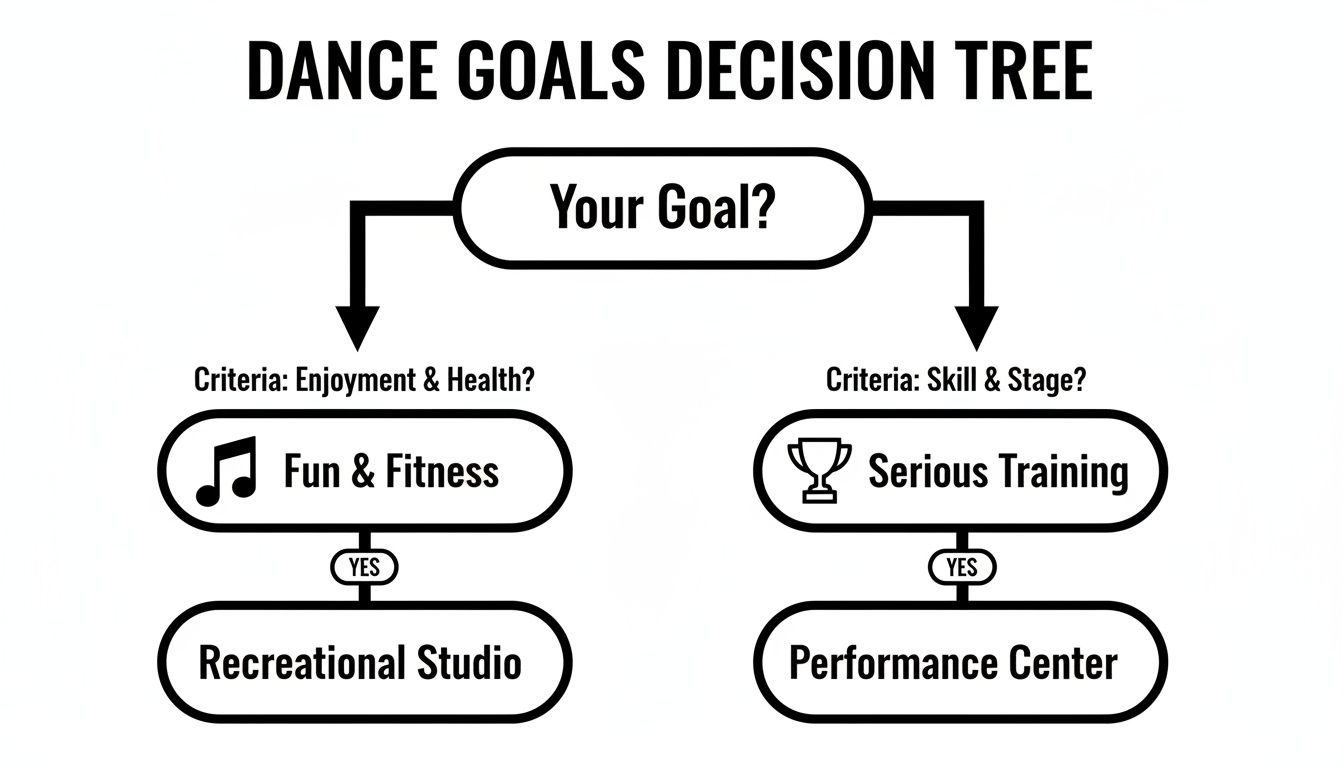
As you can see, your main goal—whether it's for pure enjoyment or serious training—is the clearest signpost pointing you toward the right kind of studio. This choice sets the foundation for everything that comes next.
To give you a clearer picture, here’s how the two types of studios typically stack up.
Performance Center vs. Recreational Studio At a Glance
This table breaks down the core differences you'll find when comparing these two distinct approaches to dance education.
| Primary Goal | Technical mastery, artistry, pre-professional training | Fun, fitness, social interaction, basic skill-building |
|---|---|---|
| Class Frequency | Multiple classes per week, often mandatory | Typically 1-2 classes per week, flexible enrollment |
| Curriculum | Structured, progressive syllabus (e.g., Vaganova, Cecchetti) | More flexible, often focused on recital choreography |
| Commitment | High; requires significant time and financial investment | Low to moderate; less demanding on family schedules |
| Instructors | Often former professional dancers with extensive training | May have varied backgrounds, focus on a fun environment |
| Opportunities | Competitions, conventions, intensive workshops, company roles | Annual recital, local community performances |
| Atmosphere | Disciplined, focused, and goal-oriented | Casual, relaxed, and social |
Seeing the differences laid out like this makes it easier to align a studio's offerings with your family's expectations.
The demand for high-quality dance training is strong. The U.S. dance studio market is projected to hit $5.0 billion in 2025, with over 14,000 businesses nationwide. This shows just how much parents value what a structured arts education can provide for their children.
Getting to Know the Instructors and Their Teaching Philosophy
Let's be honest—the heart of any great performance dance center isn't the fancy lobby or the shiny trophies. It’s the people leading the classes. These instructors are the mentors, choreographers, and role models who will shape your dancer's entire journey, so this is where you need to do your homework.
A studio’s training philosophy is like its DNA; it influences every class and every correction. You want to see a program built on a rock-solid technical foundation. Dancers who are both versatile and healthy grow from disciplined training in core styles like ballet, jazz, and contemporary. These aren't just genres; they're the essential building blocks that allow a dancer to master any style they choose later on.
This focus on fundamentals is crucial for long-term growth and, just as importantly, injury prevention. A studio that gets this right isn't just teaching routines for the next competition. It's carefully building a strong, intelligent artist from the ground up.
Looking Beyond the Bio
When you’re looking up instructors online, you need to read between the lines. A teacher’s background should do more than just list their accomplishments—it should give you confidence in their ability to lead.
- Professional Experience: Have they danced professionally? Performing with a company or in commercial work gives them priceless, real-world insight into the discipline and artistry needed to succeed.
- Teaching Credentials: What’s their actual teaching background? Look for experience with specific, recognized methods (like the Vaganova method for ballet) or certifications in programs like Acrobatic Arts or progressing ballet technique.
- Ongoing Education: The dance world never stands still. You want to see faculty who participate in workshops, get new certifications, and stay current with the latest in technique, choreography, and dancer safety.
We have many families who make the drive from cities like Draper and Sandy to our studio in Bluffdale, and it’s almost always because they recognize the value of this kind of deep expertise. A top-tier faculty is worth the commute. You can see what we mean by taking a look at the backgrounds of our dedicated staff .
Asking the Right Questions
When you visit or call a studio, come prepared with a few questions for the director. Your mission is to get a feel for their approach to developing not just skilled dancers, but well-rounded people.
A good studio will be open, transparent, and genuinely excited to talk about its teaching methods and its team's qualifications. This initial conversation can tell you almost everything you need to know about the studio's true values.
A great instructor teaches so much more than steps. They instill discipline, resilience, and a deep respect for the art form. The studio's philosophy should show a commitment to nurturing the whole student, not just the dancer.
Here are a few specific questions to get the conversation started and see if the studio's philosophy is a good match for your family:
- How do you vet and train new instructors who join your team?
- Is there a structured curriculum for each age group and level, or is it up to each teacher?
- How do you approach giving corrections in the classroom? Is the focus on positive, constructive feedback?
- What kind of professional development opportunities do you provide for your faculty?
- How do you balance artistic growth with the pressure of competitive goals?
The answers you get will paint a very clear picture of the studio's culture. A performance dance center that invests in its instructors is, by extension, investing directly in your child's success and well-being. It’s a sign that they care about excellence that lasts long after the trophies are put away.
Looking Beyond Weekly Classes to Performance Opportunities
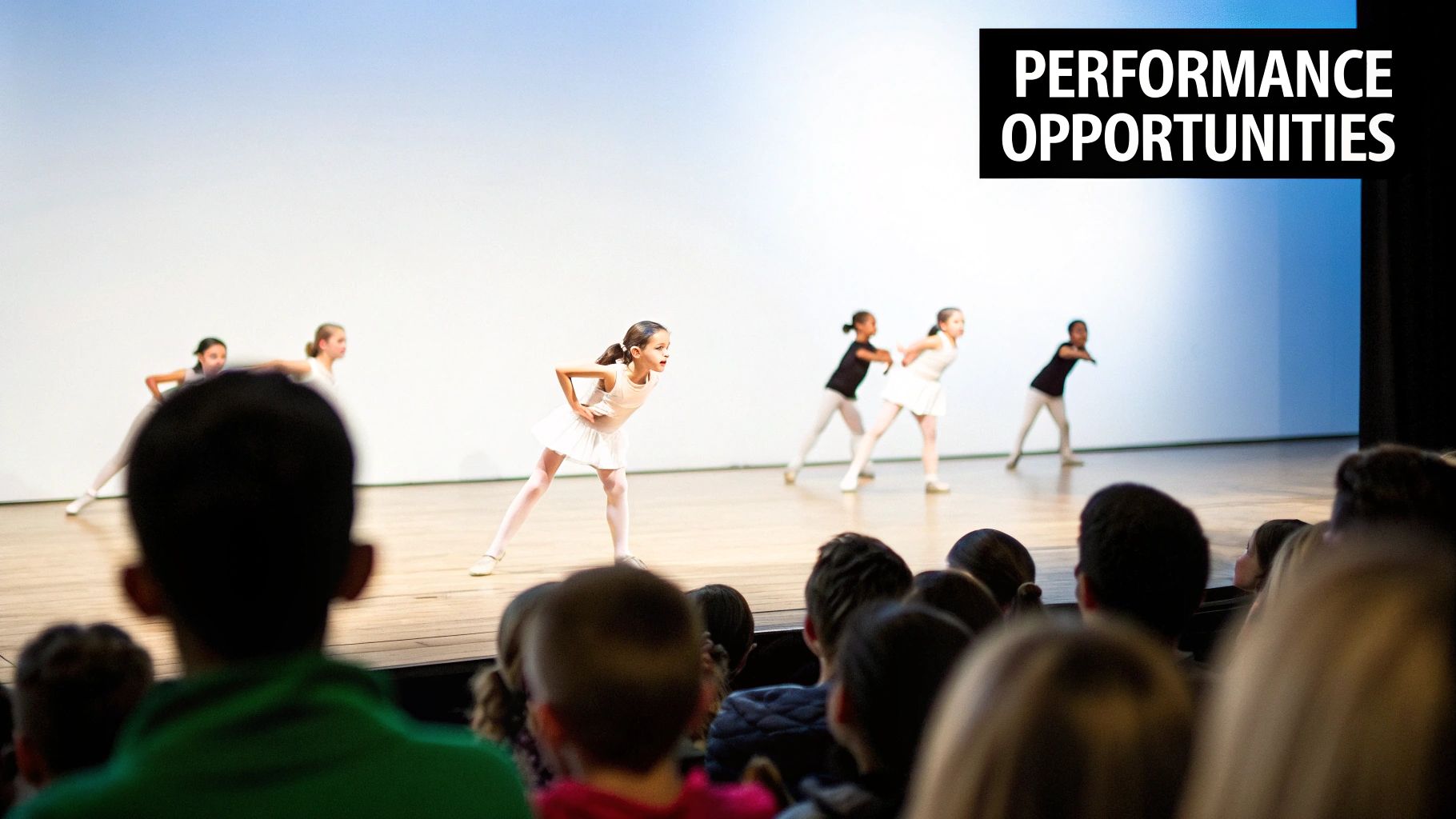
Weekly technique classes are where the hard work happens, building strength, flexibility, and precision. But let's be honest—the real magic unfolds when those skills hit the stage. For a true performance dance center, the stage is a second classroom.
This is where dancers learn to think on their feet, work as a team under pressure, and connect with an audience. It’s one thing to master a combination in front of a mirror; it's another thing entirely to share that art form with a live audience. Performance is what transforms a student into an artist.
From Recital to Competition Circuit
Not all performance opportunities are created equal, and that’s a good thing. A great studio offers a spectrum of options, so you can find the perfect fit for your dancer's goals and your family's commitment level.
Here’s a look at what you’ll typically find:
- The Annual Recital: This is the big, end-of-year show. It's a fantastic, low-pressure celebration where every single dancer gets their moment to shine and show off everything they’ve learned.
- Community Showcases: Think local festivals, parades, or charity events. These are wonderful chances for dancers to get more stage time, build confidence, and feel connected to their community.
- The Competition Track: This path is for dancers who are ready for a higher level of commitment. Competitions involve travel, professional critiques from judges, and a serious dedication to the craft. It can be incredibly motivating and a powerful way to measure growth.
If you're coming from nearby communities like Riverton or Lehi, it's especially important to understand what the competition commitment looks like. A top-notch studio will be upfront about the travel, time, and financial expectations. To get a better idea, you can see how some studios structure their competition teams .
Gauging the Studio's Approach
This is probably the most important part: What is the culture around performance? Is the focus all on winning trophies, or is it on personal growth, teamwork, and artistic expression?
A healthy, supportive environment always values the process more than the final score.
The best performance programs teach dancers not just how to win, but how to learn from a loss with grace. They celebrate the team's hard work and artistry, regardless of what a judge thinks.
When you visit a studio, ask the director directly about their philosophy on competition. Listen for words like "sportsmanship," "team support," and "artistic development." You want a leader who is passionate about building confident, resilient people, not just collecting trophies.
That balanced, thoughtful approach is the true hallmark of a premier performance dance center.
Assessing the Studio's Culture and Facilities
The best instructors in the world can't make up for a studio with a bad vibe or unsafe facilities. A dancer’s experience truly hinges on the environment where they train. That's why evaluating the physical space and the emotional atmosphere is an absolute must before you sign up.
When you tour a potential performance dance center, you have to look beyond the smiling face at the front desk. Put on your detective hat and pay attention to the details. A studio that invests in its physical space shows it cares about the quality of training and, more importantly, the safety of its students.
Your Studio Tour Checklist
As you walk through the studio, keep this mental checklist handy. These aren't just nice-to-haves; they are the marks of a professional, safety-first dance school.
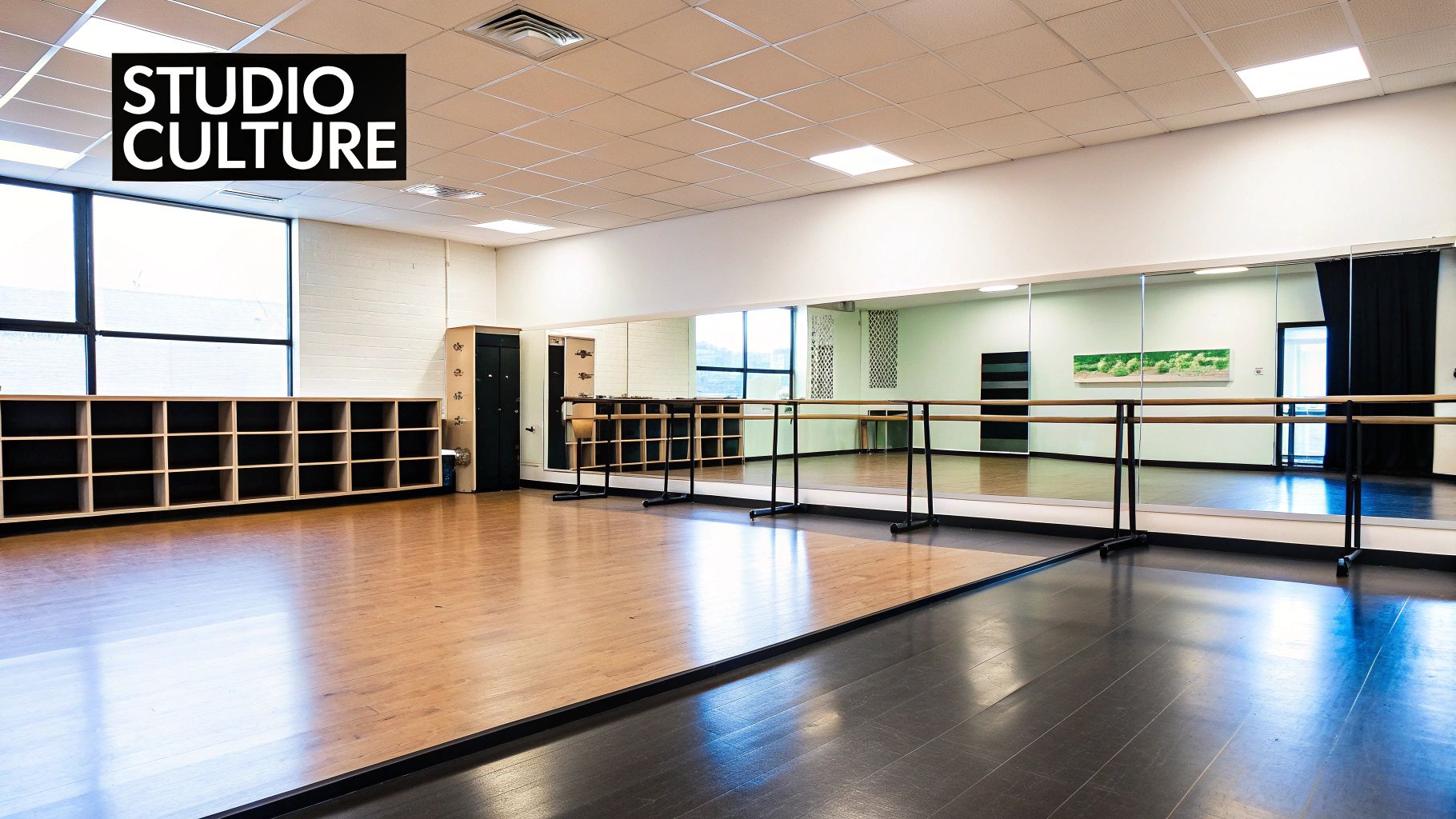
- Professionally Sprung Floors: This is the single most important safety feature. A sprung floor has give, absorbing shock and protecting a dancer’s joints from the repetitive impact of jumping. If you see hardwood laid directly on concrete, that's a huge red flag.
- Full-Length, Unobstructed Mirrors: Dancers rely on mirrors to check their alignment and correct their own technique. They need to see their entire body, from head to toe, without anything blocking the view.
- Proper Barres: Check that the barres are securely mounted and at the right height for different age groups. They shouldn't wobble!
- Cleanliness and Organization: Take a peek at the bathrooms, changing areas, and dance rooms. A tidy, well-kept space signals professionalism and respect for the students and their families.
But a great facility is only half the equation. The culture—the very soul of the studio—is where a dancer will either blossom or wilt. This requires a different kind of investigation.
Getting a Feel for the Studio's Vibe
The best way to understand a studio's culture is to see it in action. Ask if you can sit in and watch a class for a few minutes. You'll learn more from that observation than any brochure could ever tell you. For parents driving in from Lehi or Sandy, knowing your child is in a supportive environment is just as crucial as the quality of the dance floors.
A positive studio culture is one where students feel safe to make mistakes, are encouraged by their peers, and receive feedback that builds them up rather than tearing them down. It’s a place where discipline and joy coexist.
Pay close attention to the interactions. How do the instructors give corrections—is it with respect and positivity? Do the students seem to cheer each other on, or can you feel an undercurrent of unhealthy rivalry? The vibe in the room says it all. You can also get a good sense of a studio's values by reading its public-facing documents, like an official code of conduct .
The dance world is a big, competitive industry. There are over 14,622 dance studios in the U.S. alone, generating $5.0 billion in revenue. That massive number shows just how much demand there is for quality training, making your choice of where to invest your time and money even more critical.
Understanding the True Financial Commitment
When you enroll in a performance dance center, you're not just signing up for classes; you're making a real investment in your child's passion. To avoid any unwelcome surprises down the road, it's crucial to look beyond the monthly tuition fee and get a clear picture of the total cost.
A studio that values its families will be upfront about every potential expense. This transparency is what allows parents from Herriman and Draper to budget properly for the whole dance season, ensuring the focus stays on the joy of dance, not financial stress.
Deconstructing the Costs
Think of the monthly class fee as the starting point. At most performance-focused studios, there are other standard costs that cover essential parts of the training and performance experience. Knowing what they are ahead of time makes all the difference.
When you're talking with a studio director, be sure to ask about these common expenses:
- Annual Registration Fee: This is a once-a-year fee that officially holds your dancer’s spot.
- Costume Fees: These can vary quite a bit. A recreational class might have one costume, while a competitive team could have several. Find out if the fee is all-inclusive (tights, accessories, etc.) or if you'll be buying extra items.
- Recital or Showcase Fees: This fee typically helps cover the costs of putting on the big year-end show, like renting the theater and paying for professional lighting.
- Competition Entry Fees: If your dancer is on a competitive team, this will be a significant part of your budget. Fees are usually charged per dancer, per routine, for every competition on the schedule.
- Required Studio Wear: Every studio has a dress code. This includes specific styles and colors of leotards, tights, and the correct dance shoes for each class.
- Travel and Accommodation: For teams that travel to competitions or conventions, you'll need to factor in the cost of hotels, food, and gas.
Any professional performance dance center should have a detailed fee schedule ready for you. For a real-world example of how these costs can be laid out, you can check out our transparent tuition information .
The Invaluable Trial Class
Once you've crunched the numbers and feel good about the budget, there's one final step that’s absolutely essential: the trial class. This is your chance to see everything in action and feel out the studio's culture before you sign on for the year. It’s a low-risk way to make sure you're making the right choice.
A trial class is more than just a test run; it's a real-time glimpse into the daily experience your child will have. Pay attention to how they feel during and after the class—their excitement is your best indicator.
Watch how the instructor connects with the students. Do they seem engaged and encouraging? After class, talk to your child. Ask them directly: Did you have fun? Did you feel like you fit in? Did you learn something cool? Their honest answers are the most important piece of the puzzle for finding their perfect dance home.
Answering Those Last-Minute Questions
Okay, so you've done the tours, met the teachers, and maybe even watched a class or two. It’s completely normal to still have a few questions rattling around in your head. Choosing the right performance dance center is a big deal, and getting these last details sorted out is what helps you make a final decision with total confidence.
Let's tackle some of the most common questions we hear from families in Bluffdale, Riverton, and the surrounding communities.
How Many Hours a Week Are We Really Talking About?
This is probably one of the first things on every parent's mind, and the answer really depends on your dancer's age and goals. For younger dancers just starting on a pre-performance team, you're likely looking at about 2-4 hours per week. It's enough to build a solid foundation without completely taking over their schedule.
On the other hand, a serious teen on an advanced competitive team might be in the studio 10-15 hours a week, sometimes more. The best thing to do is simply ask the studio director for the specific time commitment for the exact program you’re considering. No guesswork needed.
What’s the Difference Between a 'Company' and a 'Team'?
You'll hear these words thrown around a lot, and frankly, they can mean different things from one studio to the next. Generally speaking, though, a "company" usually points toward a pre-professional path. The focus is more on artistry, pristine technique, and concert-style performances. Think of it as a conservatory-style approach to training.
A "team" often leans more into the competitive dance world, with a strong emphasis on high-energy genres like jazz, hip-hop, and contemporary. Don't assume, though! Always ask the director to explain how they define their programs so you know exactly what the focus and goals are.
Is My Child Really Ready for This?
This is a big one. Readiness for a performance program has much less to do with age and much more to do with pure passion. Does your child live and breathe dance? Are they practicing routines in the living room without being asked? Do they light up the second they hit the stage? If so, they're probably ready.
The key ingredient here is self-motivation. An audition or a placement class is the perfect next step. It’s not a scary test; it’s just a way for seasoned instructors to see where your child's technical skills are and how they focus in a more demanding setting. It's all about finding the group where they will grow the most and feel at home.
The global dance training market is projected to grow by 7.4% annually, reaching $25 billion by 2032. This boom is fueled by a new generation's search for community and meaningful experiences, with social media influencing a staggering 44% of teen enrollments. This growth just goes to show how important it is for families in areas like Herriman and Lehi to find a studio that genuinely aligns with their dancer's ambitions. You can find more details in these dance training market statistics from amraandelma.com .
What if Traveling for Competitions Is Too Much for Us?
This is a very real and valid concern for today's busy families. The good news is that it’s usually not an all-or-nothing situation. Most studios serving communities like Sandy and Draper understand this and offer different levels of commitment.
Some teams might stick to local competitions right here in the Salt Lake Valley, which means minimal travel. Others might have a schedule that includes regional or even national events. The best policy is to be upfront with the studio director about what your family can realistically handle. A great performance dance center will want to find a spot for your dancer that works for everyone.
At Encore Academy for the Performing Arts, we believe in clear communication and finding the right path for every student. We'd love for you to see if our community feels like the right fit for your family. The best way to find out is to try a class—you can book a trial class on our website today.