

Your Guide to the Utah Dance Competition Scene
Welcome to the world of Utah dance competitions—a vibrant, high-energy community where passion, artistry, and pure athleticism collide on stages all over the state. If you’ve ever been to one, you know the feeling. It’s an environment built on dedication and an unbelievable amount of hard work, and it’s why Utah is known for producing some of the most respected young dancers in the country.
This guide is your all-access pass to navigating it all.
Welcome to Utah's Elite Competitive Dance World
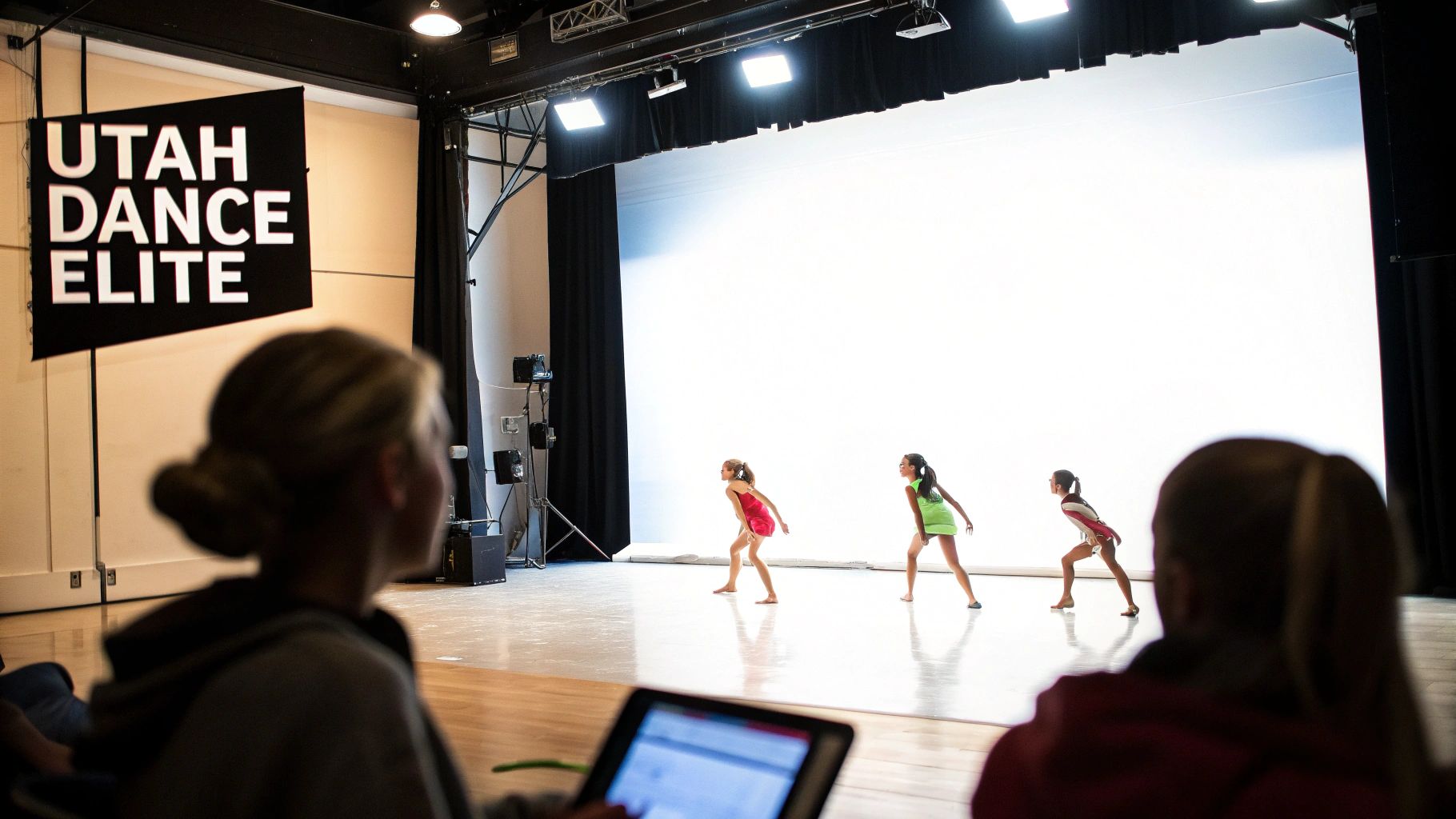
Stepping into the Utah competitive dance scene is like stepping into another world. Around here, it's far more than just a hobby; it’s a serious pursuit that demands incredible discipline and focus. For years, the state has built a reputation as a dance powerhouse, consistently turning out top-tier talent who shine on regional and national stages. So, what makes the culture here so unique?
It boils down to a powerful mix of fierce community support and an exceptionally high standard of excellence. You’ll see dedicated families from cities like Herriman, Lehi, and Riverton making the drive to centrally located studios in Bluffdale, all for elite-level training. This shared commitment creates an amazing ecosystem where dancers are constantly pushing each other to be better.
What This Guide Covers
Think of this guide as your family’s complete roadmap. We're here to pull back the curtain on every part of the competitive journey, giving you clarity and confidence whether this is your first season or your tenth. We'll break down everything you need to know:
- The Annual Competition Calendar: Get a feel for the rhythm of the season, from fall conventions and technique tune-ups to the intensity of spring regionals and summer nationals.
- How Competitions Work: We’ll explain scoring, adjudication, age divisions, and performance categories in plain English, so you can follow the action like a seasoned pro.
- A Step-by-Step Preparation Plan: You'll get a detailed timeline covering everything from in-studio training and choreography to costumes, music, and mental readiness.
- Budgeting and Logistics: We’ll help you get a handle on managing the financial and travel commitments that come with a full competition season.
At its core, competitive dance is about so much more than trophies. It's a journey that builds resilience, fosters teamwork, and teaches invaluable life lessons in discipline, time management, and poise under pressure.
The Encore Advantage
Making your way through this demanding world is a lot easier with a strong support system and expert guidance. The right training environment can make all the difference, helping dancers not only polish their technique but also build the confidence to truly own the stage. That’s where a dedicated, structured program becomes non-negotiable.
Studios across the state, including those serving dancers from Draper and Sandy, offer specialized programs designed to cultivate that competitive edge. By providing a structured curriculum, experienced choreographers, and a genuinely supportive team environment, they prepare athletes for everything the stage throws at them.
Find out more about how Encore Academy's competition teams provide the foundation, training, and community for dancers to thrive. With this guide in hand, you’ll have the knowledge you need to support your dancer on their path to success.
A Dancer’s Year: The Utah Competition Season Calendar
The competitive dance season in Utah isn't just a random series of events; it has a distinct rhythm. Think of it like a school year, with each phase building on the one before it. For families in Draper and Sandy, understanding this flow from the start makes the entire year much less stressful and way more successful.
It all starts with foundational work in the fall, builds to an intense peak of performances in the spring, and wraps up with the biggest events of the year in the summer. Knowing what’s coming helps everyone manage training schedules, travel, and expectations.
The Three Acts of a Competition Season
We can break down the whole year into three key phases. Each one has a totally different energy and a specific set of goals for our dancers.
The Foundation Phase (September - December): This is where the magic really begins. Dancers learn their routines, drill the choreography until it’s second nature, and build up the stamina needed for performance. Fall is also prime time for dance conventions—amazing weekend-long workshops with master instructors from all over the country.
The Regional Gauntlet (January - May): Once the holidays are over, things kick into high gear. This is the heart of the regional competition season. Teams are often traveling every few weekends to perform, get critical feedback from the judges, and hopefully, earn a spot at a national championship.
The National Finals (June - August): The season hits its peak with national competitions. These are huge, multi-day events, often held in fun destinations, where the best teams from across the country come to compete for the big titles. It’s the ultimate celebration of a year of incredible dedication.
The competitive dance season is a marathon, not a sprint. The fall is all about putting in the steady training miles. The spring regionals are the qualifying races. And summer nationals? That's the championship event where all that preparation finally pays off.
To give you a clearer picture, here’s a simplified breakdown of how the year typically unfolds for a competitive dancer.
A Typical Utah Dance Competition Season at a Glance
| Pre-Season | Late Summer (August) | Team placements, auditions, and initial choreography sessions. | Getting back into shape and learning the foundational choreography. |
|---|---|---|---|
| Phase 1: Foundation | Fall (Sept - Dec) | Intensive technique classes, cleaning routines, attending dance conventions. | Mastering choreography, building stamina, and perfecting technique. |
| Phase 2: Regionals | Spring (Jan - May) | Traveling to multiple regional competitions, dress rehearsals, and incorporating judge feedback. | Performing consistently, adapting to different stages, and aiming for nationals qualification. |
| Phase 3: Nationals | Summer (June - July) | Attending a multi-day national championship event, final rehearsals. | Delivering peak performances, celebrating the season's hard work, and team bonding. |
This timeline gives you a solid roadmap for planning everything from family vacations to homework schedules around the demands of the season.
Big Names on the Utah Competition Circuit
While there are tons of great competitions out there, a few major circuits are staples in the Utah dance scene. Studios usually attend a mix of these throughout the year, as each one offers a slightly different vibe. For families driving from Lehi or Herriman to a studio in Bluffdale, these are the names you'll see pop up on the schedule.
- Spotlight Dance Cup: Known for being exceptionally well-run and family-friendly, Spotlight is often a fantastic first competition experience for younger dancers.
- Radix Dance Convention: This is a high-energy event that combines a top-tier competition with an incredible convention, focusing heavily on professional training and industry connections.
- Jump Dance Convention: Much like Radix, Jump blends competition with convention classes and is famous for its dynamic atmosphere and world-renowned teaching faculty.
This calendar is the framework for our entire year of training. To see exactly where we're headed and when, check out our current calendar of events for all the specific dates and details.
How a Utah Dance Competition Actually Works
Walking into a Utah dance competition for the first time can feel like stepping into a whirlwind of glitter, music, and what looks like organized chaos. It's electric, but for families new to the scene, it can also be a little overwhelming. Let's pull back the curtain and break down what’s really happening from the moment you walk in.
Think of it less like a free-for-all and more like a highly organized showcase. Dancers from studios all over the state, from Bluffdale to Lehi, perform routines they've spent months perfecting in front of a panel of professional judges. Every single performance is categorized and scheduled down to the minute to keep the whole event running smoothly, from the first number on Friday to the last awards ceremony on Sunday.
Performance Categories and Age Divisions
The first key to understanding the competition landscape is knowing that dancers aren't all judged against each other. It wouldn't be fair to compare a solo performance by a 7-year-old to a massive production number with 25 seniors. Instead, everything is broken down into specific categories.
Performances are typically grouped by the number of dancers on stage:
- Solo: Just one dancer, showcasing their individual skill and artistry.
- Duo/Trio: A routine with two or three dancers, where teamwork and connection are key.
- Small Group: Usually features 4-9 dancers.
- Large Group: Bumps up to 10-19 dancers.
- Line/Production: The biggest, most elaborate numbers with 20+ performers, often telling a story with sets and props.
On top of that, dancers are placed into age divisions. This is crucial because it ensures they compete against others at a similar stage of development. You’ll hear terms like Petite, Junior, Teen, and Senior. This way, a young dancer from Sandy is judged on their potential and execution relative to their own peers, not someone five years older.
The Art of Adjudication
So, what are the judges really looking for? It’s easy to get fixated on the final score, but the most valuable part of the process is the expert feedback, or adjudication. These judges aren't just there to hand out trophies; they're providing professional coaching meant to help dancers grow.
They're typically evaluating a blend of three core elements:
Technique: This is the bedrock of it all. They're watching for clean lines, proper body alignment, control, and solid execution of skills specific to that dance style.
Execution: How well did the dancers actually perform the choreography? This is all about synchronization, sharp timing, and the precision of every single movement.
Performance Quality: This is that "it" factor. It’s the artistry, the emotion, and the stage presence that connects the dancer to the audience and the music. It’s what makes a routine memorable.
Think of a judge’s critique not as a final verdict, but as a personalized roadmap for improvement. Their notes on technique and performance are the most valuable takeaways from any competition weekend, offering clear, actionable steps for growth.
Decoding the Scoring System
When the results are in, you'll see a score and an award level. Most competitions don't just give out a number grade. Instead, they use a tiered system with levels like Platinum, High Gold, Gold, and so on. This is a brilliant way to reward dancers for reaching a certain standard of excellence, rather than just ranking them first, second, and third.
For instance, several different routines in the Junior Jazz Small Group category could all earn a Platinum award if they each meet the score threshold for that level. This approach celebrates hard work and achievement across the board, which helps create a far more positive and encouraging atmosphere for everyone involved. You’ll also see special "Judges' Choice" awards for things like incredible choreography, stunning costumes, or a particularly moving performance, which highlight unique strengths that go beyond the numbers on a scoresheet.
A polished performance also depends on the right look, and you can get a full rundown of what’s expected in our studio’s detailed dress code guidelines for both class and the competition stage.
Your Step-By-Step Guide to Competition Preparation
That show-stopping moment on the Utah dance competition stage? It doesn't just happen. It's the final, polished result of months of sweat, focus, and a whole lot of planning. For dancers and their families, this prep phase can feel just as intense as the performance itself, but the key is turning that nervous energy into confident, organized action.
Think of this guide as your family’s timeline for getting it all done. We'll walk through the entire journey, from the first conditioning classes and learning choreography to the final frantic moments of pinning costumes and getting mentally centered. A good plan transforms a potentially chaotic process into a positive and empowering one, making sure every dancer feels 100% ready to shine.
The Foundational Months: Building Strength and Artistry
The road to the stage begins long before the first competition rolls around. The fall and early winter are all about building the physical and technical foundation that will carry a dancer through a successful season. This is where the real work happens—the kind that creates the muscle memory and stamina needed for demanding routines.
This phase is all about:
- Conditioning and Strength: Dancers hit the floor with targeted exercises to build core strength, power, and endurance. This isn't just about nailing a tough skill; it's about having the stamina to perform it flawlessly from the first beat to the final pose.
- Flexibility and Technique: You can never have enough technique class. Consistent stretching and barre work are crucial for clean lines and impressive extension. For dancers really looking to level up, our guide on flexibility training for dancers has some great exercises to help reach those goals.
- Learning and Cleaning Choreography: This is where the magic begins. Dancers learn the steps, formations, and story behind their pieces. Then, the real work starts: "cleaning." It's a meticulous process of synchronizing every movement, perfecting the timing, and refining every last detail until the group moves like a single, cohesive unit.
The level of physical prep required to compete at a high level is no joke. We see that same standard of excellence right here in Utah. Take ballroom dancers Alexander Chernositov and Arina Grishanina, who became the first American couple to win the Open World Amateur Latin Championship. Their victory, after performing five grueling routines back-to-back, shows the incredible stamina that elite training develops. You can read more about their landmark achievement in the KSL article covering the event —it’s a huge inspiration for our local dancers.
Finalizing the Details: Costumes, Music, and Rehearsals
As the competition calendar gets closer, the focus shifts from foundational training to all the production elements that bring a routine to life. This is when the vision starts to become a reality, and families from Herriman to Bluffdale know this period is filled with fittings, emails, and endless practice.
Here are the key milestones in this stage:
- Costume Fittings: Costumes are ordered months in advance and require super precise measurements. Once they finally arrive, fittings and alterations are essential to make sure every dancer has a perfect, comfortable fit that allows for a full range of motion. No wardrobe malfunctions here!
- Music Editing: Music is almost always cut and edited to fit strict time limits and to highlight specific moments in the choreography. This is a critical step to ensure the routine is compliant with the rules and has the dramatic impact it needs.
- Full-Scale Rehearsals: This is the dress rehearsal phase. Dancers start running their routines in full costume, with performance-ready hair and makeup. It helps them get used to how the costume moves and gives choreographers a chance to make final tweaks before they hit the stage for real.
Mental preparation is just as important as physical practice. The goal is to build a dancer's resilience and confidence, teaching them to channel nervous energy into a powerful and focused performance.
Mental Readiness and The Final Week
In the final weeks leading up to the first competition, the focus broadens to include mental and emotional prep. A dancer's mindset is one of their most powerful tools on stage. Learning to manage performance anxiety and build resilience are skills that will serve them well far beyond the dance world.
Visualization techniques, where dancers mentally rehearse their routines flawlessly, can be incredibly effective. We also work on positive self-talk, encouraging dancers to focus on their personal growth rather than just the final score. It helps build a much healthier competitive mindset. Once you get to the event, the flow is actually pretty simple.
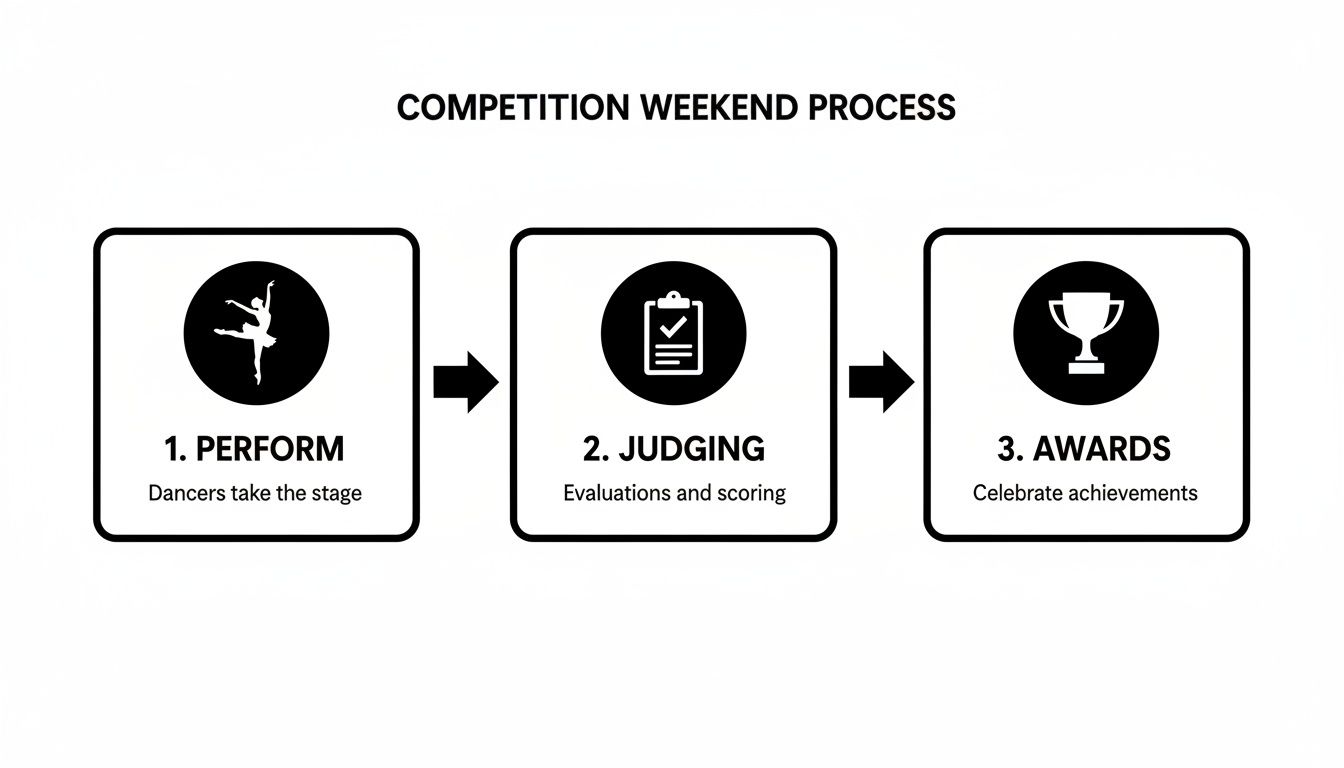
This visual really helps break down the weekend into its three core parts, demystifying the whole process and helping dancers focus on what's next. By the time they step on stage, all the hard work in the studio, the costume prep, and the mental training come together for that one incredible moment.
Utah's Legacy of Dance Excellence on the National Stage
Ever wonder why Utah produces so many incredible dancers? It’s a question you hear a lot in the competitive dance world, and the answer is so much more than just a trophy case. Utah has built a deep-rooted culture of dance excellence, grounded in intense training, incredible family support, and a community that simply expects greatness. The result is a long line of dancers and teams who don't just show up to nationals—they go there to set new standards.
These aren't just feel-good success stories. They are powerful examples of dedication, grit, and breakthrough performances that inspire young dancers all over the state. They're tangible proof that those endless hours in studios from Riverton to Draper can lead to major achievements on national and even international stages.
The Standard of Excellence Set by Local Icons
You can see Utah's high standards in action with our local collegiate teams, many of whom perform at a truly elite, professional level. The first one that comes to mind for most is the BYU Cougarettes—a team whose name is basically synonymous with victory. Their consistent domination is a direct reflection of the state's deep talent pool and the incredibly high bar for technical precision and artistry.
The Cougarettes have racked up an unbelievable 26 National Championships. This includes a staggering eight NDA Jazz IA titles and nine NDA Hip Hop Division IA championships just since 2011. Being able to consistently sweep both major categories like that shows a level of versatility and excellence that inspires young dancers to push their own limits. You can learn more about their championship wins to see the benchmark they've truly set.
The success of teams like the Cougarettes creates a powerful ripple effect. It shows the next generation of dancers from communities like Sandy and Lehi what is truly possible with elite training and an unwavering commitment to the craft.
This legacy isn't built on just one team or style, of course. It's a statewide phenomenon that has been built over decades, with studios nurturing kids from a very young age. To get a feel for how this tradition was built from the ground up, you can explore our studio's own history and the philosophy that has always guided us.
Utah Dancers Making a Mark
The pipeline from Utah studios to the national spotlight is undeniable. We constantly see dancers who grew up training right here in our local communities go on to achieve incredible things. It proves you don't have to be from a major coastal city to make a huge impact on the dance world. These individuals and teams become local heroes, lighting the path for the dancers coming up behind them.
Here are just a few examples of how Utah talent has made waves on a bigger stage, reflecting the quality of training available right here at home.
Utah Dancers Making a Mark
| Charity & Andres | Utah County | Achieved a perfect 100 score on NBC's World of Dance. | Their performance showed the world that Utah dancers have both the technical chops and captivating artistry to shine on television. |
|---|---|---|---|
| Various Studio Teams | Salt Lake County | Consistently placing in the top 10 at national finals like The Dance Awards. | Reinforces the incredible quality of group choreography and synchronized execution coming out of studios in areas like Bluffdale and Herriman. |
| Jenna Johnson Chmerkovskiy | Utah County | Became a professional dancer and Mirrorball Trophy winner on Dancing with the Stars. | Her journey is a huge inspiration, proving to young dancers that a successful professional career is a totally achievable goal. |
These stories are more than just impressive wins; they're a source of real pride and possibility for our entire Utah dance community. They show that the dedication poured into every local Utah dance competition is the very first step on a journey that can lead to the biggest stages in the world. It’s all about showing the next generation what’s possible with world-class training and a champion's mindset.
Common Questions About Utah Dance Competitions
Jumping into the world of competitive dance for the first time can feel like learning a whole new language. It’s a big commitment, and it’s natural to have a ton of questions, from budgeting for the season to navigating the emotional rollercoaster of a competition weekend. Here are some straight-up answers to the questions we hear most from parents and dancers.
What Is the Time Commitment for a Competitive Dancer?
Let's be real: competitive dance is a significant time investment. Dancers typically train multiple days a week, and those hours are packed with technique classes, choreography rehearsals, and conditioning. Once competition season kicks off, usually from January through July, you can expect to dedicate many weekends to competitions and conventions. It’s a level of dedication that families from Sandy to Herriman understand and embrace for their dancer's growth.
This is the kind of commitment that has put Utah dancers on the national map. The grit and determination developed in our studios are legendary. Just think of Utah duo Charity Anderson and Andres Presnar, who scored a perfect 100 on NBC's World of Dance—an incredible accomplishment they pulled off even with one of them dancing on a broken toe. You can read more about their amazing story and see what Utah resilience looks like firsthand.
How Much Does a Typical Competition Season Cost?
The cost of a competition season can really vary. It depends on factors like how many routines a dancer is in, the price of costumes, travel expenses, and convention fees. The best first step is to have a completely open and transparent conversation with your studio. A great studio, like those serving the Bluffdale community, will provide a detailed breakdown of all the expected costs—entry fees, choreography, team apparel—so you can plan your budget without any surprises.
The most important investment you can make is in a positive training environment. The lessons in discipline, resilience, and teamwork are priceless and will benefit your dancer long after the trophies are packed away.
How Do We Handle a Disappointing Score or Placement?
This is probably one of the most important lessons in a young performer's life. When a score or placement feels disappointing, the key is to shift the focus from the award itself to the dancer's personal growth and the judges' feedback.
Encourage your dancer to think of the critiques not as criticism, but as valuable coaching from a professional. What matters most is celebrating their hard work and the sheer courage it takes to get on that stage. This approach builds resilience, a quality far more valuable than any trophy and a core focus for top training programs in cities like Draper and Riverton. When dancers learn to value the journey over the placement, they develop a healthy competitive spirit that will serve them for the rest of their lives.
At Encore Academy for the Performing Arts, we provide the expert training, supportive community, and structured environment dancers need to excel at every Utah dance competition and beyond. We’re here to help every performer find their voice and build the confidence to shine.
Ready to take the next step? Learn more and book a trial class at https://www.encoreacademyut.com .