
What Is a Pointe Shoe? A Dancer's Complete Guide
A pointe shoe isn't just a pretty satin slipper. It’s a highly specialized piece of athletic equipment, meticulously engineered to do something extraordinary: support a dancer's entire body weight on the tips of their toes.
Their whole purpose is to help create that illusion of weightlessness and ethereal grace that is so central to the art of classical ballet.
More Than a Slipper
For any young dancer, getting your first pair of pointe shoes is a huge rite of passage. It feels like you're graduating from student to artist, and it represents years of hard work, physical conditioning, and sheer dedication.
This isn't just about getting new shoes. It's a testament to a dancer's strength, discipline, and unwavering commitment. For the many aspiring dancers dreaming of this moment, whether they're in Sandy or Herriman, it's a defining step in their journey.
The main job of a pointe shoe is to provide a solid, flat platform for the dancer to balance on. This stability allows for the incredible movements and poses that would be physically impossible in soft slippers. Think of it as a precisely constructed tool, where every single part works in harmony to protect the foot while enabling breathtaking expression.
Pointe Shoe vs. Ballet Slipper at a Glance
It's easy to see the visual difference, but the functional gap between a soft ballet slipper and a pointe shoe is massive. Here’s a quick breakdown:
| Construction | Soft leather or canvas | Hardened, layered box; stiff sole |
|---|---|---|
| Sole | Flexible, split-sole or full-sole | Rigid internal shank for support |
| Toe | Soft, follows foot shape | Hard, flattened box and platform |
| Purpose | Training, general classwork | Dancing en pointe (on the tips of the toes) |
Ultimately, a ballet slipper is for learning the fundamentals, while a pointe shoe is a specialized tool for advanced technique.
A Symbol of Dedication
Before a dancer even thinks about going en pointe, they have to build an incredibly strong foundation. This means years of consistent, serious training to develop the necessary strength in the feet, ankles, legs, and core.
Instructors are trained to look for very specific signs of readiness. They need to be absolutely sure a dancer's body is prepared for the intense physical demands to prevent injury and ensure a safe, gradual progression.
The journey to pointe is not a race. It’s a slow and steady process that honors each dancer's individual development. It’s about building a body that is not only skilled but also resilient enough for the challenges ahead.
Understanding what a pointe shoe truly is—a supportive tool earned through years of hard work—is the first step on a beautiful and demanding path. Programs that focus on proper technique, like the comprehensive ballet training we offer at our Bluffdale studio, are designed to guide dancers safely toward this incredible achievement.
In the end, the pointe shoe is more than a shoe; it’s a symbol of artistry built on a foundation of pure strength and perseverance.
A Closer Look: The Anatomy of a Pointe Shoe
To the untrained eye, a pointe shoe might just look like a delicate satin slipper. But beneath that elegant exterior lies a marvel of engineering, with every single part designed to support a dancer’s entire body weight on the tips of their toes. It’s less of a slipper and more of a specialized tool.
Think of it this way: the shoe’s internal structure has to be incredibly strong, yet flexible enough to allow for fluid, graceful movement. This is precisely why getting a professional fitting is an absolute must for any dancer, whether they're in Herriman, Draper, or anywhere else. It's not about just finding the right size; it's about finding the right support.
The Two Powerhouses: Shank and Box
When you get down to it, two parts of the shoe do most of the heavy lifting: the shank and the box.
- The Shank: This is the backbone of the shoe. It’s a rigid insole that runs along the bottom, providing the primary support for the arch of the foot. Shanks come in a wide range of strengths, from very flexible to extra-hard. The key is matching the shank's strength to the dancer's foot strength. Too soft, and it will buckle under pressure, offering no support at all. Too hard, and the dancer won't be able to properly roll through their foot.
- The Box: If the shank is the spine, the box is the protective helmet for the toes. It’s the hard enclosure at the front of the shoe, built from layers of tightly packed fabric and glue. This is what creates the stable, flat surface—the platform—that a dancer balances on. It has to be firm enough to hold the toes in the correct alignment without crushing them.
This mind map really breaks down the purpose of a pointe shoe into its three core elements: support, grace, and the milestone it represents in a dancer's journey.
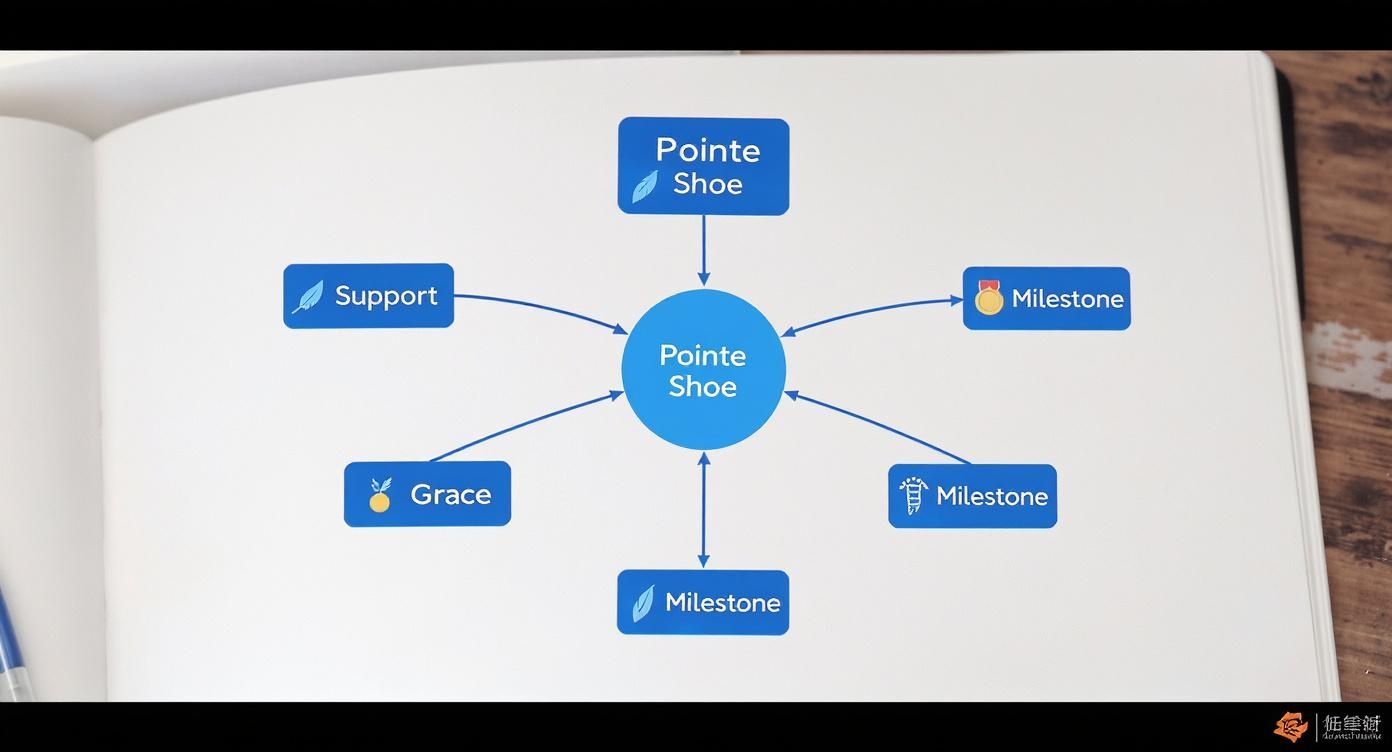
As you can see, the physical support from the shoe is what makes artistic grace possible, marking a huge achievement in a young dancer's training.
Fine-Tuning the Fit: Other Key Components
Beyond those two main structures, a few other parts are crucial for getting that perfect, secure fit. They turn the shoe from a simple covering into a true extension of the dancer’s foot.
The platform is the flat tip of the box that a dancer actually balances on. Its shape and size play a huge role in stability. Then there’s the vamp, which is the top part of the shoe that covers the toes and foot. If a vamp is too low, the foot can pop out; if it’s too high, it can dig in and restrict movement.
A correctly fitted pointe shoe should feel like a firm, supportive glove. The dancer's toes should lie completely flat and straight inside the box, held securely but not painfully crunched.
Finally, you have the drawstring to cinch the shoe snugly around the foot, plus the ribbons and elastics. Dancers have to sew these on themselves, and they are absolutely essential for anchoring the shoe to the ankle. Every piece has to work in harmony. Understanding how these parts come together is a critical step in the journey toward dancing on pointe , as it empowers dancers to find the best fit and properly care for their most important piece of equipment.
The Journey to Pointe: Are You Truly Ready?
Understanding the anatomy of a pointe shoe is one thing, but knowing when a dancer is ready to wear one is a completely different conversation. This is where the focus shifts from the equipment to the artist. The journey to pointe is a huge milestone in any dancer's life, and readiness has very little to do with a specific age—it has everything to do with physical development and technical skill.
Before a dancer can ever dream of safely rising onto their toes, they have to build an incredibly strong foundation. Think of it like building a house; you’d never start putting up the walls and roof before pouring a solid, stable concrete base. For a dancer, that base is their core stability, ankle strength, and consistent ballet technique.
Rushing this process is one of the most dangerous things a young dancer can do. Without that solid foundation, the risk of serious injury to the feet, ankles, and even the back goes up dramatically. For families in Lehi or Draper who are thinking about this next step, it's absolutely crucial to trust the assessment of a qualified instructor who knows how to spot true readiness.
The Non-Negotiable Physical Benchmarks
So, what does “ready” actually look like? It’s not a simple checklist. It’s a combination of strength, control, and body alignment that an experienced teacher carefully evaluates over time. Dancers have to show they’ve mastered several key areas before they can even be considered for pointe work.
Here are a few key signs of pointe readiness:
- Consistent Posture: The dancer must be able to hold proper alignment—shoulders over hips, hips over knees, knees over toes—without needing constant reminders.
- Sufficient Ankle Strength: They should be able to do multiple, controlled relevés (rising onto the balls of the feet) in the center without wobbling or grabbing the barre for support.
- Core Engagement: A strong core is absolutely non-negotiable. It’s what provides the central stability a dancer needs to lift their body weight up and out of the shoes, which prevents them from sinking.
- Proper Technique: The dancer must have a solid grasp of fundamental ballet technique, showing control and precision in all their movements.
An instructor's first and most important job is to keep their students safe. They will only give the green light for a dancer to start pointe when they are 100% confident that the student's body is prepared for the intense physical demands. This decision is always made with the dancer's long-term health and success as the top priority.
Beyond Strength: The Role of Flexibility
While strength is the main event, flexibility also plays a vital role in preparing a dancer for pointe. The ankle and foot must have enough range of motion to get into the correct alignment on the shoe's platform. If a dancer’s feet are too stiff, they can't get properly "over the box," which puts immense and unsafe pressure on all the wrong parts of the foot. To learn more about this crucial part of training, check out our guide on flexibility training for dancers .
Ultimately, earning the privilege to wear pointe shoes is a testament to years of dedication. It means a dancer from Bluffdale, Riverton, or any of our neighboring communities has put in the work, built the necessary strength, and developed the maturity to take on this beautiful—and challenging—art form safely. It’s a journey where patience and preparation truly matter more than anything else.
Finding Your Perfect Fit: A Guide to Pointe Shoe Fitting
Your journey to dancing en pointe doesn't just start with strong ankles; it begins with the perfect shoe. The fitting process is arguably one of the most critical steps, turning a beautiful but highly technical piece of footwear into a true extension of your foot. For dancers in Riverton getting ready for this huge milestone, knowing what's involved can make all the difference.
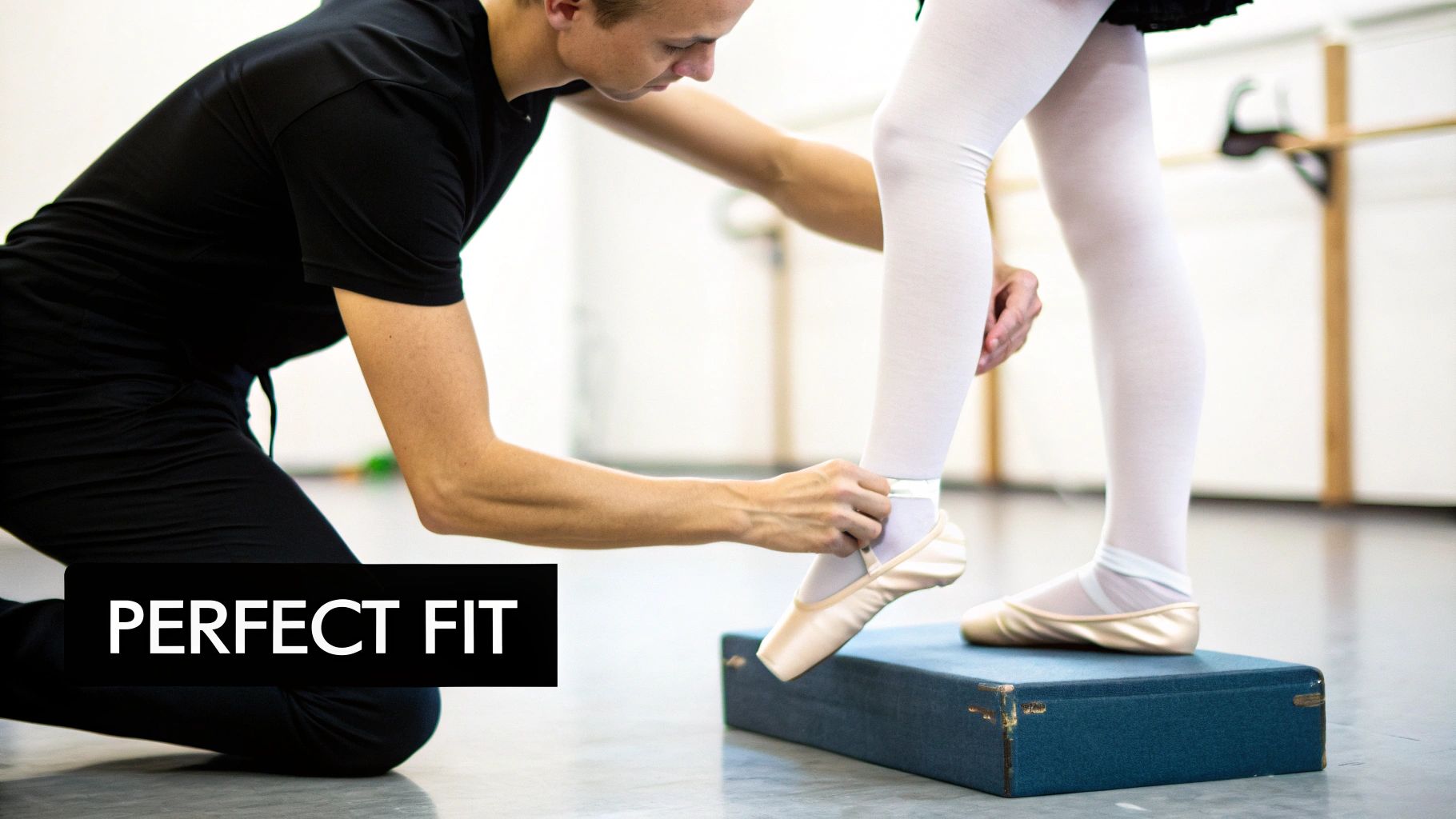
A professional pointe shoe fitting is so much more than trying on a pair of sneakers. It's an interactive, incredibly detailed assessment. A great fitter is part artist, part scientist, carefully analyzing the unique anatomy of a dancer's foot to find its ideal match. This is exactly why buying your first pair online is such a big "no-no"—there are just too many variables for a website's size chart to ever get right.
What to Expect at Your First Fitting
When you walk in for your fitting, expect the process to be thoughtful and methodical. The fitter will begin by just looking at your bare feet. They'll assess everything from the shape and length of your toes to the flexibility of your arch and overall foot strength. They’re searching for key characteristics that will point them toward the right shoe.
Next, you'll likely be asked to do a few simple ballet movements, like a plié and a relevé. This isn't a test! It just lets the fitter see your foot in action and understand how it handles pressure and movement. This dynamic analysis is crucial for finding a shoe that gives you support exactly where you need it most.
After this initial look, the fitter will start bringing out boxes of shoes. You’ll try on several pairs as they check for the tell-tale signs of a good—or bad—fit.
Identifying Common Fitting Problems
The right shoe should feel snug and supportive, almost like a firm handshake for your foot. But a shoe that fits poorly isn't just uncomfortable; it can cause pain and even lead to injury. A professional fitter has a trained eye for spotting these common issues.
- Sinking in the Box: Does your foot feel like it's falling to the bottom of the shoe? That means the box is too wide or tapered for your foot shape. This puts a lot of painful pressure on your big toe knuckle and throws off your alignment. The fitter will look for a narrower box to hold your foot securely in place.
- Knuckling Toes: If your toes are curled or crunched up inside the box, the shoe is almost certainly too short. Your toes need to lie completely flat and straight, just touching the end of the shoe without having to bend.
- Excessive Gapping: A tiny gap at the heel when you plié is normal. But if you see big gaps along the sides of your foot when you're just standing flat, the shoe is too wide. The fitter will find a different width to give you that glove-like fit.
The goal of a fitting is to find a shoe where the dancer feels lifted and supported, not pinched or wobbly. It should allow you to get all the way "over the box" onto the platform without fighting the shank.
This careful, meticulous process makes sure the shoe works with you, not against you. For dancers just starting out, that supportive foundation is everything. Building your knowledge with resources like a guide to beginner ballet concepts can also help prepare you for the technical skills pointe work demands.
Ultimately, taking the time for a professional fitting gives you the confidence and safety you need to truly soar on your toes.
From Stage Experiment to Ballet Icon: The Shoe's Evolution
The pointe shoe is so much more than just a piece of footwear for today's dancer; it's a direct connection to ballet's long and fascinating past. Every time a dancer rises onto their toes, they’re participating in a tradition that started centuries ago with little more than daring stage experiments. The shoe we recognize now wasn’t invented in a single moment—it was sculpted over generations by artists and innovators who were constantly pushing the limits of their craft.
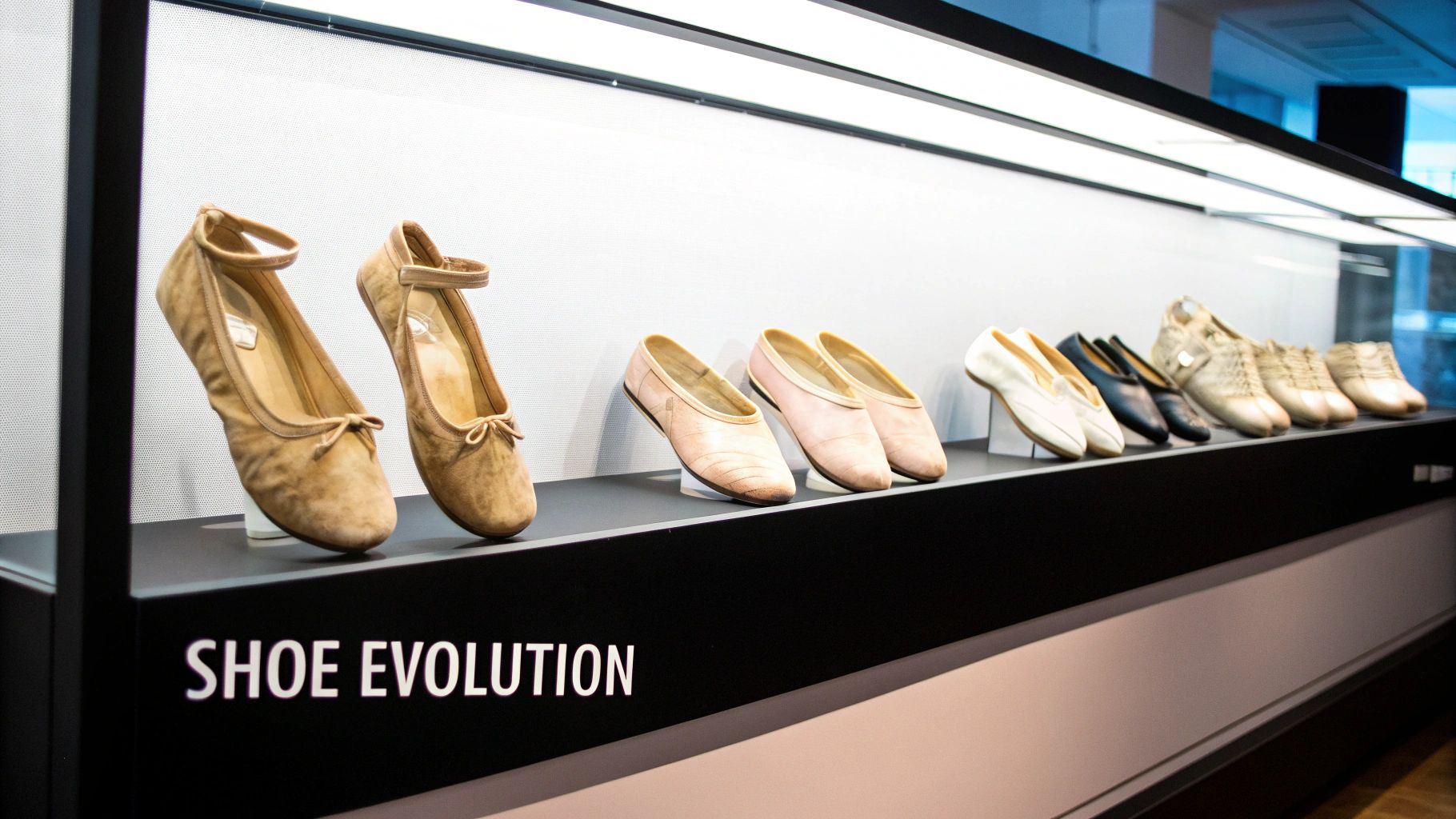
This incredible journey took nearly two hundred years. You can trace its origins back to the 1730s, when a Paris Opéra Ballet dancer named Marie Camargo made the radical decision to chop the heels off her dance shoes. This created the very first flat ballet slipper. But the real game-changer came much later, in the mid-to-late 19th century. Italian shoemakers began crafting the first reinforced toe boxes out of simple materials like newspaper and flour paste, which suddenly made sustained balances and pirouettes possible. You can dive deeper into the incredible history of how pointe shoes were developed on Pointe Magazine .
The Dawn of Weightlessness
The early 19th century was ballet’s Romantic era, a time when audiences were spellbound by stories of supernatural beings and otherworldly spirits. To embody these ethereal characters, dancers started modifying their soft slippers themselves. They would darn the tips with thread to create a harder, flatter surface, which let them rise onto their toes just long enough to create an illusion of floating.
These early attempts were brief and demanded incredible strength for just a flicker of magic. The shoes gave almost no real support, so holding a position on pointe was out of the question. Still, the idea was planted.
The Italian Innovation
The big breakthrough arrived later in the 19th century, thanks to legendary Italian ballerinas and the brilliant shoemakers who worked with them. Together, they created the direct ancestor of the modern pointe shoe. By layering fabric and stiffening it with glue, they built a hardened box at the toe. This design finally gave dancers the solid platform they needed to balance, turn, and execute complex footwork all on the very tips of their toes.
The development of the reinforced box wasn't just an improvement; it was the key that unlocked the technical and artistic potential of classical ballet as we know it today.
This sturdier shoe made the dazzling choreography of ballets like Swan Lake and The Sleeping Beauty a reality. In the process, the simple slipper was transformed into a highly specialized piece of athletic equipment, forever changing the face of the art form.
Your Pointe Shoe Questions Answered
The world of pointe can feel like a bit of a mystery, especially when you're just starting out. It's totally normal to have a ton of questions, from "will this hurt?" to "how much will these cost?" Let's clear up some of the most common ones that dancers and parents ask.
How Long Do Pointe Shoes Actually Last?
This is the big one, and the honest answer is: it really depends. Think of a pointe shoe like a specialized tool—its lifespan is all about how much you use it, how strong you are, and what you're asking it to do.
For a student in Sandy taking class a few times a week, a pair might last anywhere from 10 to 20 hours of dancing. But for a professional ballerina, a brand-new pair might only survive a single performance. That’s a huge difference!
A shoe is considered "dead" when the box gets too soft to support your toes or when the shank breaks and can no longer hold up your arch. Dancing on dead shoes is a recipe for disaster and seriously ups your risk of getting hurt.
Is Dancing on Pointe Supposed to Hurt?
Okay, let's be real. Standing on your toes isn't going to feel like wearing slippers, but it should never cause sharp, shooting pain. There’s a big difference between the discomfort of hard work and actual pain that signals a problem. A well-fitted shoe works wonders to minimize this, but the physical challenge is still there.
You need to learn what your body is telling you.
- Working Discomfort: This feels more like overall pressure or muscle fatigue. It's the feeling of your feet getting stronger.
- Problem Pain: This is a sharp, stabbing feeling, often in one specific spot like a toe knuckle. It could mean blisters, bruising, or a bad fit.
The goal is to feel challenged, not damaged. This is why toe pads and other accessories are so important—they add that crucial layer of cushioning to protect your feet.
Can I Learn Pointe by Myself at Home?
I can't say this strongly enough: no. Please, don't ever try to teach yourself pointe from YouTube videos. It's incredibly dangerous and can lead to serious, long-term injuries that could stop you from ever dancing again.
Building the necessary strength, perfecting your alignment, and learning the technique can only be done safely with a qualified ballet teacher watching your every move.
Professional guidance isn't just a good idea—it's non-negotiable. An experienced instructor is the only one who can properly assess your readiness, correct your form, and prevent devastating damage to your feet, ankles, and even your back.
What Is the Best Brand of Pointe Shoe to Buy?
There’s no magic answer here. The "best" brand of pointe shoe simply doesn't exist. Instead, there’s only the best shoe for your foot. Brands like Bloch, Grishko, and Freed of London all make fantastic shoes, but they're all built differently for different foot shapes.
The best brand for you is whatever a professional fitter selects after taking a good look at your feet, your strength, and your needs. Forget brand loyalty; focus on finding the perfect fit. This is why an in-person, professional fitting is absolutely essential. For dancers just starting out, getting the basics right is everything. You can learn more about the best age for children to start ballet in our guide on the topic.
At Encore Academy for the Performing Arts, we don’t just teach steps; we guide dancers safely and thoughtfully through their entire ballet journey, including their transition to pointe. Book a trial class and let our expert instructors help your dancer chase their dreams the right way.