
What Is Contemporary Dance Style and Why Is It So Popular
So, what exactly is contemporary dance?
Imagine a language that tells stories not with words, but with movement. That’s contemporary dance in a nutshell. It beautifully weaves together the graceful lines of ballet, the earthy, grounded feel of modern dance, and the heartfelt expression of lyrical. It’s an art form that’s all about freedom of movement and forging a deep, powerful connection between your mind and your body.
Getting to the Heart of Contemporary Dance
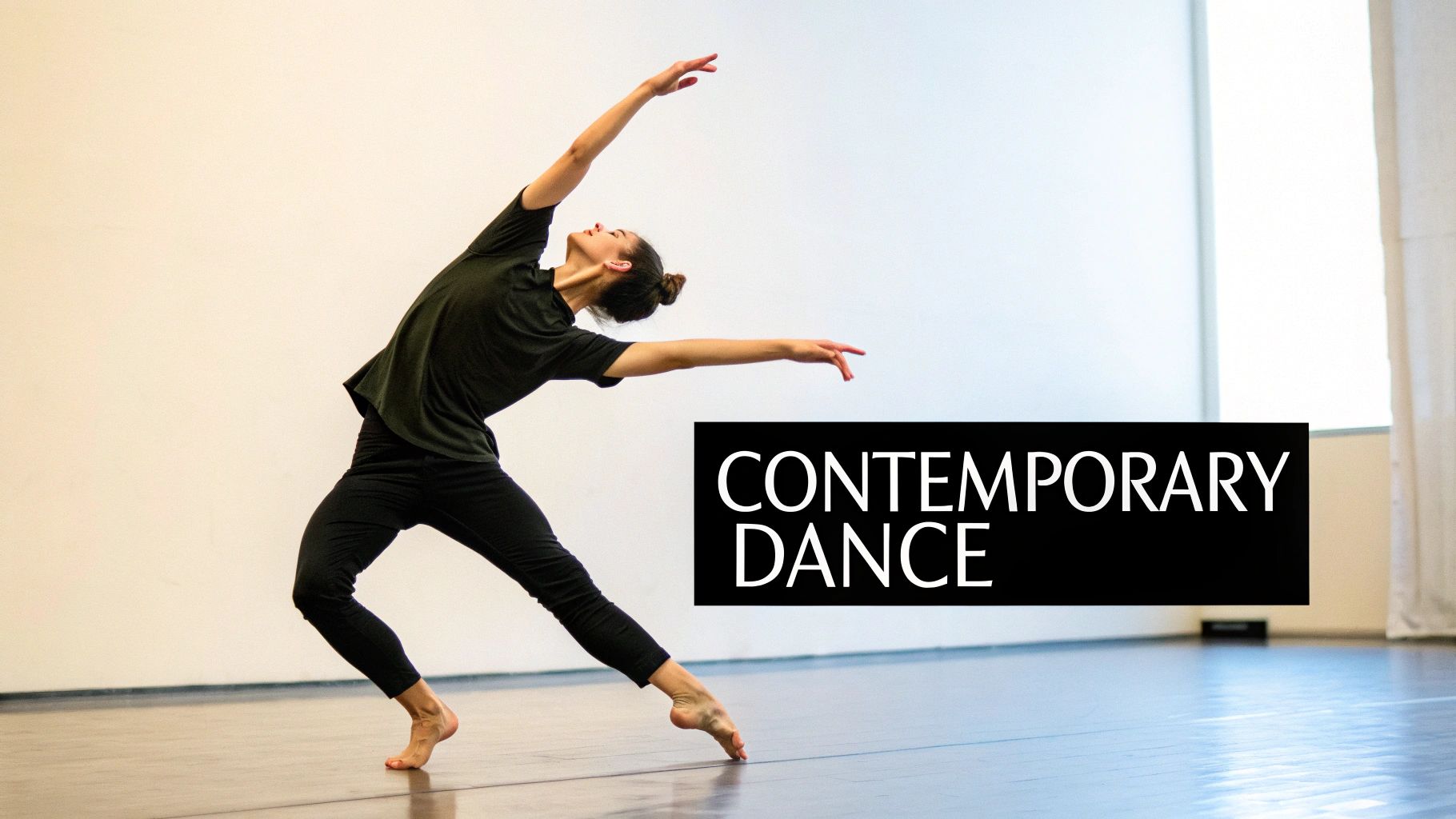
While some dance styles follow a very strict set of rules, contemporary dance throws the rulebook out the window. It encourages dancers to bring their own interpretations to the music and the choreography. The style is instantly recognizable for its fluidity, impressive athleticism, and raw emotional power, which is why it’s become one of the most popular forms of dance today, with students from Herriman to Lehi falling in love with its expressive freedom.
Contemporary dance first started making waves in the mid-20th century. It grew out of a desire to break free from the very formal structures of classical ballet and even early modern dance. Instead of choosing one style, it borrowed the best from many, creating a new vocabulary that was all about personal expression, improvisation, and dynamic movements like floor work.
At its core, contemporary dance is about connection. It’s about the mind connecting to the body, the dancer connecting to the music, and, ultimately, the performance connecting with the audience. This powerful link is built on a few key ideas and techniques that really make the style unique.
The Core Pillars of the Style
To really understand contemporary dance, it helps to look at the ingredients that make it what it is. These are the foundational elements that give the style its distinct feel, blending incredible technical skill with pure, honest emotion.
To give you a clearer picture, here’s a quick breakdown of what defines contemporary dance. These are the concepts you'll explore from your very first class.
Core Pillars of Contemporary Dance at a Glance
| Expressive Storytelling | Movements are used to tell a story, explore an idea, or convey a specific feeling, creating a strong emotional connection with the audience. |
|---|---|
| Fluidity and Versatility | Dancers move seamlessly between sharp, staccato actions and soft, flowing phrases, showing incredible dynamic range. |
| Use of Gravity | While ballet often aims to defy gravity, contemporary embraces it. Dancers use their body weight to create grounded, powerful, and swinging movements. |
| Emphasis on Floor Work | The floor becomes an extension of the stage. Dancers often perform intricate phrases while rolling, sliding, and connecting with the ground. |
These pillars work together to create a style that is both technically demanding and creatively liberating.
Contemporary dance is less about hitting a perfect pose and more about communicating a genuine feeling. It gives dancers the tools to use their whole body as an instrument, making every single performance a one-of-a-kind, personal statement.
This emphasis on individual artistry is why so many dancers feel at home in contemporary. It’s a style that champions creativity while building amazing physical strength and control. To see these principles in action, check out the different dance programs we offer. It's the perfect choice for any student in the Bluffdale area seeking both an athletic challenge and a powerful outlet for artistic expression.
Tracing the Roots of Contemporary Movement
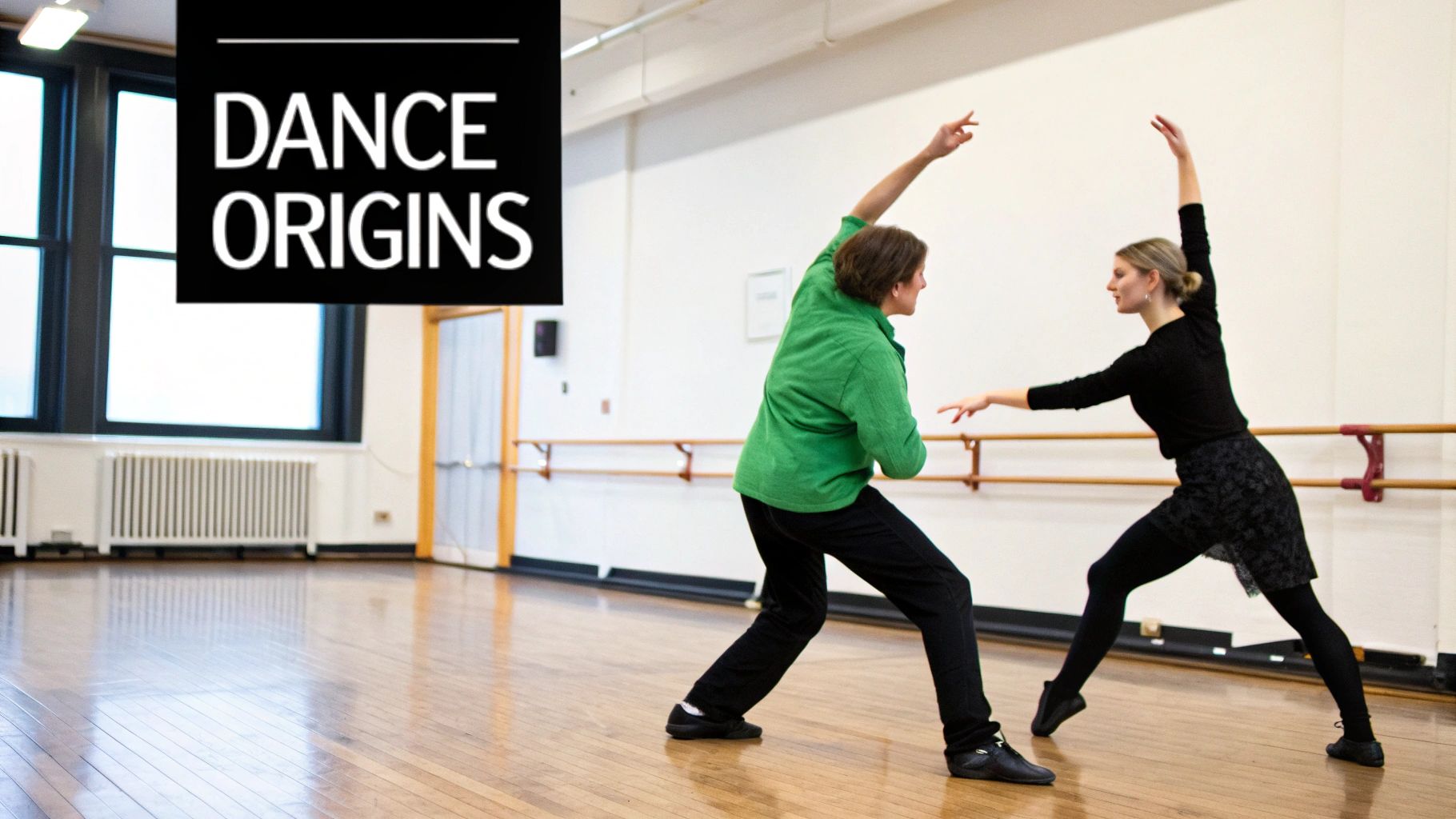
To really get contemporary dance, you have to understand its rebellious streak. It first exploded onto the scene in the mid-20th century, not as a gentle evolution, but as a direct challenge to the strict, formal world of classical ballet. Dancers and choreographers were getting restless.
They started asking big questions. Why does dance always have to be light and lifted? Can’t it be raw, grounded, and messy—just like real life? This spirit of questioning is still the beating heart of contemporary dance today.
The Innovators Who Broke the Mold
This new way of thinking didn't happen overnight. It was driven by visionaries like Martha Graham and Merce Cunningham, artists who weren't just tweaking the rules but throwing out the rulebook entirely.
Martha Graham gave us the powerful idea of "contract and release," a technique built around the core, visceral act of breathing. Her choreography wasn't just pretty; it was psychological, full of drama, and used sharp, angular movements to explore deep human emotions.
Merce Cunningham, on the other hand, went in a totally different direction. He famously separated dance from storytelling, arguing that movement could be interesting all on its own. He would often use chance—like the flip of a coin—to decide his choreography, focusing purely on what the human body was capable of.
Their shared belief was a game-changer: creative expression and raw experimentation were far more valuable than following a rigid set of pre-approved steps.
This legacy of artistic freedom is exactly what we celebrate in our studio. The techniques these pioneers forged are the very same ones inspiring young dancers from Draper and Sandy right here in Bluffdale. They're learning more than just steps; they're learning to move without limits.
The ideas that sparked contemporary dance also helped shape its close cousin, modern dance. To see how these histories connect, you can learn more about the foundations of modern dance and explore its own unique language of movement.
Foundational Techniques That Define the Style
To really get what contemporary dance is all about, you have to look past the steps and into the philosophy of the movement itself. It’s built from a specific vocabulary that values raw expression and athletic control way more than perfect, rigid poses. These are the core techniques we teach our dancers, helping them turn abstract feelings into powerful physical art.
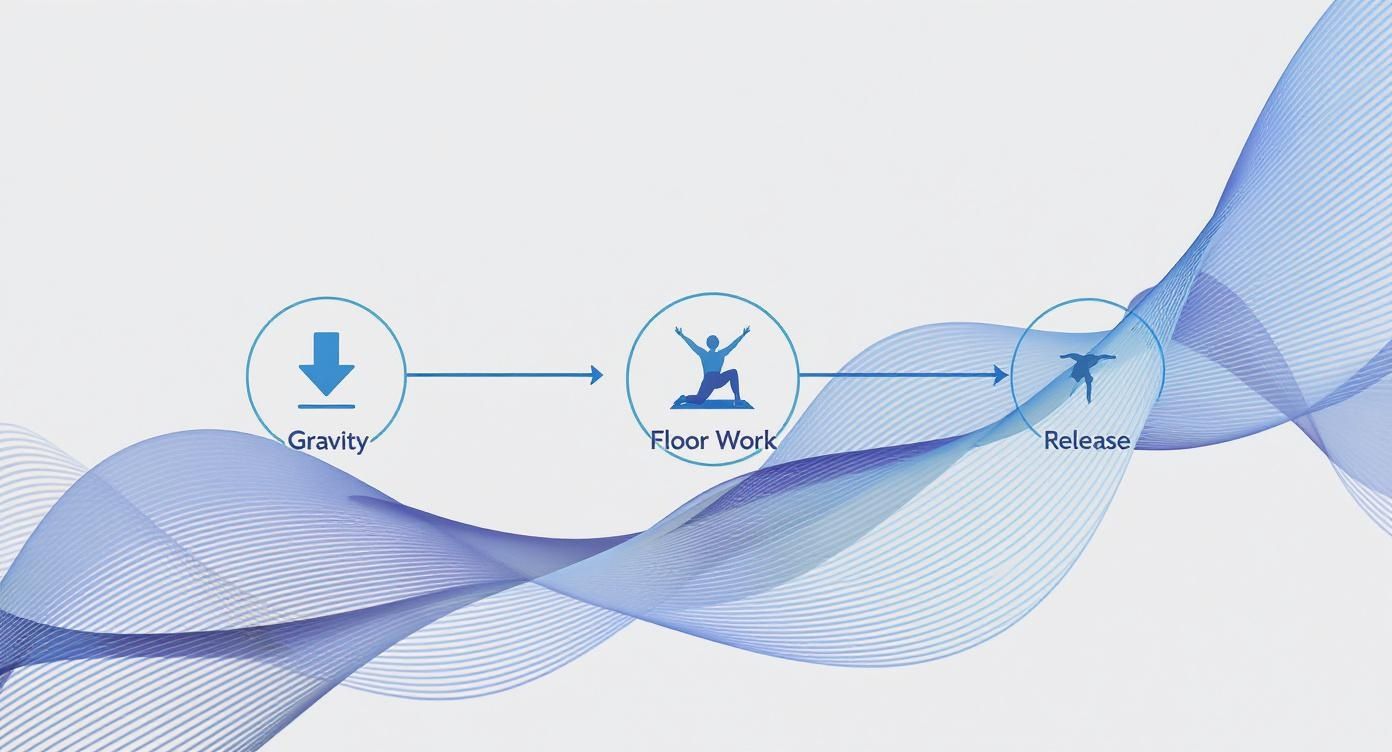
One of the biggest departures from classical ballet is how contemporary dance treats gravity. Where ballet dancers often strive to look weightless and defy gravity, contemporary dancers embrace it. They learn to work with the pull of the earth, not against it. This creates a grounded, powerful quality you can feel, allowing for incredible shifts in weight and explosive momentum.
Embracing Gravity and the Floor
A perfect example of this is the concept of fall and recovery. Picture a leaf letting go of a branch. It doesn't just drop; it twists, spirals, and catches the air before finally settling. That’s the feeling behind fall and recovery—it’s a controlled surrender to gravity, immediately followed by a rebound that sends energy flowing back through the body. It’s a constant, beautiful cycle of release and regain.
This deep connection to gravity naturally leads to another signature element: extensive floor work.
- The Floor as a Partner: In contemporary, the floor isn't just a stage. It becomes a partner in the dance. Dancers roll, slide, and pivot across the ground, using it for support, leverage, and a different kind of expression.
- Seamless Transitions: A true mark of a skilled contemporary dancer is the ability to move from standing to the floor and back up again without any visible effort. It creates a mesmerizing, uninterrupted flow.
Contemporary dance teaches that there is real strength in surrender. By yielding to gravity and connecting with the floor, dancers unlock a whole new dimension of power and fluidity—one you simply can't find when you're always fighting to stay upright.
The Power of Breath and Core Movement
The engine behind every contemporary dancer is their core, and it’s all powered by the rhythm of breath. Martha Graham’s legendary technique of contract and release is truly the heart of the style.
A contraction is a sharp, percussive exhalation that hollows out the core and curves the spine inward, starting deep in the pelvis. It’s a gut-level, emotional movement—think of the body’s natural reaction to a punch or a sudden shock. The release is the breath flowing back in, an expansion that returns the body to a neutral state, like a sigh of relief. This pulse of contracting and releasing makes the movement feel intensely alive and deeply human.
Dancers also use incredible spinal articulation to create fluid, wave-like motions. Think of a melting ice sculpture—it doesn’t move in straight, rigid lines but flows and softens as it changes. Dancers strive for that same organic quality, using spirals, arches, and deep curves to make their movement feel natural. While mastering these intricate skills is a huge focus, so is understanding how to build explosive, athletic power. For dancers interested in that side of things, our guide on developing powerful leaps and turns is a great resource for building that dynamic ability.
How Contemporary Stands Apart From Other Styles
Is contemporary just slow jazz? Or ballet without the strict rules? These are questions we hear all the time from families in Herriman and Lehi starting their dance journey. While contemporary certainly borrows from other styles, it’s a powerful and distinct art form all its own.
Think of it this way: no single style is "better" than another. They are simply different languages of movement, and finding the right one depends entirely on a dancer's personality and goals.
Contemporary vs. Modern vs. Ballet vs. Jazz
To really get a feel for what makes contemporary unique, it helps to see it side-by-side with the styles that influenced it. Each has its own history, technique, and creative philosophy.
The table below breaks down the key differences in a nutshell.
| Philosophy | Emotional expression, storytelling, and blending techniques. | Rebellion against ballet; focuses on raw, human experience. | Codified rules, achieving ethereal lightness, and perfection of form. | Rhythmic, high-energy, and rooted in entertainment and social dance. |
|---|---|---|---|---|
| Posture | Grounded and fluid; uses the spine in all directions. | Often grounded, heavy, and uses the concept of "fall and recovery." | Upright, pulled-up, and defying gravity. | Varies, but often features sharp isolations and a strong core. |
| Movement Quality | Seamless flow, release of tension, and use of gravity. | Angular, abstract, and often based on a specific founder's technique. | Precise, controlled, and weightless. | Sharp, syncopated, percussive, and dynamic. |
| Music | Lyrical, instrumental, spoken word, electronic—anything goes. | Often abstract, minimalist, or even silent. | Primarily classical music. | Upbeat popular music, Broadway show tunes, and funk. |
| Relationship to Floor | The floor is a partner; floor work is integral. | The floor is a source of grounding and power. | The goal is to get away from the floor. | Some floor work, but mostly upright and presentational. |
This comparison shows how contemporary acts as a creative bridge, connecting the dots between different worlds of dance.
A Deeper Dive into the Differences
Let's unpack that a bit more. The biggest contrast is with classical ballet. Ballet is built on a foundation of unbending rules and exact technique—think perfectly turned-out legs, an upright spine, and a constant feeling of pulling up, away from the floor.
Contemporary takes the legwork and strength of classical ballet but throws out the rulebook. It embraces a flexible, articulated spine, allows for parallel leg positions, and works with gravity, not against it. It's less about perfect form and more about honest, emotional expression.
The lines can feel a little blurrier when we talk about modern and jazz. Modern dance actually came first, born as a direct rebellion against the confines of ballet. It often centers on specific, foundational techniques from pioneers like Martha Graham or José Limón. Contemporary is more of a fusion, pulling from modern dance, ballet, jazz, and even hip-hop. So, a dancer in Sandy might find a contemporary class feels more fluid and lyrical than a classic modern class, which might be more abstract or intense.
And what about jazz? Jazz is all about high energy, syncopated rhythms, and sharp, isolated movements. It has a completely different pulse. While contemporary can be incredibly athletic, its focus is typically on seamless, flowing transitions and storytelling, rather than the percussive, high-kick showmanship that defines so much of jazz.
The best way to think of contemporary is as a creative melting pot. It takes the leg strength of ballet, the groundedness of modern, and the occasional dynamic flair of jazz, then blends them all into a style that prioritizes authentic, personal expression.
The Whole-Person Benefits of Contemporary Dance
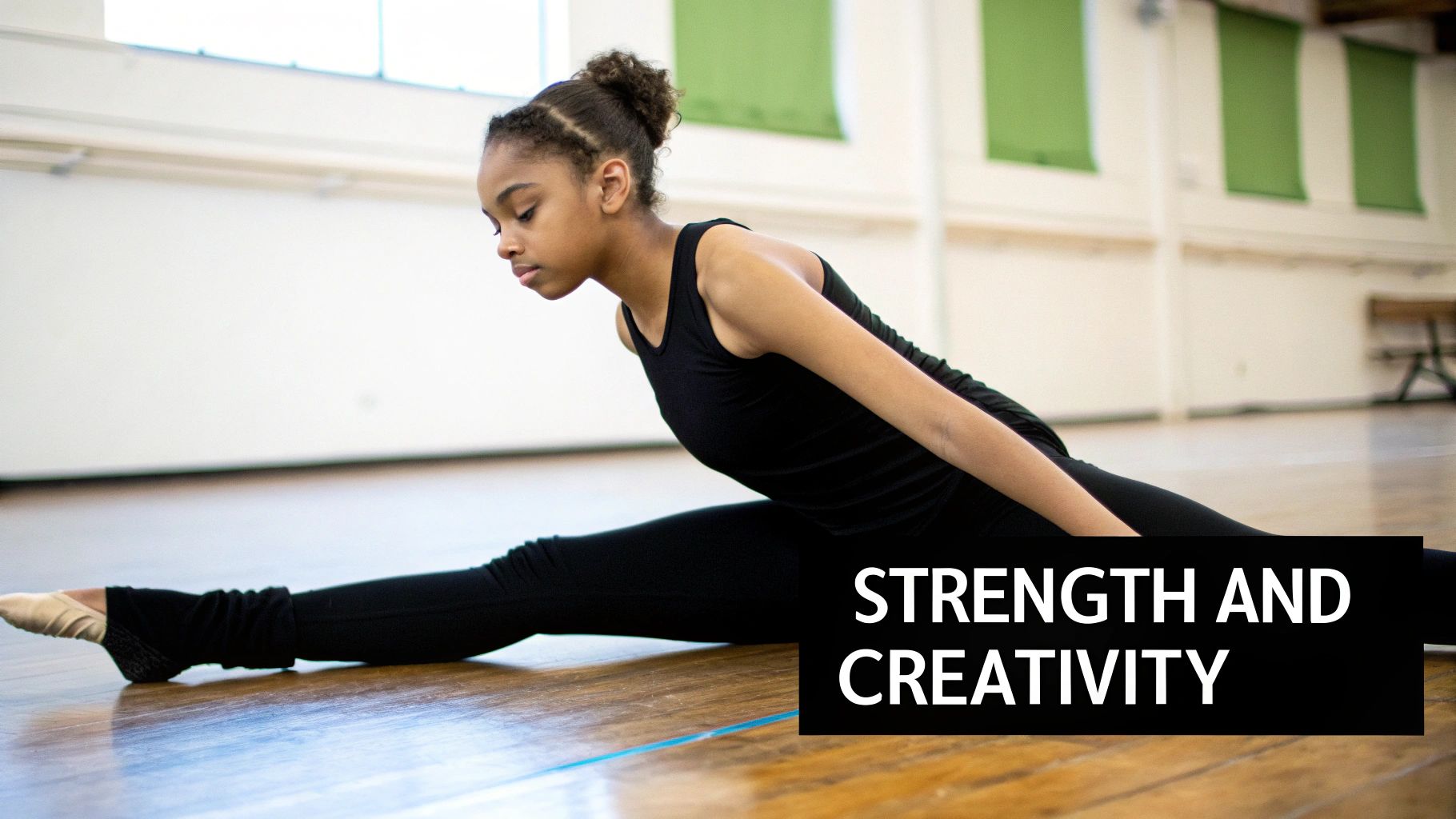
When a student falls in love with contemporary dance, they gain so much more than just impressive moves. This style shapes resilient, creative, and insightful individuals. The benefits ripple out far beyond the studio, touching everything from physical health to emotional intelligence, which is why it's such a valuable activity for kids and teens from Draper to Riverton.
On a purely physical level, it’s a powerhouse. The blend of athletic and fluid movement builds incredible core strength, stamina, and body control. Dancers learn to master floor work, powerful jumps, and seamless transitions, which fine-tunes their coordination and balance for life.
It's More Than Just Physical
While the athletic perks are obvious, the mental and emotional growth is where contemporary dance really shines. Improvisation is baked into its DNA, constantly pushing dancers to think on their feet. This sharpens creative problem-solving and teaches them how to take artistic risks in a safe, supportive space.
Contemporary dance also provides a powerful and healthy outlet for self-expression. It’s a physical language, giving students a way to explore and communicate complex feelings that words can't always capture.
- Builds Real Confidence: Nailing a tough piece of choreography or baring your soul in an improv session builds a deep, unshakable sense of self-esteem.
- Deepens Self-Awareness: The style is all about the mind-body connection, helping dancers become more in tune with both their physical and emotional states.
- Teaches Resilience: Learning to fall and get back up—literally, during floor work, and figuratively, when a move doesn't work—is a life lesson in adapting and persevering.
Contemporary dance isn't just about learning steps; it's about learning who you are. It provides a space for dancers to tell their own stories, building a foundation of confidence that serves them both on and off the stage.
Total Body Conditioning and a Growing Art Form
One of the most significant physical gains is a dramatic increase in flexibility. The style's focus on release techniques and whole-body movement demands a supple, yet powerful, physique. For students serious about this aspect, dedicated flexibility training for dancers is a fantastic way to accelerate progress and prevent injury.
This holistic approach is a big reason for the style's explosive popularity around the world. The contemporary dance market is a fast-growing segment of the performing arts industry. In fact, North America currently holds the largest slice of the pie with a 35% market share, driven by strong studio communities and social media platforms that have made the art form more visible than ever. You can learn more about the growth of the dance market and its expanding global reach.
What to Expect in Your First Contemporary Class
Walking into your very first contemporary dance class should be exciting, not scary. Whether you’re coming over from Herriman or live right around the corner in Bluffdale, knowing a little about what's in store can help you relax and dive right in. While every teacher has their own unique style, most classes follow a natural progression designed to build your skills and get your creativity flowing.
The Warm-Up: More Than Just Stretching
First things first, we’ll start with a solid warm-up. This isn't just about touching your toes; it's a crucial time to get your mind and body on the same page. We'll move through exercises that get your spine moving—think gentle rolls up and down—and fire up your core muscles, which are the powerhouse for everything we do. This part of class is all about conditioning and finding your alignment, setting you up for success in the movements to come.
Building the Foundation
Once everyone is warm, we’ll start moving across the floor. This isn't about learning a complicated routine just yet. Instead, we’ll focus on foundational movements that teach you how to work with gravity, shift your weight effortlessly, and use momentum to your advantage. You can expect to practice things like fluid runs, simple turns, and small jumps that play with the contract-and-release techniques that are at the heart of contemporary dance.
The last part of class is usually dedicated to learning choreography. This is where the magic happens! We’ll take the concepts and movements we've worked on and string them together into a short combination. It’s a chance to really express yourself and tell a story without saying a word.
The most important thing to bring to your first class is an open mind. Contemporary dance is all about individuality and emotion, so don't stress about getting every step perfect. Just focus on how the movement feels in your body.
What to Wear and What to Bring
Comfort is key. Opt for form-fitting clothes you can move in easily, like leggings and a tank top or fitted t-shirt. Most of the time, we dance barefoot to really connect with the floor, but some dancers like to wear socks or special half-sole shoes called turners.
And of course, don’t forget a water bottle!
It's interesting to see how new dancers get inspired these days. Many find their passion online before even setting foot in a studio. In fact, trends show social media influences 44% of teen enrollments in dance. You can read more about how social media is shaping dance education and see why so many aspiring dancers from Riverton are getting their start scrolling through their feeds.
Common Questions About Contemporary Dance
As you get ready to explore contemporary dance, you probably have a few questions. Whether you're a parent in Draper wondering about classes or a new student from Sandy trying to figure out if it’s the right fit, getting some straight answers can make all the difference.
Is Contemporary Dance Hard to Learn?
It’s definitely a challenge, but you might be surprised at how welcoming contemporary dance is for beginners. It doesn't have the rigid, strict rules you’d find in classical ballet. Instead, the focus is on natural, fluid movements that often feel more intuitive to the body.
Think of it this way: you’re learning to work with your body, not against it. Our instructors in Bluffdale are fantastic at breaking down the core techniques in a way that makes sense, no matter your experience level. The goal is to build strength and confidence by exploring movement, not chasing perfection from day one.
What's the Best Age to Start?
Honestly, there’s no magic number. While plenty of dancers start as kids, the emphasis on organic movement makes contemporary accessible for teens and adults, too.
Having some background in ballet or jazz can give you a great head start, but it's absolutely not a requirement. What matters most is being open to trying new things and wanting to express yourself. That curiosity is the real key to understanding what contemporary dance is all about.
One of the coolest things about contemporary is its musical freedom. You'll see routines set to almost anything you can imagine—from slow, lyrical songs and powerful instrumental scores to pop music, electronic beats, or even just the sound of a spoken-word poem. The music sets the mood and helps tell the story, opening up a huge world of creative expression.
Ready to see what the powerful, expressive world of contemporary dance is all about? At Encore Academy for the Performing Arts, we offer a supportive space for every student to find their own creative voice. Book a trial class today and take that first step onto the studio floor.