
8 Powerful Acting Exercises for Beginners to Master in 2026
Stepping onto the stage for the first time is an exhilarating experience, but it can also be intimidating. Where do you even begin? The secret to building confidence and delivering a believable performance lies in practice-specifically, in targeted acting exercises for beginners designed to sharpen your foundational skills.
Whether you're a young performer just starting your journey in cities like Herriman or Lehi, or an adult in Draper exploring a new passion, the right drills can transform your potential into tangible talent. These aren't just abstract warm-ups; they are the fundamental building blocks of compelling storytelling. From mastering emotional truth to developing a powerful stage presence, the exercises in this guide provide a clear roadmap for growth.
This comprehensive list breaks down eight essential acting exercises, offering step-by-step instructions, practical tips, and the "why" behind each technique. You will learn actionable methods for:
- Connecting with genuine emotions through Affective and Sense Memory.
- Thinking on your feet with Improvisation games.
- Building believable characters using Backstory Development.
- Using your body to tell a story through Physicalization.
- Analyzing scripts and understanding your character’s motivations in Scene Study.
Think of this article as your personal acting coach, providing the tools you need to build a strong, versatile performance toolkit. For students in nearby Sandy or Riverton who are ready to take their training to the next level, our classes at Encore Academy in Bluffdale are the perfect place to put these skills into practice and receive expert guidance. Let's begin building your craft.
1. Emotion Memory (Affective Memory)
Emotion Memory, also known as Affective Memory, is a powerful and advanced technique where an actor consciously taps into a personal past experience to evoke genuine emotions for a performance. Instead of pretending to feel sad, angry, or joyful, the actor recalls a specific memory that carries the required emotional weight, allowing those authentic feelings to surface and inform the character's reactions. This method, a cornerstone of Stanislavski’s system and famously adapted by Lee Strasberg, helps create performances of profound emotional depth and truth.
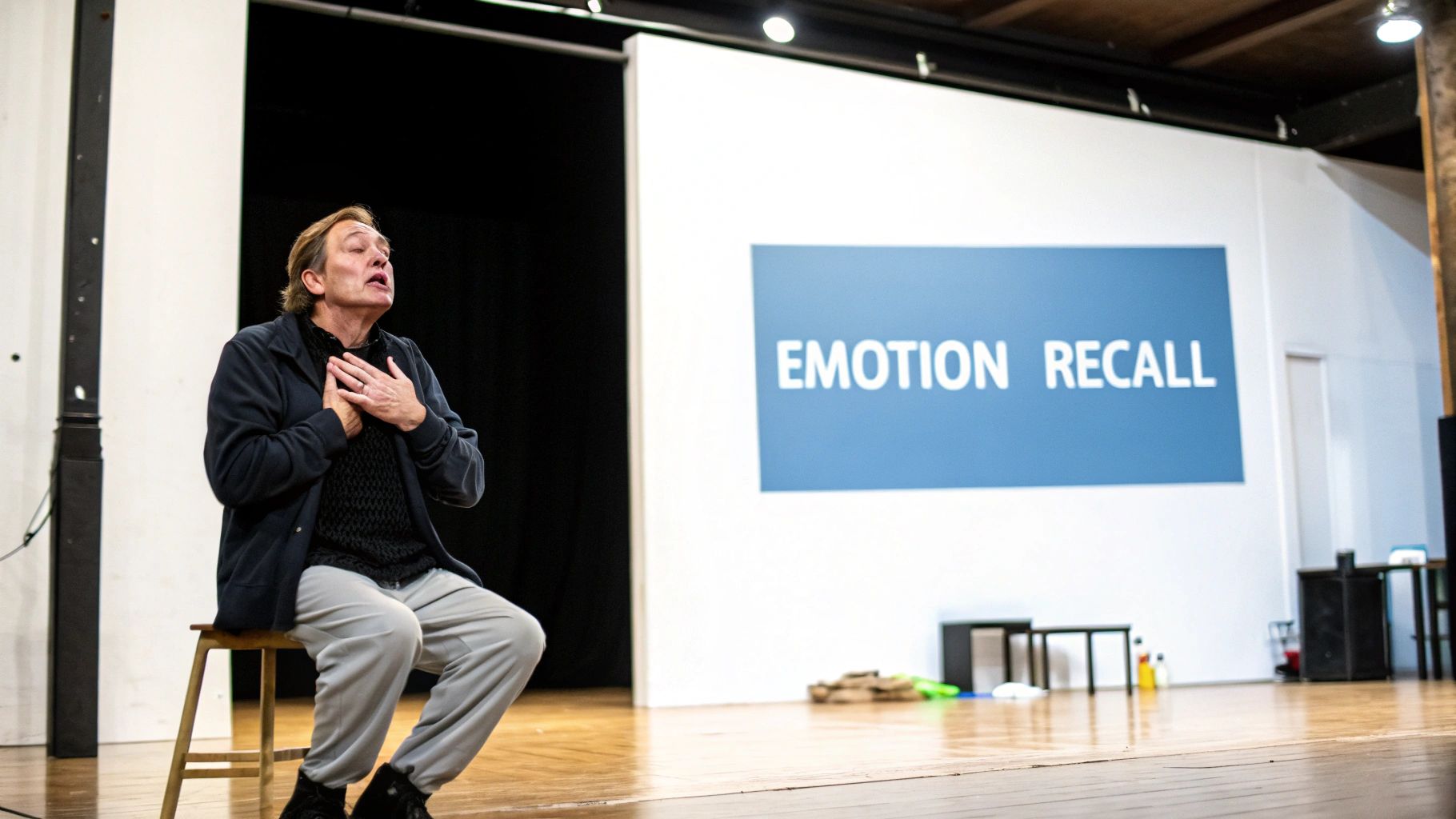
This exercise is particularly effective for dramatic scenes demanding authentic vulnerability. By grounding a character's emotional state in a real, lived experience, an actor can deliver a nuanced and believable performance that truly resonates with the audience. Icons like Meryl Streep and Daniel Day-Lewis have utilized similar techniques to achieve their famously immersive and emotionally rich characterizations. For a beginner, practicing this technique builds an essential bridge between pretending to feel and truly experiencing an emotion on stage or screen.
How to Practice Emotion Memory Safely
Because this is one of the more intense acting exercises for beginners, it’s crucial to approach it with care and intention. Students in our Bluffdale-based programs, many who travel from nearby Lehi, are always guided through this process with professional support.
- Start Small: Begin by recalling memories with mild emotional charges, such as the joy of a surprise party or the slight disappointment of a canceled plan.
- Use Sensory Triggers: Focus on the sensory details of the memory. What did you see, hear, or smell? Re-engaging the senses can often unlock the associated emotion more effectively than forcing the feeling.
- Journal Your Experiences: Keep a private journal to document memories and their corresponding emotions. This creates a personal "emotional library" to draw from for future roles.
- Create a Cool-Down Ritual: After the exercise, it's vital to separate yourself from the character and the recalled emotion. Do something completely different: listen to upbeat music, take a walk, or talk to a friend about your day. This grounds you back in the present.
This technique helps actors connect their physical and emotional responses, which is intrinsically linked to vocal control. A genuinely felt emotion will naturally affect your breathing and voice, making your delivery more powerful. You can explore how emotional connection impacts vocal performance with our expert voice coaches .
A Word of Caution: Never force yourself to relive deeply traumatic memories for a role, especially without professional guidance. The goal is to use emotion as a tool, not to re-traumatize yourself. Prioritize your mental and emotional well-being above all else.
2. Sense Memory
Sense Memory exercises train actors to vividly recall and recreate physical sensations (sight, sound, smell, taste, touch) to inhabit their character's world with authenticity. Rather than just imagining a setting, an actor uses this technique to mentally reconstruct detailed sensory information, like the specific chill of a winter morning or the rough texture of a wooden bench. This practice, foundational to Stanislavski's system and later expanded by teachers like Lee Strasberg, grounds the performer in the physical reality of the scene, making their actions and reactions specific and believable.
This exercise is invaluable for building a character's relationship with their environment, whether real or imagined. By focusing on how things feel, taste, or smell, an actor’s performance becomes layered with subtle, truthful details that draw the audience in. For example, an actor recalling the sensation of bitter cold will physically manifest that experience through their posture, breath, and movement, making the imaginary circumstance feel completely real. For beginners, Sense Memory is a crucial tool for moving beyond simple recitation and into a fully realized, immersive performance.
How to Practice Sense Memory
Sense Memory is one of the most accessible yet profound acting exercises for beginners, and with consistent practice, it can dramatically elevate your work. Students in our Herriman-area acting classes often start with simple objects to build this essential skill.
- Start with a Single Sense: Choose a simple object, like a lemon. First, just observe it visually. Then, explore its texture, its weight, and its smell. Finally, recall the sharp, sour taste. Practice recalling each sensation individually without the object present.
- Focus on Environmental Details: Sit in a room and close your eyes. Try to recall a specific place, like a favorite coffee shop in Draper or a park in Sandy. Rebuild it in your mind using all five senses: the smell of coffee beans, the sound of the grinder, the warmth of the mug, the sight of the decor, and the taste of your usual order.
- Create a Sense Journal: Dedicate a notebook to documenting powerful sensory experiences from your daily life. Describe them in vivid detail. This becomes a personal library you can access when preparing for a role that requires a specific physical environment or sensation.
- Integrate into Scene Work: Before starting a scene, take a moment to create the sensory reality. If the scene is set outside on a hot day, spend a minute recalling the feeling of the sun on your skin and the sound of cicadas before you say your first line.
This technique is fundamental because a character's physical experience directly influences their emotional state and behavior. Mastering it allows you to build a rich inner life that translates into a compelling and believable outer performance.
Pro Tip: Don't just "think" about the sensation; try to physically re-experience it. If you are recalling the weight of a heavy suitcase, allow your muscles to tense as if you are actually holding it. The goal is to create a genuine physical response to an imaginary stimulus.
3. Improv (Improvisation)
Improv, or Improvisation, is the art of creating dialogue, characters, and entire scenes spontaneously without a script. It challenges actors to think on their feet, listen intently, and react authentically in the moment. Instead of relying on pre-written lines, performers collaborate to build a story from scratch, developing crucial skills like quick thinking, creativity, and teamwork. This technique, popularized by pioneers like Viola Spolin and institutions like Second City, is fundamental for breaking down self-consciousness and building unshakable stage confidence.

Improv is invaluable for helping beginners discover character choices they might never find in a script and learning how to recover gracefully when things go unexpectedly on stage. Performers like Tina Fey and Amy Poehler honed their comedic timing and character work through improv, showcasing its power to create dynamic and memorable performances. For a new actor, practicing improv is one of the best ways to stop planning a reaction and start genuinely having one.
How to Practice Improvisation
Improv is one of the most fun acting exercises for beginners because it's all about play and discovery. Students in our Bluffdale-area programs, many coming from Riverton and Herriman, find that improv quickly becomes a favorite part of their training.
- Embrace "Yes, And...": This is the golden rule of improv. Always accept the reality your scene partner creates ("Yes") and add a new piece of information to it ("and..."). This collaborative principle keeps the scene moving forward.
- Listen Actively: The key to great improv isn't thinking of the next funny line; it's listening carefully to your partner. Their words and actions will give you everything you need to react authentically.
- Commit to Your Choices: Don't second-guess yourself. If you decide your character is a pirate who is afraid of water, commit to it fully. Bold choices are more interesting than safe ones, even if they "fail."
- Start with Games: Begin with structured improv games like "One-Word Story" or "Party Quirks" before moving to open-ended scene work. These games provide a clear framework that makes it easier to learn the core principles.
Practicing improv directly builds skills that are essential in all forms of acting, from musical theatre to dramatic film roles. It teaches you to be present and adaptable, which is a huge advantage in any audition or performance setting. You can explore how these skills fit into a broader curriculum by checking out our guide to performing arts classes in your area .
A Word of Advice: The goal of improv is not to be funny; it's to be truthful to the character and the situation. The humor or drama will arise naturally from that truth. Focus on connection and collaboration, not on getting a laugh.
4. Character Analysis & Backstory Development
Character Analysis is a foundational technique where an actor systematically investigates their character's life to build a complete, multi-dimensional person. Instead of just memorizing lines, the actor creates a detailed backstory, uncovering the character's history, motivations, fears, and relationships. This intellectual and imaginative work provides a logical and emotional roadmap for every choice made on stage or screen, transforming a flat script into a living, breathing individual.
This exercise is essential for creating performances with consistency and psychological depth. By understanding why a character says or does something, an actor’s delivery becomes purposeful and authentic. Legends like Daniel Day-Lewis are famous for their exhaustive research, which allows them to fully inhabit their roles. For a beginner, this is one of the most crucial acting exercises for beginners, as it teaches you to think like a playwright and a psychologist, grounding your performance in truth.
How to Practice Character Analysis
Building a character from the ground up is a deeply rewarding process. Our students in programs near Draper and Riverton learn to ask the right questions to unlock complex characters and make their performances memorable.
- Create a Character Questionnaire: Go beyond the script. Ask and answer at least 20 detailed questions: What was my first childhood memory? What is my biggest secret? Who do I love most, and why? What is my relationship with money?
- Research Their World: Understand the historical, social, and cultural context your character lives in. A person from 1920s New York will think and behave differently from someone in modern-day Herriman. This research adds layers of authenticity.
- Identify Core Objectives: Every character wants something. Clearly define your character's primary objective in the overall story (super-objective) and their goal in each specific scene. What stands in their way?
- Write from Their Perspective: Write a diary entry, a letter to another character, or a monologue from your character's point of view. This helps you find their unique voice and internal thought process.
This deep analytical work ensures that your physical and vocal choices are motivated and specific, rather than generic. When you know a character's deepest secrets, it influences the way you stand, speak, and interact with others.
A Word of Advice: Your character analysis is a private roadmap, not a performance in itself. Allow the research to inform your choices subconsciously, but avoid "playing" the backstory. The best work is often subtle, felt by the audience rather than explicitly shown.
5. Physicalization & Movement Work
Physicalization is the art of expressing a character through the body, using movement, posture, gestures, and spatial awareness to tell a story without words. Instead of relying solely on dialogue, an actor uses their physical instrument to reveal personality traits, emotional states, and relationships. Every movement becomes intentional and rooted in the character's truth, transforming an actor's presence and making the character three-dimensional, memorable, and visually compelling. This approach, central to physical theater pioneers like Jerzy Grotowski and Jacques Lecoq, is essential for any beginner.
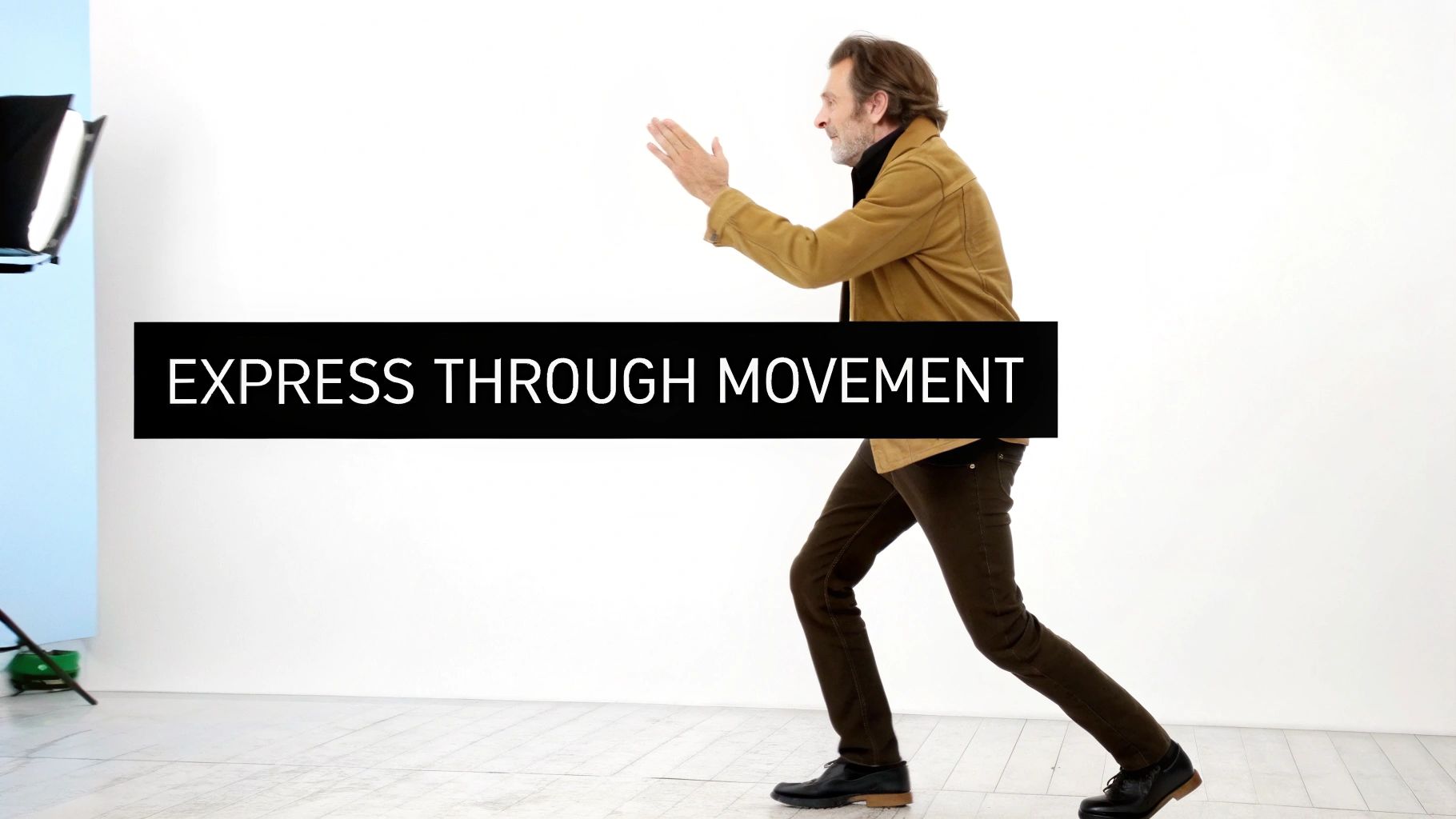
This exercise is vital for developing a fully embodied character. A character with poor posture might reveal low self-esteem, while a distinctive gait can signify age, injury, or arrogance. Think of Charlie Chaplin’s iconic walk; his physical comedy expressed more than words ever could. For beginners, practicing physicalization builds a powerful awareness of how the body communicates, which is a cornerstone of our integrated dance and theater programs available to students from Bluffdale, Draper, and surrounding areas.
How to Practice Physicalization
Developing a physical vocabulary for your characters is one of the most exciting acting exercises for beginners. It connects your internal understanding of a character to their external expression.
- Observe and Embody: Watch people in public spaces, whether you're in Lehi or Sandy. Notice how they walk, stand, and hold their bodies. Choose one person and try to embody their physicality. How does it make you feel?
- Lead with a Body Part: Imagine your character leads with a specific part of their body. Does their chin lead, suggesting arrogance? Or perhaps their heart leads, showing vulnerability? Walk around the room leading with that body part.
- Explore Character Gestures: Identify a distinctive gesture or physical tic for your character. Do they constantly wring their hands when nervous? Do they gesture broadly when excited? Practice integrating this gesture into simple actions.
- Use the Space: Pay attention to how your character moves through a room. Do they hug the walls, or do they confidently occupy the center? Use movement to show their relationship to their environment and other people.
This technique is especially powerful when combined with dance and movement training, as it builds core strength and body awareness. Developing physical control is key, and you can learn more about how to improve your body’s readiness for performance through targeted training.
A Word of Caution: Be mindful of your body's limits. When exploring extreme physicalities, such as a limp or a hunched back, warm up properly and avoid movements that cause pain. The goal is to embody a character, not to injure yourself.
6. Scene Study & Script Analysis
Scene Study & Script Analysis is the foundational process of dissecting a script to understand its core components. Instead of just memorizing lines, an actor learns to uncover the character’s objectives (what they want), obstacles (what’s in their way), and tactics (how they try to get what they want). This methodical approach teaches beginners to look for the subtext, the unspoken thoughts and feelings that drive the dialogue. By breaking down a scene into smaller units called "beats," where a specific action or intention shifts, actors can make deliberate, informed choices.
This exercise is the bedrock of creating a believable character and is essential for any form of scripted performance, from dramatic plays to musical theater. It bridges the gap between simply saying words and truly understanding why a character says them. By analyzing the script, actors like Viola Davis or Mark Rylance build complex, layered performances that feel deeply human and intentional. For a new actor, this practice transforms the script from a set of instructions into a rich roadmap for performance.
How to Practice Scene Study & Script Analysis
A systematic approach to the text is one of the most valuable acting exercises for beginners. Students in our Herriman-area acting programs learn to turn script analysis into a creative tool.
- Break Down the Beats: Read through the scene and identify every moment the character’s intention or tactic changes. Mark these as "beats" in your script.
- Identify Objectives and Obstacles: For each beat, ask: "What does my character want right now?" (the objective) and "What is stopping them from getting it?" (the obstacle).
- Explore Tactics: Once you know what the character wants, determine how they try to get it. Do they charm, threaten, plead, or manipulate? These are your tactics.
- Research the Context: Understand the world of the play. Research the time period, social norms, and any specific references in the script to inform your character's worldview and behavior.
- Reread, Reread, Reread: Each time you read the script, you will discover new layers of meaning, subtext, and character motivation. Never assume you've found everything on the first pass.
This analytical work is not just intellectual; it directly informs your emotional and physical choices on stage. Understanding a script's structure is also key for aspiring writers; you can learn more about how to develop your own compelling narratives .
A Word of Caution: Avoid getting so lost in analysis that your performance becomes rigid or academic. The goal of script analysis is to build a strong foundation that gives you the freedom to play and be spontaneous within the scene.
7. Tableau & Freeze Frame
Tableau, also known as a living picture, is an exercise where actors create a static, frozen scene that tells a story using only their bodies. Without dialogue or movement, performers must use posture, gesture, and spatial relationships to convey character, emotion, and narrative. A related exercise, Freeze Frame, involves stopping a scene mid-action to analyze the story being told by that single, suspended moment. These techniques, staples in Viola Spolin's Theater Games, are fundamental for developing non-verbal storytelling and an understanding of stage composition.
This exercise is incredibly effective for beginners because it removes the pressure of remembering lines and complex blocking, allowing actors to focus purely on physical expression. By creating these frozen pictures, performers learn how their position on stage relative to others communicates power, intimacy, or conflict. This builds a strong foundation for physical awareness and ensemble work, skills that are essential for every actor, from school plays to professional productions. It’s a core component of many introductory acting classes, including those we offer to students from Riverton and the surrounding areas.
How to Practice Tableau & Freeze Frame
Tableau is a versatile tool that can be practiced solo or in a group. It's an excellent warm-up that gets actors thinking creatively and physically before diving into scene work.
- Start with a Simple Prompt: Begin with a simple theme, like "a family dinner," "the first day of school," or "a moment of discovery." As a group, create a single frozen image that tells that story.
- Focus on Levels and Spacing: Pay attention to how height and distance between characters affect the story. Is one character standing tall over another? Are two characters huddled close together or far apart? These choices build the narrative.
- Embody a Strong Emotion: Each actor in the tableau should choose a clear, strong emotion for their character. How does that emotion manifest physically? A slumped posture for sadness, a rigid back for anger, or an open chest for joy.
- Analyze and Refine: After holding the tableau for a few seconds, "break" the pose. Discuss what story the image told. What was clear? What was confusing? Then, try creating a new tableau to make the story even stronger.
This focus on physical storytelling directly translates to more dynamic and intentional movement in scripted scenes. When you understand how to tell a story with your body in stillness, you can bring that same awareness to your every move on stage. At Encore, our instructors guide students on how to connect this physical awareness to character development in our trial acting programs.
Pro Tip: Record your tableaus on a phone or camera. Watching them back allows you to see the composition from an audience's perspective, revealing what reads clearly and what needs adjustment.
8. Given Circumstances & 'Magic If'
One of the most foundational and transformative acting exercises for beginners is exploring the 'Magic If'. This core Stanislavski principle asks the actor a simple yet profound question: "What would I do if I were in this character's situation?" Instead of pretending to be someone else entirely, the actor imagines themselves within the character's specific "given circumstances" (the who, what, where, when, and why of the scene). This technique masterfully bridges the gap between the actor's authentic self and the fictional character, making performances feel psychologically truthful and deeply human.
This method is incredibly effective because it grounds abstract character work in tangible reality. An actor playing a character in a historical drama might ask, "If I lived in this era, with this social status, what would I truly want?" This approach helps actors access genuine emotional and instinctual responses, making their choices on stage or screen feel spontaneous and earned. It is a cornerstone of nearly all modern acting methodologies because it moves the performer from imitation to embodiment, a crucial step for any aspiring artist.
How to Practice the 'Magic If'
At Encore, we guide students from Herriman, Riverton, and the surrounding areas through this process to build believable characters from the ground up. This technique is less about intense emotion and more about imaginative inquiry.
- Detail the Given Circumstances: Before anything else, write down every fact the script gives you about your character's world. Where are they? What time is it? Who are they with? What just happened before this moment?
- Ask the 'Magic If' Question: Frame your exploration with the question. For example, "What would I do if my family's fortune depended on this single conversation?"
- Connect to Your Own Experience: While you may have never faced a dragon, you have likely felt fear or determination. Use your own life's emotions as a starting point to understand your character's internal world.
- Discuss with Scene Partners: Aligning on the given circumstances with your scene partners is crucial. If you believe it's freezing cold and they believe it's a warm day, your performances won't be in sync.
- Revisit and Refine: As you rehearse, new details will emerge. Continuously revisit your understanding of the circumstances to deepen your performance.
This technique is fundamental to storytelling and is a key focus in our comprehensive theater programs , where students learn to build authentic and compelling characters.
Key Insight: The power of the 'Magic If' is its simplicity. You are not trying to become another person. You are exploring what would happen if you, with all your unique thoughts and feelings, were placed in their extraordinary circumstances.
Beginner Acting Exercises: 8-Point Comparison
| Emotion Memory (Affective Memory) | High 🔄 — intense emotional control & boundaries | Moderate ⚡ — low props, needs coaching & decompression time | ⭐⭐⭐⭐⭐ | Deep emotional authenticity; strong audience resonance; possible emotional fatigue | Dramatic, character-driven roles; start with mild memories, journal, work with a coach |
|---|---|---|---|---|---|
| Sense Memory | Moderate 🔄 — disciplined sensory reconstruction | High ⚡ — regular practice, sensory journaling, rehearsal time | ⭐⭐⭐⭐ | Enhanced realism and presence; improved prop/environment handling | Physical scenes & realistic detail; train one sense at a time, keep a sense journal |
| Improv (Improvisation) | Low 🔄 — simple rules but group-dependent | Low ⚡ — minimal equipment; needs regular practice | ⭐⭐⭐⭐ | Increased spontaneity, listening, adaptability; discovery of new character choices | Comedy, confidence-building, ensemble work; use "Yes, and...", record sessions |
| Character Analysis & Backstory Development | High 🔄 — systematic research and interpretation | High ⚡ — time-intensive research and documentation | ⭐⭐⭐⭐⭐ | Consistent, psychologically grounded choices; richer character layers; risk of rigidity | Complex or long-running roles; use questionnaires, research context, write diaries |
| Physicalization & Movement Work | Moderate 🔄 — body training and spatial awareness | Moderate ⚡ — studio space, movement drills, video feedback | ⭐⭐⭐⭐ | Distinctive physical traits, stronger stage presence; risk of exaggeration | Musical theater, non-verbal storytelling; record rehearsals, integrate dance training |
| Scene Study & Script Analysis | Moderate 🔄 — structured beat and subtext work | High ⚡ — extensive reading, breakdowns, rehearsal time | ⭐⭐⭐⭐⭐ | Script-grounded, deliberate choices; clearer objectives and subtext; may inhibit spontaneity if overdone | Foundational for all acting; create beat sheets, identify tactics and objectives |
| Tableau & Freeze Frame | Low 🔄 — compositional thinking, static posing | Low ⚡ — minimal props, quick exercises | ⭐⭐⭐ | Improved visual storytelling and spatial composition; limited dialogue training | Beginners, staging and visual composition; focus on height/distance, record for review |
| Given Circumstances & "Magic If" | Low 🔄 — imaginative but conceptually simple | Low ⚡ — quick to apply with proper script knowledge | ⭐⭐⭐⭐⭐ | Accessible psychological truth; clearer motivation and empathy; depends on solid analysis | All scenes and beginners; write out circumstances, ask "What if I were in this situation?" |
From Practice to Performance: Your Next Steps on Stage
You've just explored a comprehensive toolkit of foundational acting exercises for beginners. From the deep emotional recall of Affective Memory to the spontaneity of Improv, and from the detailed blueprint of Scene Study to the imaginative spark of the 'Magic If', each drill is a crucial building block. These aren't just one-off activities; they are the daily vitamins for an actor's craft, designed to be repeated, refined, and woven into a consistent practice.
The journey from a beginner to a confident performer is paved with dedication. It’s about more than just reading the steps; it's about doing the work. It’s about turning your living room into a rehearsal space, whether you’re in Riverton or Draper, and truly committing to the process. The most significant growth happens when these exercises stop feeling like homework and become second nature, sharpening your instincts and expanding your emotional range.
Key Takeaways: Integrating the Actor's Toolkit
To truly benefit from this guide, focus on transforming theory into action. Your goal is to build a holistic practice where mind, body, and voice work in harmony.
- Consistency Over Intensity: A dedicated 20-minute practice session three times a week is far more effective than a single, sporadic four-hour marathon. Create a simple schedule that incorporates a vocal warm-up, a physical exercise like Physicalization, and a creative drill like Improv.
- Observation is Your Superpower: The exercises in this article, particularly Sense Memory and Character Analysis, are rooted in observation. Pay attention to the world around you. How does a tired cashier in Sandy stand? What is the specific sound of rain on a window in Herriman? Your daily life is an endless source of authentic material.
- Embrace the "Failure": Improvisation and the 'Magic If' teach us that there are no wrong answers, only new discoveries. Some of your choices will feel brilliant, while others might fall flat. That’s okay. The goal is to build creative courage, not to be perfect every time.
Actionable Next Steps: Building Your Practice
Now, let's put it all together. The most important step you can take is to create a tangible routine.
Start a Practice Journal: Dedicate a notebook to your acting work. After each session, jot down what you discovered. Did a specific Sense Memory exercise unlock a powerful emotion? Did you struggle with a particular Improv prompt? This journal will become an invaluable record of your progress.
Find a Practice Partner: Convince a friend from Lehi or a family member to run scenes with you. Practicing Tableau or Scene Study with a partner introduces the vital element of listening and reacting, which is the very heart of acting.
Bridge the Gap to Performance: These exercises are not meant to exist in a vacuum. The next time you work on a monologue or a scene, consciously apply them. Ask: What are my character's Given Circumstances? How can I use Physicalization to express their inner state? This bridge from practice to application is where real growth occurs.
Ultimately, mastering these acting exercises for beginners is about building a profound sense of self-awareness and empathy. It’s about learning to listen with your whole body, to respond truthfully under imaginary circumstances, and to connect authentically with a story. Whether you dream of community theater in Bluffdale or simply want to build confidence for public speaking, these skills will serve you well beyond the stage. Keep playing, keep exploring, and never lose the curiosity that brought you here in the first place.
Ready to move from solo practice to collaborative creation? The expert instructors at Encore Academy for the Performing Arts can guide you through these exercises and more in a supportive, dynamic group setting. Visit Encore Academy for the Performing Arts to book a trial class and take the next step in your performance journey today.