
Learn Beginner Jazz Dance Moves Your Ultimate Guide
Ready to dive into the world of jazz dance? It all starts with a few foundational moves. Think of steps like the jazz walk, ball change, and pivot turn as your new alphabet. They are the essential building blocks for almost every piece of jazz choreography you'll ever learn, helping you build coordination, find your balance, and tap into that signature jazz energy.
Discovering the Energy of Jazz Dance
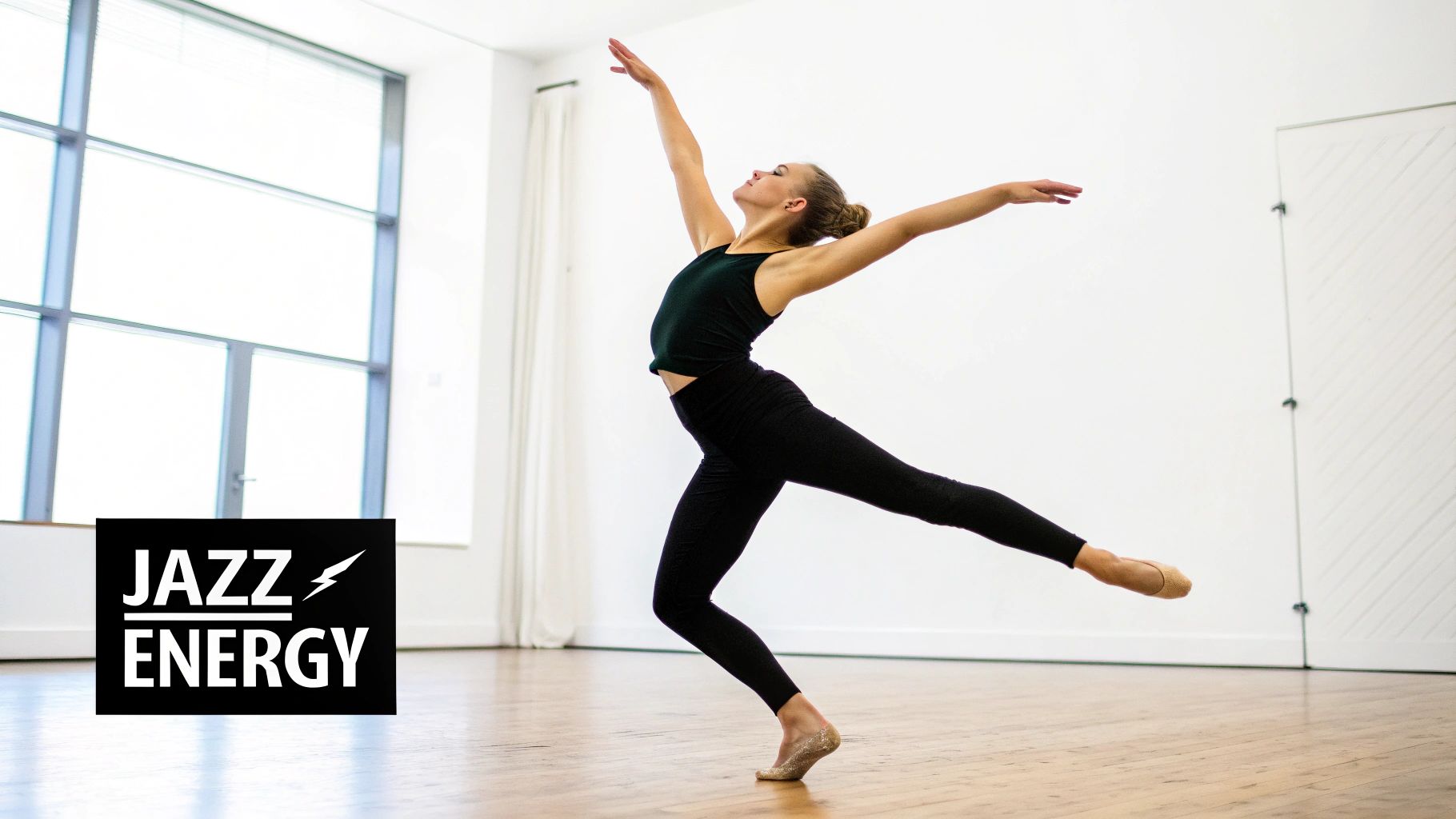
Jazz is pure conversation between music and movement. It’s known for its incredible energy, sharp, punchy accents, and deeply expressive style, which is why it's a favorite for dancers of every age. From its rich historical roots to the explosive routines you see on stage today, jazz is all about rhythm and personality.
This powerful art form really started to take shape in the United States back in the early 1900s, growing right alongside jazz music in New Orleans. By the 1920s, it had grabbed mainstream attention, thanks in large part to the Charleston. This iconic solo dance was famously featured in the 1923 Broadway show 'Runnin' Wild,' set to a song inspired by the unique rhythms of Charleston City dockworkers.
Before we get into the steps, let's break down the core ideas you'll be working with. These concepts are what give jazz its unique flavor.
Core Elements of Beginner Jazz Dance
| Isolations | Moving one part of your body independently, like a shoulder roll or a head snap. | This teaches incredible body control and adds sharp, clean detail to your dancing. |
|---|---|---|
| Rhythm & Musicality | Learning to hear, interpret, and embody the beats and syncopation in the music. | Jazz isn't just moving to music; it's about becoming a part of the music itself. |
| Syncopation | Emphasizing the off-beats in the music to create surprising and dynamic accents. | This is where the "snap" and "pop" of jazz comes from. It adds an exciting, unpredictable quality. |
| Grounding | Maintaining a strong connection to the floor, often with a bent-knee stance (plié). | A low center of gravity gives you power for jumps, turns, and quick transitions. |
These elements are the secret sauce of jazz. Mastering them will make every move you learn feel more authentic and powerful.
What to Expect in a Beginner Class
For anyone thinking about trying jazz, stepping into a beginner class is an exciting first move. The goal is to create a supportive, encouraging space focused on building a solid foundation, not chasing perfection right away.
A typical class kicks off with a great warm-up to get your muscles ready to move safely. From there, you'll start learning those key concepts we talked about—isolations, rhythm, and syncopation—and see how they fit into actual steps.
At its heart, jazz is about storytelling through movement. Every step, turn, and leap is a chance to express an emotion or idea, connecting you directly to the music and the audience.
Whether you're practicing in your living room in Herriman or joining us at the studio, these fundamentals are crucial. Beginner jazz moves aren't just steps; they are the vocabulary you'll use to build confidence and express your own artistic voice. Our Bluffdale jazz dance program is designed to give you the structured, expert guidance to help you master these skills and fall in love with the art form.
Getting Your Body Ready to Move
Before you even think about hitting the floor for your first jazz walk, you have to get your body prepped. Trust me on this—jumping straight into choreography with cold muscles is one of the fastest ways to get injured or just feel frustrated. A solid warm-up does more than just protect you; it actually wakes up the exact muscles you're about to use, which makes every move you do feel sharper and more connected.
Think of it as the difference between feeling stiff and clunky versus feeling fluid and ready to move with power. Taking a few minutes to prepare is non-negotiable, whether you're practicing in your living room in Sandy or stepping into a studio for the very first time.
What Makes a Great Warm-Up?
Your pre-dance routine should be all about moving, not just holding static stretches. We want to get the body ready for the high-energy, expressive quality of jazz dance.
Here’s what I always include in my warm-ups:
- Dynamic Stretches: Get things moving with leg swings (front-to-back and side-to-side), big arm circles, and gentle torso twists. The goal is to guide your joints through their full, fluid range of motion.
- Waking Up Your Core: A quick plank or a few bird-dog poses are perfect for this. In jazz, everything comes from your center, so a strong, engaged core is your best friend for staying balanced in turns and controlled in leaps.
- Basic Steps: You can’t go wrong with some simple pliés (bending your knees over your toes) and tendus (stretching your foot out along the floor). These are fantastic for warming up every part of your lower body, from your feet all the way up.
This kind of routine primes your body perfectly for the specific demands of beginner jazz dance moves.
Your warm-up is like a personal pre-show. It’s a moment to have a quick conversation with your body, check in with how everything feels, and set yourself up for a fantastic practice.
Why Your Alignment Is Everything
Beyond the warm-up, we need to talk about alignment. Good posture is the foundation of everything in jazz. The style is known for its clean lines and strong shapes, and all of that starts with how you hold yourself.
Picture a string gently pulling you up from the very top of your head, making your spine feel long and tall. Let your shoulders relax down and away from your ears, pull your belly button in toward your spine to engage your core, and keep your weight slightly forward over the balls of your feet.
This strong, stable posture is your home base for everything from isolations and turns to kicks and leaps. For anyone looking to safely improve their lines and range of motion, our guide on flexibility training for dancers has some fantastic exercises that pair perfectly with any warm-up. Getting a feel for proper alignment is truly the first step toward dancing with real confidence and control.
Mastering Your First 7 Jazz Moves
Alright, this is where the real fun begins. You're warmed up and focused, so it's time to dive into the core vocabulary of jazz dance. Think of these first seven moves as the alphabet. Once you know them, you can start forming words, then sentences, and eventually, full-on choreographic stories.
Every step here is a building block. As you get comfortable with them, you'll gain the confidence and coordination you need to really express yourself on the dance floor, whether you're in our Bluffdale studio or practicing in your living room in Riverton.
Let’s break them down, one by one.
Before you jump in, remember the process: get your body ready by stretching, find your posture and alignment, and then activate the muscles you're about to use. It’s a simple flow that makes a huge difference in both your performance and your safety.
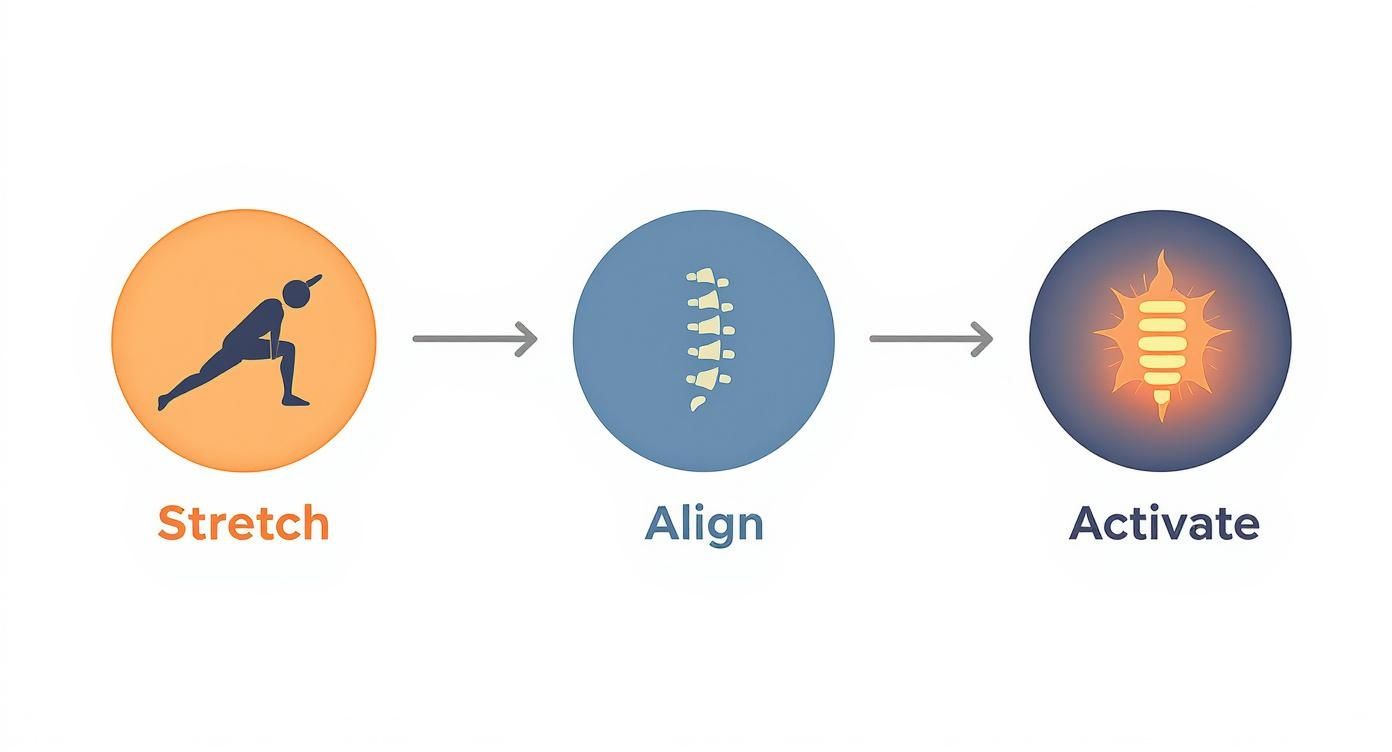
This little reminder shows that great dancing starts before you even take the first step. Proper preparation is everything.
1. The Jazz Walk
First thing's first: a jazz walk is nothing like your everyday walk to the mailbox. This is a stylized, slinky walk full of attitude. You move low to the ground with your knees bent in a plié, which gives it that classic, cool feel.
To get it right, lead with the ball of your foot and roll through to your heel. Let your hips sway naturally and keep your shoulders relaxed but held with confidence. Your arms can add that extra bit of flair—maybe a snap or a classic "L" shape. This move is all about learning to travel across the floor with personality and control.
2. The Ball Change
The ball change is a quick, two-step weight shift that is absolutely fundamental in jazz. It's the rhythmic engine behind so much choreography, adding that syncopated, punchy feel to the music.
You start by stepping back onto the ball of one foot (the "ball"), then immediately rock your weight forward onto the other foot, which is flat on the floor (the "change"). It’s a small, sharp movement that becomes second nature once you get the hang of it.
I always tell my students that the ball change is the rhythmic punctuation in jazz. It’s not just a step; it’s an accent. It's that little "and-one" count that gives combinations their signature flavor.
3. The Jazz Square (or Box Step)
You've probably seen this one before! The jazz square is made up of four simple steps that trace a square on the floor. It’s a fantastic way to drill coordination and practice shifting your weight smoothly.
Here’s the basic pattern:
- Step forward with your right foot.
- Cross your left foot over the right.
- Step back with your right foot.
- Step your left foot out to the side, bringing you back to where you started.
The trick is to keep the steps clean and the rhythm steady. Once you feel comfortable, play around with adding arm movements or changing your head position for extra style. I see this move "click" for so many of our dancers in Draper and Lehi—it's often the first one that makes them feel like they're really dancing jazz.
4. The Pivot Turn
Looking for a simple way to add some drama? The pivot turn is your answer. It’s a sharp half-turn on the balls of your feet that teaches you balance and how to change direction quickly without the complexity of a full pirouette.
Step forward on one foot. Then, keeping the balls of both feet pressed into the floor, rotate 180 degrees to face the opposite way. Your weight should stay pretty evenly distributed. Pivot turns are often done in quick succession, creating a cool, almost disorienting effect that looks fantastic.
5. The Chassé
Pronounced "sha-say," this French term means "to chase." It’s a gliding step where one foot literally chases the other out of its spot. You’ll see this traveling step in a ton of dance styles, from ballet to contemporary, but jazz gives it its own unique energy.
To do a side chassé, you step to the side, bring your other foot to meet it (your legs will make a "V" shape in the air for a split second), and then land on that second foot. The rhythm is a quick "step-together-step." It’s your go-to for covering ground across the floor gracefully.
6. The Pas de Bourrée
Okay, the name might sound fancy, but this classic three-step move is an essential transition in jazz. A pas de bourrée (pah-duh-boo-ray) is just a quick "back-side-front" pattern that helps you switch your weight and direction seamlessly.
You’ll step behind with one foot, step to the side with the other, and then step forward with the first foot. It’s a fast little triplet that’s perfect for linking bigger, showier movements together. Because it’s all about rhythm and precise footwork, it actually shares some common ground with other percussive styles. To see how footwork creates rhythm, take a look at our guide on beginner tap dance steps .
7. The Kick Ball Change
Now it's time to put things together! The kick ball change takes that rhythmic ball change you learned and adds a powerful kick right at the beginning. This is a surefire way to inject energy and pizzazz into a routine.
Start by kicking one leg forward. As that leg comes back down, you immediately go into your ball change: step back onto the ball of the kicking foot, then change your weight forward onto the other. The whole sequence feels like "kick-and-change," creating a syncopated beat that is pure jazz. Dancers everywhere, from Herriman to Sandy, love this move because it just feels powerful and looks so impressive.
Getting these seven foundational moves down will give you a solid base for everything else you learn in jazz. Take your time, practice them slowly, and really focus on clean technique. Once the muscle memory kicks in, you can pick up the pace and, most importantly, start adding your own unique style to every step.
Putting It All Together: Your First Jazz Combo
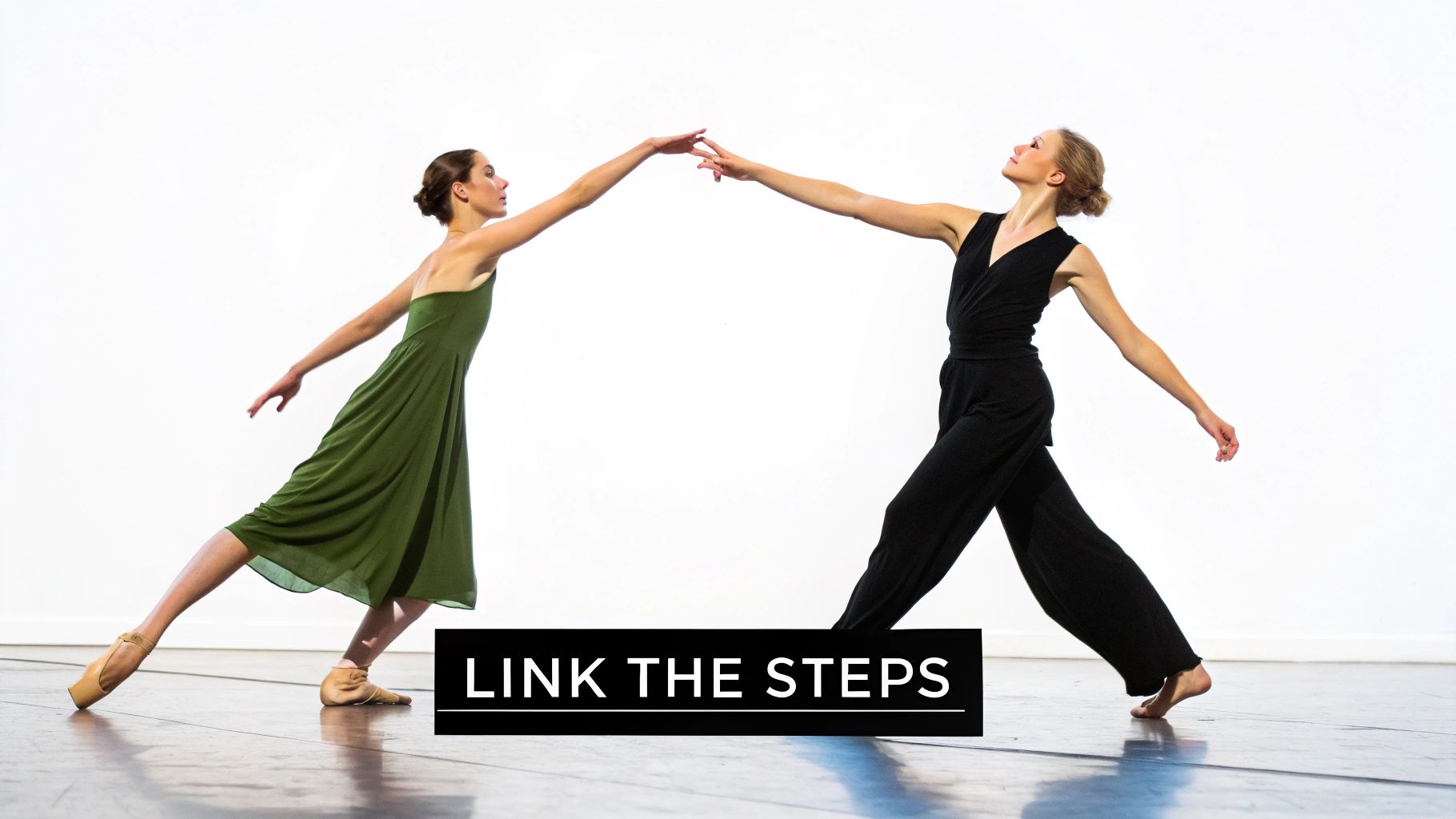
This is where the real fun begins. You've been drilling the individual steps, but the magic of jazz dance truly comes alive when you start weaving them together. A combination, or "combo," is just a short sequence of moves. It’s how you start to turn steps into dancing.
Don't worry about perfection just yet. The goal is to feel the flow—how one movement melts into the next. This is exactly how we build choreography in our Bluffdale studio, and it gives you a real sense of accomplishment. It's a foundational skill in any style, something you'll also see in our guide to contemporary dance for beginners .
Your First Mini-Combination
Ready to give it a shot? Let’s link three of the moves we just covered: the Jazz Square, a Pivot Turn, and a Chassé. Take your time and even walk through it a few times without music to get the feel of it.
Here’s the breakdown, count by count:
- Counts 1-4: The Jazz Square
- 1: Step forward with your right foot.
- 2: Cross your left foot over your right.
- 3: Step back on your right foot.
- 4: Step to the side on your left foot.
- Counts 5-6: The Pivot Turn
- 5: Step forward onto your right foot, preparing to turn.
- 6: Now, keeping the balls of your feet on the floor, pivot 180 degrees over your left shoulder. You should now be facing the back.
- Counts 7&8: The Chassé
- 7: Step to the side with your right foot.
- &: Bring your left foot to meet your right (your feet "kiss" in the air).
- 8: Land on your right foot to finish the step.
Your goal is to make the transitions seamless. Think of it as a fluid sentence rather than separate words. The end of one move should be the natural start of the next.
Making It Your Own
Once you’ve got the footwork down, start adding your own personality. What are your arms doing? Try swinging them naturally or placing them on your hips. Change your head and eye-line to add intention. Maybe you can sink lower into your plié for a bit more drama.
This is how you start to find your own style. Many of our students from nearby Herriman and Sandy tell us this is the most rewarding part of the journey. Practicing this simple combo will build your coordination and show you how beginner jazz dance moves are the building blocks for incredible choreography.
Practice Smarter, Not Harder
Let’s be real: progress in dance isn’t about logging endless hours in the studio. It’s about practicing with intention. Building strong habits from the very beginning will do more for your dancing than just mindlessly repeating a move over and over. This is how we build the muscle memory that eventually makes those tricky steps feel as natural as walking.
Your best friend for practicing at home? A full-length mirror. Seriously. It’s your own personal feedback machine, instantly showing you what’s working and what’s not with your alignment and posture. Are your shoulders hiking up to your ears? Is your back slouching? The mirror tells you the truth, helping you spot those little issues before they become bad habits.
Common Beginner Mistakes and How to Fix Them
Even with a mirror, some classic beginner moves have common sticking points. We've seen them all, and luckily, they all have a fix. This little table is your cheat sheet for troubleshooting the moves that tend to trip people up the most.
| Pivot Turn | Feeling wobbly and off-balance. | This almost always comes down to a disengaged core. Before you even think about turning, pull your belly button in toward your spine. Keep your weight forward on the balls of your feet, not sitting back on your heels. A strong center is everything here. |
|---|---|---|
| Pas de Bourrée | The footwork feels messy and tangled. | Slow. It. Down. The rhythm is a simple “back-side-front.” Break it down without music first. Keep your steps small and close to the floor. I like to tell my students to think "up, up, down" with the levels of their body to really feel the weight shift. |
| Chassé | Looking heavy instead of light and gliding. | The secret to a beautiful, floaty chassé is the push. You need to use a deep plié (bending your knees) to launch yourself across the floor. That push is what gives you the power for that signature "chasing" look and makes the move feel light and controlled. |
A little focused attention on these details can make a massive difference in how these steps look and feel. Don't be afraid to break things down and repeat the right way, even if it feels tedious at first.
Finding Your Rhythm
Technique is only half the battle. To really dance jazz, you have to connect with the music. Put on some classic jazz tracks and just listen. Don't even worry about dancing—just tap your foot. Try to find the main beat, then listen for all the interesting, syncopated rhythms that happen in between. This kind of deep listening builds your musicality, which is what separates a technician from an artist. For so many dancers, from Draper to Riverton, this is the key that unlocks their expression.
Beginner jazz steps have been taught in dance schools worldwide for over a century, forming the foundation for millions of novices annually. Due to jazz dance's rhythmic and improvisational nature, beginners often achieve measurable proficiency within months, with structured 8-12 week courses commonly culminating in performance-ready routines. Learn more about the historical roots of jazz dance .
Ultimately, smart practice is a mix of watching yourself, troubleshooting the tricky parts, and truly feeling the music. When you focus on these areas, you're not just learning steps—you're building a foundation that will support you throughout your entire dance journey.
Ready for the Next Step?
Practicing at home is a brilliant way to get comfortable with the basics. But if you're serious about improving, nothing beats the energy and expert eye you get in a real studio class.
It’s one thing to watch a move on screen; it's another to have an instructor offer a tiny correction to your posture that makes everything click. That personalized feedback on your alignment and technique is something you just can't get from a video. It's the secret to building a strong, safe foundation.
Plus, there’s a special kind of magic that happens when you're in a room full of people all working towards the same goal. It builds your confidence, keeps you motivated, and is just a lot more fun. It’s no surprise that jazz remains one of the most beloved styles in dance studios everywhere. In fact, in North American schools that offer various dance styles, participation rates for jazz consistently top 25% among young dancers. Learn more about the popularity of jazz dance .
Taking that first class is more than just learning steps; it’s about joining a community that shares your passion for movement and music.
If you're in Herriman, Riverton, or nearby and feel that spark, we'd love for you to come dance with us. When you're ready to see what you can do, finding your groove is just a class away.
Check out our beginner-friendly adult classes right here in Bluffdale and discover how amazing it feels to really connect with the music.
Got Questions About Starting Jazz? We've Got Answers
Stepping into a dance studio for the first time can feel a little intimidating, but it doesn't have to be. It's totally normal to have a few questions buzzing around your head. Getting those sorted out beforehand means you can walk into your first class focused on the fun, not the what-ifs.
Here are a few things new dancers often ask us.
What Should I Wear to My First Jazz Class?
Think comfort and movement. Your best bet is form-fitting athletic wear—things like leggings or dance shorts with a tank top or t-shirt. This isn't about looking a certain way; it's so your instructor can clearly see your body lines and help you with your alignment.
For footwear, proper jazz shoes are ideal. But if you're just trying things out, you can absolutely start in ballet slippers or even just a pair of socks. No need to invest until you're sure you love it.
Do I Need Any Dance Experience to Start?
Nope, not a bit! This guide is built for the absolute beginner, and so are our introductory classes. We start from square one.
Our Bluffdale instructors are fantastic at breaking down beginner jazz dance moves so they make sense, no matter your background. Whether you're driving in from Draper or live right around the corner, we’ll meet you where you are.
Honestly, the only thing you truly need for your first class is a positive attitude and a willingness to try. We can teach you the rest.
How Fast Will I Pick Up the Basics?
Everyone learns at their own pace, and that's okay! That said, with consistent practice, most people start to feel a real difference in their coordination and confidence within about 4 to 8 weeks.
Coming to a weekly class is the key. It gives you the structure and expert feedback you need to build solid muscle memory—something that’s much harder to achieve on your own.
Ready to feel the music and find your rhythm? At Encore Academy for the Performing Arts, we believe everyone has a story to tell on the dance floor. Book your trial class today and take that first step