
How can i dance hip hop: A Beginner's Guide to Mastering the Moves
So, you're ready to dive into the world of hip hop dance? That’s fantastic. You’re about to join one of the most exciting and expressive cultural movements on the planet.
It’s easy to feel a little intimidated when you see a complex routine on social media, but don't be. Learning hip hop is a super rewarding process that’s open to anyone, and previous experience is definitely not required. It’s all about feeling the music and finding your own way to move.
This guide is designed to break it all down for you, step by step. We’ll cover everything you need to know to get started with confidence.
Unpacking the Core Elements
Before you can nail a full routine, you've got to understand what makes hip hop dance tick. It’s not a single style but a rich blend of different movements, history, and pure artistic expression. To get started, you'll need to focus on what I call the four pillars of learning.
Think of these four pillars as your foundation. They're the essential components you'll build upon as you progress from a beginner to a confident dancer. Mastering them will give you the vocabulary to understand choreography and eventually develop your own unique style.
The Four Pillars of Learning Hip Hop Dance
| Grooves | The foundational rhythms and bounces that are the heartbeat of hip hop. | Grooves are the "feel" of the dance. They connect you to the music and make your movements look natural, not stiff. |
|---|---|---|
| Isolations | Learning to move one part of your body independently from the others. | This is how you create those sharp, clean, and controlled movements that look so impressive. |
| Musicality | Your ability to hear and interpret the music—hitting beats, accents, and lyrics. | This is what separates just doing moves from truly dancing. It's about bringing the song to life. |
| Freestyle | Improvising movements on the spot, using the grooves and isolations you've learned. | Freestyle is where you find your personal style. It builds confidence and creativity. |
Each of these pillars works together. You'll use your understanding of musicality to decide when to hit a sharp isolation, all while keeping a steady groove. It all connects.
"Hip hop dance is a conversation between your body and the music. The goal isn't just to perform moves, but to become part of the song itself."
For many new dancers, from Herriman to Sandy, jumping into a structured class is the best way to find your footing. A great instructor gives you the tools and feedback you need to build a strong foundation. You can check out the hip hop programs at Encore Academy to see how our classes are set up for total beginners.
When you start learning hip hop, you’re not just learning steps; you're joining a massive global community. In fact, an estimated 1.85 billion people listen to rap and hip hop—the very music that drives this dance style. You’re tapping into a beat that connects millions of people all over the world.
Let's get you started on that journey.
Grooves and Isolations: The Foundation of Your Flow
Every mind-blowing hip-hop routine you’ve ever seen is built on a foundation of surprisingly simple movements. Before you can even think about tackling complex choreography, you have to get comfortable with the building blocks that give hip-hop its signature fluid-yet-sharp look. It all starts with two key concepts: grooves and isolations.
Think of grooves as the very pulse of your dancing—the rhythmic bounces and rocks that physically connect you to the music. It’s what makes a dancer look like they are the beat, not just moving to it. Isolations, on the other hand, are all about razor-sharp control. It’s the art of moving one part of your body while keeping everything else completely still.
Mastering both is non-negotiable if you want to dance hip-hop well. They're what create the texture, dynamics, and clean lines that make the style so captivating.
Finding Your Foundational Groove
The groove is the soul of hip-hop. It's that constant, rhythmic flow you always come back to between the bigger, flashier moves. Without a solid groove, even the most impressive power moves can look disconnected and awkward. The goal isn't to be perfect overnight; it's to build muscle memory until feeling the beat in your body becomes second nature.
Here are two of the first grooves every dancer needs to lock in:
- The Bounce: This is ground zero. Stand with your feet about shoulder-width apart, soften your knees, and just bounce to the beat by bending and straightening your legs. It sounds almost too simple, but the real challenge is keeping that bounce consistent and relaxed while you do other things with your arms and torso.
- The Rock: This groove is all about shifting your weight. You can rock smoothly from side to side or forward and back, letting your upper body follow the motion. It’s less of a sharp bounce and more of a cool, swaying movement that keeps you sitting right in the pocket of the rhythm.
Our instructors know how crucial this is. Whether a new student is coming from Draper or Lehi to our Bluffdale studio, we spend a ton of time on these drills. A dancer who can hold a steady groove will always learn choreography faster than someone who tries to skip ahead.
The Power of Clean Body Isolations
Once you’ve got a basic groove feeling natural, you can start layering isolations on top. This is where the magic really starts to happen and your movement gains a new level of detail. Isolations are what create those sharp, clean, eye-catching moments in a performance. You're essentially teaching different parts of your body to work independently.
Here are a few classic isolations to start practicing:
Head Isolations: Moving your head side-to-side, forward-and-back, or in a full circle without letting your shoulders get involved.
Rib Cage Isolations: Shifting your ribs from left to right or pushing them forward and back, all while your hips and shoulders stay perfectly still.
Hip Isolations: Making your hips circle or move side-to-side without your upper body tagging along for the ride.
Try this: Stand in front of a mirror, put on a song with a clear beat, and try to move just one body part—say, your rib cage—for a full 8-count. It’s a lot tougher than it sounds, but it builds incredible body awareness.
These movements take a surprising amount of strength and control. A strong core and good overall agility are essential for making them look clean and effortless. To get there, you'll want to incorporate specific conditioning into your warm-ups. Improving your range of motion can make a world of difference, and you can learn more about the benefits of flexibility for dancers in our guide.
Ultimately, think of grooves and isolations as your alphabet. You can't write a sentence or tell a story without knowing your letters. By taking the time to truly master these fundamentals, you’re building a strong foundation that will support every single hip-hop move you learn from here on out.
Learning 10 Essential Hip Hop Moves
Alright, you’ve got a handle on the basic grooves and isolations. Now for the fun part: building your vocabulary of actual moves.
Think of these as your core toolkit. These are the iconic steps you’ll mix and match to build routines, throw down in a cypher, or just have a blast with when your favorite song comes on. Each move has its own history and vibe, but they all spring from the same place—rhythm and self-expression.
Don't get hung up on perfection right away. The real goal here is to understand the mechanics, feel the movement in your own body, and slowly start adding your personal flavor.
This simple breakdown shows the process every dancer goes through when learning something new.
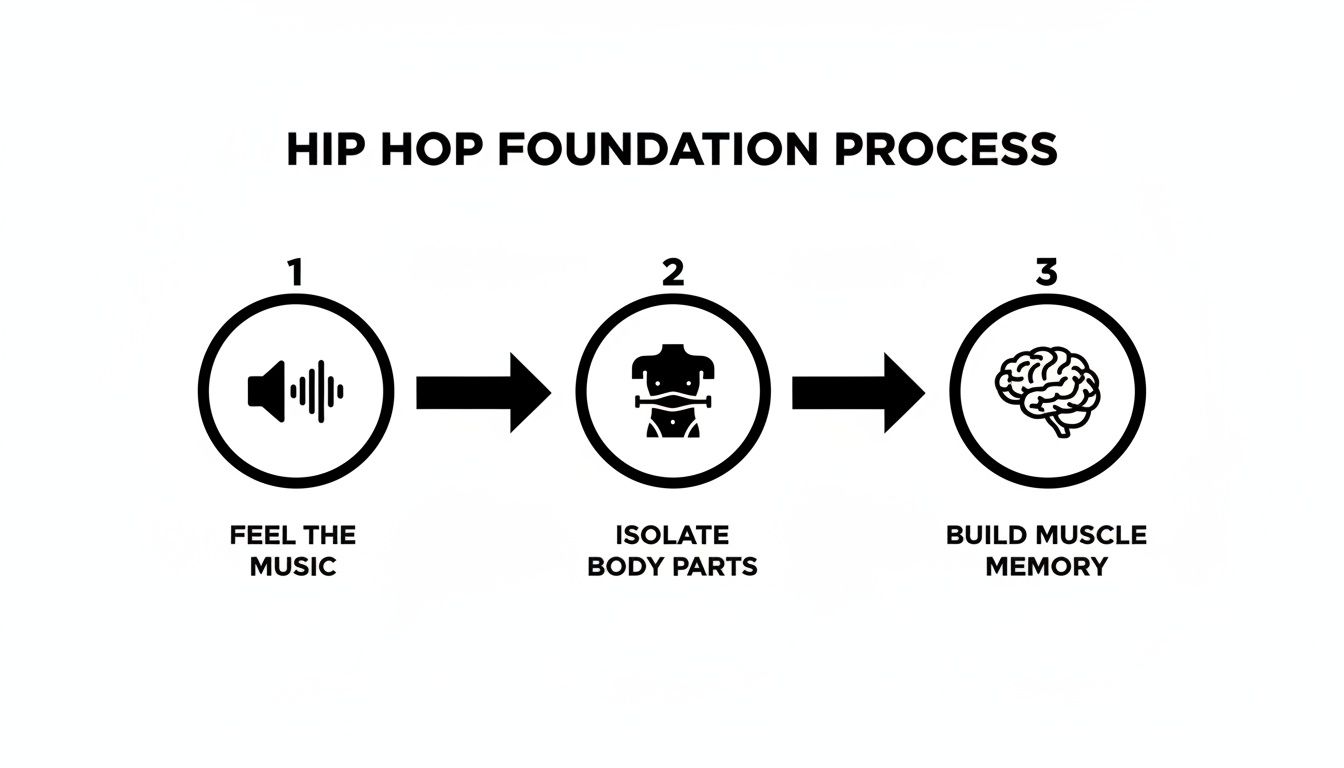
It always starts with the music. You feel the beat, you isolate the right body parts, and then you drill it until it becomes second nature. That's how muscle memory is built.
1. The Running Man
This is it—the one everyone knows. The Running Man is arguably one of the most famous hip-hop moves ever. It’s all about creating a smooth illusion of running in place, and nailing it is a rite of passage for every new dancer.
- Start with your right knee lifted high, left foot flat on the floor.
- As your right foot comes down, let it tap the ground as your left foot slides backward.
- Immediately lift your left knee high and repeat the motion, sliding your right foot back this time.
The secret is the slide. A common beginner mistake is to stomp down, which completely kills the gliding effect. Keep your arms relaxed and pumping naturally, just like you would if you were actually jogging.
2. The Cabbage Patch
This classic move is pure groove. It’s all about a relaxed, circular motion with your arms that gets your whole body moving with it. It’s a super fun, social dance that’s easy to pick up.
Imagine you're stirring a giant pot right in front of you. Your hands are in loose fists, making big horizontal circles. Let your hips and legs follow that momentum, shifting your weight from side to side with a nice, easy bounce in your knees. The key is to keep it loose and effortless.
3. The Bart Simpson
Yep, it’s named after that Bart. This is a playful, high-energy step that’s all about hopping side to side. It’s a great way to travel across the floor and inject some bounce into your dancing.
Start with your feet together. Hop to the right while kicking your left leg out. Then, hop back to the left while kicking your right leg out. It’s a simple two-step pattern, but you can give it some serious style by swinging your arms and adding your own unique bounce.
4. The Roger Rabbit
Here's another illusion-based move that makes it look like you're hopping backward. The Roger Rabbit is a bit trickier than the Running Man, but it feels incredibly cool once you get the hang of it.
You're essentially doing a little skip or hop backward, pulling your "free" leg up behind you. The whole movement is driven from your knees with a quick kick-and-pull motion.
The secret to the Roger Rabbit is keeping it small. The movement is much tighter and quicker than most people think. Focus on keeping the motion close to the ground to really sell that backward illusion.
For families with younger dancers just getting started, breaking these moves down in a fun, positive way is everything. Our guide on essential hip hop dance moves for kids has more tips and simplified versions perfect for them. We've seen so many of our students from nearby cities like Draper and Lehi begin with these exact basics before growing into amazing, confident dancers.
Developing Your Rhythm and Musicality
Anyone can learn to execute a dance move. But to truly dance hip-hop, you have to become part of the music. It’s a conversation between your body and the beat, a skill we call musicality, and it’s what turns mechanical steps into a performance that actually connects with people.
Think about it: every track is packed with layers. You’ve got the deep bassline driving everything, the sharp crack of the snare, the intricate patterns of the hi-hats, and of course, the rapper's lyrical flow. A great dancer hears all of it. They feel those different elements and decide which ones to bring to life with their body.
Training Your Musical Ear
Before you even think about moving, you have to learn how to listen. I mean really listen.
The next time you play a hip-hop track, just close your eyes. Forget the steps. Try to isolate each sound. Can you tap your foot only to the bass drum? Can you snap your fingers perfectly in time with the snare? This simple drill is huge—it trains your brain to pick apart the rhythms that are all happening at once.
This is something we work on constantly in the studio. We get dancers from all over, including nearby Riverton, and we often kick off class with listening exercises. When you can clearly identify all the different sounds in a track, you suddenly have a much bigger playground to explore with your movement.
"The beat is your roadmap, but the individual sounds are your destinations. A great dancer visits them all."
Once you can hear those layers, you can start reacting to them. Maybe you use a smooth, continuous body roll to ride out a long bass note. Then, you hit a sharp, sudden freeze to accent that loud snare hit. This is how you start telling a story with your dance.
If you really want to level up, getting a handle on how music is put together can be a game-changer. Our guide on music theory lessons for beginners is a great place to start and will totally change the way you hear rhythm.
Drills for Better Rhythm and Timing
Listening is step one, but you’ve got to put it into practice to build that muscle memory. Here are a couple of drills you can do literally anywhere to sharpen your internal metronome.
- Master the 8-Count: Almost every piece of hip-hop music and choreography is built on counts of eight. Get in the habit of counting "5, 6, 7, 8" and then "1, 2, 3, 4, 5, 6, 7, 8" out loud along with a song. It sounds basic, but building this internal clock makes learning routines a thousand times easier.
- Tempo Exploration: Don't get stuck in a rut. Throw on a playlist with different tempos and just freestyle. Start with something slow and mellow to really nail your fluid movements. Then, switch to a fast, high-energy track to push your speed and control. This forces you to adapt your groove on the spot, a skill every dancer needs.
In the end, musicality is all about letting the track lead the way. The more you listen and just play around, the more your movements will feel less like something you’re doing and more like a natural reaction to the sounds you hear.
Why Joining a Class Is Your Fastest Path to Progress
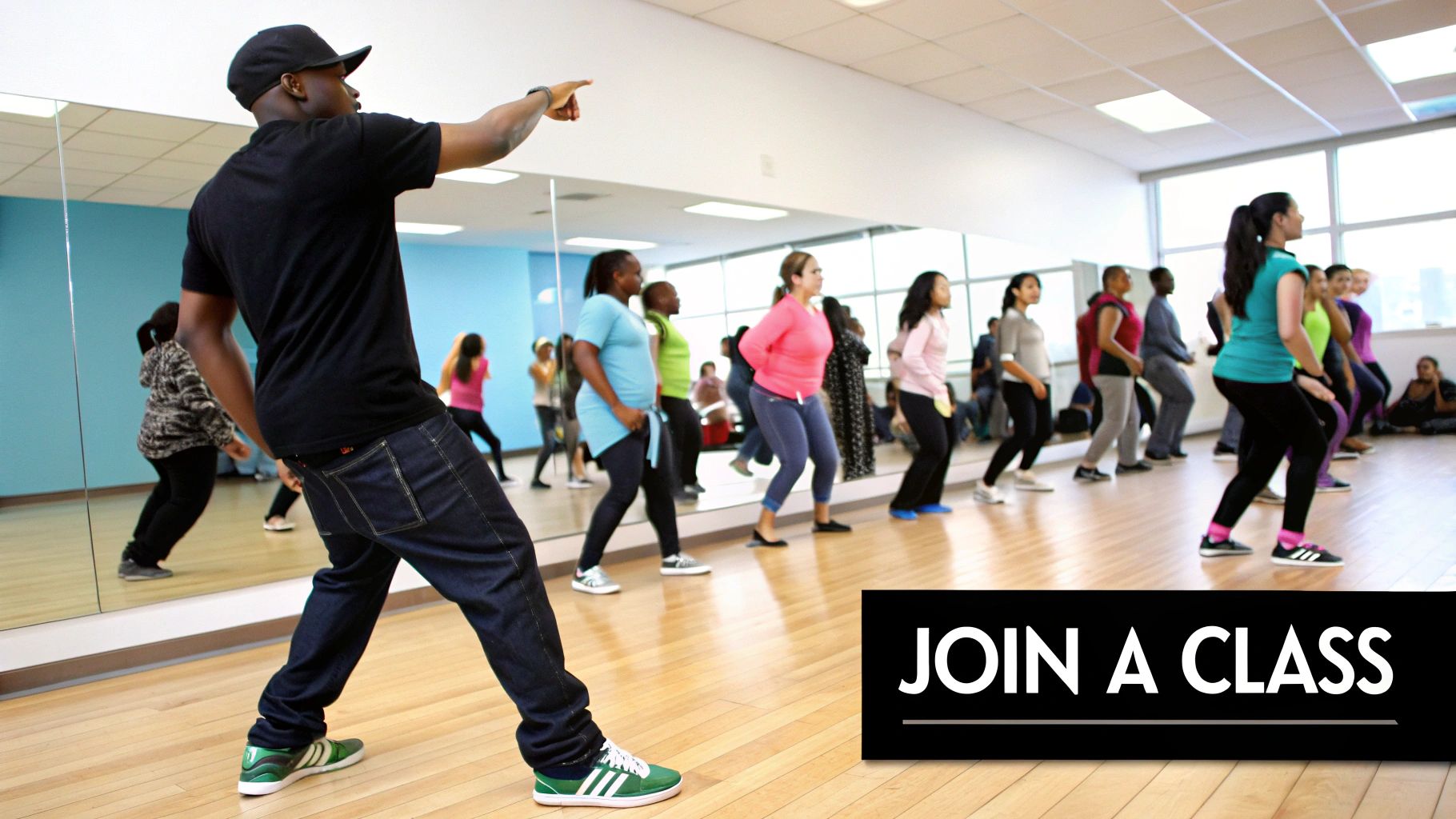
Practicing at home is a great start. You can get comfortable with the basics and build some muscle memory on your own time. But if you really want to get good, and fast, nothing beats the energy and expertise of a structured class.
There's a reason we have so many dancers making the trip from places like Sandy and Riverton to our studio in Bluffdale. They know that what you get in a live class—real-time feedback and a motivating group atmosphere—is something a YouTube tutorial just can't replicate.
The Power of Expert Feedback
An experienced instructor sees things you can't. They’re not just showing you moves; they’re watching you, ready to pinpoint exactly why something isn't quite clicking. It might be a tiny shift in your weight or a slight adjustment in your posture that makes all the difference.
In a group class, you learn not only from your own corrections but from watching others receive feedback. This shared learning experience is one of the most powerful tools for rapid improvement.
This is how you go from just copying shapes to truly feeling the movement. That personalized guidance helps you understand the groove from the inside out, not just how it looks on the surface.
Motivation and Community Energy
Let's be honest: learning to dance can be tough. On days when you feel clumsy or uninspired, the collective energy of a room full of people working toward the same goal can be the push you need.
- Positive Peer Pressure: When you see the person next to you finally nail a tricky step, it inspires you to keep trying.
- Shared Accomplishment: There's nothing like the feeling of a whole class hitting a piece of choreography in sync. It builds a powerful sense of camaraderie.
- Consistent Accountability: Having a set class time creates a routine. Just showing up is half the battle, and it keeps you committed to your progress.
The idea of formal dance training is growing. The global dance training market was valued at around USD 15 billion in 2024, and it's on the rise as more people look for structured ways to get fit and express themselves.
What to Expect in Your First Class
Walking into a dance studio for the first time can feel like a big deal, but it really doesn't have to be intimidating. Beginner hip-hop classes are designed to be welcoming. The whole point is to have fun, get you moving, and build your confidence from the ground up.
If you're feeling those first-day jitters, our guide on what to expect from dance classes in Utah can help put your mind at ease. Just remember, every single person in that room was a beginner once. The most important thing is to show up, connect with the music, and enjoy the first step of an awesome journey.
Got Questions About Learning Hip Hop? We've Got Answers.
Stepping into the world of hip hop can feel a little intimidating, and it's totally normal to have a bunch of questions swirling around. Let's tackle some of the things that are probably on your mind.
What’s the Dress Code for Class?
Honestly, it’s all about comfort. You need clothes that you can really move in without feeling restricted.
Think sweatpants, joggers, loose-fitting shorts, or leggings on the bottom. Up top, a simple t-shirt or tank top is perfect. The most important piece of gear is your footwear—grab a pair of supportive sneakers that won’t leave scuff marks on the studio floor. The goal is to wear something that makes you feel ready to dance, not something that makes you feel self-conscious.
Do I Already Need to Be Super Fit?
Not at all. In fact, hip hop class is one of the best ways to get in shape. It's a workout that's so much fun you'll forget you're even exercising.
Every good beginner class starts with a proper warm-up and eases you into the more intense stuff. Your instructor knows everyone is starting from a different place, and the whole point is to build your strength, stamina, and coordination over time. You just have to show up.
Should I Learn Online or in a Studio?
This is a big one, especially now that you can find a tutorial for just about anything online. Before the world went remote, studios were pretty much the only option. Now, the online dance training market is projected to hit around USD 8.9 billion by 2034, which tells you a lot about how people are learning these days. You can actually read more about these dance market trends if you're curious.
Most dancers I know find a sweet spot by mixing both. They'll use online videos to drill a specific move or practice choreography at home, but they rely on a studio for the stuff you just can't get through a screen: personalized feedback, a sense of community, and the chance to perform.
My two cents? A hybrid approach is the way to go. Use online resources as a supplement, but nothing beats an instructor who can see what you’re doing and give you that one tiny correction that makes everything click.
For dancers here in the Bluffdale area, making the short drive from Draper or Riverton for that in-person connection is a game-changer. Having an expert physically in the room with you is what turns simply going through the motions into actual, noticeable progress.
Your hip hop journey is ready when you are. Here at Encore Academy for the Performing Arts, we've built a supportive, expert-led space where you can find your groove and build real confidence.
Why not book a trial class and see for yourself? We’d love to help you tell your story through dance.
Find out more at https://www.encoreacademyut.com .