
A Pianist's Guide on How to Improve Sight Reading Piano
When you want to get better at sight-reading, it’s not about drilling flashcards until you can name notes faster. The real secret is to stop thinking about individual notes altogether. Instead, you need to train your brain to see the bigger picture—to recognize patterns, shapes, and rhythms in chunks. It's the difference between spelling out a word letter by letter and just reading the word.
This shift from "note-naming" to "pattern-spotting" is what transforms sight-reading from a stressful chore into a fluid, musical experience.
Mastering the Fundamentals of Sight Reading
So many pianists get stuck because they believe sight-reading is just about identifying C, F-sharp, or B-flat at lightning speed. While that’s part of it, it’s a very small part. Fluent sight-readers don't see a random jumble of dots; they see a landscape of musical ideas and relationships.
Our goal is to build that foundational understanding, making music feel as natural to read as a book. It all starts with three core skills.
Instantly Recognize Intervals
First things first: you need to get good at interval recognition. This is simply the ability to see the distance between two notes instantly. Instead of seeing a C and then a G, a seasoned reader sees a "fifth." This is a game-changer because the visual shape of a fifth is the same no matter where it appears on the staff.
Your brain can process these shapes way faster than it can name two separate notes and then do the mental math. Think about it: you don't read "apple" by sounding out A-P-P-L-E every single time. You just see the shape of the word. Intervals are the musical equivalent of common words.
Start by drilling the most frequent ones until they're second nature:
- Seconds (Steps): These are your neighbors—notes on an adjacent line and space.
- Thirds (Skips): These hop over a line or space (e.g., from a line to the very next line).
- Fourths and Fifths: Once you spot these easily, you'll start seeing the skeletons of chords everywhere.
Feel the Rhythm Before You Play
Rhythm is the engine of the music. If you lose the pulse, the whole thing grinds to a halt. A common mistake is to get so wrapped up in finding the right notes that the rhythm goes right out the window. A powerful trick is to take the notes out of the equation entirely, at least for a moment.
Before you even try to play a new piece, tap or clap the rhythm of the first few measures. Get a metronome going to keep you honest. This helps internalize the rhythmic feel in your body, freeing up precious brainpower to focus on the pitches when you start playing.
The golden rule of sight-reading is to keep going no matter what. It's far better to maintain a steady tempo and miss a few notes than to play every note perfectly but with constant stops and starts.
Spot Common Musical Patterns
Music is wonderfully repetitive. It's built from recurring patterns like scales, arpeggios, and common chord progressions. The more of these you can spot at a glance, the less you'll have to read note-by-note. This is a huge focus in any solid set of music theory lessons for beginners .
Train your eyes to look for these common shapes:
- Scales: See a string of notes moving up or down step-by-step on consecutive lines and spaces? Don't read each one—just recognize it as a scale and let your fingers take over.
- Arpeggios & Broken Chords: These are just chords played one note at a time. A C-E-G pattern is a C major chord. Seeing that shape is much faster than reading three separate notes.
- Chord Shapes: Get familiar with how basic triads look. A root position chord, for instance, always looks like a neat stack of thirds (line-line-line or space-space-space).
By zeroing in on these fundamentals—intervals, rhythm, and patterns—you’re training your brain to work smarter, not harder. This is the real path to becoming a confident sight-reader.
Building a Consistent Daily Practice Habit
Getting a handle on the fundamentals is a fantastic start, but consistency is what truly fuels real progress in sight reading. So many pianists I've worked with, from Riverton to Sandy, think they need to block out huge, grueling practice sessions to get better. That's one of the biggest myths out there. The real secret is a short, focused, and consistent daily habit.
You don't need an hour. You don't even need thirty minutes. A dedicated 10-15 minute daily commitment is so much more powerful than one long, stressful session per week. This bite-sized approach builds momentum, reinforces skills before your brain has a chance to forget them, and helps you sidestep the burnout that comes from trying to do too much at once.
Starting With Targeted Drills
The whole point of a short practice session is to make every minute count. To do that, we zero in on specific, targeted drills that build your foundational skills piece by piece. Instead of trying to tackle a complex piece of music right away, we break sight reading down into its core components.
Here are three non-negotiable drills to get you started:
- Five-Finger Position Exercises: Think of these as your daily vitamins for hand-eye coordination. Just place your right hand on C-D-E-F-G and play simple patterns written on the staff using only those five notes. The goal here isn't to create a musical masterpiece; it's to forge an instant, automatic connection between seeing a note and your finger playing it.
- Simple One-Hand Melodies: Once you're comfortable in one position, find some short melodies—maybe four to eight measures long—and practice them with one hand at a time. This isolates the task of note recognition and lets you focus completely on reading the melodic contour, which is just a fancy way of saying the ups and downs of the musical line.
- Rhythmic Clapping and Tapping: Before you play a single note of a new exercise, clap or tap out the rhythm. Seriously. Grab a metronome to keep you honest and just focus on the rhythm. This solidifies your internal clock so that when you add the notes, the rhythm is already baked in. Separating these tasks—rhythm first, then notes—is a game-changer.
This process flow shows exactly how these different skills—recognizing intervals, feeling the rhythm, and spotting patterns—all feed into each other.
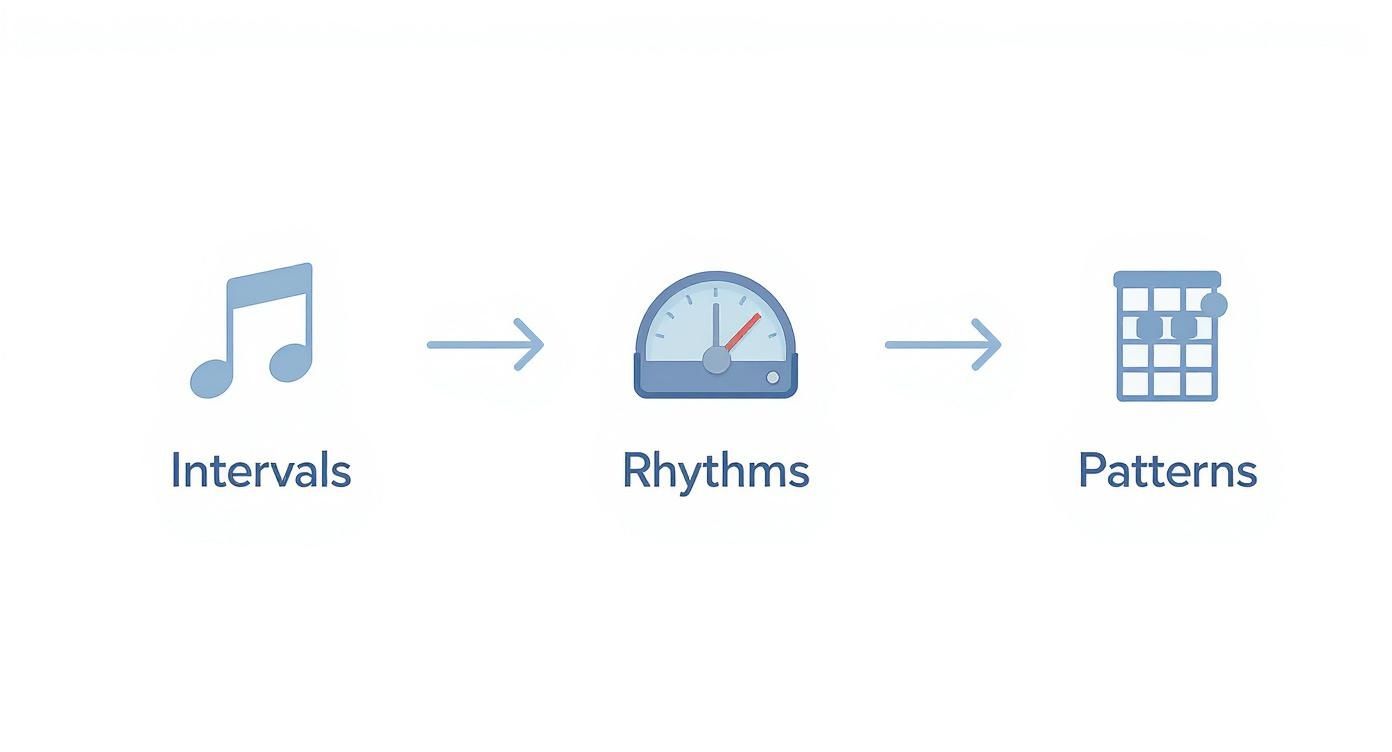
It’s not just one skill; it's a bundle of related abilities that you need to develop together.
The "Easy But Unfamiliar" Rule
Here’s the biggest mistake I see pianists make: they try to sight read music that’s at their current playing level. This almost always ends in frustration, mistakes, and reinforces the bad habit of constantly stopping and starting.
To build true reading fluency, you have to practice with music that is significantly easier than what you can play after a few practice sessions. If you’re playing Level 4 repertoire, you should be sight reading at Level 1 or 2.
This approach lets you concentrate purely on the act of reading without getting tangled up in tricky technical demands. The goal is flow and continuity, not wrestling a difficult piece into submission on the first try. As your reading chops improve, you can slowly level up your practice material. It’s a strategy that works for everyone, from our youngest beginners in Bluffdale to our advanced performers from Draper, because it flat-out gets results.
Working with an instructor can be a huge help in structuring this process and getting personalized feedback. If you're looking for that kind of guidance, you can explore our full music program schedule to see what might be a good fit.
To help you get started, I’ve put together a sample weekly plan. A balanced routine like this ensures you're hitting all the key skills without getting bored. Feel free to adapt it to your own needs!
Sample 15-Minute Daily Sight Reading Schedule
A balanced daily routine combining rhythm, melody, and coordination to build a strong sight reading foundation.
| Monday | Clap quarter and half note rhythms with a metronome. | Play five-finger position exercises in C Major (Right Hand). | Sight read a Level 1 piece, focusing only on the rhythm. |
|---|---|---|---|
| Tuesday | Tap eighth note patterns from a beginner rhythm book. | Play five-finger position exercises in G Major (Left Hand). | Sight read a new Level 1 piece with the right hand alone. |
| Wednesday | Introduce dotted quarter notes by clapping simple phrases. | Practice melodic intervals of 2nds and 3rds (one hand). | Sight read the same piece with the left hand alone. |
| Thursday | Review all rhythms from the week, alternating measures. | Combine hands in the C Major five-finger position. | Attempt to play the piece with both hands slowly. |
| Friday | Sight read a rhythm-only exercise from a sight-reading app. | Practice melodic intervals of 4ths and 5ths (one hand). | Find a brand new, easy piece and play it through once. |
| Saturday | Clap syncopated rhythms slowly with a metronome. | Alternate hands playing simple arpeggios (C-E-G). | Review Friday's piece, focusing on keeping a steady beat. |
| Sunday | Rest or playfully clap rhythms from a favorite pop song. | Free choice—review the week's most challenging drill. | Play through any of the week's pieces for fun. |
This kind of structured routine creates a powerful feedback loop. Each day reinforces what you did the day before, which builds skills and, just as importantly, boosts your confidence. Trust me, this small daily investment pays off big time in your ability to read music fluently and musically down the road.
Training Your Brain for Faster Recognition
Beyond the daily drills and pattern work lies a fundamental truth about sight-reading: it's less about fast fingers and more about a fast brain. The best sight-readers aren't just physically nimble; they've trained their minds to absorb, interpret, and anticipate musical information at an incredible speed.
This is a mental game, plain and simple. Understanding how your brain processes the music on the page is the real key to unlocking fluency. Many of our students from Lehi and Draper experience a huge breakthrough when they stop treating sight-reading as a purely technical exercise and start approaching it as a cognitive skill.
Demystifying the Eye-Hand Span
One of the most crucial concepts in this mental training is the Eye-Hand Span (EHS). Put simply, this is the distance between the note your eyes are reading and the note your hands are playing. Beginners often have an EHS of nearly zero—they look at a note, then play it, look at the next note, then play it. This one-to-one approach is what creates hesitant, choppy music.
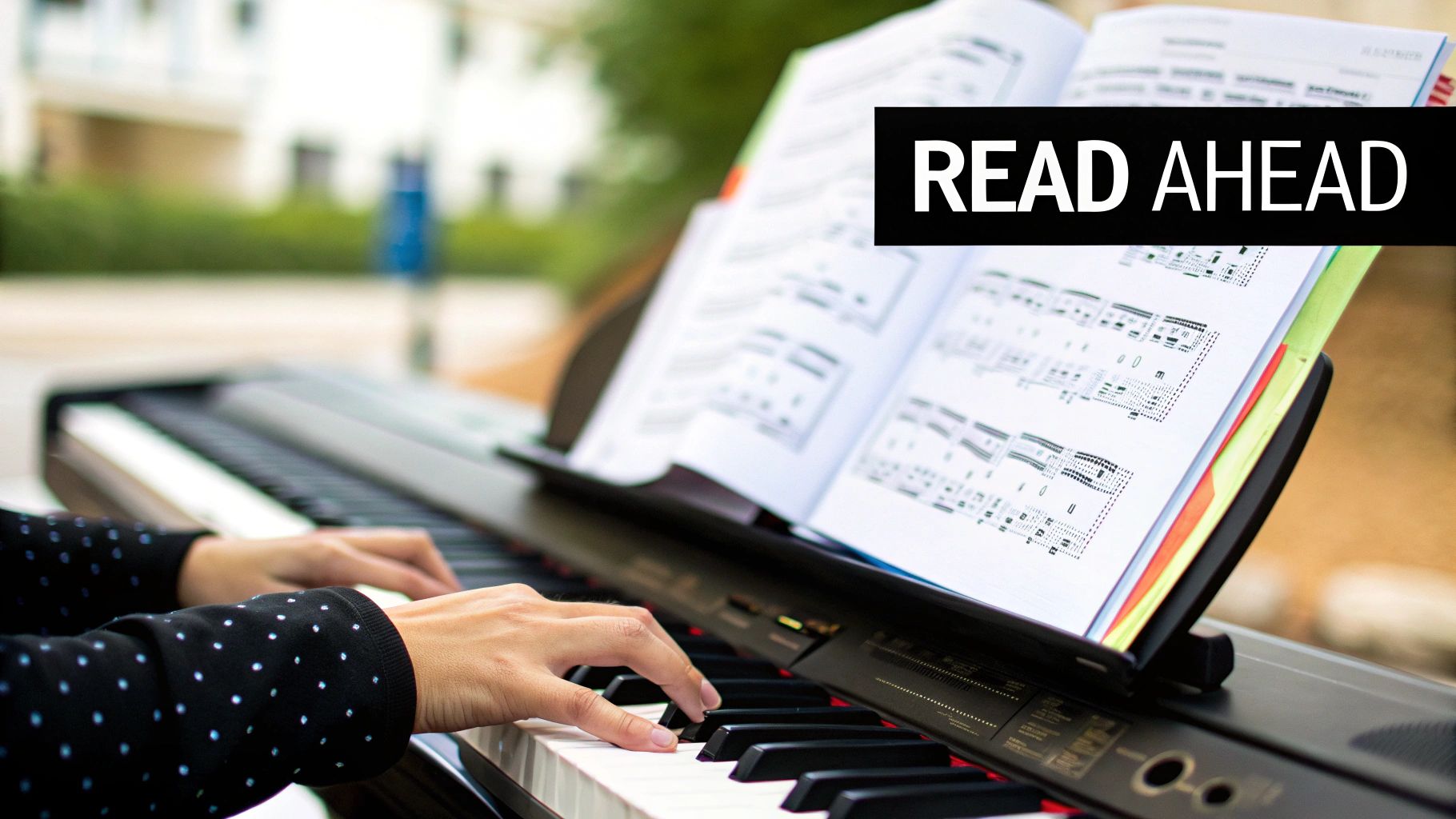
Fluent sight-readers do the opposite. They maintain a wide Eye-Hand Span, keeping their eyes several beats, or even a full measure, ahead of their hands. This "look-ahead" strategy gives their brain precious time to process what's coming next—a tricky rhythm, a big leap, a sudden accidental—before their fingers ever have to deal with it.
The single most important technique for fluent sight reading is learning to read ahead of where you are playing. It transforms the experience from a frantic reaction to a controlled, forward-looking performance.
Think of it like driving a car. You don't stare at the pavement directly in front of your tires. You scan the road far ahead to anticipate curves, traffic, and potential obstacles. Widening your EHS is the musical equivalent of that forward gaze.
Boosting Your Cognitive Horsepower
So, how do you actually train your brain to read ahead? It all comes down to strengthening two core cognitive abilities: working memory and visuospatial processing. Your working memory holds a chunk of music in your mind while your hands are busy with the previous chunk. Your visuospatial skill helps you quickly recognize the shapes and patterns on the page.
Recent research on pianists' eye movements confirms this. It found that experts have longer eye-hand spans and spend less time looking down at their hands. Their incredible efficiency is directly linked to strong cognitive functions, proving that sight-reading excellence is built on mental agility. You can dig into the cognitive processes behind expert sight reading to see how the science backs this up.
Here are a few practical exercises to build these mental muscles:
- The Cover-Up Game: Play the first beat of a simple measure, then use a small piece of paper to cover it while you play the rest of the measure from memory. Gradually increase the amount you cover, forcing your brain to retain more information.
- Flash-Card Drills: Use flash cards with short, one-measure patterns. Give yourself just two or three seconds to look at a card, then try to play the pattern from memory. This is a direct workout for absorbing musical chunks quickly.
- Sing Before You Play: Before your fingers touch the keys, look at a simple melodic phrase and sing it aloud (using note names or solfege). This auditory step helps cement the musical information in your working memory.
Improving your sight-reading is about so much more than just logging hours at the keyboard. It's about targeted brain training that makes the connection between your eyes, brain, and hands faster and more automatic. To see how these principles are woven into a structured curriculum, explore our comprehensive music programs at Encore. When you start treating sight-reading as the high-level cognitive skill it is, you'll break through plateaus and unlock a new level of musical freedom.
Choosing the Right Music for Sight-Reading Practice
What you practice is just as important as how you practice. I've seen it time and again: a student from Sandy gets frustrated and stalls out simply because they're trying to sight-read music that's way too hard. The goal isn't to wrestle with your most difficult repertoire on the first go. It's about finding that perfect sweet spot.
I call this the "easy but unfamiliar" zone. The music needs to be simple enough that your brain can focus entirely on the act of reading, not on tangled fingerings or tricky rhythms. If you're struggling with the technical side, you aren't really sight-reading anymore—you're just struggling.
As a rule of thumb, always choose music that is at least two or three levels below your current performance level. This is the single best piece of advice I can give for making real, steady progress.
Where to Find Your Practice Material
So, where do you get an endless supply of this "easy but unfamiliar" music? The good news is, there are tons of options out there. Building a personal library of sight-reading material is one of the best investments you can make in your playing.
Here are a few of my go-to recommendations for students:
- Graded Method Books: Series like Faber's Piano Adventures or Alfred's Basic Piano Library are goldmines. If you’re playing at a Level 4, go out and buy the Level 1 and 2 books from the same series. They’re perfect for this.
- Hymnals and Folk Song Books: These are fantastic. The melodies are often simple, the chord structures are predictable, and the rhythms are straightforward. They’re excellent for training your brain to spot common patterns.
- Online Sight-Reading Generators: For a truly endless supply, tools like Sight Reading Factory are brilliant. They can generate brand-new musical examples tailored to your exact skill level, which completely sidesteps the common problem of accidentally memorizing your practice pieces.
How to Size Up a Piece in 30 Seconds
Before you even touch the keys, take just 30 seconds to scan the page. This isn't about studying the piece; it's about getting the lay of the land so your brain knows what to expect.
Here’s a quick mental checklist I run through with my students in Bluffdale:
Key Signature: How many sharps or flats? For practice, stick to keys you know well, typically those with three or fewer accidentals.
Time Signature: Is it a straightforward 4/4 or 3/4? Or is it something trickier like 6/8 or 5/4 that might trip you up?
Rhythm: Glance at the smallest note values. Are you seeing a lot of sixteenth notes or complex syncopation? If so, maybe save that piece for another day.
Leaps: Scan the melodic line for big jumps. Stepwise motion is much easier to process on the fly than large, awkward leaps.
This quick assessment is a skill in itself. It keeps you from diving into a piece that’s just going to lead to frustration. Developing this judgment is key to building a practice routine that you can actually stick with. If you'd like more personalized guidance, our piano lesson programs are designed to help you select the perfect material at every stage.
Recent research on young pianists underscores this approach. A fascinating study confirmed that skilled sight-readers rely on a mix of aural pattern recognition and spatial reasoning—it's not just about finger dexterity. The study also found that proficient readers keep an average eye-hand span of five to six notes, proving just how vital it is to read ahead. And you can only read ahead when the music isn't too hard. You can read the full study about how comprehensive training boosts sight reading for a deeper dive into the science.
Overcoming Common Sight Reading Hurdles
Every pianist, from a brand-new beginner in Herriman to a seasoned player in Draper, hits a wall with sight reading. It’s that familiar, frustrating moment when the notes blur, your fingers feel like they belong to someone else, and the urge to stop and fix a mistake is overwhelming. Trust me, this is a universal part of the journey. The real trick is learning how to push through these moments, because that's what separates a fluent reader from a struggling one.
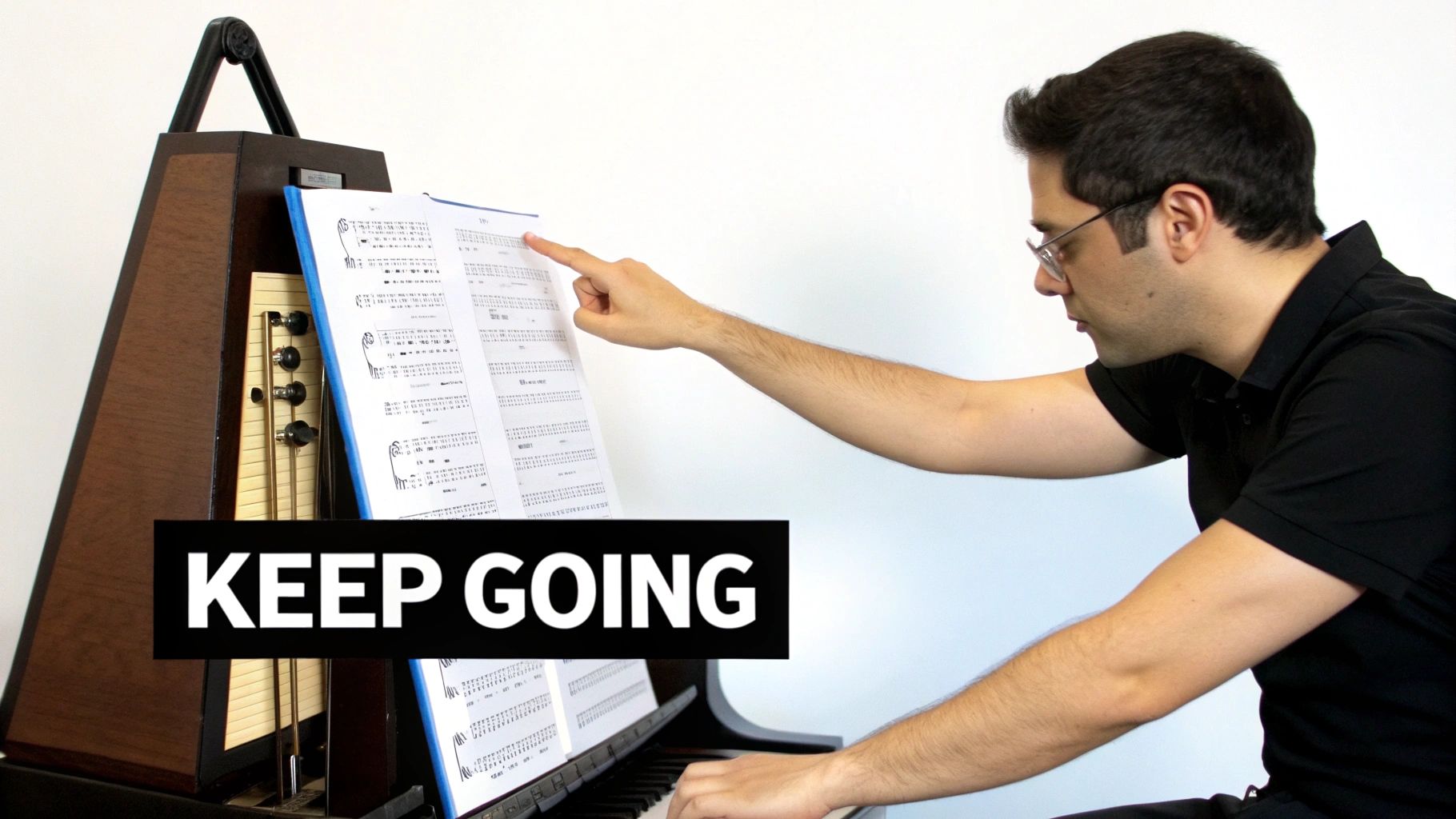
The single biggest hurdle? Stopping dead in your tracks after a mistake. The second a wrong note sounds, the instinct is to freeze. While accuracy is obviously the goal, the absolute golden rule of sight reading is to keep going at all costs. Maintaining a steady pulse is infinitely more important than hitting every single note on the first go.
Think of it like reading a sentence out loud. If you stumble over a word, you don't stop and start the entire paragraph again. You just keep the conversation moving. Music is no different—the rhythm is the flow, and your main job is to protect it.
The Mental Game of Mistakes
Panic is a performance killer. We've all been there: you see a tricky run of sixteenth notes or a dense chord looming on the horizon, and your brain just freezes. That little jolt of anxiety makes it nearly impossible to process what’s on the page.
The solution is to build a more resilient mindset. Instead of aiming for perfection, your new goal is continuity. Give yourself permission to flub a note or two in that scary-looking passage, as long as you land squarely on the downbeat of the next measure. This mental shift takes the pressure off and keeps your brain in the game.
Here are a few survival tactics we teach to build this resilience:
- Simplify on the Fly: Can't process a dense, five-note chord in time? Just play the top and bottom notes. You’ll preserve the basic harmony and keep the music moving.
- Ghost the Notes: If a fast passage looks impossible, you can "ghost" it by lightly tapping out the rhythm on the keys without fully depressing them. This keeps your hands engaged and your internal clock ticking.
- Look for the Next Landmark: Train your eyes to always scan ahead for the next major beat or harmonic shift. This gives you a safe landing spot to aim for, even if getting there is a little messy.
These aren't just tricks; they're strategies for navigating musical challenges in real-time without letting one stumble derail the whole piece. The expert instructors on our team spend a lot of time working with students on these very mental strategies to build sight-reading confidence.
Turning Awkward into Automatic
Beyond the mental game, there's a physical reality to overcoming sight-reading hurdles. Every single time you practice, you are literally rewiring the connection between your brain, eyes, and fingers. What feels clumsy and awkward at first gradually becomes smooth and automatic with focused repetition.
This isn't just a feeling; it's backed by science. Biomechanical research has shown that a pianist's movements become more efficient after just one repetition of a sight-read piece. One study even measured significant jumps in the speed and range of motion of the hands between the first and second attempts. You can explore the research on neuromuscular adaptation in pianists to see just how quickly our bodies learn and adapt.
What this really means is that every time you push through a difficult passage—even if it's messy—you are physically teaching your hands how to be more efficient and coordinated for next time.
Ultimately, getting past these common hurdles comes down to building better habits. It’s about training yourself to prioritize rhythm over perfection, managing your reaction to mistakes, and trusting that consistent, focused practice will eventually make the impossible feel easy.
Tackling Your Top Sight-Reading Questions
As you start to really dig into sight-reading, you're going to have questions. It's a tricky skill, and it’s natural to wonder if you’re doing it right. Let's walk through some of the most common questions I hear from my own students.
Getting these things straight will help you practice smarter, build your confidence, and keep you from getting stuck.
How Long Does It Take to Get Good at This?
This is the big one, isn't it? While there’s no magic number, most pianists start to feel a real difference in their sight-reading ability within three to six months of consistent, daily practice.
And the key really is consistency. You’ll see far better results from 10-15 minutes every single day than you will from one long, grueling session each week. It’s all about creating a habit and letting those connections in your brain form naturally. Progress here is a slow burn, not a sudden flash of brilliance.
Should I Be Looking at My Hands or the Music?
The goal is to keep your eyes glued to the music. You're trying to build proprioception—that fantastic internal GPS that tells your brain where your hands are on the keyboard without you needing to look. You want to feel the keys, not find them with your eyes.
Now, are quick glances forbidden? Of course not, especially for a big jump up or down the keyboard. But your primary focus must be on reading the notes ahead. Every time you look down, you break the flow and have to find your place again. It's a tough habit to break, but it’s absolutely essential for fluent reading.
What's More Important: Hitting the Right Notes or Keeping the Beat?
Rhythm. No question. The golden rule of sight-reading is never, ever stop.
Think about it: if you play a wrong note but nail the rhythm, the listener still gets the gist of the music. They can follow the pulse and the shape of the phrase. But if you play every note perfectly and your rhythm is choppy with stops and starts, the music completely disintegrates. Keeping a steady beat is non-negotiable; it forces your brain to process the music under real-time pressure. This is often the hardest rule for my students from Bluffdale to Lehi to follow, but it pays off big time.
Don't let the fear of a wrong note kill the momentum. A performance with a few clunkers but a rock-solid pulse will always sound more compelling and musical than a technically perfect but hesitant one.
Is It Possible to Be a Great Pianist But a Terrible Sight-Reader?
Oh, absolutely. It’s incredibly common, so don't feel bad if this is you. Playing a polished piece and sight-reading are two totally different skill sets.
- Playing Repertoire is about muscle memory, deep interpretation, and recalling information you've stored over weeks or months.
- Sight-Reading is a live decoding process. It’s about rapid-fire pattern recognition and predicting what comes next on the page.
I've known many phenomenal pianists who can play incredibly difficult concertos from memory but will stumble through a simple hymn they've never seen before. Sight-reading is a separate skill, and just like any other, it only gets better if you give it its own dedicated practice time.
At Encore Academy for the Performing Arts, we make sight-reading a core part of our music lessons to develop confident, well-rounded musicians. To see how our instructors can help you or your child, take a look at our programs at https://www.encoreacademyut.com .