
Learning how to dance to hip hop: A Practical Guide for Beginners
Learning how to dance hip hop isn't about pulling off a crazy choreographed routine on your first day. It’s about putting on some comfortable clothes, getting your head in the right space, and focusing on practice over perfection. It’s a journey that starts with the simple act of finding your own groove and building confidence from the ground up.
Getting Started with Your Hip Hop Dance Journey
Jumping into the world of hip hop is exciting, but it’s totally normal to feel a bit overwhelmed. Where do you even start? The great news is, you don’t need fancy gear or any previous experience to get going. The whole culture is built on personal expression and community, not on being perfect from day one.
Think of this guide as your launchpad. It’s designed to get you comfortable and confident before you even set foot on a dance floor, so you feel prepared and actually want to keep going. We’ll cut through the noise and focus on what really matters for a beginner.
What You Really Need to Begin
First, let's bust a myth: you don't need a specific "look" or expensive branded gear. All you truly need are a few practical things that let you move freely and safely.
- Comfortable Clothing: Grab anything that doesn’t hold you back. Sweatpants, joggers, shorts, and a loose t-shirt are perfect. You want to be able to bend, squat, and jump without feeling restricted.
- Supportive Sneakers: Your most important piece of equipment is a decent pair of sneakers. Try to avoid running shoes with super-heavy tread, as that intense grip can make it tough to pivot and slide on the floor.
- A Positive Mindset: Honestly, this is the most critical part. Give yourself permission to be a beginner. Every single dancer you admire was once in your shoes. Progress comes from showing up consistently, not from having some kind of instant, natural talent.
Setting Realistic Goals and Expectations
Look, progress in dance is a marathon, not a sprint. If you set small, achievable goals, you’ll stay motivated and see real improvement. Instead of telling yourself you need to master a complex routine in a week, just focus on nailing one foundational move or feeling the rhythm of a basic groove.
Hip hop is so much more than a dance style; it's a way to express yourself and tell a story. It started as a way for communities to connect, and that spirit of individuality and support is still at its heart. It’s less about perfectly copying someone and more about finding your own voice through movement.
Your journey is about celebrating the small wins. It doesn't matter if you're practicing in your living room in Riverton or thinking about joining a studio in Draper—the main goal is to enjoy the process of learning. That consistent practice is what builds a solid foundation for everything that follows.
The music’s global reach has made learning hip hop dance more popular than ever. In fact, hip hop was the second most popular music genre worldwide in 2021, with a staggering 1.85 billion listeners. If you're curious, you can check out more stats on the rise of hip hop music to see just how massive its cultural impact is.
For those near Bluffdale who feel ready to take that first step in a studio, exploring what classes are available can give you a clear path forward. You can review our class schedule to see how a beginner hip hop class could fit into your week.
Mastering the Foundational Moves of Hip Hop
Every single hip hop dancer you admire, whether they're killing it in a music video or holding their own in a cypher, started right where you are: with the fundamentals. This is where you build your vocabulary. Think of these foundational moves as your alphabet—once you know them, you can start forming words, sentences, and eventually, tell your own story.
The goal isn't just to mimic what you see. It's about getting these movements deep into your muscle memory so you can add your own style, your own flavor. That's the real spirit of hip hop.
Before we dive in, let's get the logistics sorted. A little preparation goes a long way.
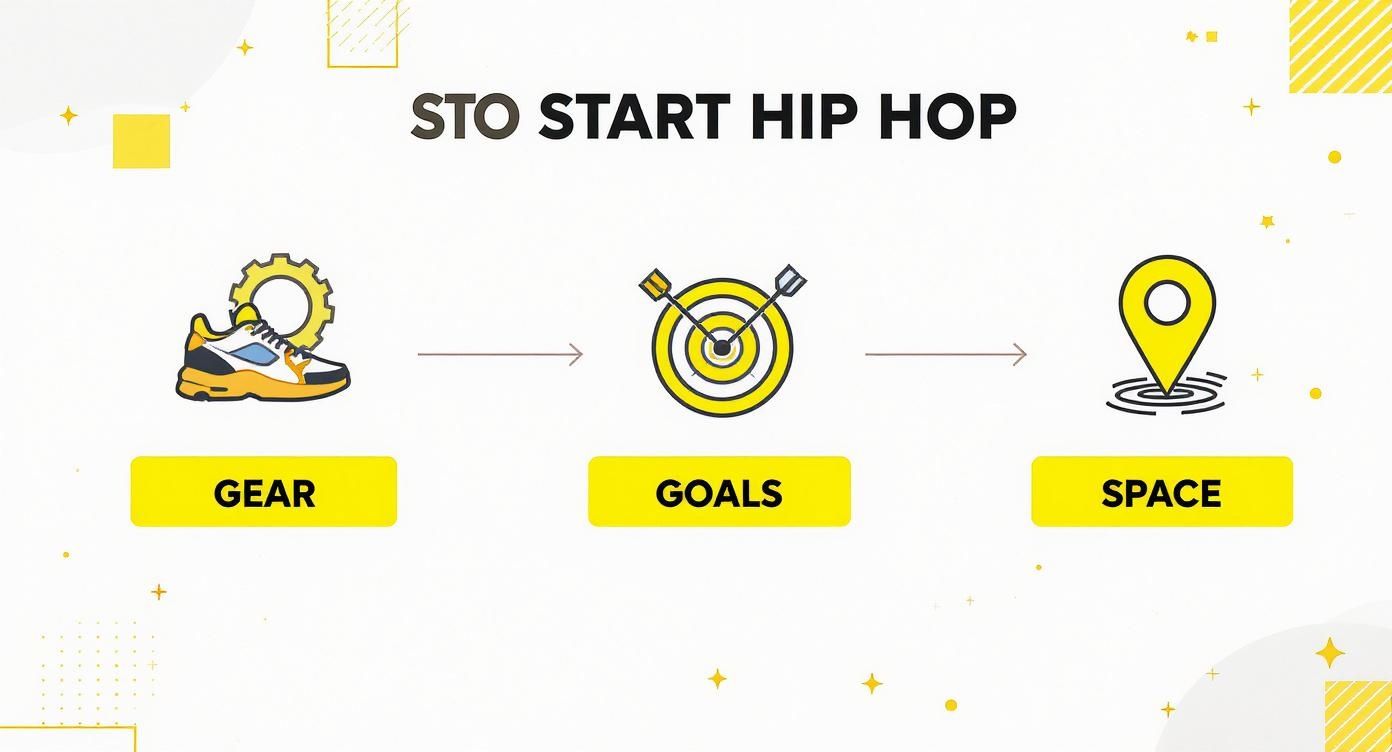
As you can see, it really is that simple. Good shoes, a clear goal, and a spot you can call your own are all you need to get the ball rolling.
Isolations: The Art of Control
Before you can nail any cool steps, you have to learn to control your body. Isolations are the key. They’re drills where you move just one part of your body while everything else stays perfectly still. This skill is what makes movements look sharp, clean, and powerful.
Try this: Imagine a string is pulling just your rib cage to the right, then left, then forward, then back. Your shoulders and hips shouldn’t budge an inch.
- Head Isolations: Practice nodding "yes" and shaking "no," then move your head side-to-side (like a typewriter) without letting your shoulders get involved.
- Shoulder Rolls: Roll your shoulders forward and backward, first one at a time, then together. Feel that full range of motion.
- Rib Cage Slides: This is a big one. Master moving your rib cage side-to-side and front-to-back. It's trickier than it sounds!
- Hip Circles: Isolate your hips by drawing smooth circles. The challenge? Keep your upper body as stable as you can.
These might feel a little robotic at first, but trust the process. You're building the muscle memory that makes complex choreography possible later on. I once had a student from Herriman who told me their biggest breakthrough came from spending a week doing nothing but isolation drills in front of a mirror. It works.
Finding Your Groove and Bounce
The groove, or bounce, is the absolute heartbeat of hip hop. It's that nonstop rhythmic motion that plugs you into the music and makes everything look effortless. It's less of a specific move and more of a feeling—a vibe.
To find it, stand with your feet about shoulder-width apart, knees soft. Throw on a track with a clear, heavy beat. Now, just bounce. Bend and straighten your knees in time with the rhythm. Let your shoulders, arms, and head relax and just go with the flow.
Hip hop is a dialogue between the music and your body. The groove is your response to the beat. It’s your personal, authentic reaction.
Once you feel that basic bounce, start shifting your weight from one foot to the other, letting your upper body follow naturally. This simple weight shift is the secret foundation for countless hip hop steps. You're not just moving to the music; you're becoming a part of it.
Your 4-Week Foundational Moves Practice Plan
To help you put all this into practice, here's a structured plan. Stick with it for four weeks, and you'll build an incredible foundation for your dance journey. Consistency is everything.
| Week 1 | Isolations & Body Control | Head isolations, shoulder rolls (forward/backward), rib cage slides (side-to-side), basic hip circles. | 15-20 minutes: Focus on clean, precise movements. Use a mirror. |
|---|---|---|---|
| Week 2 | Finding the Groove | Basic two-step bounce, weight shifts to the beat, adding relaxed arm swings. | 15-20 minutes: Try grooving to different tempos and styles of hip hop music. |
| Week 3 | Introducing Basic Footwork | The Two-Step, The Cabbage Patch. Continue practicing the bounce and isolations. | 20-25 minutes: Drill each footwork pattern until it feels natural. |
| Week 4 | Combining & Refining | The Running Man. Practice transitioning smoothly between the Two-Step, Cabbage Patch, and Running Man. | 20-25 minutes: Focus on keeping your groove going while executing the footwork. |
After these four weeks, you'll feel much more comfortable and confident in your movement. This isn't about perfection; it's about building a solid base you can grow from.
Classic Footwork Every Beginner Should Know
Ready to learn some iconic moves? After getting comfortable with isolations and your groove, it’s time to tackle footwork. These are often called "party dances" because they are social, fun, and form the basis of so many hip hop styles.
- The Two-Step: The most essential step, period. Just step to the right with your right foot, and then bring your left foot to meet it. Now, repeat on the left side. Simple, right? But it's the foundation for everything.
- The Running Man: A true classic that creates the illusion of running in place. It’s all about timing: lift one knee high while the opposite foot slides back along the floor.
- The Cabbage Patch: This move is pure fun. It combines a side-to-side step with a circular, "stirring the pot" arm motion. It’s perfect for loosening up and just feeling the rhythm.
Don't sweat it if these feel awkward at first—everyone feels that way. Pull out your phone, record yourself, and compare it to a tutorial. Small adjustments make a huge difference. If you're looking for more personalized feedback and structure, exploring our hip hop dance classes can help you master these moves and many more.
Finding Your Rhythm and Musicality
Here's a secret: great hip hop dancing isn't just about nailing the moves. It’s about having a physical conversation with the music. This is where we get into musicality—your ability to actually hear the different layers in a song and let them guide how you move.
Think about the dancers you can’t take your eyes off of. They have a certain magnetism, right? That’s rhythm. It’s what separates someone who is just doing steps from someone who is truly performing.
First, Just Listen
Before you even think about moving, you need to train your ears. Hip hop is incredibly rich and layered. There's the main beat, the bassline, the lyrics, the high-hats, and a dozen other sounds all woven together. Your first job is to start pulling those threads apart.
Seriously, just put on a track, close your eyes, and listen. No dancing yet.
- Find the Kick Drum: This is that deep "boom" sound. It's the pulse, usually hitting on counts 1 and 3. Try tapping your foot to it.
- Catch the Snare: That's the sharper, cracking sound, the "snap" that often lands on counts 2 and 4. You can clap your hands to this one.
- Follow the Bassline: This is that low, groovy melody that everything else sits on top of. Just try nodding your head along with it.
Doing this over and over again trains your brain to hear these different rhythmic options automatically. Soon, you won't even have to think about it; you'll just feel them.
Musicality isn't about hitting every single beat. It’s about choosing which sounds to ride and which to accent, turning your dance into a dynamic performance instead of a robotic one.
This is a non-negotiable skill if you want to learn how to dance to hip hop. If you really want to level up your understanding of rhythm, our guide on music theory lessons for beginners can give your musical ear a serious boost.
From Beat to Body
Okay, once you can pick out the basic parts of the beat, it's time to connect that sound to your body. This is the fun part, where you move beyond just counting and start actually interpreting the music.
The cool thing is, hip-hop is a global language now. Thanks to platforms like TikTok and Instagram, dancers from all over the world share tutorials and challenges, making it easier than ever to learn. If you're curious, you can explore how hip hop dance went global and became the phenomenon it is today.
Ready to try a simple drill?
Kick & Snare Drill: Put on a song with a clear, simple beat. Every time you hear the kick drum, stomp your foot or drop your weight. Every time you hear the snare, make a sharp, quick movement—like a pop in your chest or a quick head snap. This literally teaches your body to have a physical reflex to different sounds.
Lyric & Melody Interpretation: Now, forget the drums for a minute. Try to dance to the rapper's flow or a synth melody in the background. Does the voice get louder? Go bigger. Does the melody get smoother? Make your moves flow. This is how you start telling a story with your dance.
Stringing Moves Together: Your First Taste of Choreography
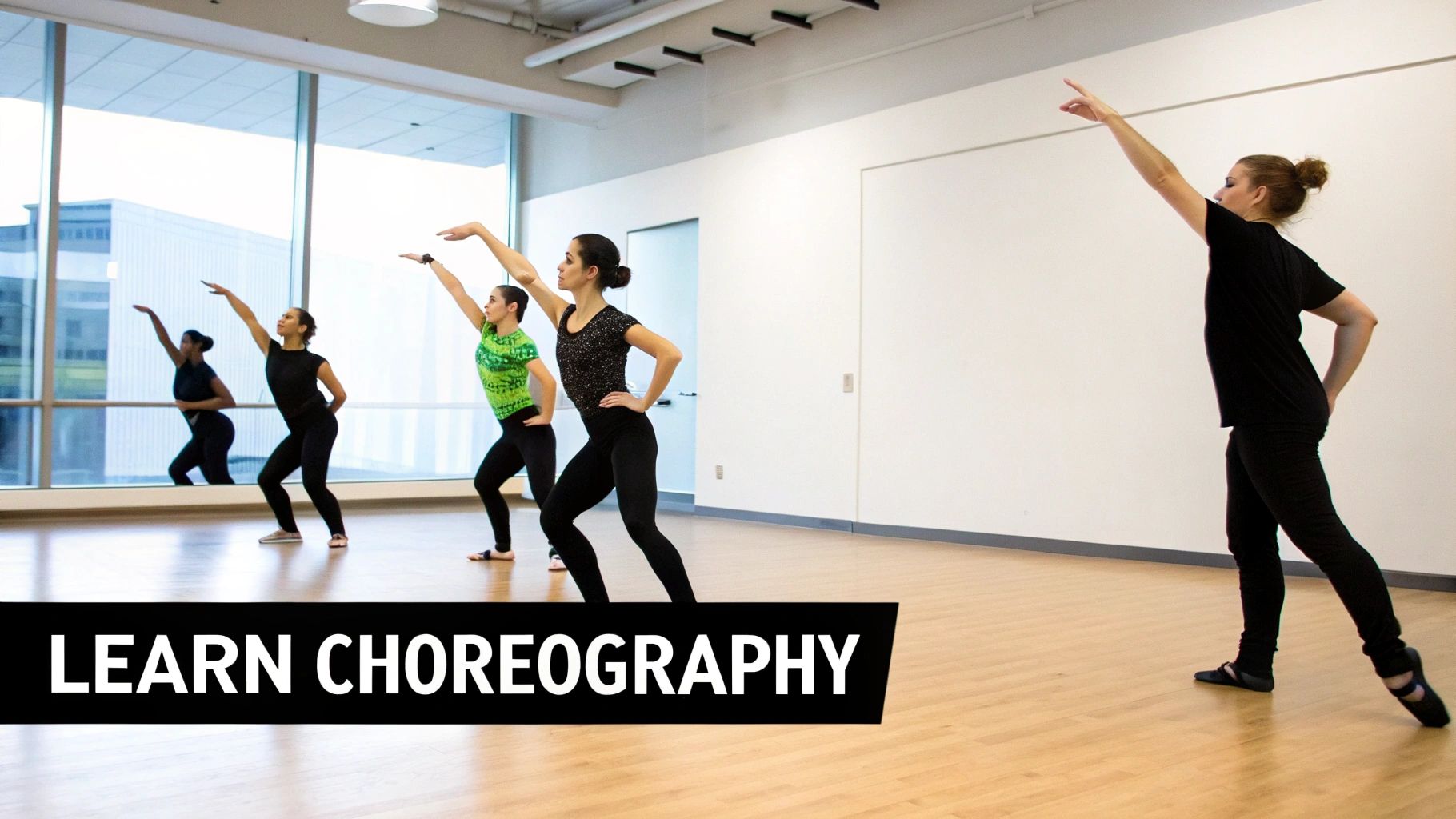
Alright, you've been drilling your isolations, you're starting to find your groove, and your footwork is feeling less clumsy. Now for the fun part: connecting all those dots. Choreography is really just the art of stringing individual moves together to match the vibe and story of a song.
This is the bridge between just practicing steps and actually dancing. It can feel like a huge leap, but if you break it down, you'll find it's way more manageable than it looks. Honestly, this is where the real magic happens.
The 8-Count Is Your Best Friend
Almost every piece of hip hop choreography you'll ever learn is built on the 8-count. Seriously, if you can count to eight, you've got this. Think of it like a musical sentence. In class, instructors break routines down piece by piece, teaching one 8-count at a time.
Your job is to connect one move to each number. It might look something like this:
- Counts 1-2: Two-step out to the right.
- Counts 3-4: Hit a chest pop forward, then pull it back.
- Counts 5-6: Roll your left shoulder.
- Counts 7-8: Strike a sharp pose and hold.
By focusing on one small block at a time, you can build a whole sequence without feeling totally lost. It’s a method we use at our Bluffdale studio with students from all over, including Sandy and Lehi, because plain and simple, it works.
The real breakthrough happens when you stop thinking about each separate move and start feeling the flow between them. The transitions—how you get from count 2 to count 3—are just as important as the steps themselves.
Learn It Slow, Dance It Fast
Don't ever try to learn a new routine at full speed right out of the gate. That’s just a fast track to frustration. The secret is building muscle memory slowly and correctly. We call this "marking," which basically means you walk through the movements at half-speed (or even slower) without worrying about power or hitting it hard.
First, try marking the choreography with no music at all. Just count out loud and get the sequence into your body. Once that feels okay, play the song at 50% speed. When you can do it comfortably, bump it up to 75%. Only after that feels solid should you go for the real tempo. This layering process makes sure the moves are locked in the right way.
How to Make Choreography Stick
Let's be real—memorization is a huge part of dance. Everyone's brain works a little differently, so you'll need to play around and see what clicks for you.
Here are a few tricks I’ve seen work for countless dancers:
- Give Moves a Name: It's so much easier to remember a cue like "slide-stomp-turn" than it is to recall the specific mechanics for counts 1, 2, and 3.
- Connect to the Music: Find a specific word, beat, or sound in the song and attach a move to it. Soon enough, you'll hear that sound and your body will just know what to do.
- Chunk It Down: Never try to swallow a whole 32-count combo at once. Nail the first 8-count until you could do it in your sleep. Then, add the second 8-count, and so on.
The more you practice these techniques, the faster you'll pick up routines in any class. And if you're looking for more basic moves to add to your arsenal, check out our guide on fun hip hop dance moves for kids —many of the fundamentals are exactly the same for all ages.
Knowing When to Join a Local Dance Class
Practicing in your living room is a fantastic start, but sooner or later, you might feel like you’ve hit a wall. That feeling of hitting a plateau is a pretty clear sign it's time to think about joining a structured class. The energy and accountability you get from a group setting are things you just can't replicate on your own.
Stepping into a studio can seriously fast-track your progress. You get instant, personalized feedback from a real instructor, you get to feed off the energy of the group, and you become part of a community that gets what you’re doing.
What to Expect in Your First Hip Hop Class
Walking into a studio for the first time can be a little intimidating, I get it. But knowing what’s coming can make all the difference. Most beginner hip hop classes follow a pretty standard flow designed to build your skills from the ground up.
A typical class usually breaks down something like this:
- Warm-Up: You'll kick things off with a dynamic warm-up to get your blood flowing and prep your muscles. Expect some cardio, stretching, and basic grooves to get you moving.
- Foundations and Drills: From there, the instructor will likely lead everyone through some foundational drills. This is where you'll lock in the basics, like isolations or essential footwork patterns.
- Choreography Breakdown: The main part of the class is learning a short routine. The instructor will break it down piece by piece, usually in 8-count chunks, and repeat it until everyone starts to feel comfortable.
- Performance and Cool-Down: At the end, you'll run the choreography a few times, either all together or in smaller groups. Then, you'll finish with a proper cool-down to stretch out and keep soreness at bay.
Classroom Etiquette and Best Practices
To really get the most out of your class, it helps to know a little studio etiquette. These unwritten rules are all about making sure everyone has a great experience. For instance, try to find a spot where you can see the instructor in the mirror without accidentally blocking someone else's view. It's a small thing that makes a big difference.
And please, don't be afraid to ask questions if a step isn't clicking! Instructors want you to succeed. Most importantly, bring a positive attitude. Everyone in that room is there to learn and have fun, so be ready to cheer on your fellow dancers. For anyone in the Herriman or Riverton area, finding a welcoming studio like Encore Academy in Bluffdale is a perfect place to start.
A studio class is a safe space to make mistakes. Every single dancer in that room, including the teacher, started as a beginner. Embrace the learning process and celebrate your progress, no matter how small.
Hip-hop's popularity just keeps growing. In fact, by 2021, there were roughly 1.2 million dance studio memberships in the U.S., and hip-hop is one of the fastest-growing styles out there. With over 25% of new dance class sign-ups happening on mobile apps, it's never been easier to get involved.
If you feel ready to see what a group class is all about, exploring adult hip hop dance classes is an excellent next step on your dance journey.
Got Questions About Learning Hip Hop? We’ve Got Answers.
Stepping into a new dance style is exciting, but it almost always comes with a few questions. When it comes to learning hip hop, we see the same worries and myths pop up time and time again. This is where we clear the air and give you the confidence to get started.
We hear these from new dancers who walk through our doors every day, whether they're from right here in Bluffdale or drive in from places like Riverton, Sandy, or Draper. Let's tackle them head-on.
Am I Too Old to Start Learning Hip Hop?
Let’s get this one out of the way first: absolutely not. Hip hop is a culture, not an age bracket. The idea that you have to be a kid to get good at something is one of the biggest myths in dance, period. Sure, kids might learn differently, but adults bring a level of focus, discipline, and a genuine connection to the music that’s just as powerful.
At its core, hip hop is about self-expression. There’s no age limit on that. Whether you’re 15 or 55, the goal is to find your own groove and have fun doing it.
How Long Until I Feel Comfortable Dancing?
This is the classic “it depends” question, because everyone’s journey is different. How quickly you feel comfortable depends on your natural coordination, how often you practice, and whether you’re learning in a structured class environment.
That said, here’s a rough timeline you can expect:
- 1–2 Months: You’ll start getting the hang of basic grooves and foundational footwork. That initial awkward feeling begins to fade as your body starts building muscle memory.
- 3–6 Months: Things will start to feel more fluid. You'll pick up simple choreography faster and your musicality will improve—you’ll be connecting to the beat without having to consciously think about every single step.
- 1 Year+: With consistent practice, you'll have a strong foundation under your belt and can really start to develop your own personal style.
The real goal isn't to hit some imaginary finish line where you suddenly "feel comfortable." Comfort is built in small moments, class by class. Celebrate the little wins, like finally nailing that move that felt totally impossible last week.
What’s the Difference Between Hip Hop and Street Dance?
This is a common point of confusion because you’ll often hear the terms used interchangeably. The easiest way to think about it is that "Street Dance" is the big umbrella category. It covers all the dance styles that didn't start in a traditional studio but on the streets, in clubs, and at block parties.
Hip hop is one of the most well-known styles under that street dance umbrella. Other styles include popping, locking, breaking, and house. So, while all hip hop is a form of street dance, not all street dance is hip hop. Many dancers in cities like Lehi and Draper actually train in several street styles to become more versatile.
Do I Need to Be in Great Shape to Start?
You don't need to be a gym rat to start your hip hop journey. You just have to be willing to move. A good hip hop class is definitely a workout, and it will naturally improve your stamina, strength, and coordination over time.
Just start where you are, listen to your body, and you'll build the fitness you need as you go.
Ready to stop wondering and start dancing? At Encore Academy for the Performing Arts, we’ve built a supportive, welcoming space for beginners of all ages. Come find your rhythm with us.