
10 Fun Movement Activities for Preschool Kids in 2026
Welcome, parents! If you've ever watched a preschooler, you know they're wired for action. From boundless wiggles to spontaneous spins, movement is their natural language. But it's also a critical engine for their development, building the foundation for everything from coordination and balance to emotional expression and cognitive skills. High-quality movement activities for preschool children do more than just burn off energy; they sculpt developing brains and bodies, preparing them for a lifetime of learning and creativity.
For families in Bluffdale, and our neighbors in nearby communities like Riverton, Sandy, and Draper, finding structured yet joyful ways to channel this energy is key. Whether your child is destined for the stage or simply needs a positive outlet for their enthusiasm, the right activities can make all the difference. This guide is designed to be a practical resource for parents seeking engaging ways to support their child’s growth through dynamic play.
Inside, you will find a curated list of ten powerful movement activities that foster physical literacy, build confidence, and introduce foundational skills. Each activity includes clear instructions, learning goals, and tips for adapting them to different skill levels, mirroring the supportive environment we cultivate in our programs. From creative storytelling through dance to cooperative games with props, these ideas provide a blueprint for enriching your preschooler’s daily routine. Let's dive into a world where every jump, twirl, and stretch is a step toward a brighter future, one that may even lead them to the dance floors and stages right here in the Herriman area.
1. Dance Movement Stories (Creative Storytelling Through Movement)
Dance Movement Stories blend narrative with physical expression, transforming storytime into an interactive adventure. Instead of just listening, children embody the characters, settings, and emotions of a tale through dance and movement. This powerful technique taps into a preschooler's natural inclination to learn through play, making abstract concepts like plot and character motivation tangible and exciting.
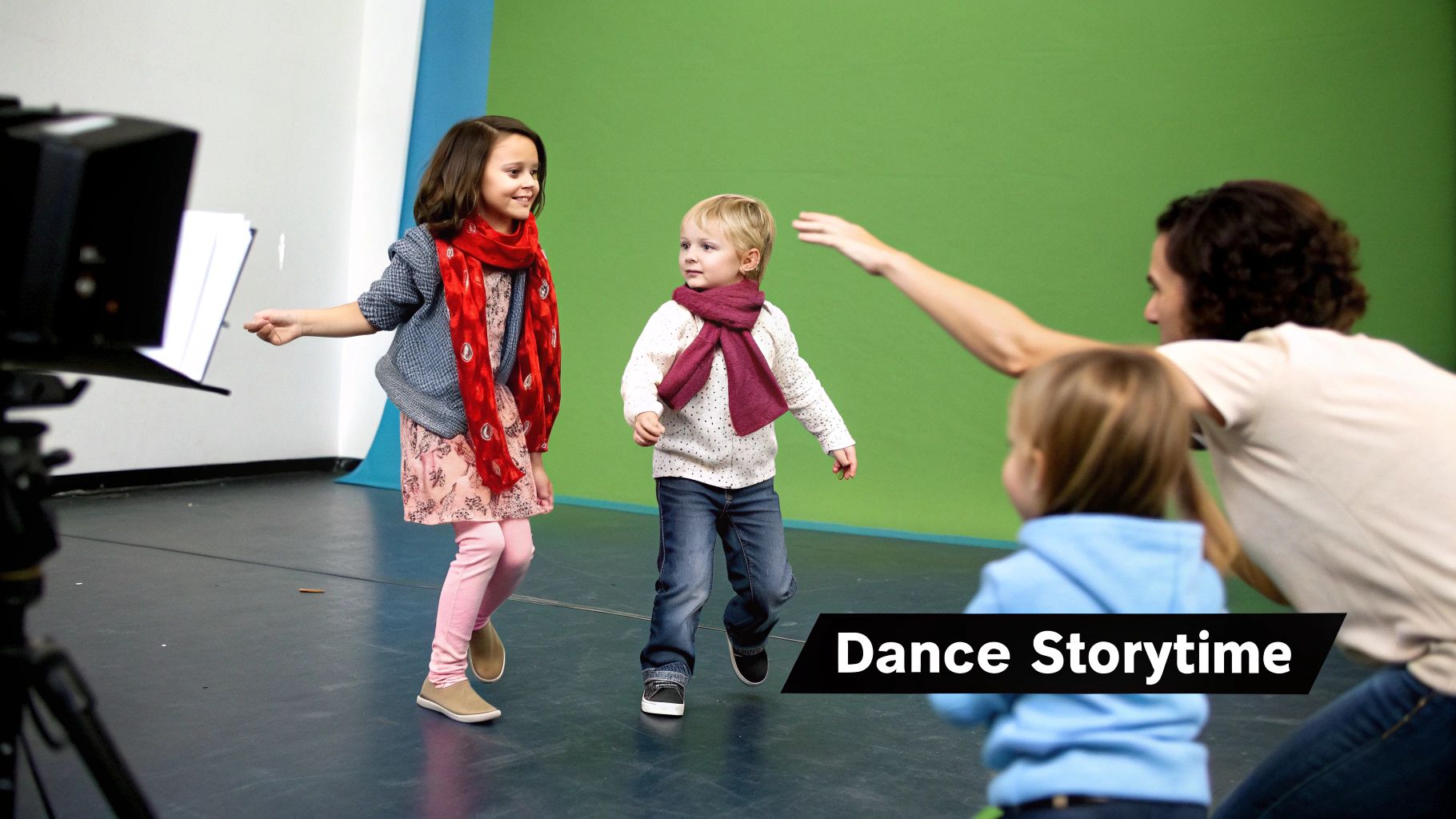
This approach is one of the most effective movement activities for preschool because it simultaneously develops gross motor skills, listening comprehension, and emotional intelligence. As a child pretends to be a tiny seed growing into a tall tree or a brave knight crossing a rickety bridge, they are practicing balance, coordination, and spatial awareness while also interpreting narrative cues.
How to Implement Dance Movement Stories
Getting started is simple. Choose a familiar story with clear, actionable events. Narrate the story aloud while using instrumental music to set the mood, and guide the children to move their bodies to match the plot.
- Jungle Adventure: Narrate a trip through the jungle. Prompt children to slither like snakes, stomp like elephants, and leap like monkeys.
- The Very Hungry Caterpillar: Children can curl up in a small ball as an egg, wiggle and crawl as the caterpillar, build a still "cocoon," and finally, spread their arms wide to emerge as beautiful butterflies.
- Going on a Bear Hunt: This classic is perfect, with built-in actions for swishing through grass, squelching through mud, and stumbling through a forest.
Tips for Success
To make your dance stories engaging for every child, from a shy toddler in Draper to an energetic preschooler in Bluffdale, focus on creating a supportive environment.
Key Insight: The goal is creative interpretation, not perfect imitation. Encourage each child to express the story in their own unique way. A child’s quiet sway might represent the wind just as effectively as another's dramatic spinning.
Use simple props like colorful scarves for flowing water or ribbons for soaring birds. Most importantly, ensure the space is safe and non-judgmental, allowing children to explore movement without fear of doing it "wrong." This foundation of creative confidence is a cornerstone of the integrated arts approach at Encore Academy, where storytelling is woven into our youngest dance and theater classes.
2. Rhythm and Movement Games (Music-Driven Motor Development)
Rhythm and Movement Games harness the infectious power of music to guide physical activity, turning simple songs and beats into dynamic learning experiences. Children instinctively respond to musical cues like tempo and volume, allowing them to practice coordination, balance, and listening skills in a joyful, structured way. This method directly links auditory processing with physical response, building crucial neural pathways.
This category of movement activities for preschool is exceptionally effective because it develops both gross motor skills and a foundational understanding of musical concepts. When a child marches to a strong drumbeat or sways gently to a lullaby, they are learning to control their body while internalizing rhythm, tempo, and dynamics. This foundational experience is a key building block for future artistic pursuits.
How to Implement Rhythm and Movement Games
Implementation is as simple as pressing "play" or tapping a drum. The core idea is to use sound as the primary instruction for movement. Use a variety of musical styles to keep children engaged and exposed to different rhythms.
- Freeze Dance: A classic for a reason. Play upbeat music and have children dance freely. When the music stops, they freeze in place. This is great for impulse control and quick physical response.
- Tempo Explorers: Use a hand drum or rhythm sticks to create a beat. Ask children to walk, hop, or tiptoe to match the speed. Start slow, then speed up, and slow down again to challenge their listening and motor planning skills.
- Scarf Dancing: Give each child a light, colorful scarf. Play different genres of music-classical, jazz, pop-and encourage them to move the scarf to match the feeling of the music, making big swoops for dramatic sounds and small wiggles for fast notes.
Tips for Success
To make rhythm games a hit with every preschooler, from a quiet child in Riverton to an energetic one in Herriman, focus on participation over precision.
Key Insight: The primary goal is to feel the beat, not to perfectly match it. Celebrate every stomp, clap, and sway as a successful connection between sound and movement.
Introduce simple instruments like shakers or tambourines that children can play while moving. Repeating favorite songs helps build confidence and mastery. For parents wondering when to introduce more formal instruction, understanding the developmental stages for music lessons can be highly beneficial. At Encore Academy, our preschool music programs integrate these very games to build a joyful, intuitive relationship with music.
3. Parent and Me Movement Class (Bonding Through Guided Movement)
Parent and Me Movement Classes offer a unique opportunity for shared physical experiences, where parents or caregivers and preschoolers move together in a guided setting. In these classes, the adult acts as a partner, a secure base, and a movement model, fostering a safe and encouraging environment. This collaborative approach not only introduces fundamental motor skills but also strengthens the parent-child bond through joyful, synchronized activity.
This format is one of the most nurturing movement activities for preschool because it builds physical confidence in the child while providing precious one-on-one connection. As a child holds their parent's hands while learning to balance or follows their lead in a playful dance, they are developing coordination, rhythm, and body awareness within the safety of a trusted relationship. This foundational experience is a cornerstone of our Parent and Me program at Encore Academy.
How to Implement Parent and Me Movement
The core of these classes is interactive, paired movement. The instructor guides both parent and child through activities that are engaging for both age levels, using music and props to enhance the experience.
- Partner Dances: Simple, guided dances where the parent and child move together, holding hands to sway, spin, and march to the beat.
- Mirror Games: The child tries to mirror the parent's movements (and vice versa), from making silly faces to reaching high for the sky.
- Movement Exploration: The parent helps the child explore movements like rolling, crawling through a "tunnel" made by the parent's legs, or being gently lifted and swayed like an airplane.
Tips for Success
To ensure a positive experience for families, including those traveling from nearby Sandy to our Bluffdale studio, the focus should always be on connection over perfection.
Key Insight: The true value of a Parent and Me class is the shared joy and interaction. The goal is not for the child to perfectly execute a movement but for the pair to have fun and connect through the activity.
Provide clear, simple instructions for both the adult and child, and always offer modifications for parents with physical limitations. Most importantly, foster a welcoming, non-judgmental atmosphere where laughter and play are the primary measures of success. This approach makes movement accessible and builds a love for the performing arts from the earliest age.
4. Sensory Motor Play (Exploration-Based Movement Development)
Sensory Motor Play integrates physical activity with sensory exploration, creating an environment where children learn about their bodies and the world through touch, sight, and proprioception. This approach involves setting up various stations or activities that invite children to engage with different textures, surfaces, and objects. It’s a child-led process that respects each preschooler's unique developmental timeline and sensory preferences.
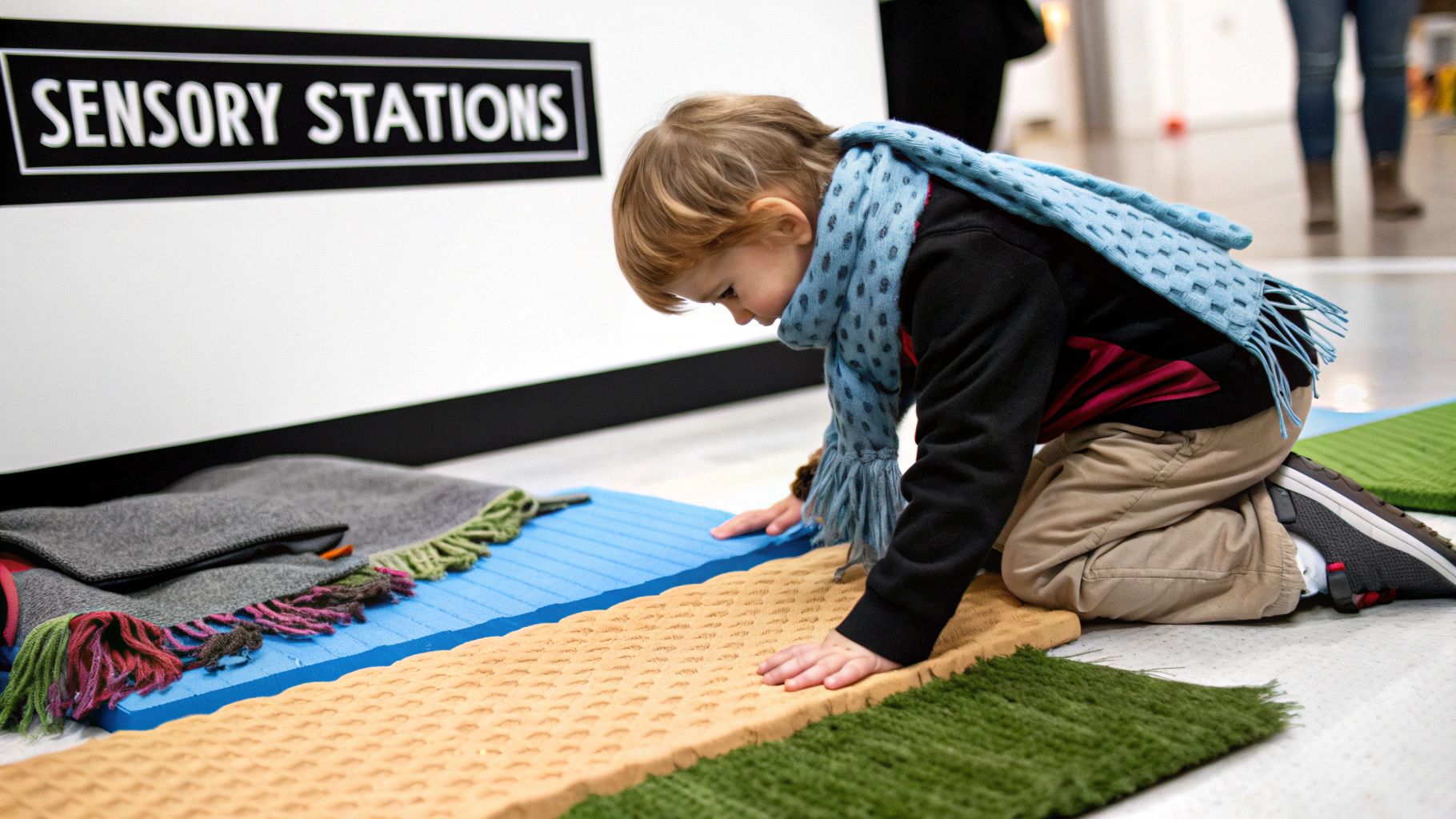
This method is one of the most foundational movement activities for preschool because it builds the neural pathways necessary for more complex motor skills. As a child walks across a textured mat, manipulates playdough, or navigates a low balance beam, they are actively developing body awareness, balance, and motor planning. This hands-on exploration directly supports skills needed for everything from writing to participating in structured dance classes.
How to Implement Sensory Motor Play
The key to successful sensory motor play is providing a variety of safe, engaging invitations to move and explore. Set up distinct stations and allow children to move freely between them, following their own curiosity.
- Texture Path: Create a pathway using different textured mats or shallow bins filled with materials like dry beans, sand, or smooth stones for children to walk on barefoot.
- Balance and Climbing: Set up a low, wide wooden beam, a small A-frame climbing structure, or even just a line of tape on the floor for children to practice balance.
- Heavy Work Station: Provide items like small, weighted balls, beanbags, or blocks for children to push, pull, and carry. This provides valuable proprioceptive input.
- Free Movement with Props: Offer a bin of colorful scarves, ribbons, or streamers. This encourages expressive, whole-body movements as children wave them through the air.
Tips for Success
To create an effective sensory play environment, whether at a home in Herriman or a preschool in Lehi, the focus should be on observation and gentle encouragement rather than direct instruction.
Key Insight: The process is more important than the outcome. A child’s hesitation to touch a new texture is just as valid a part of the learning experience as another child's enthusiastic jump into a ball pit.
Rotate the stations and materials regularly to keep the environment stimulating and novel. Ensure all items are age-appropriate and clean, and be mindful of potential sensory overload in more sensitive children by providing a quiet corner. At Encore Academy, we understand that this foundational sensory work is crucial, preparing young minds and bodies for the more structured coordination and expression found in our introductory dance and music programs.
5. Ballet Basics for Preschoolers (Foundational Dance Technique)
Ballet Basics for Preschoolers introduces young children to the fundamental concepts of ballet in a playful, age-appropriate manner. This approach focuses on imaginative movement and storytelling rather than strict technical correction, using imagery to guide children through foundational positions and movements. It serves as a gentle introduction to the structure and discipline of dance, building strength, improving posture, and sparking an early love for the art form.
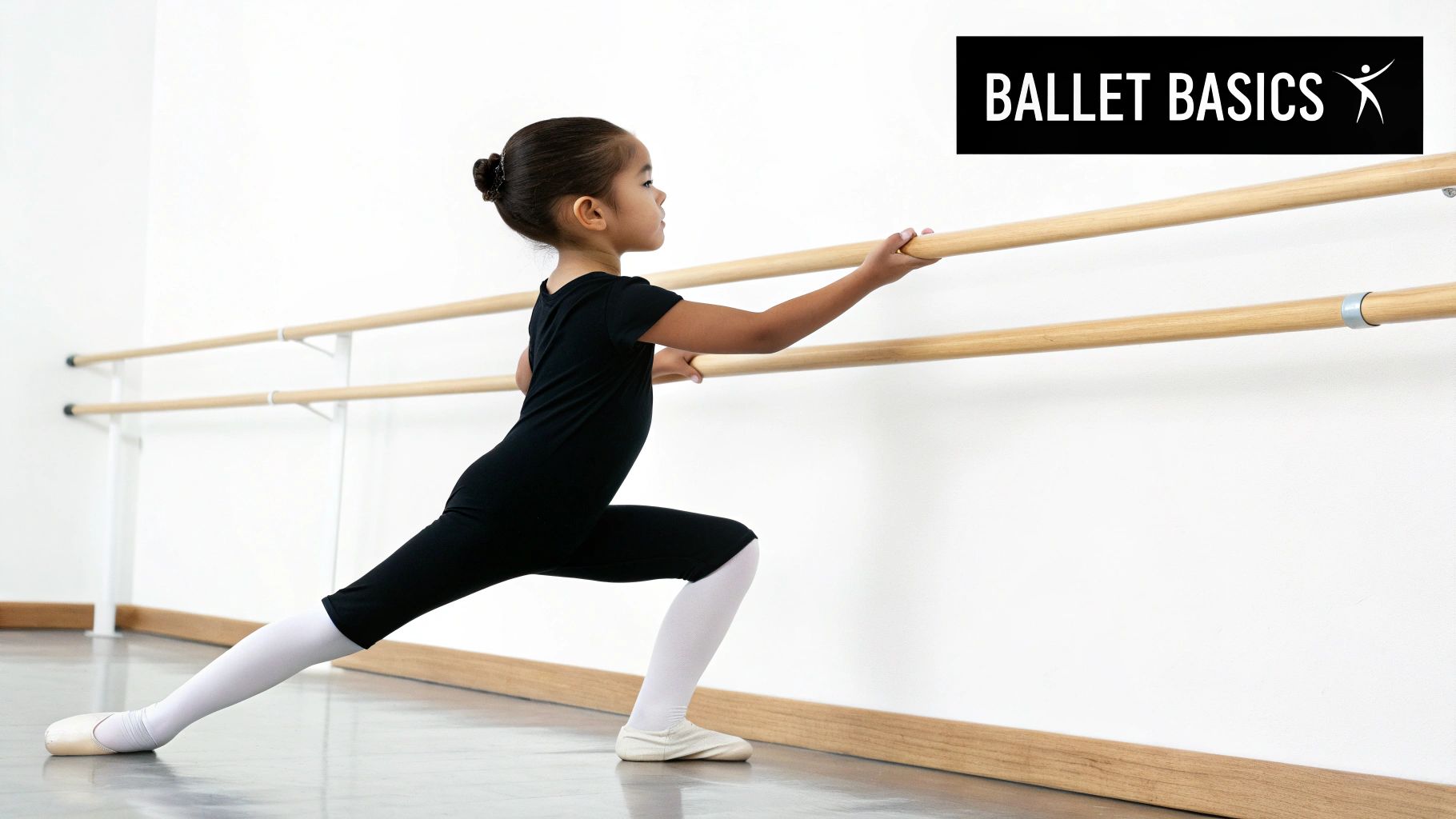
This method is one of the most structured movement activities for preschool, yet it remains deeply rooted in creativity. When a child pretends to be a flower growing tall (first position) or a soldier marching with a straight back, they are developing muscle control, balance, and body awareness. These foundational skills create a strong, safe starting point for more formal dance training later on.
How to Implement Ballet Basics
The key is to use imagination to teach core concepts. Play classical music to familiarize children with ballet's soundscape and guide them through simple, story-based exercises. Keep sessions short, around 20-30 minutes, to align with a preschooler's attention span.
- Growing Flowers: Have children pretend to be a seed and slowly grow, reaching their arms up and placing their heels together to "bloom" in first position.
- Plié Dips: Encourage children to hold onto a sturdy chair (the "barre") and "dip" like they are curtsying or picking up a magical stone.
- Balance Birds: Challenge them to stand on one leg like a flamingo or a bird about to take flight, seeing how long they can hold their balance.
- Floating Arms (Port de Bras): Ask children to move their arms like floating clouds, gentle waves, or bird wings, introducing graceful arm movements.
Tips for Success
Creating a positive and encouraging environment is essential, whether you're in a living room in Riverton or a studio in Bluffdale. The focus should always be on participation and personal expression.
Key Insight: Use imaginative language instead of technical corrections. Say "make your legs straight like sticks" or "point your toes like you're dipping them in paint" instead of demanding perfect form. This builds confidence and keeps the activity joyful.
Use mirrors to help children see their own bodies and positions, but celebrate their effort above all. Comfortable clothing is perfectly fine; there's no need to pressure a child into full ballet attire initially. As children grow and show more interest, you can explore the best age to start more formal ballet classes and transition them into a structured program like those offered at Encore Academy.
6. Jazz Hands and Hip Hop Basics (Contemporary Movement Introduction)
Jazz Hands and Hip Hop Basics introduces preschoolers to the exciting world of contemporary dance. This approach uses upbeat, popular music and playful choreography to teach foundational moves from jazz and hip hop, styles that children often see in movies and on TV. It taps into their desire to be "cool" and modern, making dance feel relevant and incredibly fun.
This activity is a fantastic addition to any list of movement activities for preschool because it builds coordination, rhythm, and musicality with a fresh, energetic twist. Children learn to isolate body parts, memorize simple sequences, and express their individual style, all while grooving to their favorite tunes. It’s a confidence-boosting experience that feels more like a dance party than a structured lesson.
How to Implement Jazz Hands and Hip Hop Basics
The key is to keep the energy high and the moves simple. Choose clean, age-appropriate versions of popular songs with a strong, clear beat. Break down choreography into small, manageable chunks that are easy to remember.
- Follow the Leader Groove: Start a simple 8-count pattern like step-touch four times, clap four times, and add sparkly "jazz hands." Have children copy your movements.
- Freeze Dance with Poses: Play an upbeat hip hop track and have children dance freely. When the music stops, call out a "cool" pose for them to freeze in, like pointing to the sky or crossing their arms.
- Simple Choreography: Teach a short routine to a song like "Can't Stop the Feeling!" This could involve simple bounces, shoulder shrugs, and basic footwork that builds into a mini-performance.
Tips for Success
To make contemporary movement a hit with every preschooler, from a budding performer in Herriman to a more reserved child in Lehi, focus on celebrating individuality and fun.
Key Insight: The emphasis should be on personal expression, not perfect technique. Hip hop and jazz are all about style, so encourage children to add their own flair and personality to every movement.
Use a call-and-response teaching method ("I stomp, you stomp!") to keep children engaged. Keep choreography patterns short and repetitive, and be sure to allow moments for freestyle movement where they can just enjoy the music. For parents interested in building on this foundation, you can find more beginner-friendly hip hop dance moves for kids to practice at home. At Encore Academy, our introductory hip hop and jazz classes use these same principles to make dance accessible and exhilarating for our youngest students.
7. Tumbling and Acro Introduction (Dynamic Strength and Balance)
Tumbling and Acro Introduction provides preschoolers with a safe and exciting way to explore dynamic movements like rolls, somersaults, and balance challenges. These activities are designed to channel a child's boundless energy into foundational acrobatic skills, building physical strength, coordination, and body awareness. By learning to control their bodies in new ways, children develop confidence and resilience.
This type of activity is one of the most beneficial movement activities for preschool because it directly enhances proprioception, the body's ability to sense its own position in space. As a child masters a forward roll or holds a balanced pose, they are developing core strength, flexibility, and a deep understanding of cause and effect in physical motion.
How to Implement Tumbling and Acro Introduction
A safe, soft environment is key. Use padded mats or soft grass and start with simple, confidence-building movements. Guide children through foundational skills before attempting anything complex, always providing hands-on support.
- Log and Egg Rolls: Have children lie down and roll side-to-side like a log. Then, have them tuck into a tight ball and rock back and forth like an egg (a precursor to a somersault).
- Balance Beam Walks: Use a line of tape on the floor or a low, wide beam for children to practice walking forward, backward, and sideways to challenge their balance.
- Animal Poses: Incorporate poses that build strength, such as bear walks (walking on hands and feet), crab walks, and donkey kicks (kicking feet up gently while hands are on the floor).
Tips for Success
Safety and encouragement are the top priorities. The goal for a preschooler in Herriman or Lehi is not perfect form but safe exploration and the joy of accomplishment.
Key Insight: Progress should be child-led. Never pressure a child into trying a skill they are not ready for. Celebrate every attempt, whether it’s a wobbly balance or a crooked somersault, to build the self-assurance needed for more advanced skills.
Ensure you have a low student-to-teacher ratio for adequate supervision. Teach children how to fall safely by rolling or curling up. The foundational strength built here is invaluable, which is why we explore how tumbling for dancers can create more powerful and versatile performers. This structured play provides an incredible foundation for more formal programs, like the acro and tumbling classes offered at Encore Academy.
8. Improv Movement Games (Theatrical Physical Expression)
Improv Movement Games are spontaneous, theater-based activities that teach preschoolers to use their bodies to express ideas, emotions, and characters without scripts or planned choreography. This approach merges physical play with the foundational principles of acting, helping children develop quick thinking, non-verbal communication skills, and creative confidence in a dynamic and playful setting.
These games are exceptional movement activities for preschool because they build a direct bridge between physical energy and imaginative storytelling. When a child is asked to move like a melting ice cream cone or show "excitement" using only their body, they are learning to translate abstract concepts into physical action. This develops body awareness, emotional literacy, and problem-solving skills all at once.
How to Implement Improv Movement Games
The key is to use simple, clear prompts that spark imagination without being restrictive. Start with familiar concepts and gradually introduce more abstract ideas as children become more comfortable expressing themselves.
- Animal Parade: Call out different animals and have children move across the room embodying that creature’s walk, sound, and energy. How does a penguin from Herriman waddle differently than a snake from Lehi?
- Emotion Ocean: Ask children to show an emotion (happy, sad, surprised, sleepy) with their whole body. You can use music to help set the tone for each feeling.
- Character Freeze: Play music and let the children move freely. When the music stops, they freeze in a pose. Go to each child and ask them, "Who are you?" They can be a superhero, a chef, or a tree.
Tips for Success
Creating a safe and encouraging space is paramount for successful improv. The focus should be on participation and creative exploration, not on performance quality or getting it "right."
Key Insight: The core principle of improv is "Yes, and..." In a preschool setting, this translates to celebrating every offer. There are no wrong answers, only creative choices that build upon the fun.
Establish a clear signal for starting and stopping the activity. Use extensive positive reinforcement to praise effort and creativity. At Encore Academy, our introductory theater classes use these very games to help students from Draper to Riverton build the ensemble-based trust and spontaneity that are essential for the performing arts.
9. Parachute Play and Props Movement (Cooperative Movement Activities)
Parachute Play and Props Movement uses large, colorful parachutes, scarves, and ribbons to create dynamic, collaborative experiences. Children work together, holding the edges of a parachute or waving props in unison, fostering a sense of community and shared purpose. This activity is a vibrant way to build cooperation and coordination while providing powerful sensory-motor stimulation.
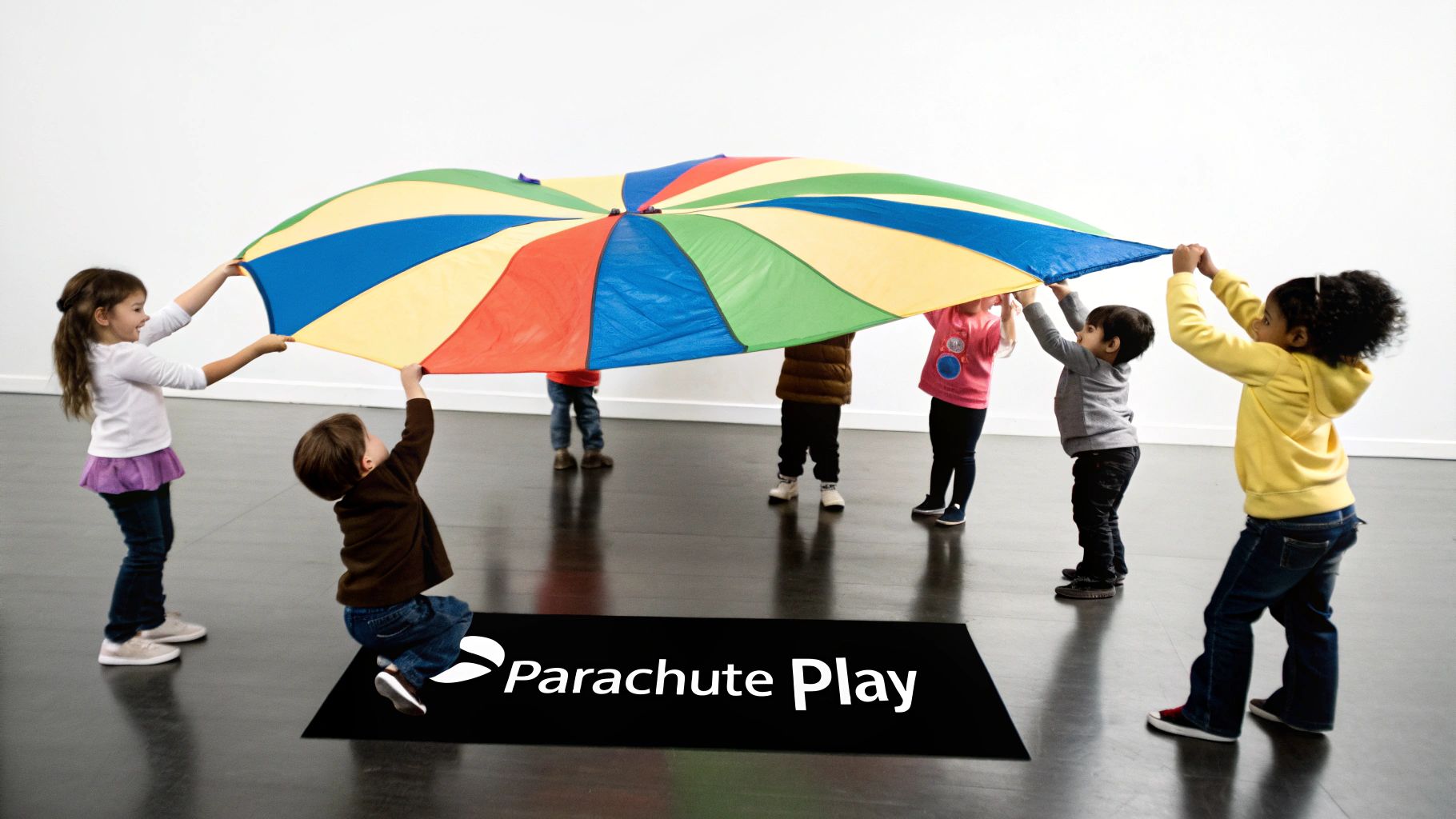
This method is one of the most beloved movement activities for preschool because it teaches children how their individual actions contribute to a group outcome. When they lift the parachute together to create a "tent," they are learning about teamwork, timing, and cause and effect. It's an excellent tool for developing gross motor skills, spatial awareness, and rhythmic understanding in a joyful, low-pressure setting.
How to Implement Parachute Play and Props Movement
Begin with simple, guided movements before introducing more complex coordination challenges. Use upbeat music to inspire energy and focus.
- Ocean Waves: Children hold the parachute edges and gently shake them to create small ripples or make big movements for stormy waves.
- Mushroom Cloud: On the count of three, everyone lifts the parachute high above their heads and then quickly pulls it down behind them, trapping air to create a "mushroom."
- Scarf Dancing: Give each child a colorful scarf and play music with varying tempos. Encourage them to wave their scarves slowly for calm music and quickly for energetic tunes.
Tips for Success
The key to successful parachute and prop play is creating a positive, inclusive environment where every child feels empowered to participate.
Key Insight: The parachute itself becomes a visual representation of teamwork. Children can immediately see how their cooperation creates a bigger, more impressive effect than any single person could achieve alone.
For a group of preschoolers in Herriman or Lehi, start with activities that keep the parachute low to reduce any anxiety about it going overhead. Pair movements with a story, turning the parachute into a magical flying carpet or a starry night sky. At Encore Academy, we use props like scarves and ribbons in our introductory dance classes to help young dancers visualize their movements and explore self-expression in a tangible way.
10. Flexibility and Stretching Sequences (Body Awareness and Wellness)
Flexibility and Stretching Sequences introduce preschoolers to the foundational concepts of body awareness and wellness through gentle, playful movements. This activity uses age-appropriate, yoga-inspired poses and creative imagery to improve range of motion, enhance balance, and teach early mindfulness. Instead of rigorous exercise, it's about exploring how the body can bend and lengthen in a safe, calming, and enjoyable way.
This practice is one of the most important movement activities for preschool because it builds a healthy foundation for all future physical pursuits, from dance to sports. By learning to connect breath with movement, children develop coordination and body control. It also serves as a perfect cool-down activity, helping active kids transition from high-energy play to a state of calm focus.
How to Implement Flexibility and Stretching Sequences
The key is to make stretching feel like a game, not a chore. Use imaginative language and relatable concepts to guide children through different poses. Play calm, soothing music in the background to create a relaxed atmosphere.
- Animal Poses: Guide children to arch their backs like a "cat" and then dip them down like a "cow." They can also stretch their arms up high like a giraffe reaching for leaves or tuck into a ball like a sleepy hedgehog.
- Nature Imagery: Have children sit with the soles of their feet together for a "butterfly" stretch, gently flapping their "wings" (knees). A forward fold can become reaching for their toes to "tickle" them.
- Growing Flowers: Start crouched down as a tiny seed. Slowly "grow" by stretching arms and legs, reaching up toward the sun until they are a big, tall flower.
Tips for Success
To make stretching a positive experience for every child, from a careful toddler in Riverton to an adventurous preschooler in Herriman, prioritize gentle guidance and fun.
Key Insight: The goal is exploration, not perfection. Never force a child into a deeper stretch. The focus should be on how the movement feels, encouraging them to listen to their own bodies and respect their limits.
Keep stretches brief, holding each for about 10-20 seconds to match a preschooler’s attention span. Model deep, calm breathing and a positive demeanor. This early introduction to body wellness is crucial for young performers, which is why we emphasize safe and effective flexibility training for dancers in our programs at Encore Academy.
10 Preschool Movement Activities: Quick Comparison
| Dance Movement Stories (Creative Storytelling Through Movement) | 🔄 Moderate — choreography, story prep, and space | ⚡ Medium — props, themed music, costumes | 📊 Gross motor + imagination; listening/comprehension; ⭐ High engagement | 💡 Integrated dance-theater classes, performances, parent showcases | ⭐ Strong storytelling + confidence building; blends dance & theater |
|---|---|---|---|---|---|
| Rhythm and Movement Games (Music-Driven Motor Development) | 🔄 Low–Moderate — tempo/control and cueing | ⚡ Medium — quality speakers, percussion, music library | 📊 Auditory-motor coordination; musical literacy; following directions; ⭐ High | 💡 Group warm-ups, transitions, early music readiness | ⭐ Builds rhythm, listening skills; very engaging |
| Parent and Me Movement Class (Bonding Through Guided Movement) | 🔄 Low — simple activities but scheduling/logistics matter | ⚡ Low–Medium — minimal props, space for adult-child pairs | 📊 Stronger parent-child bond; reduced separation anxiety; ⭐ Medium–High | 💡 Family classes, beginner comfort-building, early engagement | ⭐ Parental modeling; safer environment for shy children |
| Sensory Motor Play (Exploration-Based Movement Development) | 🔄 Moderate — station setup and ongoing safety monitoring | ⚡ High — multiple stations, varied materials and space | 📊 Sensory processing, body awareness, independent discovery; ⭐ Highly adaptable | 💡 Inclusive exploration, sensory-focused sessions, assessment | ⭐ Child-led discovery; suits diverse developmental needs |
| Ballet Basics for Preschoolers (Foundational Dance Technique) | 🔄 Moderate — trained instructor for safe alignment | ⚡ Medium — barres/chairs, ballet music, clear floor space | 📊 Posture, alignment, strength; early technical foundation; ⭐ Strong long-term value | 💡 Early technique prep; feeder to formal ballet programs | ⭐ Builds discipline, body control, and classical foundation |
| Jazz Hands and Hip Hop Basics (Contemporary Movement Introduction) | 🔄 Low–Moderate — choreography and music curation | ⚡ Low — music, simple props | 📊 Rhythm, coordination, confidence; exposure to contemporary styles; ⭐ High fun factor | 💡 Intro to hip hop/jazz, high-energy classes, community events | ⭐ Highly motivating; promotes self-expression and style |
| Tumbling and Acro Introduction (Dynamic Strength and Balance) | 🔄 High — progressive spotting, safety protocols | ⚡ High — mats, safety equipment, low teacher:student ratio | 📊 Strength, balance, spatial awareness; confidence in movement; ⭐ High physical gains | 💡 High-energy classes, pre-gymnastics or acro feeder programs | ⭐ Rapid physical development; prepares for advanced acro |
| Improv Movement Games (Theatrical Physical Expression) | 🔄 Moderate — needs skilled facilitation and structure | ⚡ Low — minimal props, flexible space | 📊 Creativity, quick thinking, emotional expression; reduced performance anxiety; ⭐ High for confidence | 💡 Theater prep, ensemble-building, warm-ups | ⭐ Fosters creativity, listening, and ensemble skills |
| Parachute Play and Props Movement (Cooperative Movement Activities) | 🔄 Low–Moderate — group coordination and safety | ⚡ Medium — parachutes/props and ample space/high ceilings | 📊 Teamwork, proprioception, coordination; strong group bonding; ⭐ Visually engaging | 💡 Large-group activities, transitions, sensory-inclusive play | ⭐ Inclusive, low-risk cooperative play; strong vestibular input |
| Flexibility and Stretching Sequences (Body Awareness and Wellness) | 🔄 Low — calm, patient instruction required | ⚡ Low — mats, calm music | 📊 Flexibility, posture, body awareness, early mindfulness; ⭐ Good wellness foundation | 💡 Warm-ups/cool-downs, mindfulness segments, injury prevention | ⭐ Low-impact; supports long-term physical health and dance readiness |
Take the Next Step in Your Child's Movement Journey
The journey of a preschooler is a whirlwind of discovery, and movement is their primary language for exploring the world. As we've explored, incorporating diverse movement activities for preschool children is not just about burning off energy; it's about building the very foundation for lifelong learning, health, and creative expression. From the imaginative narratives of Dance Movement Stories to the foundational grace of Ballet Basics, each activity serves a unique and critical purpose in your child’s development.
The activities detailed in this guide, like Sensory Motor Play and Parachute Play, are powerful tools for developing gross motor skills, enhancing coordination, and fostering social-emotional growth. They teach preschoolers how to navigate space, cooperate with others, and connect their minds to their bodies in a joyful, intuitive way. The key takeaway is that movement is a holistic developmental catalyst. It strengthens muscles, wires neural pathways for complex learning, and gives children a powerful outlet for their emotions and ideas.
Putting Movement into Motion: Your Actionable Next Steps
Making these activities a regular part of your routine is the most impactful step you can take. You don't need a grand plan; a few intentional moments of movement each day can make a profound difference.
- Create a "Movement Menu": Keep a simple list of your child’s favorite activities from this article on the fridge. When you have 10 minutes, let them pick one to do together. This empowers them and makes movement a fun, accessible choice.
- Integrate, Don't Isolate: Weave these activities into your daily life. Use Rhythm and Movement Games during cleanup time, practice Flexibility and Stretching Sequences after a long car ride, or turn a walk to the mailbox into an Improv Movement Game.
- Observe and Adapt: Pay attention to what truly excites your child. Do they love the structure of Jazz Hands and Hip Hop Basics or the free-form creativity of Dance Movement Stories? Leaning into their natural interests will keep them engaged and eager to participate. For parents in communities like Riverton, Sandy, and Draper, observing this natural inclination is the first step toward finding a more structured outlet that aligns with their passion.
The Lasting Impact of Early Movement Education
By prioritizing these movement activities for preschool, you are giving your child a profound gift. You are nurturing their physical literacy, which is just as crucial as learning the alphabet. A child who is confident in their body’s ability to run, jump, balance, and express itself is a child who is more prepared to tackle academic challenges, build strong friendships, and develop a resilient sense of self.
This foundation supports everything from handwriting skills (fine motor control) to problem-solving (spatial awareness). The confidence gained from mastering a small tumbling sequence or leading a dance game translates directly into the courage to raise their hand in class or try a new, challenging puzzle. You are not just raising a mover; you are raising a confident, capable, and expressive human being. For families in Herriman and Lehi, fostering this early love of movement can open doors to incredible opportunities for personal growth and artistic development right in our local community.
Ready to channel your child's boundless energy into a structured, inspiring, and joyful learning experience? Discover how the expertly designed preschool programs at Encore Academy for the Performing Arts can nurture their talent and build their confidence. Visit us online at Encore Academy for the Performing Arts to book a trial class at our Bluffdale studio today and watch their passion for movement ignite