
8 Fun Music and Movement Activities for Preschoolers in 2025
Welcome to the vibrant world where wiggles meet melodies! For preschoolers, the fusion of sound and motion is more than just playtime; it's a powerful engine for holistic development. Purposeful music and movement activities for preschoolers are instrumental in building foundational cognitive, social-emotional, and physical skills. They help your child understand patterns, develop gross motor control, learn to express emotions constructively, and collaborate with others.
This comprehensive guide is designed for parents and educators seeking practical, engaging, and developmentally appropriate ideas. Whether you're a parent in Bluffdale looking for creative indoor activities or a teacher in nearby Riverton or Draper searching for fresh circle time inspiration, you'll find everything you need right here. We move beyond generic suggestions to provide a curated collection of eight dynamic activities, each packed with actionable steps, lists of materials, specific learning objectives, and helpful variations.
We will explore everything from structured action songs and rhythm instrument play to imaginative musical story dramatization and mindful movement with yoga. This listicle breaks down how to transform your home or classroom into a dynamic learning environment. You'll gain the confidence to lead activities that not only entertain but also significantly contribute to your preschooler's brain development and physical coordination. Get ready to discover how simple, playful rhythms can unlock your child's immense potential, one beat and one step at a time.
1. Music-Based Circle Time
Music-based circle time is a foundational group activity that serves as a cornerstone for many preschool programs. It involves gathering children in a circle to participate in a structured sequence of songs, chants, fingerplays, and simple, coordinated movements. More than just a sing-along, this activity is a powerful tool for building community, developing crucial listening skills, and introducing foundational musical concepts in a joyful, interactive setting.
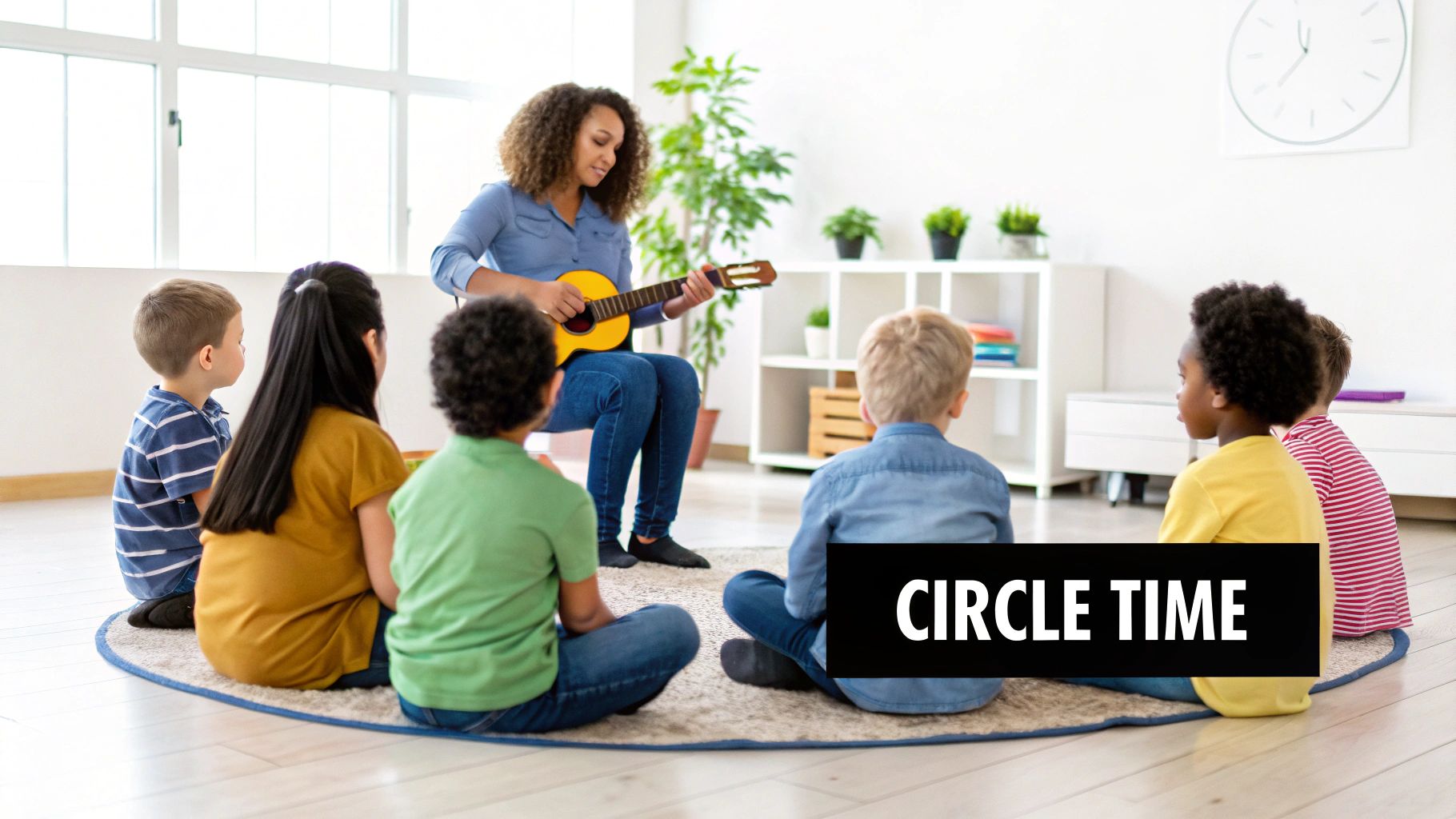
This method is highly effective for starting the day, transitioning between activities, or winding down. It creates a predictable routine that helps children feel secure while engaging their bodies and minds. The circular formation itself is intentional; it ensures every child can see the leader and their peers, fostering a sense of belonging and encouraging social interaction.
Why It Works for Preschoolers
Music-based circle time is one of the most beloved music and movement activities for preschoolers because it meets multiple developmental needs simultaneously. It enhances gross motor skills through actions like clapping, stomping, and jumping, and refines fine motor skills with intricate fingerplays. Socially, children learn to take turns, listen to others, and participate as part of a group. Cognitively, they develop language, memory, and pattern recognition by learning lyrics and repeating melodies.
How to Implement Music-Based Circle Time
Establish a Routine: Designate a specific time and place for circle time each day. Use a consistent opening song, such as 'Good Morning to You' or 'The More We Get Together', to signal the start of the activity.
Select Age-Appropriate Songs: Choose songs with simple, repetitive lyrics and clear actions. Songs like 'Wheels on the Bus' or 'Head, Shoulders, Knees, and Toes' are excellent starting points.
Incorporate Props: Use props like scarves, beanbags, or rhythm sticks to add a tactile element and maintain engagement. For example, wave scarves during a song about the wind or tap rhythm sticks to the beat.
Model with Enthusiasm: Sit at the children's eye level and model all movements with clear, expressive energy. Your enthusiasm is contagious and encourages participation.
Allow for Choice: As children become familiar with the routine, allow them to choose a favorite song or lead a simple action. This builds confidence and gives them ownership of the activity.
Pro-Tip: Keep individual songs short, ideally 1-3 minutes, to align with a preschooler's attention span. Repetition is key; performing the same songs for a week or two helps children master the lyrics and movements, which builds their confidence.
For families in Herriman or Riverton looking to build on these foundational skills, a structured music class can provide the next step in their child's development. Discover how our programs integrate these principles by exploring the music classes at Encore Academy .
2. Action Songs and Fingerplays
Action songs and fingerplays are classic, interactive activities that pair simple melodies with specific hand, finger, and body movements. These engaging songs often tell a story or illustrate a concept, such as the journey of the "Itsy Bitsy Spider" or the twinkling of a star. By physically representing the words they sing, children connect language with meaning in a powerful, multisensory way.
This method is incredibly versatile and requires no special equipment, making it perfect for spontaneous moments, transitions, or calming a group. The focused, small-scale movements of fingerplays help improve concentration, while larger action songs provide a wonderful outlet for physical energy. It's a fundamental activity that supports a wide range of developmental milestones.
Why It Works for Preschoolers
Action songs and fingerplays are exceptional music and movement activities for preschoolers because they directly target fine motor skill development. The intricate finger movements required for songs like 'Twinkle, Twinkle, Little Star' strengthen the small muscles in the hands and fingers, which is essential for future writing skills. On a cognitive level, these activities boost memory, sequencing, and language comprehension as children learn to match actions to lyrics in the correct order.
How to Implement Action Songs and Fingerplays
Start with Simple Classics: Begin with well-known songs that have straightforward movements, such as 'Itsy Bitsy Spider' or 'Where is Thumbkin?'. Their familiarity makes it easier for children to join in.
Model Slowly and Clearly: Face the children and perform the actions slowly and with exaggerated motions. This helps them see and copy the movements accurately. For fingerplays, practice without the music first to isolate the motor skills.
Use Hand-Over-Hand Guidance: If a child is struggling to coordinate a movement, gently offer hand-over-hand assistance to help them feel the motion. This supportive approach builds confidence.
Encourage Creativity: Once children are familiar with a song, invite them to create their own movements. Asking, "What's another way we can show the rain coming down?" fosters imagination and ownership.
Build Complexity Gradually: As children master simpler songs, introduce ones with more complex sequences or faster tempos, like 'Head, Shoulders, Knees, and Toes' at varying speeds.
Pro-Tip: Sit in a circle on the floor so all children have a clear view of your hands and face. Repetition is vital; performing the same fingerplay multiple times over several days helps children commit both the lyrics and the motor patterns to memory.
For families in Bluffdale and surrounding areas like Sandy, these activities are a perfect introduction to the world of expressive arts. To see how expert instruction can refine these skills, consider exploring the music programs at Encore Academy .
3. Dance and Free Movement Exploration
Dance and free movement exploration is an activity centered on self-expression, where children respond to music without rigid choreography or specific steps. It encourages them to move their bodies in ways that feel natural and instinctive, translating sound and emotion into physical expression. This approach is fundamental for developing body awareness, creativity, and emotional intelligence.
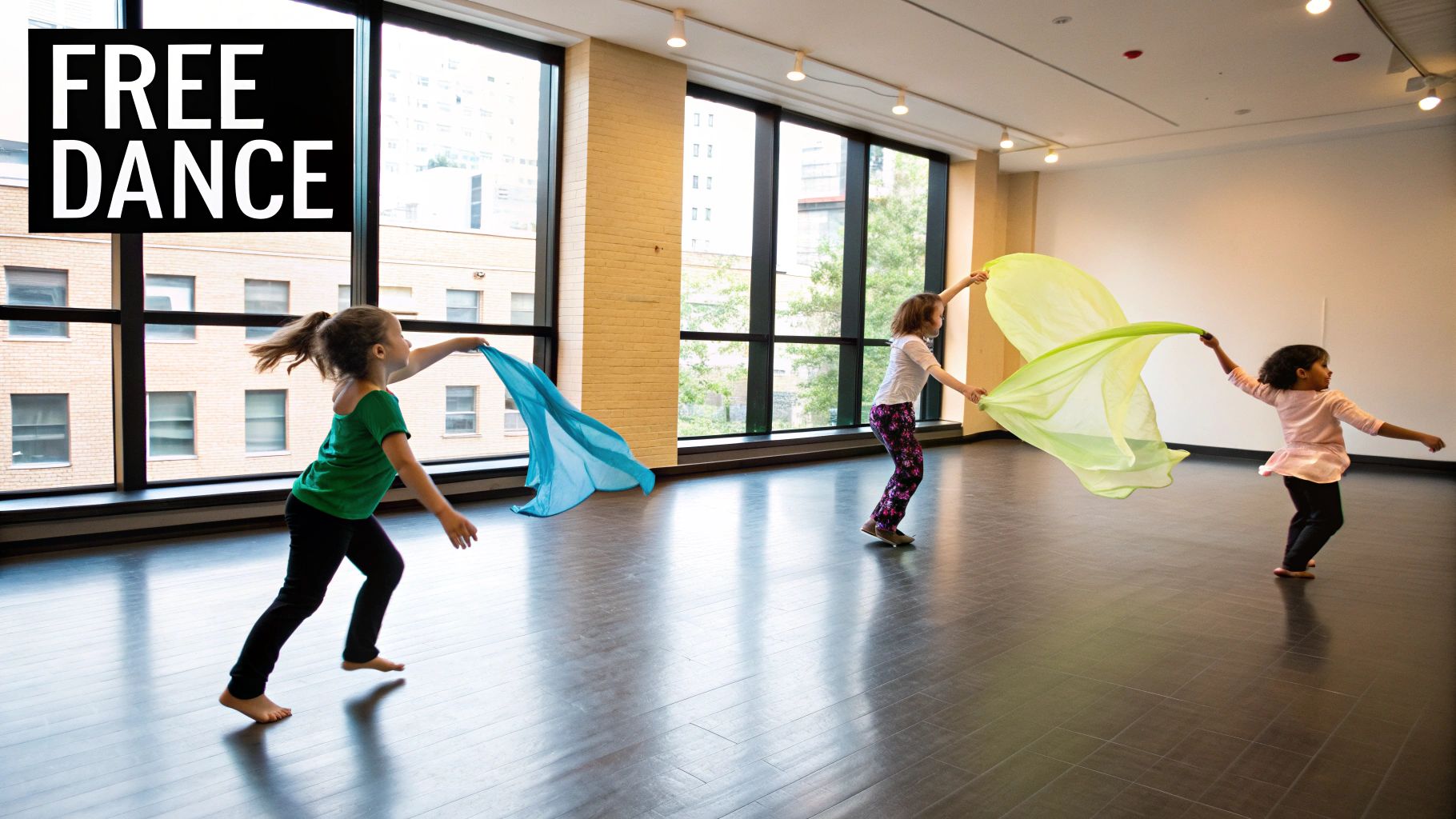
This method provides a vital outlet for a preschooler’s boundless energy and imagination. Whether it's a "Freeze Dance" game or a session moving like different animals, the focus is on the process of discovery, not on a perfect final product. It validates each child’s unique way of moving and helps them build confidence in their physical abilities in a non-judgmental environment.
Why It Works for Preschoolers
Free movement is one of the most liberating music and movement activities for preschoolers because it taps directly into their natural inclination to play and explore. This activity supports gross motor development as children learn to gallop, leap, and twirl, enhancing their balance, coordination, and spatial awareness. Cognitively, it fosters problem-solving and creativity as they decide how to interpret a piece of music. Emotionally, it provides a safe, non-verbal way for children to express feelings like joy, excitement, or even frustration.
How to Implement Dance and Free Movement Exploration
Create a Safe Space: Ensure the movement area is open and free of obstacles. Define personal space with clear, simple rules like "stay in your bubble" to prevent collisions.
Use Varied Music: Play a wide range of musical genres, tempos, and moods. Contrast upbeat, fast-paced songs with slow, lyrical pieces to inspire different types of movement and emotional responses.
Introduce Simple Prompts: Guide their exploration with creative prompts. Ask them to move like a slithering snake, a floating feather, or a melting ice cube. This gives a starting point for their imagination.
Incorporate Props: Offer props like colorful scarves, ribbons, or streamers to extend their movements and add a visual, sensory element. These tools can help shy children feel more comfortable expressing themselves.
Join In the Fun: Participate alongside the children. Your willingness to move freely and creatively models confidence and shows that there is no "wrong" way to dance.
Pro-Tip: For a successful free movement session, start with more structured movements to build comfort before transitioning to complete freedom. A game like "Follow the Leader" can serve as a perfect warm-up.
For parents in Draper or Lehi, seeing your child's creative expression can be incredibly rewarding. To learn more about how to support this growth, you can find helpful information in this guide to the best dance classes for toddlers .
4. Rhythm and Percussion Instrument Exploration
Rhythm and percussion instrument exploration gives preschoolers a hands-on opportunity to become active music-makers. This activity involves providing children with child-friendly instruments like maracas, drums, bells, and tambourines to discover rhythm, beat, and sound. It moves beyond passive listening, empowering children to experiment with cause and effect, volume, and tempo in a tangible way.
This hands-on approach is fantastic for developing auditory discrimination as children learn to distinguish between different sounds. It also builds a foundational sense of rhythm and strengthens motor skills through shaking, tapping, and striking. The activity is highly adaptable, perfect for both individual exploration and structured group experiences like a drum circle.
Why It Works for Preschoolers
Instrument exploration is one of the most engaging music and movement activities for preschoolers because it satisfies their natural curiosity and desire to make noise. It provides immediate auditory feedback, which is highly rewarding and motivating. On a cognitive level, children engage in pattern recognition through rhythm echo games. Socially, they learn self-control and cooperation when asked to start and stop playing together or take turns with a favorite instrument.
How to Implement Rhythm and Percussion Instrument Exploration
Introduce Instruments Gradually: Start with a single type of instrument, like shakers or rhythm sticks, for the whole group. This allows children to focus on the rhythm without being distracted by too many choices.
Establish Clear Signals: Create simple hand signals for "start playing" and "stop playing." Practice these signals to help children develop listening skills and impulse control.
Lead Rhythm Echoes: Play a simple, short rhythm pattern (e.g., tap-tap-tap...tap) and have the children echo it back to you. This builds listening and memory skills.
Create a DIY Instrument Station: Set up an area where children can create their own shakers using paper towel tubes, rice, and tape. This adds a creative, sensory element to the musical exploration.
Hold a Music Parade: Give each child an instrument and lead a parade around the room or playground. This combines rhythmic playing with gross motor movement and is a wonderful activity for families in communities like Herriman and Lehi.
Pro-Tip: Before handing out instruments, establish the rule that they are for making music, not for hitting friends or furniture. Model how to hold and play each instrument correctly and gently.
Understanding these basic rhythmic patterns is the first step toward more formal musical education. To see how these concepts are developed further, you can explore some foundational concepts with our guide to music theory lessons for beginners .
5. Movement Breaks and Brain Breaks
Movement breaks, often called brain breaks, are short, structured bursts of physical activity designed to reset and refocus young minds. These are not just random moments of play; they are intentional, 2-5 minute interludes that use music and motion to release pent-up energy, improve concentration, and smooth the transitions between different parts of the preschool day. They serve as a powerful classroom management tool that supports both cognitive function and physical well-being.
This approach is highly effective for managing the natural ebbs and flows of a preschooler's energy. Instead of correcting wiggly behavior, educators can channel it productively with a quick, upbeat song, a round of "Freeze Dance," or a follow-the-leader sequence. These planned interruptions help children return to quiet activities like reading or art with renewed focus and a calmer demeanor.
Why It Works for Preschoolers
Movement breaks are one of the most essential music and movement activities for preschoolers because they directly address the connection between the body and the brain. Physical activity increases blood flow and oxygen to the brain, which enhances cognitive functions like memory and attention. For children, who learn through their bodies, these breaks are not a distraction from learning; they are a vital component of it. They also help develop self-regulation skills as children learn to transition from high-energy to low-energy states on cue.
How to Implement Movement Breaks and Brain Breaks
Schedule Strategically: Plan breaks before activities that require quiet focus, such as story time, or during transitions, like before cleaning up for snack time. This proactive approach prevents restlessness before it starts.
Use a Clear Signal: Establish a consistent audio or visual cue to signal the start and end of the break. This could be a specific song, a chime, or a hand signal that helps children switch gears quickly.
Create a Go-To List: Have a handful of simple, no-prep movement songs or activities ready. Songs like "Shake Your Sillies Out" or video-based guides from platforms like GoNoodle are perfect for immediate engagement.
Follow Energy with Calm: After an energetic break involving jumping or dancing, guide children through a calming activity like deep breathing or slow stretching to help them settle down for the next task.
Offer Variations: Provide options for different energy levels. While some children may need to jump and run in place, others might prefer quieter movements like stretching or yoga poses.
Pro-Tip: Match the intensity of the brain break to the time of day. Use more vigorous activities in the morning to wake up bodies and minds, and opt for gentler, more rhythmic movements in the afternoon to avoid overstimulation before naptime.
Parents in Herriman and Bluffdale can incorporate these same principles at home. Using music for short, fun breaks can make daily routines smoother. To see how structured movement can build focus and coordination, you can explore some exciting dance moves that work perfectly for brain breaks in our guide to hip-hop dance moves for kids .
6. Musical Story Dramatization
Musical story dramatization is a captivating activity where children use their bodies and voices to act out stories set to music. This narrative-based approach transforms a simple story time into an interactive performance, allowing preschoolers to embody characters, explore emotions, and interpret events through movement. It's a dynamic way to merge literacy with physical expression, turning a beloved tale into a living, breathing experience.
This method goes beyond simple mimicry; it encourages children to interpret a story's plot and a character's feelings. Whether they are huffing and puffing like the Big Bad Wolf or fluttering like "The Very Hungry Caterpillar," children connect with the narrative on a much deeper, more personal level. The addition of music provides an emotional backdrop and rhythmic cues that guide their movements and enhance the atmosphere.
Why It Works for Preschoolers
Musical story dramatization is one of the most creative music and movement activities for preschoolers because it integrates so many developmental domains. It powerfully supports language development by reinforcing vocabulary, narrative structure, and comprehension. Socially and emotionally, children learn empathy by stepping into a character’s shoes and collaborating with peers to tell a story. It also boosts creativity, problem-solving skills, and physical confidence as they decide how to portray actions and emotions.
How to Implement Musical Story Dramatization
Choose a Familiar Story: Start with a simple, well-known story that has clear, sequential actions, such as 'Goldilocks and the Three Bears' or 'The Three Little Pigs'. Familiarity reduces anxiety and lets children focus on the performance.
Assign Roles Collaboratively: To reduce performance anxiety, assign the same role to multiple children. Let a group of children be the "Three Bears" together, or have everyone be a "Little Pig" building their house.
Incorporate Simple Props and Music: Use basic props like scarves for a flowing river or cardboard blocks for houses to spark imagination. Select instrumental music that matches the story's mood, from playful and light to dramatic and suspenseful.
Practice Movements First: Before acting out the full story, guide children through the key movements. Practice stomping like a giant, tiptoeing like a mouse, or whirling like the wind.
Focus on Fun, Not Perfection: Emphasize participation and creative expression over a polished performance. Encourage every child’s interpretation and celebrate their effort and imagination.
Pro-Tip: Keep the dramatization short, around 5-10 minutes, to hold everyone's attention. Allow children to choose whether they want to be an actor or an engaged audience member; forcing participation can stifle creativity.
For families in Riverton or Sandy looking to nurture their child's natural love for storytelling and performance, a structured theater program can build on these skills. Discover how we bring stories to life at Encore Academy's theater classes .
7. Yoga and Mindful Movement for Preschoolers
Yoga and mindful movement for preschoolers combines gentle, age-appropriate physical poses with calming music and focused breathing exercises. This practice is not about perfecting poses but about exploring movement, developing body awareness, and learning self-regulation skills. By framing yoga through storytelling and nature themes, it becomes a playful and engaging activity that nurtures both physical and emotional well-being.
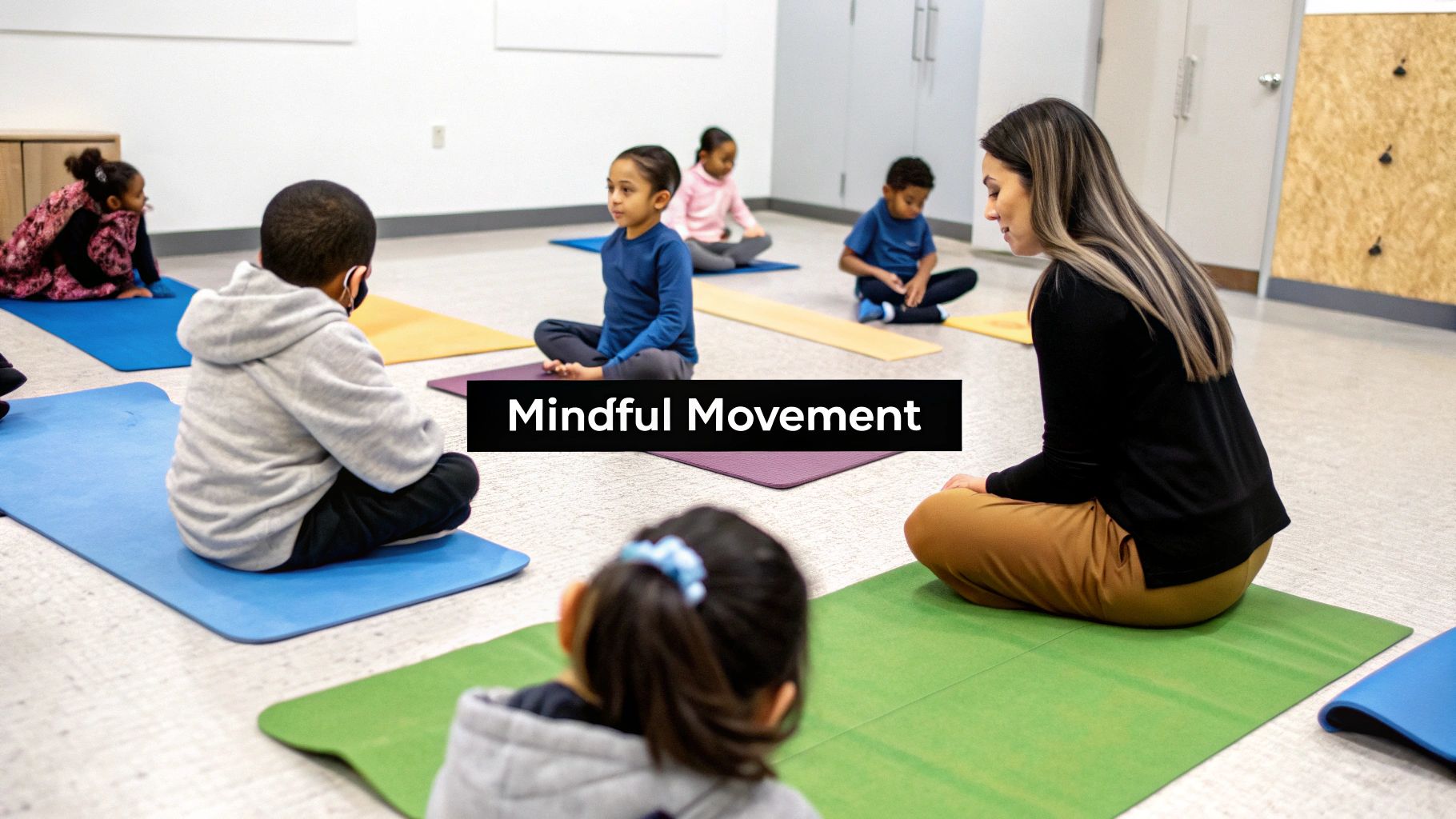
This method provides a unique opportunity for children to connect their breath to their bodies, which can be a powerful tool for managing big emotions. It offers a structured way to experience quiet and focus, balancing the more high-energy activities in a preschooler's day. The gentle stretches improve flexibility and balance, contributing to overall physical development in a non-competitive environment.
Why It Works for Preschoolers
Yoga and mindful movement is one of the most beneficial music and movement activities for preschoolers because it uniquely addresses the mind-body connection. Physically, it enhances balance, coordination, and strength through poses like "Tree Pose" or "Downward Dog." Cognitively, it improves focus and listening skills as children follow guided instructions. Emotionally, it introduces crucial self-soothing techniques, such as deep breathing ("smell the flower, blow out the candle"), which helps them learn to regulate their feelings.
How to Implement Yoga and Mindful Movement
Create a Calming Atmosphere: Dim the lights and play soft, instrumental music. Designate a special, comfortable space for your yoga practice, using mats or a soft rug.
Use Storytelling to Guide Poses: Frame poses within a story or theme. For example, a trip to the zoo could include stretching like a giraffe, roaring like a lion, or curling up like a sleeping cat.
Model and Move Slowly: Demonstrate each pose clearly and encourage children to try, but don't force perfection. Praise their effort and exploration of what their bodies can do.
Incorporate Mindful Breathing: Start and end with simple breathing exercises. Use visual cues, like pretending to fill a balloon in their belly as they inhale and letting the air out slowly as they exhale.
Keep It Short and Sweet: Begin with sessions lasting just 5-10 minutes. End with a moment of quiet rest, or "Savasana," where they lie still and listen to the calming music.
Pro-Tip: Connect poses to things children already know. A "Butterfly Pose" is more engaging than a "Baddha Konasana." Use resources like Cosmic Kids Yoga for fun, story-based video guides that keep children entertained.
For families in Herriman and surrounding areas like Draper looking to foster focus and body awareness, the principles of mindful movement are woven into many performing arts disciplines. Learn how our programs help build these skills at the Encore Academy of Dance, Music, and Theatre .
8. Interactive Musical Games and Sound Exploration
Interactive musical games and sound exploration involve structured activities that use music and sound as the central element of play. These games, such as musical statues or sound matching, are designed to sharpen listening skills, develop rhythm awareness, and enhance cognitive abilities. By framing musical learning within the context of a game, children are motivated to listen intently and respond physically, making it a highly engaging and effective teaching method.
This approach transforms abstract concepts like tempo, pitch, and rhythm into tangible, playful challenges. Whether it's freezing when the music stops or guessing an animal sound, these activities encourage children to connect what they hear with how they move and think. It’s a dynamic way to build foundational auditory processing skills essential for both musical and language development.
Why It Works for Preschoolers
Interactive games are a perfect fit for a preschooler’s natural inclination to learn through play. As one of the most effective music and movement activities for preschoolers, this method teaches critical skills like impulse control (waiting for a musical cue), auditory discrimination (differentiating between sounds), and social cooperation (following group rules). The excitement of the game keeps children focused and participatory, reinforcing learning without feeling like a formal lesson.
How to Implement Interactive Musical Games
Start with Familiar Games: Introduce simple, well-known games like Musical Statues (Freeze Dance). Play a high-energy song and have children dance, instructing them to freeze in a fun pose the moment the music stops.
Create a Sound Matching Game: Gather several pairs of sound-making objects (e.g., two shakers with rice, two boxes with bells). Hide one of each pair and have children shake the remaining items to find their match based on the sound.
Play 'Guess the Sound': Use a phone or tablet to play various sounds (animal noises, vehicle sounds, household noises). Have children guess the sound and then act out the corresponding animal or object.
Introduce Call-and-Response: Start a simple rhythmic pattern by clapping or tapping on a drum. Encourage the children to listen and then echo the pattern back to you. Keep the patterns short and simple at first.
Adapt Musical Chairs: To ensure inclusivity, play a non-elimination version. Instead of removing a chair, remove an object like a beanbag. When the music stops, everyone finds a chair, but one person won't get a beanbag. That child can then lead the next dance-off.
Pro-Tip: Keep the rules very simple and demonstrate a full round of the game before asking the children to play. Use non-elimination variations whenever possible to ensure every child remains engaged and feels successful throughout the activity.
For families in Bluffdale and surrounding areas like Lehi, these games provide a wonderful foundation. To see how structured play can elevate your child's musical understanding, learn more about the engaging curriculum in the music classes at Encore Academy .
Music & Movement: 8-Activity Comparison
| Music-Based Circle Time | Low — teacher-led routine; moderate timing skill | Low — minimal props, small cleared area | Social bonding, language development, listening, gross motor | Morning meetings, transitions, whole-group routines | ⭐⭐⭐⭐ Builds community; adaptable; low cost |
|---|---|---|---|---|---|
| Action Songs and Fingerplays | Low — requires clear demonstration and pacing | Very low — no equipment; small space | Fine & gross motor skills, sequencing, memory | Small groups, fine-motor practice, literacy links | ⭐⭐⭐⭐⭐ Targets motor + cognitive skills; highly adaptable |
| Dance and Free Movement Exploration | Moderate — open facilitation and boundary-setting | Moderate–High — needs safe, spacious area; optional props | Creativity, body awareness, emotional expression, cardio | Creative time, outdoor play, expressive sessions | ⭐⭐⭐⭐ Fosters expression & confidence; inclusive |
| Rhythm & Percussion Instrument Exploration | Moderate — ensemble management and scaffolding | Moderate — instruments, storage, noise control | Rhythm literacy, auditory discrimination, coordination | Music classes, group rhythm practice, transitions | ⭐⭐⭐⭐ Hands-on rhythm skills; engaging; scalable |
| Movement Breaks / Brain Breaks | Low — quick routines; requires transition planning | Very low — minimal space; videos optional | Improved focus, behavior regulation, energy release | Between lessons, attention dips, short transitions | ⭐⭐⭐⭐⭐ Quick to implement; immediate focus benefits |
| Musical Story Dramatization | High — planning, role management, timing | Moderate — props/costumes, moderate space, prep time | Narrative comprehension, creativity, social-emotional skills | Literacy integration, drama/music sessions, performances | ⭐⭐⭐⭐ Deep language & SEL gains; immersive |
| Yoga & Mindful Movement for Preschoolers | Moderate — guided facilitation; patience needed | Low — mats optional; calm, uncluttered space | Balance, flexibility, emotional regulation, focus | Calming routines, wind-downs, sensory regulation | ⭐⭐⭐⭐ Supports self-regulation; low-impact |
| Interactive Musical Games & Sound Exploration | Moderate — clear rules and strong management | Low–Moderate — simple instruments/objects; flexible space | Listening, rhythm, turn-taking, memory, auditory skills | Group play, music centers, listening skill practice | ⭐⭐⭐⭐⭐ Highly engaging; teaches rules and listening |
Ready to Find Your Rhythm? Take the Next Step!
We’ve explored a vibrant world of music and movement activities for preschoolers, journeying through eight dynamic ways to engage your child's body and mind. From the structured call-and-response of Music-Based Circle Time to the uninhibited joy of Dance and Free Movement Exploration, each activity is more than just a way to pass the time. They are foundational building blocks for a lifetime of learning, creativity, and physical confidence.
The common thread weaving through all these activities is the powerful, scientifically-backed connection between physical motion and cognitive development. When your child stomps like a dinosaur during a musical story or carefully follows the rhythm of a clapping game, they are forging new neural pathways. These pathways support everything from language acquisition and mathematical reasoning to emotional regulation and social skills.
Key Takeaways: From Play to Progress
Let's distill the core lessons from our journey. Mastering these approaches isn’t just about entertaining your preschooler; it's about providing a rich, multi-sensory learning environment right in your living room, whether you're in Bluffdale, Lehi, or Sandy.
Here are the most important takeaways:
- Consistency is Crucial: Integrating short, 5-10 minute movement breaks or one action song into your daily routine is more effective than one long, infrequent session. Consistency builds familiarity and makes music and movement a natural, anticipated part of the day.
- Process Over Performance: The goal is not a perfect dance or a flawless rhythm. The true value lies in the exploration, the experimentation, and the joy of participation. Celebrate effort and enthusiasm above all else.
- Adaptability is Your Superpower: A single activity, like Rhythm and Percussion Exploration, can be adapted for a sleepy morning with soft shakers or an energetic afternoon with loud drums. Pay attention to your child's energy and mood, and adjust the activity to meet them where they are.
- You Are the Most Important Instrument: Your enthusiasm, participation, and encouragement are what bring these activities to life. When you sing along, clap your hands, and dance with abandon, you give your child permission to do the same, fostering a safe space for creative expression.
Turning Inspiration into Action
Now that you're armed with ideas, the next step is to put them into practice. You don’t need a fancy studio or expensive equipment to get started. All you need is a little space, a simple playlist, and a willingness to be silly.
Actionable Insight: Choose just one new activity from this list to try this week. Perhaps it's introducing Musical Story Dramatization with a favorite book or setting up a simple Interactive Musical Game after snack time. Small, consistent steps build momentum and create lasting habits.
For many families from Riverton to Draper, these at-home activities spark a deeper interest. You might notice your child has a natural knack for rhythm, a captivating flair for dramatic play, or an undeniable love for dance. This spark is a precious thing, and nurturing it in a more structured, specialized environment can be the next logical step in their artistic journey. It’s about channeling that raw, joyful energy into foundational skills that build confidence, discipline, and a genuine passion for the arts.
These music and movement activities for preschoolers are the first steps on a path of discovery. They lay the groundwork for physical literacy, emotional intelligence, and creative problem-solving. By embracing them, you are not just teaching your child to sing and dance; you are teaching them how to listen, how to express themselves, and how to connect with the world and others in a profoundly meaningful way.
Ready to see that spark of creativity ignite into a confident flame? Encore Academy for the Performing Arts offers specialized music and dance programs, including our popular Parent and Me classes, designed to build on the foundational skills you've started at home. Book a trial class at our Bluffdale studio today and give your child a stage where their love for music and movement can truly soar.