
10 Fun Music and Movement Activity for Preschool Ideas for 2025
Welcome to the vibrant world where wiggles meet melodies! A high-quality music and movement activity for preschool is more than just a way to burn off energy; it's a cornerstone of early childhood development, building crucial neural pathways for learning, coordination, and emotional expression. For families in communities like Bluffdale, Riverton, and Draper, finding engaging activities that support whole-child growth is a top priority. This guide moves beyond generic ideas to offer 10 dynamic, expert-approved activities that transform playtime into a powerful learning experience.
Each entry is packed with specific, actionable instructions, learning objectives, and creative variations to keep things fresh and exciting. Whether you're a parent in Lehi looking for rainy-day ideas or a caregiver in Sandy seeking fresh inspiration, these activities are designed to be adaptable, fun, and profoundly beneficial. Forget the endless searching; this curated list provides everything you need to foster creativity and physical literacy in your child. Let's explore how rhythm and motion can help your little one thrive, laying a foundation for future success in both the arts and academics, right from your home in Herriman or a neighboring city.
1. Freeze Dance and Musical Statues (Themed Poses)
This classic music and movement activity for preschool gets a powerful upgrade by combining the energetic fun of Freeze Dance with the mindful challenge of Musical Statues. Instead of just freezing in place, children are prompted to hold specific themed poses, adding a layer of cognitive engagement and creativity to a beloved game. This hybrid activity is excellent for developing listening skills, body awareness, balance, and the crucial skill of self-control.
The activity is simple: play upbeat music and encourage children to move freely. When the music stops abruptly, call out a theme or a specific pose, like "freeze like a superhero!" or "make a tall tree pose." This approach transforms a simple game into a dynamic exercise that builds both gross motor skills and imaginative thinking.
How to Implement Themed Freeze Dance
- Materials: A music player and a diverse playlist with clear starts and stops.
- Instructions:
Teach a few simple poses first, such as "starfish," "airplane," or "frog."
Play a song and let the children dance, jump, or move around the space.
Stop the music and immediately call out one of the practiced poses.
Hold the freeze for 3-5 seconds, offering praise for focus and creativity.
Repeat with different songs and poses, gradually introducing new ones.
Tip for Encore Academy Integration: In our Parent and Me classes in Bluffdale, we use this game to build confidence and coordination. It’s also a fantastic warm-up before our younger dance classes, including those exploring the best age to start ballet , helping students from Riverton and Herriman energize their bodies and minds for focused instruction.
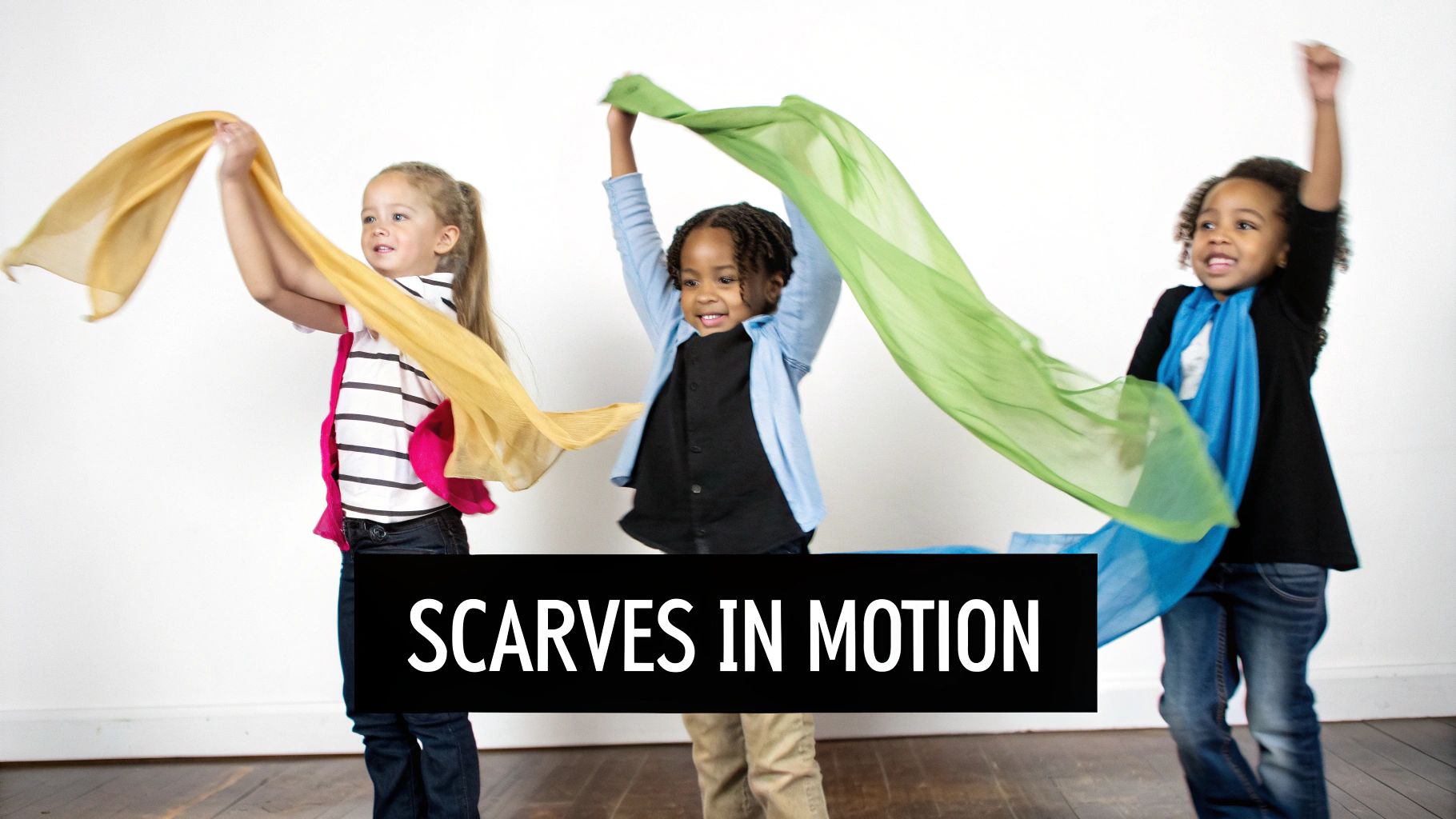
2. Scarves and Ribbons Movement
This imaginative music and movement activity for preschool uses lightweight scarves or ribbons to create beautiful visual extensions of a child's movements. Children manipulate these props while moving to music, providing powerful sensory input and encouraging larger, more fluid, and confident motions. This tactile and visual exercise is exceptional for enhancing creative expression, gross motor control, and spatial awareness.
The activity involves giving each child a scarf and playing music that inspires different types of movement, from slow and flowing to quick and energetic. As they move, the scarves amplify their actions, helping them visualize concepts like flow, speed, and direction. This makes it a perfect gateway to more expressive and interpretive dance forms.
How to Implement Scarves and Ribbons Movement
- Materials: Lightweight scarves (24-36 inches) or ribbons, a music player, and a diverse playlist (classical, ambient, upbeat).
- Instructions:
Give each child a scarf and allow them a moment to explore its texture and weight.
Play slow, flowing music and guide them through basic movements: making waves, drawing circles, or sweeping the scarf from side to side.
Use directional language like "wave your scarf up high!" or "paint a rainbow across the sky."
Gradually introduce faster tempos and encourage them to interpret the music with their scarves.
Progress to storytelling, where scarves become rivers, wind, or flames.
Tip for Encore Academy Integration: We often use scarves in our Parent and Me classes as a wonderful bonding tool and a gentle introduction to creative movement for families from Riverton and Lehi. This activity is also a foundational element in preparing young dancers for contemporary and interpretive styles, helping them connect emotion to physical expression in our Bluffdale studio.
3. Action Songs with Choreography
This classic music and movement activity for preschool embeds choreography directly into musical learning, turning familiar songs into full-body experiences. Action songs like 'Wheels on the Bus' or 'If You're Happy and You Know It' use simple, repetitive movements tied to lyrics, which helps develop memory, coordination, and a foundational understanding of rhythm and phrasing. This method is incredibly effective because it makes abstract musical concepts tangible and fun.
By connecting words to physical actions, children build stronger neural pathways, enhancing both language acquisition and motor planning. The predictable structure of these songs provides a sense of security, encouraging even shy children to participate, sing along, and express themselves through movement.
How to Implement Action Songs
- Materials: A music player or just your voice, and optional props like scarves or beanbags.
- Instructions:
Choose a simple, familiar action song to start.
Teach the movements first, without the music, demonstrating each action clearly and slowly.
Practice singing the lyrics without the movements.
Combine the song and the movements, performing it together slowly at first.
Repeat the song, gradually increasing the tempo and encouraging enthusiastic participation.
Tip for Encore Academy Integration: Action songs are a cornerstone of our Parent and Me classes, where families from Draper and Lehi learn together. We also use them as fun warm-ups for our youngest performers to build group cohesion and focus. The coordination learned here provides a great foundation for more complex choreography, like the moves explored in our guide to hip hop dance moves for kids .
4. Rhythm Instruments with Movement
This highly engaging music and movement activity for preschool empowers children to become active music-makers. By combining age-appropriate percussion instruments like drums, shakers, and tambourines with physical movement, children learn to produce sound while they march, sway, and dance. This hands-on approach is phenomenal for developing an internal sense of rhythm, improving hand-eye coordination, and fostering an early awareness of playing together as an ensemble.
This method transforms listening into a participatory experience. Children don't just hear the beat; they create it, feel it through their bodies, and connect their movements directly to the sounds they produce. It’s a powerful way to build a foundational understanding of musical concepts like tempo, beat, and dynamics in a joyful, kinesthetic way.

How to Implement Rhythm Instruments with Movement
- Materials: A collection of simple percussion instruments (maracas, tambourines, hand drums, rhythm sticks) and a music player.
- Instructions:
Introduce one instrument at a time, allowing for free exploration of its sound.
Start with a simple call-and-response game: you play a simple beat, and the children copy it.
Play music and guide movement that matches the instrument (e.g., marching while playing a drum, swaying while using shakers).
Encourage children to keep a steady beat along with a favorite song.
Gradually create a small ensemble, with different groups playing different instruments.
Tip for Encore Academy Integration: Our Parent and Me music classes in Bluffdale often use rhythm instruments to build these core skills. The rhythmic foundations developed here are also incredibly beneficial for students from Sandy and Draper who are exploring different dance styles, especially when learning complex rhythms in our tap dance steps for beginners classes .
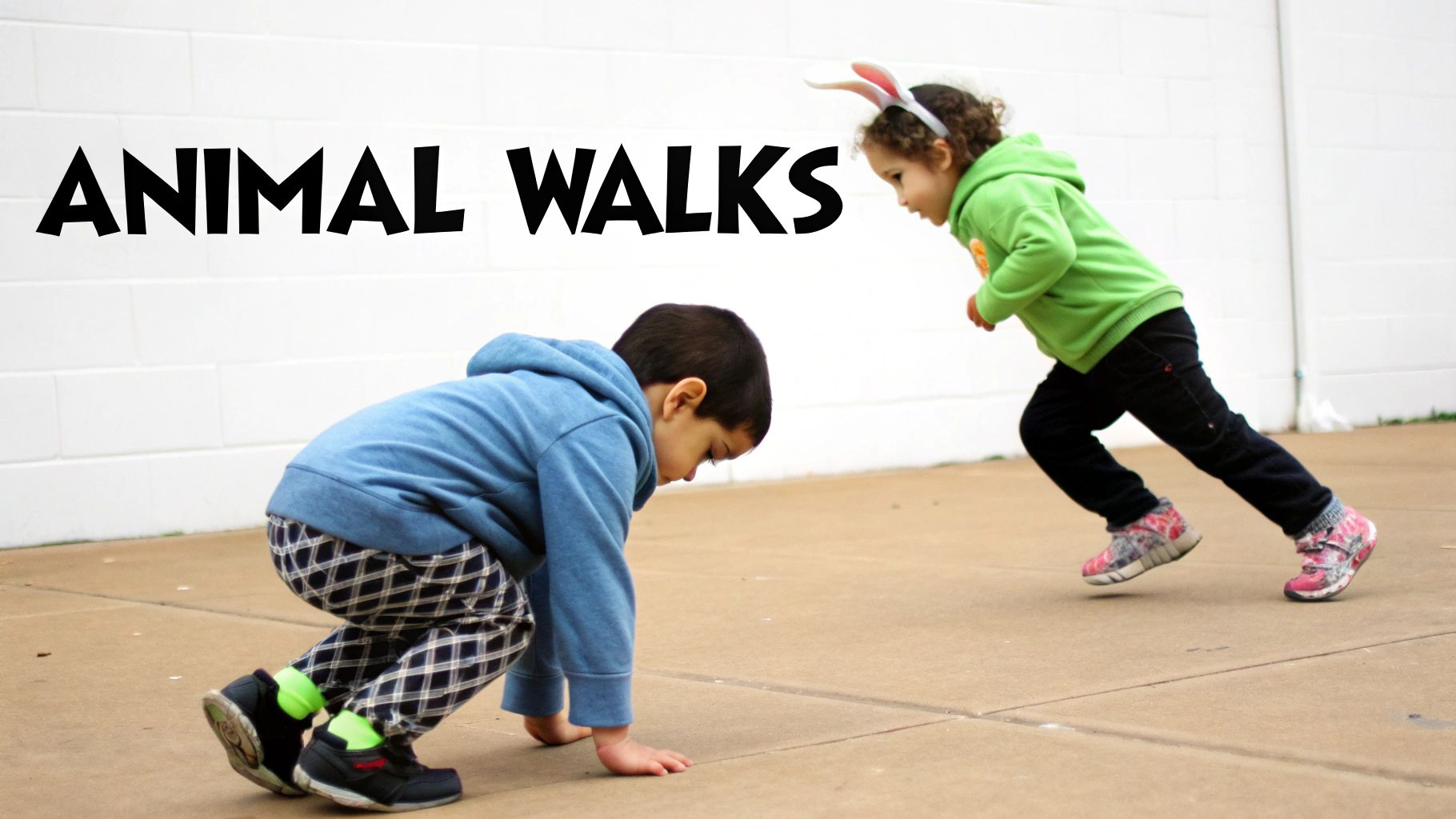
5. Animal Walks and Nature-Inspired Movement
This highly imaginative music and movement activity for preschool encourages children to embody the world around them by mimicking animal locomotion and natural phenomena. From powerful elephant stomps and quick bunny hops to slithering like a snake or swaying like a tree in the wind, this activity builds a strong connection between music, movement, and the natural world. It is a fantastic method for developing gross motor skills, coordination, creative problem-solving, and the foundational elements of character-based movement.
Children listen to music and translate its rhythm and mood into the physical characteristics of an animal or a nature element. This narrative-driven approach not only strengthens their bodies but also expands their understanding of different movement qualities, like fast, slow, heavy, and light, making it a rich sensory and physical experience.
How to Implement Animal Walks
- Materials: A music player with a varied playlist (e.g., slow, majestic music for whales; fast, light music for hummingbirds), and optional props like scarves or animal masks.
- Instructions:
Introduce one animal at a time. Demonstrate how it moves and make its sound.
Play a piece of music that matches the animal's characteristics and invite the children to move around the room like that animal.
Ask descriptive questions to deepen their engagement: "How big are an elephant's steps?" or "How quietly can a fox sneak?"
Hold the movement for the duration of the song or a set time.
Repeat with different animals, eventually creating a "jungle safari" or "ocean adventure" where they transition between movements.
Tip for Encore Academy Integration: We love using animal walks in our Parent and Me classes to foster imagination and bonding. This activity also serves as an excellent introduction to character work in our theater programs and helps develop the strength and body awareness crucial for students in Draper and Herriman interested in foundational skills, which are further explored in our guide on tumbling for dancers .
6. Dance Scarecrow and Puppet Movements
This imaginative music and movement activity for preschool explores the contrast between stiff and fluid motion, building exceptional body awareness and control. Children start by moving like rigid scarecrows or puppets on strings and then gradually "come to life" with flowing, graceful movements. This exercise is fantastic for teaching motor control, sequential movement, and the foundations of storytelling through dance.
The core of the activity is transformation. Children learn to isolate and control specific body parts, moving them in a stiff, articulated manner before transitioning to a more natural, fluid style. This concept not only strengthens gross motor skills but also introduces preschoolers to basic character development and expressive performance, making it a powerful tool for both dance and theater training.
How to Implement Scarecrow and Puppet Movements
- Materials: A music player with a playlist that can transition from staccato, rigid music to more flowing, lyrical pieces.
- Instructions:
Demonstrate stiff "scarecrow" or "puppet" movements. Emphasize moving one joint at a time (e.g., just the elbow, then the wrist).
Play rigid, percussive music and have children move around the room like puppets.
Call out body parts to "wake up" one by one, like "your fingers are coming to life!" or "your knees can now bend smoothly."
Switch the music to something more fluid and encourage children to melt into graceful, flowing dances.
Create a simple story, like Pinocchio coming to life, to guide the transformation.
Tip for Encore Academy Integration: This activity is a cornerstone of our early theater and dance programs, teaching students from Riverton, Draper, and Bluffdale how to use their bodies for storytelling. It builds the foundational skills needed for more complex choreography in our competitive dance teams, where performers must master quick transitions between sharp, controlled movements and lyrical grace.
7. Parachute Games and Partner Movement
This highly engaging music and movement activity for preschool uses a large fabric parachute to foster teamwork, rhythm, and gross motor skills. Children hold the edges and work together to create waves, bubbles, and canopies in response to music, turning individual movement into a powerful, collaborative experience. This activity is exceptional for developing cooperation, spatial awareness, and coordinated group movement while providing a delightful shared sensory experience.
The core of the activity involves synchronizing movements to a musical beat. As the music changes in tempo or volume, the group adjusts their actions, lifting the parachute high on a crescendo or making small, gentle waves to a quiet melody. This shared effort builds a strong sense of community and ensemble awareness.
How to Implement Parachute Games
- Materials: A large, lightweight play parachute and a music player with a varied playlist.
- Instructions:
Have children stand in a circle and hold the parachute edge with both hands.
Begin with simple movements like making small “ripples” or big “waves.”
Introduce bouncing lightweight balls or beanbags on top for added focus.
On a strong beat, have everyone lift the parachute high to create a “mushroom” or “dome.”
Practice taking turns running underneath the dome before it falls.
Tip for Encore Academy Integration: Our group classes for preschoolers from Herriman, Draper, and surrounding areas use parachute games to build ensemble awareness and listening skills. This is a perfect activity for our Parent and Me classes, promoting family bonding through cooperative play and laying a foundation for the teamwork required in future dance and theater performances.
8. Creative Movement to Instrumental Music
This expressive music and movement activity for preschool encourages children to listen deeply and translate sound into unique physical forms. Instead of following prescribed steps, children engage in unstructured, child-led movement in response to instrumental music. This fosters a profound connection between hearing, feeling, and moving, allowing them to explore how different sounds make their bodies want to react. This activity is exceptional for developing emotional expression, artistic interpretation, and listening skills.
The core of this activity is to empower children to become interpreters of music. By playing a piece of instrumental music, whether classical, jazz, or even nature sounds, you create a canvas for them to paint with their bodies. This process honors individual creativity and teaches them that there is no single "correct" way to respond to art, building confidence in their own artistic voice.
How to Implement Creative Movement
- Materials: A music player and a curated playlist of instrumental music with varied tempos, dynamics, and textures.
- Instructions:
Designate a safe, open space with clear boundaries for movement.
Play a short musical excerpt (2-4 minutes) and invite children to move in any way the music makes them feel.
Avoid demonstrating movements; instead, use guiding questions like, "What shape does this sound make?" or "Is the music fast or slow?"
After the music, encourage a brief moment of reflection where children can share how the music felt.
Repeat with different musical styles to explore a range of emotions and physical responses.
Tip for Encore Academy Integration: We use this approach to build foundational skills for interpretive dance in our programs for toddlers and preschoolers from Draper and Bluffdale. It’s a wonderful way to introduce the concepts explored in the best dance classes for toddlers , nurturing creativity and emotional awareness long before formal choreography begins.
9. Alphabet and Number Movement Games
This fantastic music and movement activity for preschool transforms abstract concepts like letters and numbers into tangible, physical experiences. Children use their bodies, either individually or in groups, to form the shapes of letters and numbers while music plays. This kinesthetic approach to learning reinforces academic concepts while simultaneously developing spatial reasoning, body awareness, collaboration, and gross motor skills.
The activity involves guiding children to create shapes with their bodies as the music changes or pauses. For example, they might stand tall with arms outstretched to form a "T" or work with a partner to create the letter "H." This method seamlessly blends pre-literacy and numeracy skills with creative expression, making learning a joyful, full-body adventure.
How to Implement Alphabet and Number Movement
- Materials: A music player, open space, and optional visual aids like alphabet or number flashcards.
- Instructions:
Start with simple, recognizable letters that are easy to form individually, such as "L," "T," or "Y." Demonstrate each one clearly.
Play upbeat music and have the children move around the room.
When the music stops, call out a letter or number for them to create with their bodies.
Encourage partners or small groups to work together to form more complex shapes like "B" or the number "8."
Celebrate their creative formations before starting the music again for the next round.
Tip for Encore Academy Integration: We use this activity in our Parent and Me classes to create powerful educational bonding moments. It's also a creative warm-up in our pre-dance classes, helping young dancers from Herriman and Draper develop the spatial awareness and cooperative skills essential for future group choreography and performance.
10. Music and Movement Storytelling
This immersive music and movement activity for preschool blends narrative storytelling with expressive movement, turning children into active participants in a story. Instead of just listening, preschoolers embody characters and act out plot points, using their bodies to interpret the narrative as music sets the emotional tone. This powerful method integrates dance, drama, and literacy, fostering narrative comprehension, empathy, and creative expression.
The activity involves guiding children through a story where specific actions are tied to characters or events. For example, they might tiptoe quietly like a mouse, stretch tall like a growing beanstalk, or gallop like a horse. The combination of auditory storytelling, musical cues, and physical action creates a multi-sensory learning experience that helps solidify comprehension and builds a rich emotional connection to the narrative.
How to Implement Music and Movement Storytelling
- Materials: A familiar children's book or story, a music player with a playlist that matches the story's mood (e.g., suspenseful, happy, gentle), and optional simple props like scarves or hats.
- Instructions:
Choose a simple, well-known story like "The Three Little Pigs" or "Goldilocks."
Read the story aloud, assigning a specific movement to each character or key event (e.g., huffing and puffing, stirring porridge).
Retell the story, this time playing music and prompting the children to perform the movements as you narrate.
Encourage children to add their own creative movements and sounds.
Repeat, allowing different children to take on lead roles or even create new story endings.
Tip for Encore Academy Integration: We utilize storytelling in our Parent and Me classes to strengthen the parent-child bond through shared creative play. For families in Riverton and Herriman, this activity is a wonderful introduction to the dramatic arts, laying the groundwork for our more structured youth theater and dance programs. It builds the confidence and imagination essential for future performers.
10 Preschool Music & Movement Activities Comparison
| Freeze Dance and Musical Statues (Themed Poses) | Low–Medium 🔄🔄 — teach poses + music stops | Minimal ⚡ — music player, clear floor space | High ⭐⭐⭐ — listening, balance, self-control, body awareness | Warm‑ups, preschool yoga, recitals, Parent & Me | Use distinct stops; teach poses without music first |
|---|---|---|---|---|---|
| Scarves and Ribbons Movement | Low 🔄 — teach patterns and safety | Low cost ⚡ — 24–36" scarves, storage, space | Medium‑High ⭐⭐ — creativity, fine/gross motor, confidence | Creative movement, storytelling, recitals | Start with slow music; teach basic waves/spirals |
| Action Songs with Choreography | Low 🔄 — simple gestures + repetition | Minimal ⚡ — recorded songs, optional small props | High ⭐⭐⭐ — memory, language, coordination, rhythm | Group classes, Parent & Me, parades, assemblies | Teach movements first, then add lyrics |
| Rhythm Instruments with Movement | Medium 🔄🔄 — technique + ensemble patterns | Moderate — instruments (cost/storage), space, supervision | High ⭐⭐⭐ — rhythm, fine motor, ensemble awareness | Music classes, mixed music‑movement performances | Start with large, easy‑to‑hold instruments and call‑and‑response |
| Animal Walks and Nature‑Inspired Movement | Low 🔄 — imaginative cues; flexible structure | Minimal ⚡ — open space; optional small props | Medium ⭐⭐ — gross motor variety, creativity, storytelling | Preschool play, theater intro, warm‑ups | Introduce one animal at a time; match tempo to animal |
| Dance Scarecrow and Puppet Movements | Medium–High 🔄🔄🔄 — needs precise modeling | Minimal — space; optional costumes/props | Medium‑High ⭐⭐⭐ — body isolation, control, contrast awareness | Character work, theater, choreography detail | Demonstrate rigid→loose progression; isolate body parts |
| Parachute Games and Partner Movement | Medium 🔄🔄 — group coordination & transitions | Moderate — parachute/sheet, large space, close supervision | High ⭐⭐⭐ — teamwork, timing, spatial awareness | Parent & Me, large‑group classes, community events | Practice grips/transitions; use clear verbal cues |
| Creative Movement to Instrumental Music | Medium–High 🔄🔄🔄 — skilled facilitation | Minimal — curated instrumental music, open space | High ⭐⭐⭐ — deep listening, emotional expression, artistic voice | Contemporary/interpretive classes, older children, adults | Use short excerpts; set clear boundaries; honor individual choices |
| Alphabet and Number Movement Games | Medium 🔄🔄 — demos + group formation | Minimal — open space, optional floor markers | Medium‑High ⭐⭐⭐ — spatial reasoning, literacy/numeracy, cooperation | Pre‑dance, literacy‑integrated lessons, Parent & Me | Start with simple letters; use group shapes for complex forms |
| Music and Movement Storytelling | High 🔄🔄🔄 — planning, multi‑disciplinary coordination | Moderate–High — music, props/costumes, rehearsal time | High ⭐⭐⭐ — narrative comprehension, ensemble, performance skills | Integrated arts productions, recitals, culminating projects | Break story into scenes; assign clear movement cues |
Bring Music and Movement to Life at Encore Academy
The ten activities we have explored, from the spontaneous joy of Freeze Dance to the imaginative world of Music and Movement Storytelling, provide a powerful toolkit for any parent or educator. Each activity is more than just a way to burn off energy; it is a carefully structured opportunity for holistic development. By integrating these practices, you are directly nurturing your preschooler's gross motor skills, enhancing their rhythmic awareness, and building crucial social-emotional intelligence through shared creative experiences.
The common thread weaving through every activity, whether it involves animal walks or colorful scarves, is the fundamental connection between auditory input and physical expression. This connection is the bedrock of performing arts education. Mastering this link early on helps children develop superior coordination, a keen sense of timing, and the confidence to express themselves non-verbally. It’s the first step toward understanding how to tell a story with their body, a skill that is invaluable in dance, theater, and even public speaking later in life.
Key Takeaways for Your Preschooler's Journey
To make the most of each music and movement activity for preschool children, remember these core principles:
- Embrace Imperfection: The goal is participation, not perfection. Celebrate every wiggle, jump, and clap, as each one represents a successful attempt at self-expression and motor planning.
- Variety is Vital: Regularly rotate between structured activities like action songs and open-ended explorations like creative movement to instrumental music. This keeps your child engaged and supports different facets of their development, from following directions to fostering independent creativity.
- Connect to Their World: Use themes that resonate with your child. If they love dinosaurs, adapt the Animal Walks. If they are learning letters, make the Alphabet Movement Game a daily ritual. Personalization makes learning feel like play.
From Your Living Room to the Studio
Implementing these activities at home is a fantastic way to introduce your child to the arts. For families in Herriman, Draper, Lehi, Sandy, and surrounding communities looking to deepen this exploration, a structured class environment at our Bluffdale studio can be the perfect next step. A dedicated space and expert guidance can transform a child’s natural enthusiasm into foundational technique and a genuine passion for performance.
At Encore Academy, we build upon the very concepts discussed in this article. Our preschool programs are specifically designed to channel that raw, joyful energy into the building blocks of dance and music. Instructors guide students in understanding rhythm, mastering body control, and learning how to collaborate with peers, all within a supportive and inspiring setting. This is where simple movement games evolve into the first steps of a lifelong artistic journey, fostering discipline, creativity, and unshakeable self-confidence.
Ready to see how a structured class can elevate your child’s love for the arts? Discover the vibrant, nurturing community at Encore Academy for the Performing Arts, where we specialize in turning playful wiggles into purposeful art. Schedule a tour or a trial class at our Bluffdale studio by visiting us at Encore Academy for the Performing Arts and watch your little star shine.