
Top 10 Preschool Music And Movement Ideas For Creative Kids In 2025
Welcome to the vibrant world of wiggles, giggles, and rhythm! For parents and educators from Bluffdale to Herriman and beyond, finding enriching activities for preschoolers is a top priority. Preschool music and movement ideas are more than just a way to burn off energy; they are foundational tools for cognitive, social-emotional, and physical development.
During these formative years, a child's brain is rapidly building connections. When they clap to a beat, dance with a scarf, or freeze when the music stops, they are not just playing. They are learning complex concepts like rhythm, spatial awareness, and impulse control. For families in communities like Riverton and Lehi looking for ways to support this critical growth, integrating structured musical play is a powerful strategy.
This guide moves beyond generic advice to offer a comprehensive collection of ten detailed, actionable preschool music and movement ideas designed to inspire creativity and build coordination. Each activity is broken down into simple, easy-to-follow steps, complete with objectives, material lists, and practical tips for implementation, making them perfect for both home and classroom settings. Whether you are in Draper, Sandy, or right here in Bluffdale, you will find everything you need to get started. Let's dive into the activities that will have your little ones singing, dancing, and learning with joy.
1. Freeze Dance
Freeze Dance is a dynamic and beloved activity that masterfully combines music, movement, and listening skills. The concept is simple yet highly effective: children dance with complete freedom while music plays, but the moment it stops, they must freeze in their exact position, holding it like a statue until the music resumes. This game is a staple in early childhood education because it’s not just fun; it’s a powerful tool for developmental growth.
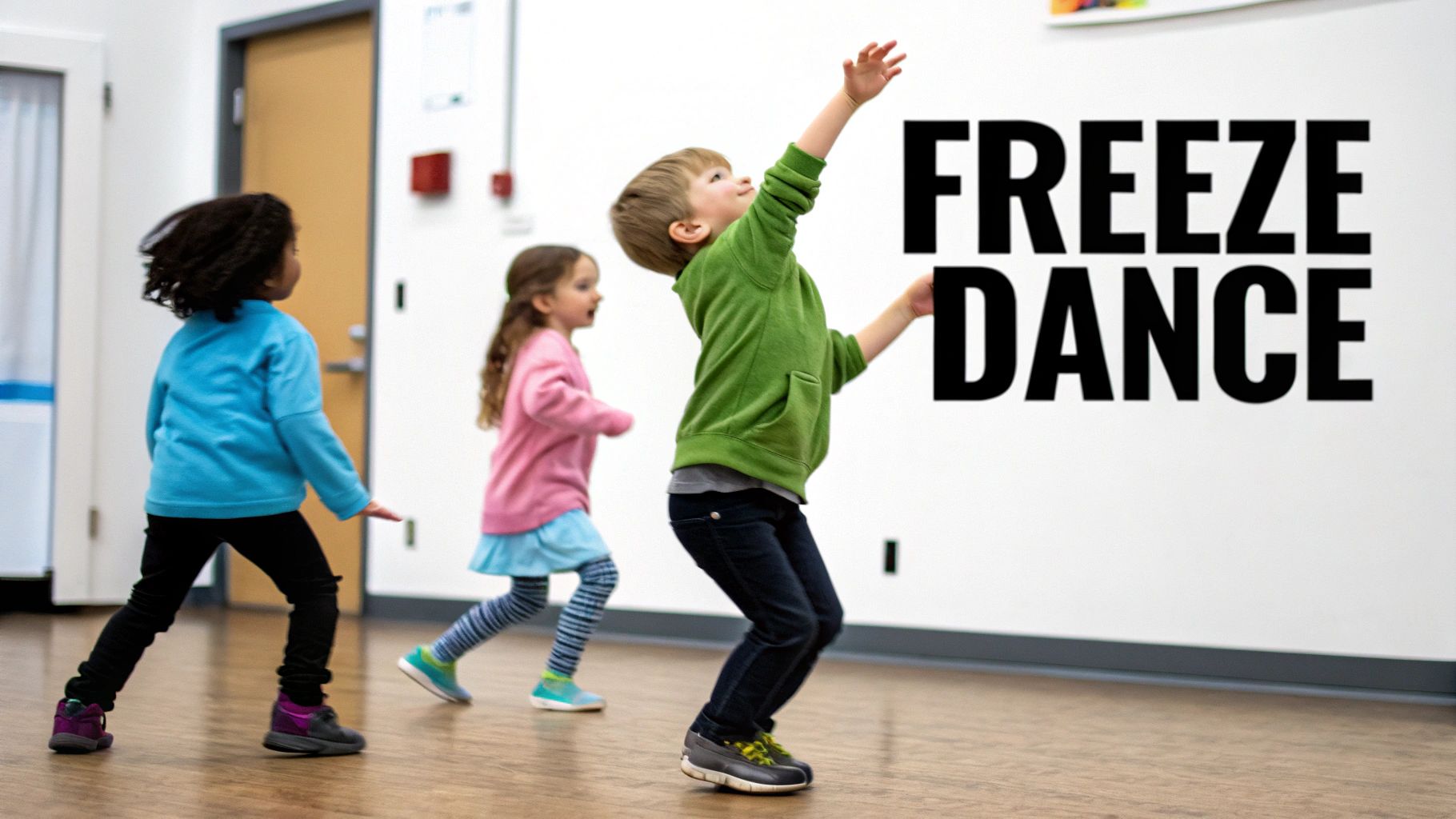
This classic is one of the most effective preschool music and movement ideas for developing self-regulation and impulse control. As children anticipate the music stopping, they are actively practicing how to control their bodies on command, a crucial skill for classroom readiness.
Why It Works for Preschoolers
Freeze Dance is perfect for the preschool age group because it requires no complex rules or equipment, just music and space. It taps directly into a young child’s natural love for movement and music while building foundational skills.
- Gross Motor Skills: Children can jump, spin, wiggle, and wave their arms, strengthening large muscle groups and improving coordination.
- Listening Skills: The game demands active listening as children must respond instantly to the auditory cue of the music stopping.
- Body Awareness: Freezing in unique and sometimes challenging positions helps children develop a greater sense of where their bodies are in space (proprioception).
Implementation Tips for Home or Classroom
To make Freeze Dance a hit with your little ones in Bluffdale or surrounding areas like Herriman and Riverton, try these actionable tips:
- Vary the Music: Keep children engaged by switching between different tempos and genres. Try a slow, classical piece followed by an upbeat pop song to encourage different types of movement.
- Use Visual Cues: For younger preschoolers or children who need extra support, pair stopping the music with a visual signal, like turning off the lights or holding up a large red circle.
- Praise the Poses: Focus on creativity and effort rather than who freezes "best." Celebrate silly, imaginative, or well-balanced poses to build confidence.
- Adjust Difficulty: Start with longer periods of music and shorter freezes. As children master the game, shorten the music intervals to make the stops more frequent and challenging.
2. Action Songs with Movements
Action songs are a cornerstone of early childhood education, seamlessly blending melody, language, and physical motion. These songs, like "The Wheels on the Bus," guide children through a series of choreographed movements that correspond directly to the lyrics. This multi-sensory approach transforms singing into an engaging, full-body experience that makes learning vocabulary, rhythm, and coordination both intuitive and memorable.
This method is one of the most powerful preschool music and movement ideas because it supports multiple domains of development at once. By linking words with actions, children build stronger neural pathways, enhancing memory recall and language comprehension in a joyful, low-pressure setting.
Why It Works for Preschoolers
Action songs are perfectly suited for preschoolers because they cater to their need for movement and repetition. The predictable structure helps children feel successful and confident, while the physical actions help them stay focused and engaged.
- Fine and Gross Motor Skills: Songs like "Itsy Bitsy Spider" refine finger dexterity, while "If You're Happy and You Know It" encourages clapping, stomping, and jumping, developing large muscle control.
- Language and Vocabulary: Children learn new words and their meanings by physically acting them out, which reinforces comprehension and retention.
- Following Directions: The structure of an action song requires children to listen to the lyrics and respond with the correct movement, building crucial pre-literacy and classroom skills.
Implementation Tips for Home or Classroom
To make action songs a vibrant part of your routine in Draper, Lehi, or Bluffdale, try these simple yet effective tips:
- Demonstrate Slowly: Before playing the music, introduce the movements slowly and clearly. Repeat them a few times so children feel comfortable before adding the song.
- Repeat for Mastery: Don't be afraid to use the same songs for several weeks. Repetition builds confidence and allows children to fully master the movements and lyrics.
- Encourage Creativity: Once a song is familiar, invite children to invent their own movements for new verses. This fosters creativity and gives them ownership of the activity.
- Connect to Concepts: Use action songs to teach academic concepts. Sing a song about counting while touching fingers, or one about colors while pointing to different objects in the room. You can discover more ideas for music and movement activities for preschoolers on our blog .
3. Rhythm and Drum Circles
Rhythm and Drum Circles are a powerful, collaborative activity where children gather to create music together using various percussion instruments. Seated in a circle, they might use hand drums, rhythm sticks, tambourines, or even simple shakers to explore beat, rhythm, and ensemble playing. This activity is more than just making noise; it’s a foundational exercise in communication, listening, and teamwork.
This engaging experience is one of the most effective preschool music and movement ideas for developing social skills and a sense of community. As children listen to one another and contribute their own patterns, they learn the give-and-take of a musical conversation, building an understanding of how their part fits into the whole group’s creation.
Why It Works for Preschoolers
Drum circles are perfectly suited for preschoolers because they are intuitive and allow for immediate success. There is no right or wrong way to tap a drum, which builds confidence and encourages creative expression while developing crucial abilities.
- Rhythmic Awareness: Children internalize the concept of a steady beat, the foundation of all music, by feeling it in their bodies as they play.
- Listening and Cooperation: To play together, children must listen to the leader and their peers, learning to match tempo and volume, which enhances cooperative skills.
- Fine Motor Skills: Gripping drumsticks, shaking maracas, and tapping tambourines strengthen the small muscles in the hands and wrists needed for writing.
Implementation Tips for Home or Classroom
To host a successful drum circle for your little musicians in Draper or nearby communities like Sandy and Lehi, try these practical tips:
- Start with Call and Response: Begin by tapping a simple rhythm and having the children echo it back to you. This "call and response" pattern is easy to follow and teaches active listening.
- Use a Leader: Designate a child to be the "rhythm leader" who starts a new pattern for everyone to follow. Rotate this role so every child gets a turn to lead.
- Explore Dynamics: Guide children to play very loudly (forte) and then very softly (piano). Use hand signals, like raising a hand high for loud and lowering it for quiet, to make it a game.
- Vary the Instruments: You don't need expensive drums. Use pots, pans, plastic containers, and wooden spoons. The different sounds (timbres) will make the experience richer and more interesting.
4. Dancing with Ribbons and Scarves
Dancing with Ribbons and Scarves is a visually captivating activity that encourages creative expression and graceful movement. Children use lightweight scarves or ribbon wands to paint the air with color, exploring how different movements create different visual effects. This simple yet profound activity is a staple in many early childhood programs, like Waldorf preschools, because it beautifully integrates sensory play, artistic expression, and physical development.
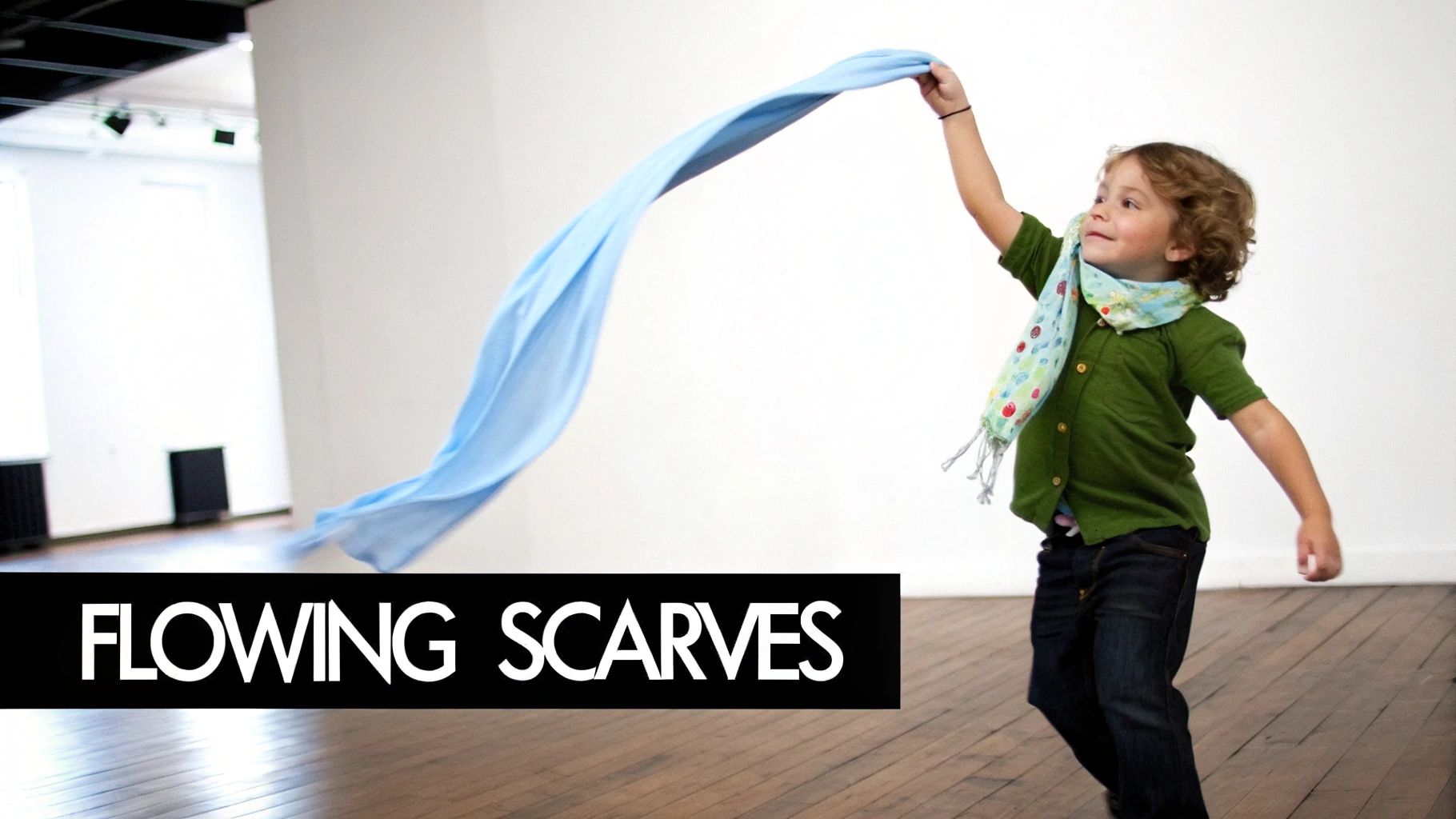
This is one of the most elegant preschool music and movement ideas for connecting emotional expression with physical action. As a child listens to flowing music and moves a scarf, they are translating what they hear and feel into a tangible, beautiful motion, building a strong mind-body connection.
Why It Works for Preschoolers
Scarves and ribbons are ideal props for young children because they are lightweight, safe, and provide immediate visual feedback. The activity taps into a child’s imagination while refining both large and small muscle groups.
- Gross Motor Skills: Making big arcs, waves, and circles with the scarves engages the arms, shoulders, and core, improving coordination and strength.
- Fine Motor Skills: The simple act of gripping the ribbon wand or pinching the corner of a scarf develops finger dexterity and hand strength.
- Creative Expression: There is no right or wrong way to move a scarf, which empowers children to express themselves freely and build creative confidence.
- Cause and Effect: Children quickly learn that a fast movement creates a sharp streak of color, while a slow, gentle motion makes the scarf float, teaching them foundational physics concepts.
Implementation Tips for Home or Classroom
To bring the magic of scarf dancing to your little ones in Bluffdale, Draper, or surrounding areas, consider these simple tips:
- Choose Flowing Music: Instrumental pieces, classical music, or ambient soundscapes work beautifully to inspire fluid and expressive movements.
- Provide Lightweight Materials: Use sheer, lightweight scarves (like silk or chiffon) that float easily and are safe for young children.
- Start with Exploration: Before giving instructions, allow children free time to simply explore how the scarves move. Let them discover what happens when they run, spin, or toss them.
- Introduce Themed Movements: Guide their play by suggesting they "paint a rainbow," "make waves in the ocean," or "be a floating leaf." This helps spark their imagination and provides structure. For older kids ready for more defined moves, you can explore dance moves for kids and adapt them to scarf play.
5. Musical Statues and Pose Games
Musical Statues and Pose Games elevate the classic freeze dance concept by adding a creative and imaginative twist. Instead of simply freezing in place, children are challenged to strike a specific pose or embody a character when the music stops. This activity brilliantly merges listening, movement, and cognitive skills, asking children to think, interpret, and then express an idea with their bodies.
This variation is one of the most effective preschool music and movement ideas for strengthening vocabulary and conceptual understanding. By asking a child to become a "tall tree" or a "sleeping cat," you're not just guiding their movement; you're connecting words to physical actions, reinforcing learning in a deeply memorable way.
Why It Works for Preschoolers
Musical Statues taps into a preschooler's budding imagination and desire for creative expression. The directed poses provide just enough structure to guide them, while still allowing for personal interpretation and silliness, making it an engaging challenge.
- Imagination and Creativity: Prompts like "freeze like a superhero" or "show me a melting snowman" encourage children to think creatively and express themselves non-verbally.
- Vocabulary and Concept Building: This game is a fantastic tool for reinforcing learning themes. A "Jungle Safari" theme can have them freezing as lions, monkeys, and snakes, solidifying animal names and characteristics.
- Gross Motor Control: Holding specific poses, whether balancing on one foot like a flamingo or stretching wide like a star, requires significant muscle control and enhances body awareness.
Implementation Tips for Home or Classroom
To bring Musical Statues and Pose Games to life for your children in Sandy or nearby communities like Bluffdale, try these actionable tips:
- Introduce a Theme: Connect the poses to a story you just read or a concept you're learning. For example, after a book about weather, have them pose as rain, wind, or sunshine.
- Demonstrate and Participate: Model a few examples of poses before you begin. Your enthusiasm is contagious and gives children who are hesitant a clear idea of what to do.
- Let Children Lead: After a few rounds, invite the children to suggest the next pose. This empowers them, boosts their confidence, and keeps the game fresh and exciting.
- Praise Interpretation: Celebrate every child's unique interpretation of a pose. There is no right or wrong way to be a "bumpy rock," and acknowledging all efforts fosters a safe, creative environment.
6. Parachute Games and Activities
Parachute play is a highly collaborative and visually stimulating activity that brings children together for coordinated movement. Using a large, colorful parachute, children hold onto the edges and work as a team to create mesmerizing effects like waves, domes, and the ever-popular "popcorn" game. This activity is a vibrant centerpiece for any group-focused music and movement session, promoting teamwork alongside physical development.
This group activity is one of the most powerful preschool music and movement ideas for teaching cooperation and shared goals. Children quickly learn that the parachute only moves correctly when everyone lifts, lowers, and shakes in unison, providing a tangible lesson in cause and effect on a group scale.
Why It Works for Preschoolers
Parachute games are ideal for preschoolers because they are non-competitive and sensory-rich, relying on simple, repetitive motions that are easy for young children to master. The cause-and-effect nature of lifting together to make the parachute billow is instantly rewarding and encourages participation.
- Gross Motor Skills: Gripping the handles, lifting arms overhead, and shaking the parachute engages shoulder, arm, and core muscles.
- Cooperation and Teamwork: Children must communicate and coordinate their actions, learning to work together to achieve a common goal, like making a 'mushroom' dome.
- Rhythm and Timing: Following verbal cues or moving to the beat of a song helps children develop a sense of rhythm and the ability to synchronize their movements with others.
Implementation Tips for Home or Classroom
To ensure your parachute activities are a success for preschoolers in Bluffdale and nearby communities like Draper and Lehi, follow these practical tips:
- Use Clear Verbal Cues: Start with simple, consistent commands like "Ready, set, lift!" or "Let's make small waves." This helps children anticipate the next movement.
- Incorporate Music: Play songs with a steady beat to guide the rhythm of the movements. Songs about weather (wind, rain) or the ocean pair perfectly with making waves.
- Introduce Games Gradually: Begin with basic up-and-down motions before introducing games like "popcorn" (placing light balls on top to bounce) or having children run underneath.
- Ensure Ample Space: Parachute play requires a large, open area, whether indoors in a gym or outdoors at a park in Riverton. Make sure there is plenty of room for children to move safely around the perimeter.
7. Instrument Exploration and Petting Zoo
An Instrument Exploration and Petting Zoo is a hands-on, sensory-rich activity where children are invited to freely explore a variety of musical instruments. Set up like a "petting zoo," this station-based approach encourages discovery and curiosity, allowing children to touch, hold, and play with instruments like maracas, drums, and xylophones without the pressure of formal instruction. This method is a cornerstone of child-led learning and a fantastic way to introduce musical concepts.
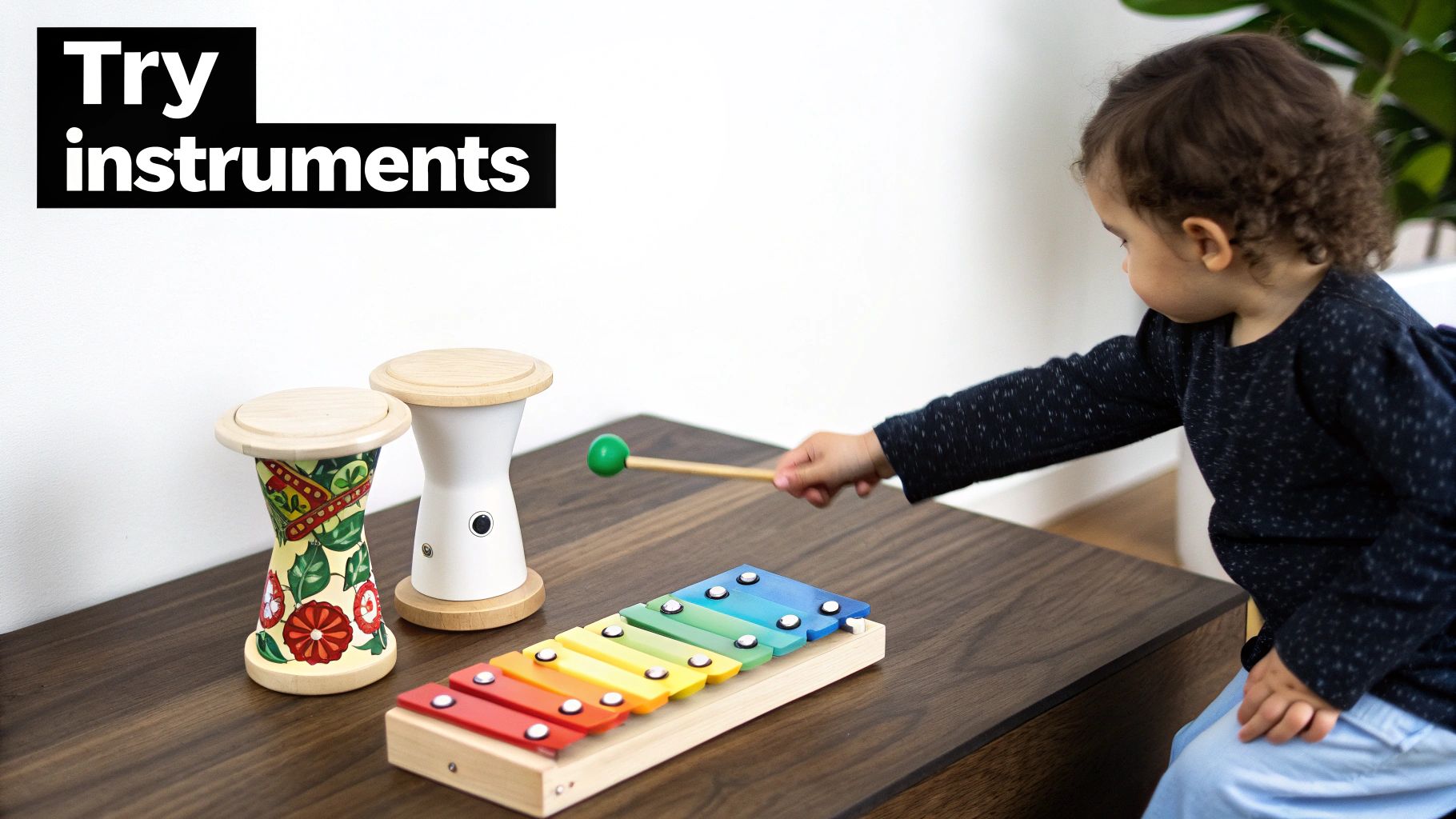
This idea is one of the most effective preschool music and movement ideas because it empowers children to become active participants in their own learning. By experimenting with how different actions create different sounds, they are engaging in scientific thinking (cause and effect) and developing a personal connection to music-making.
Why It Works for Preschoolers
The "petting zoo" concept is perfectly suited for preschoolers' inquisitive nature and desire for tactile experiences. It removes the fear of "doing it wrong" and instead celebrates the process of exploration, which is crucial for building a positive relationship with music.
- Fine Motor Skills: Manipulating small instruments like finger cymbals, bells, and rhythm sticks strengthens hand-eye coordination and the small muscles in the fingers and hands.
- Auditory Discrimination: Children learn to distinguish between different sounds, pitches, and timbres, a foundational skill for both musical and language development.
- Creativity and Self-Expression: With the freedom to experiment, children can express themselves creatively, discovering rhythms and sounds that are uniquely their own.
Implementation Tips for Home or Classroom
To create a successful instrument petting zoo for your little ones in Bluffdale or nearby Lehi, consider these practical tips:
- Rotate Instruments: Keep the experience fresh and exciting by rotating the available instruments weekly. This prevents boredom and introduces new sonic possibilities.
- Demonstrate Gentle Handling: Briefly show children how to hold and play with each instrument gently. Use phrases like "Our instruments are like friends; we treat them with care."
- Use Open-Ended Prompts: Encourage exploration with questions like, "What happens if you shake it softly?" or "How does this one sound different from that one?"
- Create Sound Zones: If space allows, set up a "quiet corner" with instruments like rain sticks and a "loud zone" with drums and cymbals to help manage noise levels.
Early exposure to instruments in a playful setting can spark a lifelong passion for music. You can learn more about how Encore Academy nurtures this curiosity through its early childhood music programs designed for young learners.
8. Story-Based Movement and Musical Theater
Story-Based Movement and Musical Theater transforms beloved narratives into interactive, physical experiences by inviting children to act out stories using their bodies and voices. This method combines the magic of storytelling with the expressiveness of music and dance, allowing preschoolers to embody characters, emotions, and plot points. Instead of just listening to a story, they become the hungry caterpillar, the brave pig, or the swirling wind.
This powerful approach is one of the most enriching preschool music and movement ideas because it integrates literacy, emotional intelligence, and physical development. Children learn to connect actions with words and feelings, building a deeper, more personal understanding of the narrative while developing their creativity and confidence.
Why It Works for Preschoolers
This activity is exceptionally effective for preschoolers as it taps into their natural inclination for imaginative play and storytelling. It provides a structured yet flexible framework for creative expression, making abstract concepts like character and plot tangible and understandable.
- Literacy and Comprehension: Acting out a story reinforces plot sequence, character motivations, and key vocabulary, significantly boosting reading comprehension skills.
- Emotional Development: Children explore and express a wide range of emotions-from the wolf’s frustration to a character's joy-in a safe and guided environment, building empathy.
- Creative Expression: This activity encourages children to interpret characters and scenes in their own unique way, fostering imagination and problem-solving skills.
Implementation Tips for Home or Classroom
To bring story-based movement to life for children in Bluffdale and nearby communities like Draper and Lehi, consider these practical tips:
- Start with Familiar Tales: Begin with well-known stories like "The Three Little Pigs" or "Goldilocks." Children’s familiarity with the plot allows them to focus on movement and expression.
- Let Children Lead: Encourage children to invent the movements. Ask, "How would a hungry caterpillar crawl?" or "Show me how you would build a strong brick house."
- Use Simple Props: Offer optional props like scarves for wind, blocks for houses, or animal masks. Keep them simple to inspire imagination rather than direct the play.
- Connect Movement to Emotion: Prompt children to think about how characters feel. Ask, “What does your body look like when you are scared of the wolf?” to link physical and emotional expression.
For those interested in exploring this further, you can learn more about our theater programs that build these foundational skills.
9. Follow-the-Leader Movement Games
Follow-the-Leader is a timeless game that beautifully blends imitation, creativity, and social interaction. In this activity, one person (a teacher or a child) acts as the "leader" and performs a series of movements, while the other children follow along, copying the actions as closely as possible. It's a fantastic way to encourage observation and coordination, transforming simple mimicry into a joyful, shared experience.
This classic activity is one of the most versatile preschool music and movement ideas because it builds both physical and social-emotional skills. Children practice paying close attention to others while also getting the chance to express their own creativity when it’s their turn to lead, which builds confidence and self-esteem.
Why It Works for Preschoolers
Follow-the-Leader is highly effective for preschoolers as it leverages their natural tendency to imitate. The game's structure is simple enough for young minds to grasp quickly, yet it offers endless possibilities for creative expression and skill development.
- Observation Skills: Children must watch the leader carefully to replicate their movements, sharpening their visual tracking and attention to detail.
- Social Awareness: The game teaches turn-taking and how to participate in a group activity, fostering a sense of community and cooperation.
- Creativity and Leadership: When a child takes a turn as the leader, they get to invent their own movements, empowering them and encouraging creative thinking.
Implementation Tips for Home or Classroom
To make your Follow-the-Leader game a success with children in Bluffdale or nearby communities like Sandy and Herriman, consider these practical tips:
- Start Simple: Begin with basic, easy-to-copy movements like clapping, stomping, or waving. As children gain confidence, the leader can introduce more complex sequences.
- Use Music for Pacing: Play a song with a steady beat to help structure the movements and maintain a fun, energetic pace for the game.
- Encourage All Leaders: Gently encourage hesitant children to take a turn leading, but don't force them. Offer to lead with them or suggest a simple starting move to help them feel comfortable.
- Rotate Leadership Frequently: Ensure everyone who wants a turn gets one. This keeps the game dynamic and gives more children the opportunity to build their leadership skills.
10. Yoga and Mindful Movement for Preschoolers
Yoga and mindful movement introduce preschoolers to the connection between their bodies and emotions through playful, story-based poses. Rather than focusing on perfect form, this practice uses imagination to guide children through movements like stretching like a cat or standing tall like a tree. It masterfully combines physical activity with crucial skills for emotional regulation and focus, making it a calming yet engaging addition to any routine.
This approach is one of the most effective preschool music and movement ideas for building self-awareness and providing children with tools to manage big feelings. By linking breath to movement, even in a very simple way, children learn to find stillness and calm their nervous systems, a foundational skill for lifelong well-being.
Why It Works for Preschoolers
Preschool yoga is successful because it meets children where they are, transforming abstract concepts like "mindfulness" into concrete, imaginative play. It taps into their natural creativity while supporting holistic development.
- Emotional Regulation: Simple breathing exercises and calming poses help children learn how to self-soothe and respond to stress.
- Body Awareness & Flexibility: Holding poses like "Downward Dog" or "Warrior" builds strength, balance, and an understanding of how their bodies can move. Explore how flexibility training can benefit young movers.
- Focus and Attention: Following a sequence of poses, even a short one, helps improve concentration and listening skills.
Implementation Tips for Home or Classroom
To successfully introduce yoga to your preschoolers in communities like Bluffdale, Lehi, or Draper, keep it lighthearted and accessible with these tips:
- Use Storytelling: Frame the yoga session as an adventure. Go on a "trip to the jungle" where you meet a lion (Lion's Breath), a snake (Cobra Pose), and tall trees (Tree Pose).
- Keep It Short: A 5 to 10-minute session is perfect for a preschooler's attention span. Integrate it as a transition activity or a way to wind down before naptime.
- Play Calming Music: Use gentle, ambient music or nature sounds to create a peaceful atmosphere. This helps signal that it's time for a different kind of movement.
- Focus on Fun, Not Form: Praise effort and participation over perfect poses. The goal is exploration and body positivity, not technical precision.
10-Activity Comparison: Preschool Music & Movement
| Freeze Dance | Low — simple rules and cues | Minimal — music source and clear space | Listening, gross motor control, impulse regulation | Quick energy breaks; transitions; mixed-ability groups | ⭐ Highly engaging; low-prep; adaptable |
|---|---|---|---|---|---|
| Action Songs with Movements | Low–Medium — teach and rehearse movements | Minimal — songs (live or recorded) and space | Language, rhythm, coordination, muscle memory | Circle time; vocabulary teaching; repetition-based learning | ⭐ Multi-sensory learning; easy for teachers |
| Rhythm and Drum Circles | Medium — leader structure and turn-taking | Moderate — percussion instruments and maintenance | Beat recognition, ensemble skills, listening | Music class; group cohesion activities; rhythm lessons | ⭐ Builds collaboration and auditory skills |
| Dancing with Ribbons and Scarves | Low — simple prompts and demonstrations | Low — scarves/ribbons and open space | Spatial awareness, fine/gross motor control, visual tracking | Creative movement; sensory exploration; expressive play | ⭐ Visually engaging; motivates participation |
| Musical Statues and Pose Games | Low — music plus themed pose cues | Minimal — music and prompt cards | Imagination, vocabulary, balance, body control | Story integration; thematic vocabulary lessons | ⭐ Combines imagination with body awareness |
| Parachute Games and Activities | Medium — coordinated group management | High — large parachute, ample space, supervision | Teamwork, gross motor strength, timing, cardiovascular | PE sessions; cooperative group play; outdoor programs | ⭐ Highly inclusive; promotes cooperation |
| Instrument Exploration (Petting Zoo) | Low–Medium — station setup and rules | Moderate — variety of instruments, labeling | Musical curiosity, fine motor, exploratory learning | Open-ended centers; introduction to instruments; sensory tables | ⭐ Low-pressure discovery; individualized pacing |
| Story-Based Movement & Musical Theater | High — planning, choreography, roles | Moderate–High — props, costumes, rehearsal time | Literacy, sequencing, empathy, performance skills | Thematic units; dramatic play; school performances | ⭐ Integrates learning domains; memorable |
| Follow-the-Leader Movement Games | Low — simple imitation structure | Minimal — optional music, open area | Observation, imitation, leadership, coordination | Small groups; transitions; leadership practice | ⭐ Encourages peer modeling; no equipment |
| Yoga & Mindful Movement for Preschoolers | Medium — safe adaptations and cueing | Low — mats/clear area; trained instructor recommended | Self-regulation, balance, flexibility, focus | Calm-down routines; emotional regulation; short sessions | ⭐ Teaches lifelong regulation and body awareness |
Bringing the Stage Home: Your Next Steps in Music and Movement
Throughout this guide, we've explored ten dynamic and engaging preschool music and movement ideas designed to ignite your child's imagination and foster critical developmental skills. From the simple joy of Freeze Dance to the expressive freedom of dancing with scarves and the collaborative energy of a Rhythm and Drum Circle, each activity offers a unique pathway to learning. You now have a comprehensive toolkit filled with actionable steps, material lists, and practical variations to transform any space into a vibrant stage for discovery.
The core takeaway is that music and movement are not just pastimes; they are fundamental languages of early childhood. When a preschooler stomps like a dinosaur in a story-based movement game or follows the leader in a silly, winding line, they are doing much more than playing. They are building neural pathways, enhancing gross motor skills, developing spatial awareness, and learning to express complex emotions without words. These activities provide a powerful, screen-free alternative for channeling a child’s boundless energy into constructive, joyful, and educational experiences.
Key Insights: The Symphony of Development
Let's distill the most crucial benefits we've uncovered. Integrating these preschool music and movement ideas into your routine consistently yields profound results across multiple developmental domains:
- Cognitive Growth: Activities like Musical Statues and Action Songs require listening, processing instructions, and memory recall. This strengthens cognitive functions and builds a foundation for more complex learning.
- Physical Literacy: From the large, sweeping motions of parachute play to the focused balance required in preschooler yoga, these games are essential for developing coordination, strength, and proprioception.
- Social-Emotional Learning: Group activities, especially drum circles and follow-the-leader, teach vital social skills. Children learn to take turns, listen to others, work as a team, and build confidence in a group setting.
- Creative Expression: Providing tools like ribbons, scarves, or a variety of instruments in an "instrument petting zoo" gives children a tangible way to express their unique inner world, fostering creativity and self-assurance.
The true magic happens when these elements combine. A single session of dancing with scarves can simultaneously be a physical workout, an exercise in creative expression, and a lesson in understanding how music can influence mood and movement.
From Living Room Fun to Lifelong Passion
The wonderful thing about these activities is their adaptability. You don’t need a dedicated studio or expensive equipment to get started. A simple scarf, a pot-and-pan drum, and a curated playlist can create moments of profound connection and learning right in your living room, whether you're in Herriman or right here in Bluffdale. The goal is to cultivate an environment where your child feels safe to explore, experiment, and be themselves.
As you continue this journey, observe what resonates most with your child. Do they love the structure of action songs, or do they thrive on the freeform expression of dancing with ribbons? Paying attention to their preferences allows you to tailor activities that will keep them engaged and excited. Remember, consistency is more important than complexity. A simple, 10-minute Freeze Dance session every day can have a more significant impact than an elaborate, infrequent activity.
For families in our local communities like Riverton, Draper, and Lehi looking to deepen this experience, the next step can be a guided class. A structured environment with peers and a professional instructor can channel that raw, playful energy into foundational skills in music and dance. It’s here that the fun of at-home activities can blossom into a genuine passion and a set of refined abilities, setting the stage for a lifetime of artistic appreciation and confidence.
Ready to see how these foundational concepts are brought to life in a professional, nurturing studio environment? Discover how Encore Academy for the Performing Arts can elevate your child's natural love for song and dance into a structured, skill-building journey. Explore our early childhood and Parent & Me programs designed for young artists in Bluffdale and the surrounding communities by visiting us at Encore Academy for the Performing Arts .