
A Guide to Competition Teams for Dance
For dancers who are ready to move beyond the fun of a weekly class and truly test their skills, a competition team is the next big step. It’s where passion gets a serious dose of purpose. Think of it as the difference between playing in a neighborhood kickball game and joining a traveling soccer league—the commitment, training, and goals all get dialed way up.
What Are Competition Dance Teams
A competition dance team isn't just an advanced class. It's a structured, high-intensity program designed to forge exceptional dancers. The entire focus is on honing technical precision, deepening artistic expression, and building the kind of teamwork that makes a group shine on stage.
The goal is to prepare dancers to perform intricate, demanding choreography under the bright lights of a competition. For families in areas like Riverton or Draper, studios in nearby Bluffdale offer this very pathway, providing specialized training that goes far beyond what a typical recreational class can offer.
Common Competitive Dance Styles
While you can find competitions for almost any genre, a few styles tend to dominate the circuit. These are the ones known for their technical demands and crowd-pleasing energy:
- Jazz: Full of high-energy, sharp movements, and impressive leaps and turns.
- Contemporary: A fluid blend of ballet, jazz, and modern dance that focuses on emotional storytelling.
- Hip Hop: Requires incredible musicality to execute intricate and hard-hitting choreography.
- Lyrical: This style uses the grace of ballet and the expressiveness of jazz to interpret song lyrics and tell a story.
The world of competitive dance is bigger than you might think and it's growing fast. The dance studio industry in the United States, which is the engine behind these teams, includes 14,622 businesses and generated a staggering $5.0 billion in revenue in 2025. This explosion shows just how many dancers are seeking out high-level training.
The moment a dancer joins a competition team is a defining one. It's the point where they learn that raw talent isn't enough—it's the relentless dedication that creates a truly unforgettable performance.
Joining a team is an investment in a dancer's future, building discipline, resilience, and artistry that lasts a lifetime. To get a better feel for the local scene, you can check out our complete guide to Utah dance competitions .
Recreational Dance vs Competition Teams at a Glance
Wondering what the shift from a regular class to a competition team really looks like? This table breaks down the key differences in commitment, focus, and opportunity. It's a great way to see if your dancer is ready for the next level.
| Commitment | Low (1-2 hours/week) | High (4-10+ hours/week) |
|---|---|---|
| Focus | Fun, basic skills, creativity | Technical mastery, performance quality |
| Performances | 1-2 recitals per year | 3-6+ competitions per season |
| Training | General technique | Specialized, intensive skill-building |
| Cost | Lower tuition & costume fees | Higher tuition, multiple costumes, travel |
| Teamwork | Individual growth focus | Strong emphasis on group cohesion |
Making the jump to a competition team is a significant decision, but for the dancer who lives and breathes to perform, it’s an incredibly rewarding journey that pushes them to achieve their absolute best.
Understanding the Full Commitment
Deciding to join one of the competition teams for dance is a big step. It’s a serious investment—of time, energy, and money. While the payoff in skill, confidence, and personal growth is absolutely huge, it’s crucial to go in with your eyes wide open. This isn't just about adding another class to the schedule; for many families in Herriman and nearby cities, it becomes a new lifestyle.
For parents new to the competitive world, the time commitment can be the biggest surprise. A dancer’s week fills up fast. You’re looking at several mandatory technique classes, often including multiple hours of both ballet and jazz. Then, you add on the weekly choreography rehearsals for each routine, which can easily tack on another 3-6 hours. And as competition season ramps up, you can bet there will be extra weekend practices to polish every count and clean every transition.
The Financial Investment in Your Dancer
The financial side is just as important to map out. For families in Lehi or Sandy looking at studios in Bluffdale, it’s helpful to think of these costs as an investment in your child's passion and discipline, similar to what you’d expect for any elite sport. The expenses are more than just the monthly tuition you might be used to.
Here’s a realistic look at what you can expect:
- Team Tuition: This covers the intensive class and rehearsal schedule.
- Competition Entry Fees: Every competition charges a per-dancer fee for each routine they perform.
- Costumes: Expect a unique, often custom-made, costume for every single group dance.
- Team Apparel: Most teams require matching jackets, dance bags, and specific practice wear to create a unified look.
- Travel Expenses: When competitions are out of town, families are responsible for their own hotel, food, and transportation.
This diagram shows the typical journey a dancer takes as they progress toward the competitive stage.
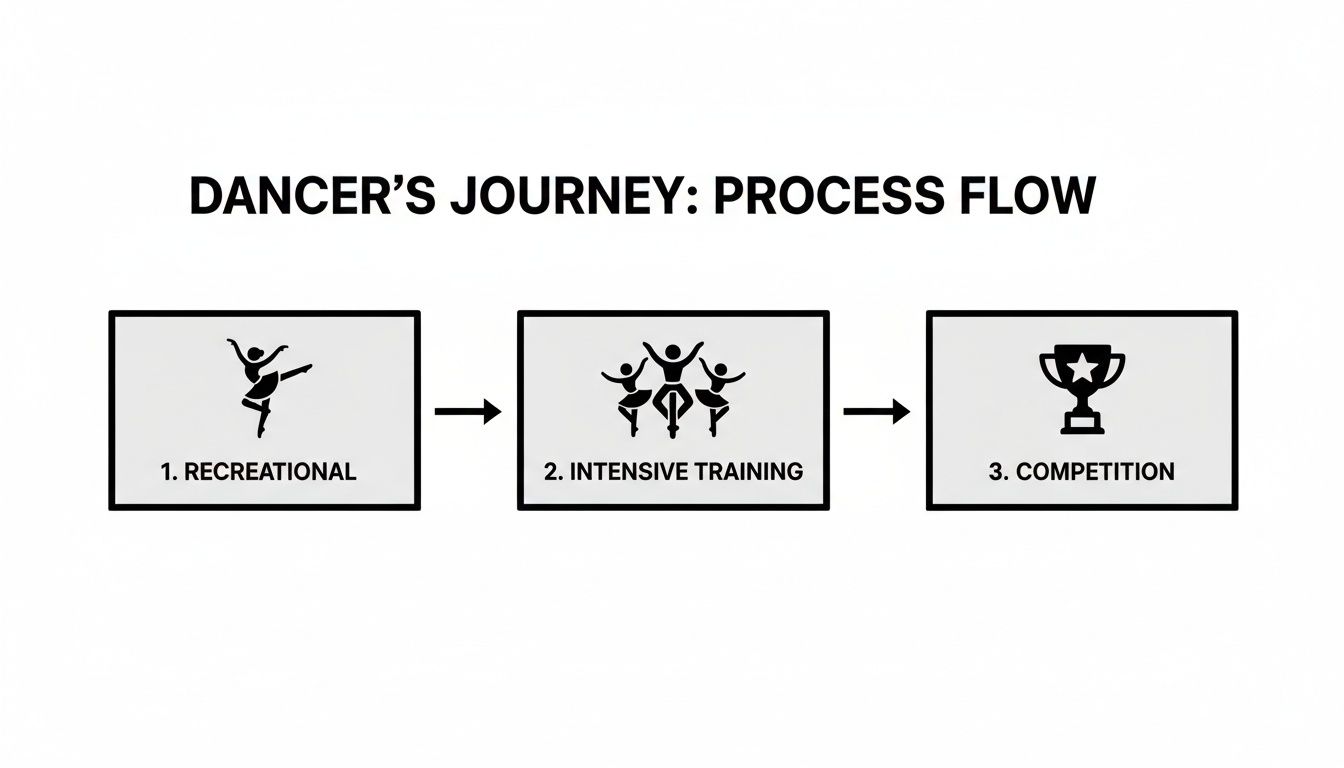
As you can see, competition isn't the starting point. It's the culmination of a journey that begins with a foundation of fun, recreational classes and moves into more focused, intensive training.
Weighing the Costs and Benefits
That list of commitments might seem daunting, but the rewards are truly priceless. Dancers on our teams build a work ethic, discipline, and resilience that they'll carry with them long after they leave the stage. They learn how to perform under pressure, work as part of a tight-knit team, and truly dedicate themselves to a shared goal. To get a better feel for the events themselves, check out our guide to dance competitions in Utah.
It’s all about perspective. See it as an investment not just in your child’s dance technique, but in their character. You’re helping them build the confidence and drive to chase excellence in whatever they choose to do in life.
When you’re fully prepared for what’s involved, the entire experience becomes a positive, exciting, and deeply rewarding journey for both the dancer and their family.
How to Prepare for Auditions
Auditions for competition teams for dance can seem intimidating, but with the right approach, they're an amazing opportunity to show what you've got. Think of it less as a test and more as a chance to share your passion and artistry. Real success in the audition room isn’t about hitting every move perfectly on that one day; it's the payoff for all the hard work you’ve put in leading up to it.
The journey starts with your technical foundation. Ballet and jazz are the cornerstones of almost every competitive style you can imagine. Judges are trained to spot clean lines, solid core control, and precise technique in fundamental skills like turns, leaps, and extensions. These aren't just moves to master—they're the vocabulary every competitive dancer needs to speak fluently.
Building Your Technical and Mental Edge
So, how do you get that extra edge? Summer intensives and workshops are fantastic for this. These immersive programs are designed to push you out of your comfort zone, refine your technique, and expose you to new choreographers. This is crucial preparation for the fast-paced audition environment, where the ability to learn choreography quickly is a huge advantage.
But great dancing is more than just technique. Your mindset is just as important. Here’s how you can mentally prepare to walk into that room with confidence:
- Practice Mock Auditions: Get a feel for the pressure by running through a simulated audition at home or with a friend. It makes the real thing feel much more familiar.
- Develop Quick Recall: Challenge yourself by taking drop-in classes with instructors you don't know. It's the perfect way to practice picking up new combos on the fly.
- Showcase Your Personality: Judges aren't looking for robots! They want to see an artist who truly loves to perform. Let your personality and stage presence shine through.
What judges look for goes beyond flawless execution. They seek dancers with a strong work ethic, a positive attitude, and the ability to be a supportive teammate. A dancer who is attentive, respectful, and eager to learn will always stand out.
What Judges Really Want to See
Whether you're a dancer in Herriman hoping to join a team in Bluffdale or anywhere else, remember that directors are building a cohesive team, not just collecting a group of talented soloists. They're looking for dancers who are coachable and will add to a positive group dynamic. They’ll notice the dancer who keeps pushing through a tough combination, encourages others, and hangs on every word of feedback.
Ultimately, the best way to prepare is to just dive in and embrace the process. For an even deeper look, explore our detailed guide on how to prepare for a dance audition. Confidence isn't something you find; it's something you build, one practice at a time. It comes from knowing you’ve put in the work and are ready to share your love for dance.
Choosing the Right Dance Program for Your Child
Finding the right program for competition teams for dance isn't about chasing the team with the most trophies. It's about finding the right home for your dancer—a place that clicks with their personality, your family’s values, and what you both hope to achieve. This is a search for a studio where your child won’t just learn steps, but will genuinely thrive as an artist and a person.
The first thing to do is look past the awards shelf and get a feel for the studio's core philosophy. Is the main goal to win at all costs? Or is it about nurturing personal growth, building solid technique, and fostering a deep love for dance? A truly great program knows how to balance both, pushing dancers to be their best while celebrating every bit of progress along the way.
Key Factors to Evaluate in a Dance Program
When you're checking out different studios, it helps to have a mental checklist. This is especially true if you're commuting from a nearby city like Draper or Lehi to a studio in Bluffdale. A strong program is built on a few essential pillars that create a positive and productive atmosphere for everyone.
Here’s what you should be looking for:
- Instructor Qualifications: Are the teachers just teaching steps, or do they have real professional experience and a true passion for mentoring young artists?
- Team Culture and Atmosphere: Watch how the dancers interact. Is the vibe supportive and encouraging? The best teams are the ones that lift each other up.
- Studio Communication: A well-organized studio is a dream. You want clear, consistent updates about schedules, costs, and expectations so there are no surprises.
- Focus on Foundational Technique: Make sure the program has a strong emphasis on the fundamentals, especially ballet. It’s the backbone of every great competitive dancer.
The most important question you can ask is simple: "Will my child be happy and feel supported here?" A positive environment where dancers feel safe enough to take creative risks is absolutely essential for their growth and confidence.
One of the best ways to get a real sense of a studio is to sit in on a class or chat with families already enrolled. Hearing about their firsthand experiences can tell you more than any website ever could. To get a better idea of what a dedicated training environment feels like, you can learn more about our performance dance center .
The dance world is growing bigger and more exciting every year. The global dance market is expected to explode from $3.22 billion in 2025 to $12.23 billion by 2033, thanks in large part to social media and digital platforms that let teams share their passion with the world. North America is at the heart of this growth, with studios training thousands of dancers for major events.
At the end of the day, picking the right dance program is about finding a true partner. You’re looking for a studio that will not only train your child to be a fantastic dancer but will also help them grow into a confident, resilient, and dedicated young adult.
The Life Skills Gained Beyond the Trophies
While the sparkling trophies and shiny medals are definitely a fun part of the journey, the real rewards of joining competition teams for dance are the powerful life skills that stick with a dancer long after the applause fades. These are the lessons that shape them into confident, capable, and well-rounded young adults.
The sheer commitment required instills an incredible work ethic. Dancers learn early on that progress doesn't just happen—it's earned through consistent effort, focus, and dedication, day in and day out. That kind of discipline becomes second nature.
Mastering Time Management and Resilience
One of the first things a competitive dancer learns is how to manage their time. Juggling a demanding training schedule with school, family, and a social life is a real-world crash course in organization. A dancer from Herriman driving to a studio in Bluffdale learns to use every spare moment wisely, a skill that will be invaluable in college and their future career.
Competition also builds a tough, resilient spirit. Dancers navigate the emotional rollercoaster of a flawless performance one day and a frustrating mistake the next. They learn to handle the pressure and bounce back from scores that weren't what they hoped for.
Resilience is forged in the studio. It’s about getting back up after a fall, taking constructive feedback without getting discouraged, and understanding that every challenge is an opportunity to grow stronger.
This ability to recover with grace is one of the most valuable assets they'll ever develop. It reframes setbacks not as failures, but as essential steps on the path to improvement. For a dancer, building this mental toughness is just as critical as their physical conditioning, which you can learn more about in our guide on flexibility training for dancers .
Building a Foundation of Teamwork
Beyond personal growth, competitive dance is fundamentally a team sport. Dancers learn to trust and rely on each other, moving as one to achieve a shared goal. They celebrate each other’s wins and lift each other up when a teammate is struggling. This creates a powerful sense of community and teaches profound lessons in sportsmanship and collaboration.
These aren't just "dance skills"; they are skills for life. They are shaping future leaders and innovators. Think about it: the professional dance world is constantly evolving. In the 2023-2024 season, world premieres choreographed by women hit 48.8%, a steady rise that points to a more inclusive industry for today's dancers to enter. You can explore more about this evolving industry on Dance Data Project .
The discipline, resilience, and teamwork learned on a competition team prepare dancers to excel in any field they choose, proving the lessons from the studio truly last a lifetime.
How We Raise Dancers to Compete
At Encore Academy for the Performing Arts, our whole approach to competition dance is built on one simple, powerful idea: a strong foundation opens up limitless potential. We don’t just churn out routines for the stage. Our goal is to develop well-rounded artists, and that means a deep focus on technical mastery, artistic expression, and personal growth.
It all starts with our holistic training philosophy. We see strong technique as the bedrock for everything else. That's why every single one of our competitive dancers is required to train extensively in core disciplines like ballet and jazz. This gives them the strength, control, and dance vocabulary needed to handle even the most complex choreography, no matter the style.
It's All About the Individual Artist
We truly believe that every dancer has a unique voice waiting to be heard. Our experienced instructors don't just teach steps; they provide personalized mentorship, guiding each student to discover their artistic strengths and build unshakable confidence. It's this supportive, family-like environment that encourages dancers to take creative risks and push past the limits they thought they had.
Our mission is to empower every artist to find their voice and tell their story through movement. We aim to create not just great dancers, but great people who carry confidence and discipline into every aspect of their lives.
Our studio, located in Bluffdale, has become a proud training ground for dedicated performers from all over the area. We’re thrilled to welcome passionate dancers from Riverton, Draper, Lehi, and Sandy to join our family.
Building More Than Just a Team
We've carefully designed our team structures to challenge dancers at every single stage of their journey. With multiple levels, we can ensure each performer is placed in a group that feels both demanding and nurturing. This tiered system creates a clear path for progression and helps our dancers set and achieve their goals.
Ultimately, we foster a culture where teamwork is everything. Dancers learn to support and motivate one another, celebrating wins as a group and building friendships that last long after the curtain closes. This sense of community is the real heart of our program, creating a place where every member feels valued, inspired, and ready to reach their full potential.
Common Questions About Competition Dance
Diving into the world of competition teams for dance always brings up a lot of questions. As a parent, you want to feel completely confident that you’re making the right choice for your child and your family's schedule. So, let's walk through some of the most common things we hear from families who are considering taking this exciting step.
Our goal here is to give you clear, straightforward answers that help you navigate this decision. We’ve found that a well-informed family is an empowered one, ready to cheer on their dancer every step of the way.
At What Age Can My Child Join a Competition Team?
While you might see studios offering "mini" teams for dancers as young as five, the truth is that readiness has much more to do with individual maturity and skill than a specific birthday. The real question is whether a child can thrive in an environment that's more focused, structured, and yes, a bit more demanding.
At Encore, we look at every dancer as an individual. We want to place them in a spot where they'll be challenged but not overwhelmed. It's all about setting them up for a successful and joyful season.
How Many Competitions Do Teams Attend Each Year?
A typical season for us includes anywhere from 3 to 6 regional competitions. Some of our teams might also travel to a national event during the summer months.
We know many of our families are making the trip from cities like Lehi or Sandy to our Bluffdale studio, so we make planning as simple as possible. You'll get a full, detailed schedule of all mandatory events well in advance, so you can prepare for the season without any last-minute surprises.
The right studio environment makes all the difference. A healthy program emphasizes personal growth, sportsmanship, and achieving personal bests over simply winning trophies. This turns pressure into a tool for building resilience, not a source of stress.
Can My Child Balance Dance with Other Activities?
Absolutely, but there’s no sugarcoating it—it requires excellent time management and real commitment. Competitive dance is a team sport, and consistent attendance at all classes and rehearsals is crucial for the whole group to succeed.
We always encourage an open conversation about your child's schedule to make sure they can do it all without feeling burnt out. Many of our dedicated dancers from Draper and Herriman are also top students and involved in other pursuits. They learn to prioritize and plan, and honestly, that balancing act is a life skill in itself.
At Encore Academy for the Performing Arts, we're committed to nurturing not just skilled dancers, but confident and resilient individuals. We provide a supportive environment where every artist can thrive. Discover our programs and see if our team is the right fit for your family.