
How to Prepare for a Dance Audition A Dancer's Guide
Walking into an audition shouldn't feel like a last-minute scramble. The real work, the kind that builds unshakable confidence, happens weeks before you ever step into that room. A smart, structured approach is your secret weapon. This guide will walk you through exactly how to prepare for a dance audition, covering everything from physical conditioning to mastering your mental game.
Your Blueprint For Audition Success
Showing up unprepared is like trying to perform in silence—you might know the steps, but the performance will fall flat. True success in an audition room isn't just about raw talent; it’s the result of a dedicated, well-organized preparation plan that starts long before the big day. When you channel nervous energy into a structured plan, you transform anxiety into focused confidence.
This blueprint is designed to give our dancers a real competitive edge, ensuring you arrive ready to perform at your absolute best and leave a memorable impression. It’s about more than just drilling the choreography. It’s a complete approach.
- Strategic Conditioning: You need the stamina to look just as strong in the final cut as you did in the first combination.
- Technical Refinement: This means sharpening the specific skills and styles you know will be required for the team or role you want.
- Mental Fortitude: It's about building the resilience to handle pressure, pick up choreography in a flash, and project confidence, even when you're nervous.
- Logistical Planning: Getting everything organized—from your outfit and snacks to your warm-up playlist—eliminates day-of stress so you can focus purely on your performance.
This timeline gives you a bird's-eye view of the key stages, from a month out to the day of the audition itself.
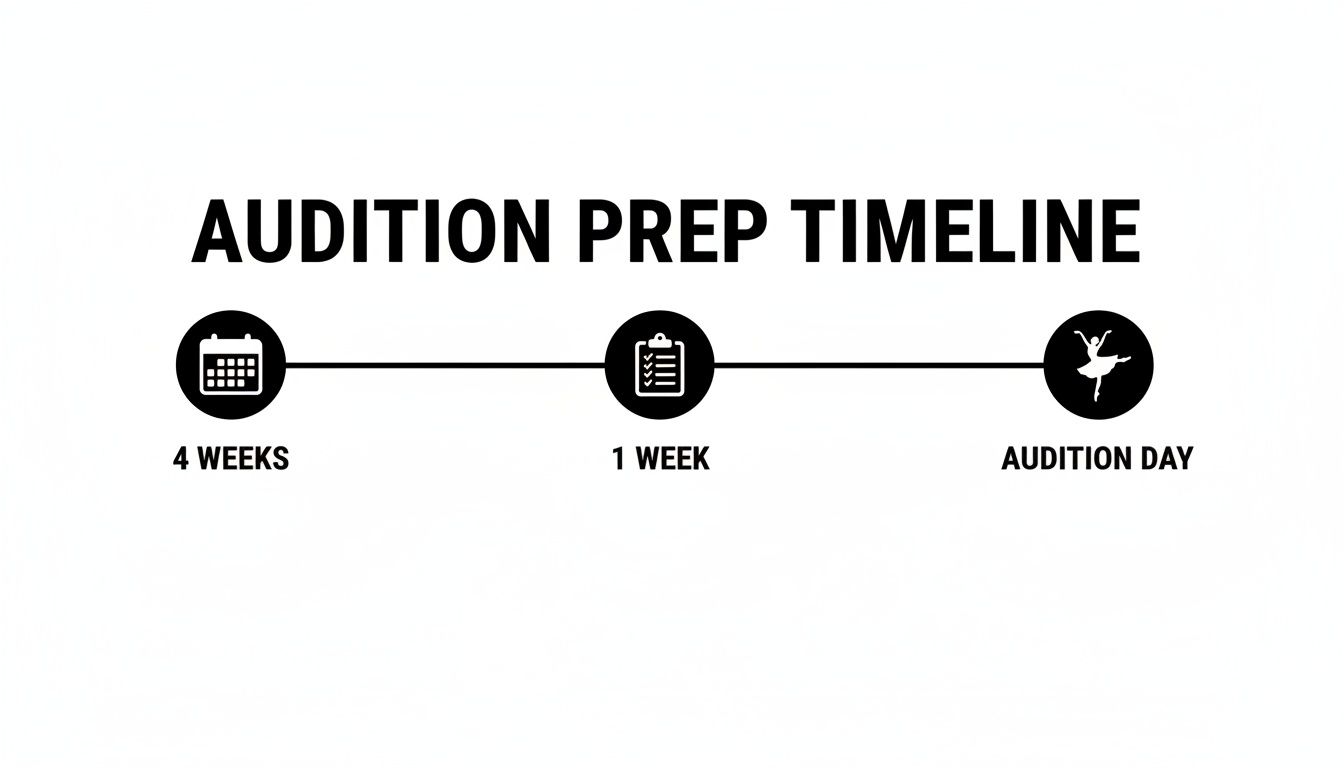
As you can see, your focus gradually shifts from big-picture conditioning and research to the finer, detail-oriented tasks as audition day gets closer.
To help you stay on track, here's a quick summary of what your schedule should look like.
Audition Prep Timeline At a Glance
| 4 Weeks Out | Foundation & Research | Increase conditioning, research the company/team, and set clear goals. |
|---|---|---|
| 2 Weeks Out | Technique & Rehearsal | Focus on style-specific skills, run mock auditions, and refine your solo. |
| 1 Week Out | Polish & Logistics | Fine-tune details, plan your audition bag, and focus on nutrition and rest. |
| The Day Before | Rest & Mental Prep | Do a light stretch, visualize success, and pack your bag. No intense workouts! |
| Audition Day | Execution & Confidence | Eat a good breakfast, arrive early for a personal warm-up, and be professional. |
This table provides a clear roadmap, but remember that the secret to a great audition lies in the work you put in consistently.
The most successful dancers treat an audition not as a test, but as a performance they've been methodically preparing for. Every detail, from your physical training to your mindset, is part of the choreography for success.
This guide will break down each of these phases, giving you the tools to build a truly comprehensive plan. For even more tips on standing out in a competitive setting, check out other articles on the Encore Academy performance dance center blog . Now, let's start by building your physical and technical edge.
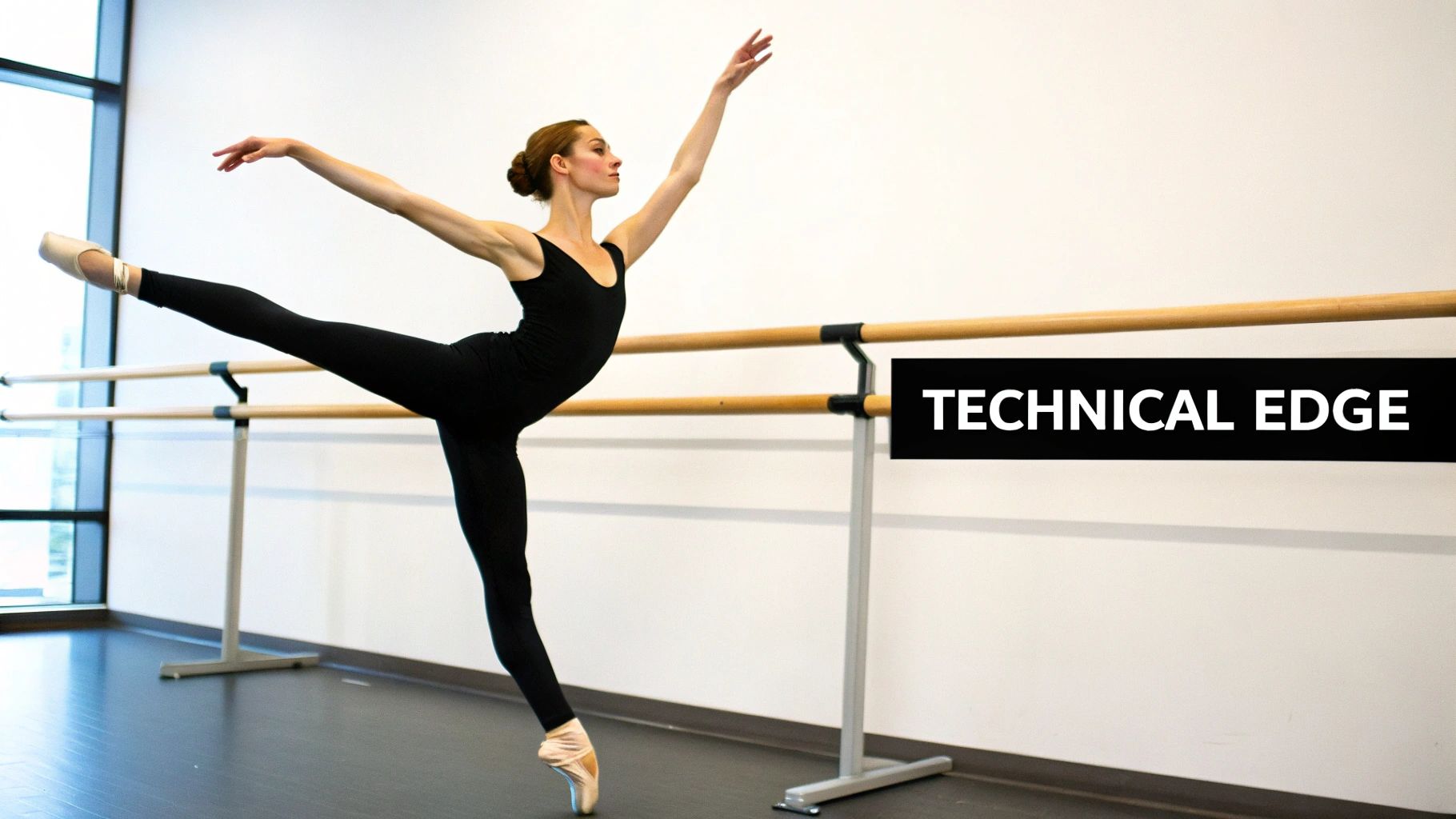
Building Your Physical and Technical Edge
Talent will get you in the door, but it’s the disciplined training and peak physical conditioning that will get you the job. Simply showing up for your regular classes isn’t going to cut it in a room full of serious dancers. To truly stand out, you need to build a body that can handle hours of intense dancing, absorb choreography on the fly, and perform under immense pressure.
Think of this as building the engine that powers your art. For our dancers making the trip from Riverton, Herriman, or Lehi to train with us in Bluffdale, every single session has to count. The mission is to develop an undeniable physical presence and technical command that a director simply can't ignore.
Ballet: The Unshakeable Foundation
It doesn't matter if you're auditioning for a contemporary company, a jazz crew, or a Broadway show—a strong ballet foundation is your single greatest asset. Ballet is what gives you core strength, clean lines, impeccable alignment, and the control that underpins every other dance form. It's the universal language of dance, and every casting director speaks it fluently.
Your ballet training is the framework of your entire dance "house." Without that solid structure, everything else becomes wobbly and unreliable. In the weeks before an audition, make it your absolute priority.
- Sweat the Small Stuff: Get obsessive about your turnout, épaulement, and the precision of your footwork.
- Build Your Stamina: Don't coast. Push through the entire barre and center work with full energy, as if you’re already on stage.
- Clean Up Your Lines: The mirror is your best friend and your harshest critic. Use it to relentlessly check your posture, arm placement, and extensions.
This commitment to the fundamentals ensures your technique holds up when the pressure is on.
Layer Your Training for Maximum Versatility
While ballet is the bedrock, versatility is what makes you a chameleon—and what makes you marketable. Directors are almost always looking for dancers who can slip into different styles without missing a beat. Layering other techniques on top of your ballet training shows them you’re adaptable and have a rich movement vocabulary.
Auditioning for a contemporary company? Your schedule must include contemporary and modern. Eyeing a musical theater role? Jazz and tap become non-negotiable. This is about more than just learning steps; it’s about fully embodying the unique quality and texture of each style.
True versatility isn't just doing jazz; it's becoming a jazz dancer. It's not just performing a contemporary piece; it's inhabiting the movement with the right weight, flow, and emotional intention.
The dance world is fierce. Raw talent alone often isn't enough to land a company contract. Since the Youth America Grand Prix was founded in 1999, over 80,000 dancers have competed. Of those, only a tiny fraction—just over 450—have gone on to join professional companies. As an analysis on Ballet Scoop about the truth of company auditions points out, this statistic shows just how critical disciplined, versatile training is when thousands are fighting for the same few spots.
Condition Your Body Beyond the Studio Floor
What you do outside the studio is just as vital as what you do inside. Think of cross-training as your secret weapon for building the endurance you'll need to outlast the competition. A big audition can go on for hours, and the panel is watching to see who is just as powerful in the final combination as they were in the first.
Smart cross-training also builds balanced muscle groups, which is one of the best ways to prevent injuries.
Smart Cross-Training Choices for Dancers
- Pilates: Fantastic for developing that deep core strength that supports everything. It helps improve alignment and creates long, lean muscle without adding unnecessary bulk.
- Yoga: A game-changer for flexibility and body awareness. Plus, the breathing techniques you learn are invaluable for calming those inevitable audition-day nerves.
- Targeted Cardio: Activities like swimming or cycling are perfect for building cardiovascular stamina without the harsh impact of running, which helps protect your joints.
- Strength Training: Don't be afraid of weights! Light weight training or resistance bands can target key muscle groups like your glutes, hamstrings, and upper back to power your jumps and stabilize your turns.
Of course, flexibility is a huge piece of this puzzle. Consistent, safe stretching is absolutely essential. For a more detailed plan, check out our guide on flexibility training for dancers , which is packed with specific exercises and best practices. Your goal is to build a body that’s not just strong and agile, but also incredibly resilient. This is the work that allows your artistry to shine when it matters most.
Mastering the Mental Game of Auditions
Let's be honest. The toughest choreography you'll ever face isn't on the dance floor—it’s the routine running through your head. We all focus on our physical technique, but what often separates the dancers who get the part from those who don't is pure mental toughness. Learning to perform under that intense audition pressure is a skill you have to practice just as hard as your pirouettes.
This is the work that lets you project unshakable confidence, turning all that nervous energy into captivating artistry. It's the inner game that helps our dancers from Draper, Sandy, and other nearby cities not just nail the steps, but let their personality shine through.
Taming Performance Anxiety with Practical Tools
That fluttery, adrenaline-fueled feeling before you walk into the room? It's completely normal. In fact, it’s a good sign—it means you care! The goal isn't to get rid of the nerves, but to learn how to channel them.
Instead of letting anxiety hijack your performance, you can use a few key techniques to stay grounded and in control. Think of these as your mental anchors, keeping you present when your mind wants to race ahead with a hundred "what ifs."
- Box Breathing: This one is simple but incredibly powerful. Inhale for four counts, hold for four, exhale for four, and hold for four. Just a few rounds can calm your entire nervous system.
- Sensory Grounding: Feeling overwhelmed? Stop and name five things you can see, four things you can touch (your leotard, the floor), three things you can hear, two you can smell, and one you can taste. This trick pulls you out of your anxious thoughts and back into the room.
These aren't just empty exercises; they're proven ways to manage your body's stress response so you can think clearly and dance with intention.
The Power of Visualization
Here's something cool about your brain: it often can't tell the difference between a real experience and one you've vividly imagined. You can use this to your advantage by mentally rehearsing your success long before you ever set foot in the studio.
Find a quiet spot and close your eyes. Walk through the entire audition day in your mind.
Imagine yourself arriving early, feeling calm and prepared. Picture yourself warming up with purpose, picking up the choreography with ease, and performing every combination with confidence and joy. See the judges smile. By mentally rehearsing a successful audition, you’re creating a blueprint for it to follow.
This practice builds a deep-seated confidence that starts to feel like muscle memory. It helps you anticipate challenges and mentally work through them, so you're ready for anything.
Reframing Rejection and Building Resilience
Not every audition is going to end with a "yes." That’s a hard but essential lesson in dance. The most successful dancers aren't the ones who never get cut; they're the ones who learn to see rejection as redirection. Every audition is just a learning experience, not a final verdict on your talent.
That mindset is what separates dancers who burn out from those who build long, fulfilling careers. The gap between collegiate dancers and seasoned professionals often comes down to this mental fortitude. Research shows that only 43% of professional dancers report feeling comfortable in auditions, which is more than double the 20% of collegiate dancers. That difference highlights just how critical it is to master the mental game. You can check out the full study on psychosocial stressors in auditions here .
After an audition, take a moment to reflect:
What went well? Give yourself credit for what you nailed.
What was challenging? Pinpoint the steps or moments where you felt shaky.
What can I work on? Turn those challenges into goals for your next class.
This process turns a potentially negative experience into a stepping stone for growth. It’s a skill that will serve you well for years to come. For more on building this kind of competitive edge, check out our guide to navigating the Utah dance competition circuit . Developing this mental resilience is truly the final, critical piece of your preparation puzzle.
The Art of Rehearsal and Self-Critique
Talent gets you in the door, but how you rehearse is what sets you apart. The real work—the kind that turns a good dancer into a captivating performer—happens when you learn to be your own best coach.
Effective rehearsal isn’t just about drilling the steps until you’re exhausted. It's about intentional, focused practice paired with an honest look at your own work. This is how you build the polish and artistry that judges can't ignore.
Film Yourself. It’s Non-Negotiable.
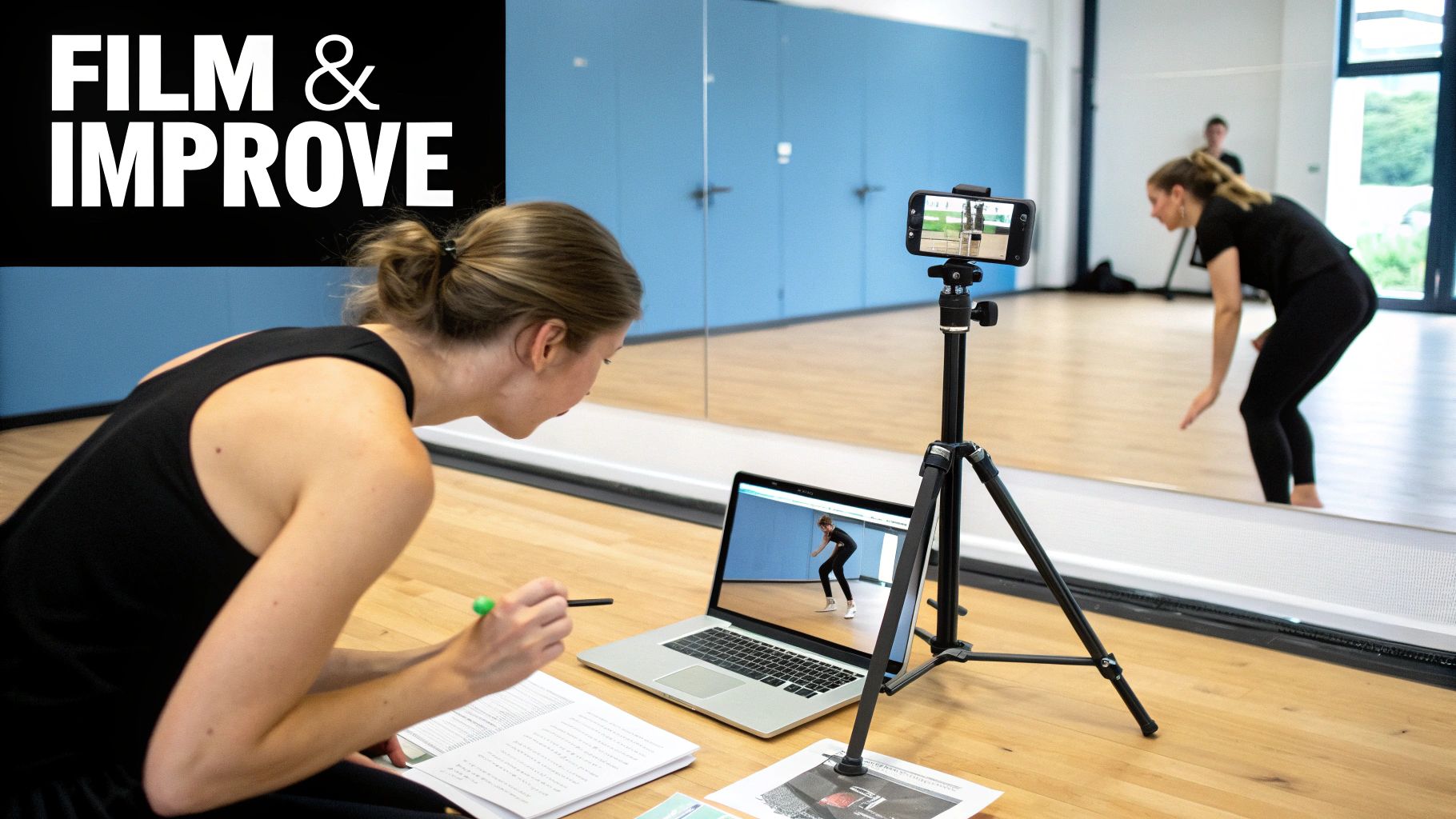
Your smartphone is hands-down the most powerful tool you have for audition prep. Why? Because you simply can't see what the judges see while you're dancing. Filming yourself gives you the unfiltered truth about your technique, your lines, and your performance quality.
I know, it can feel awkward at first. But the insights are worth it. A leap that feels powerful might look a little wild on camera. An arm placement you think is perfect could be just an inch off. This kind of objective feedback is the fastest way to see and fix the little things before they become bad habits.
Just prop up your phone, hit record, and run your combo. Then, watch it back with a plan.
- First pass, for artistry: Just watch it. Don't analyze. How does it feel? Are you telling a story? Is your energy where it needs to be?
- Second pass, for technique: Now, get nitpicky. Pause the video constantly. Check your alignment, your turnout, your footwork. Are your transitions seamless or are they clunky?
- Third pass, for musicality: Mute the video and just watch your body. Can you see the rhythm? Then, turn the sound on. Are you hitting every accent, or are you just a little behind or ahead of the music?
This simple method turns a recording into a powerful diagnostic tool, giving you a clear to-do list for your next rehearsal.
Learn to Give Yourself Good Feedback
The goal here is improvement, not discouragement. It's so easy to watch a video of yourself and spiral into negative self-talk, but that doesn't help anyone. You need to adopt the mindset of a supportive (but honest) coach.
Your inner critic should sound less like a judge and more like a choreographer. Instead of thinking, "My turns are terrible," reframe it: "To stabilize my pirouettes, I need to really focus on spotting and keeping my core locked in."
See the difference? This simple shift takes the focus off what’s wrong and puts it on how to make it right.
Keep a dedicated notebook for your audition prep and jot down these notes. It helps you track your progress and makes sure your practice time is always targeted and efficient. For those really wanting to deepen their artistic voice, exploring the principles of dance composition can be a game-changer for your self-awareness and creative choices.
The Power of Mock Auditions
You can't truly prepare for a high-pressure situation without practicing for it. Mock auditions are a crucial piece of the puzzle, because they train one of the most important skills directors look for: picking up choreography quickly and under pressure.
Grab a few trusted friends from your classes—maybe other dancers from Herriman or Draper who you see at our Bluffdale studio. Find some open studio time, pick someone to be the "choreographer," and run a mini-audition.
Here’s how to structure it:
Teach a short combo: The choreographer teaches an unfamiliar 8-count or 16-count phrase.
Set a time limit: Give everyone just a few minutes to review it on their own.
Perform in groups: Run it in small groups, just like you would in a real audition.
Switch it up: Rotate who teaches and who learns so everyone gets a turn.
This kind of practice builds the mental muscle you need for fast retention and performance. It lets you find your weaknesses in a safe, supportive space, so you can work on them before you walk into the real thing. It’s the final step that connects your hard work in the studio to a confident performance on audition day.
Your Audition Day Game Plan
After weeks of dedicated practice, the big day is finally here. On audition day, your only job should be to dance. The last thing you want is to be derailed by logistical stress, a forgotten pair of shoes, or a sudden energy crash. A solid game plan for the final 24 hours ensures you can walk into that studio feeling calm, prepared, and ready to perform.
By eliminating that last-minute scramble, you free up precious mental energy to focus entirely on your artistry. This is where all your hard work comes together.
The Night Before The Audition
Your audition day really starts the night before. What you do in these crucial hours sets the stage for success. The goal is simple: nourish your body and quiet your mind.
This is not the time for a heavy, intense workout. Instead, opt for some light stretching or foam rolling to release any lingering muscle tension. It’s also the perfect time to meticulously pack your dance bag—checking off items as you go—so there are no surprises in the morning.
"The work is done. The night before an audition, your job is to trust your training, fuel your body, and get a good night's sleep. Rest is a form of preparation, and it's non-negotiable."
A balanced dinner is essential. Focus on a meal rich in complex carbohydrates for sustained energy (like quinoa or sweet potatoes), lean protein for muscle repair, and healthy fats. Stay hydrated by drinking plenty of water throughout the evening, but don't overdo it right before bed. Aim for 7-9 hours of quality sleep. You want to wake up feeling rested and mentally sharp.
Packing Your Audition Bag
Think of your dance bag as your mobile command center for the day. Being over-prepared is always better than being caught off guard. Beyond the obvious essentials, think about backups and comfort items that will keep you focused. Especially for our dancers commuting from Lehi or Herriman to our Bluffdale studio, having everything you need is a must.
Your goal is to anticipate any potential need so you can handle it without a second thought.
We've put together a checklist to make sure you have every base covered, from your physical needs to your professional materials. Having everything organized will give you a major confidence boost.
The Ultimate Audition Bag Checklist
| Apparel | Main leotard, tights, backups of each, warm-ups, all necessary dance shoes. | Having a backup for spills or snags is crucial. Warm-ups keep your muscles ready between combinations. |
|---|---|---|
| Nutrition | Water bottle, healthy snacks (nuts, bananas, protein bar), electrolyte drink. | Sustained energy is key. Avoid sugary snacks that lead to a crash. Hydration prevents muscle cramps. |
| Personal | Hair ties, bobby pins, hairspray, deodorant, basic first-aid kit, personal makeup. | Looking polished and professional is part of your presentation. A small first-aid kit is a must for blisters. |
| Admin | Headshot, resume, pen, notebook, audition information, personal ID. | Always bring extra copies of your headshot and resume. A notebook is great for taking choreography notes. |
With a bag packed this thoughtfully, you're ready for anything the day throws at you.
Arrival, Warm-Up, And Etiquette
Plan to arrive at the audition location at least 30-45 minutes early. This buffer gives you time to find parking, check in without rushing, and get a feel for the space. Use this time to claim a spot at the barre or on the floor and begin your personal warm-up.
Your pre-audition warm-up should be dynamic. Start with some light cardio to get your heart rate up, then move into dynamic stretches like leg swings and pliés to prepare your muscles. Avoid static stretching (holding a stretch for a long time) until after the audition is over, as it can temporarily decrease muscle power.
Once the audition begins, your professionalism is on full display.
- Listen Actively: Pay close attention to every single instruction and correction.
- Claim Your Space: Dance with intention and full-out, but always be spatially aware of those around you.
- Stay Positive: If you make a mistake, recover quickly. Your attitude is just as important as your steps.
- Be Respectful: Thank the choreographer and the panel for their time before you leave.
How you behave in the room is just as important as your technique; it shows the judges what you would be like to work with. Remember, every audition is an opportunity to perform and learn, much like preparing for a big performance. You can learn more about making an impact in our guide to a successful dance showcase in Utah .
We Hear These Questions All the Time
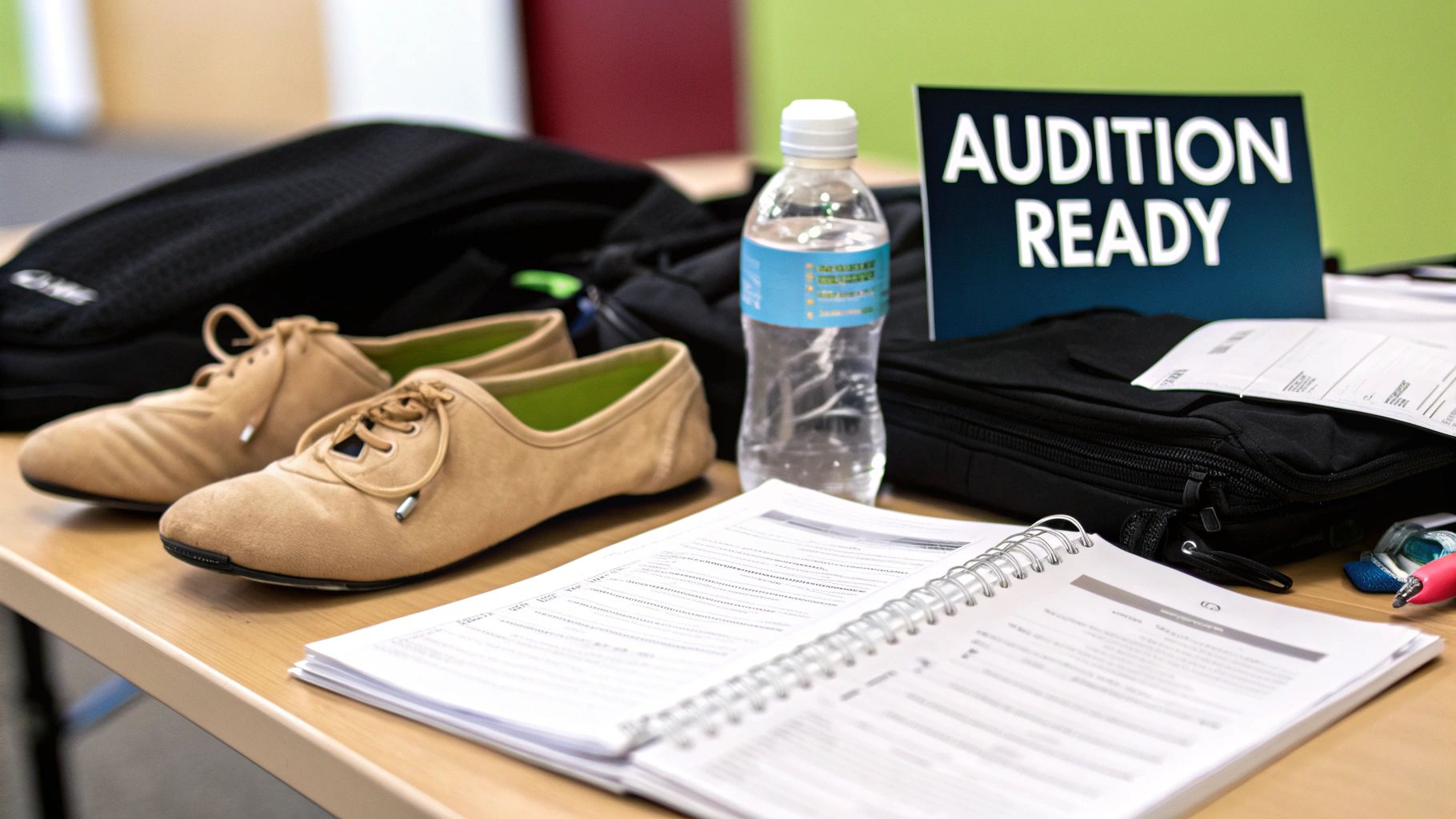
Even with the best game plan, a few questions always seem to surface as audition day gets closer. It’s totally normal to have those last-minute "what ifs" pop into your head.
Let's walk through some of the most common things dancers ask us. Think of this as a conversation with your instructor—direct answers to clear up any lingering doubts so you can walk in feeling ready for anything.
How Far in Advance Should I Start Preparing?
While you're training year-round, your focused, audition-specific prep should kick off about 4 to 6 weeks out. That’s the sweet spot. It gives you enough time to really drill the required style, build your stamina for long combos, and research the company or team you’re auditioning for—all without burning out.
For a really high-stakes audition, like for a professional company or a competitive university program, you might even start honing your technique and conditioning up to three months ahead. The goal is steady, sustainable progress. Cramming for an audition just leaves you exhausted when you need to be at your peak.
What Are the Biggest Mistakes Dancers Make in an Audition?
Honestly, the biggest slip-ups rarely have to do with messing up a step. It’s the stuff around the dancing that directors notice most. They aren't just looking for great technique; they're looking for responsible, respectful people they want to have in their studio every day.
Arriving late is a huge one. So is talking while the choreographer is giving instructions, or having visibly negative body language. These things send an immediate red flag. The same goes for what you wear—sloppy attire that hides your lines just signals that you don't take the opportunity seriously.
The most critical error? Not doing your homework. I've seen dancers show up with incredible contemporary skills for a strictly classical ballet audition. It just shows a total lack of interest in who you're dancing for. Know the room you're walking into.
Another major pitfall is letting one mistake throw off your entire performance. Everyone wobbles out of a turn now and then. The ability to shake it off, smile, and jump right back in shows maturity and resilience. Those are qualities every director is looking for.
How Do I Handle Audition Nerves on the Day?
Tackling those nerves actually starts the night before. Get a good night's sleep and eat a solid, nourishing meal. On audition day, the best thing you can do for your anxiety is to arrive early. Rushing is a recipe for stress, so give yourself a ton of extra time, especially if you’re driving in from places like Riverton, Sandy, or Draper.
When you feel that familiar flutter of nerves, come back to your breath. A simple breathing exercise works wonders: inhale slowly for four counts, hold for a moment, and then exhale for six counts. It’s a physical trick that tells your nervous system to calm down and brings you right back into the present moment.
Most importantly, try to shift your mindset. Instead of thinking, "I have to impress them," think, "I get to share my love for dance." When you focus on the sheer joy of moving, your confidence will naturally shine through.
What Should I Do Immediately After the Audition?
Your professionalism doesn't end when the music stops. Before you walk out of that studio, make eye contact with the judges, smile, and give a genuine "thank you" for the opportunity. It's a small gesture, but it leaves a big, positive impression.
Once you’re out the door, take a minute for yourself. Open the notes app on your phone or a journal and jot down a few thoughts while it's all fresh in your mind.
Post-Audition Reflection Questions:
- Which parts of the choreography felt really strong?
- What skills or combinations were a bit of a challenge?
- How was my energy and focus from start to finish?
- What's one thing I learned today that I can bring to my next class?
Doing this turns every single audition—whether you get the part or not—into a win. It becomes a valuable learning experience. Celebrate the fact that you were brave enough to put yourself out there.
A final pro tip: sending a simple, polite thank-you email to the organization within 24 hours is a classy move that helps you stand out. It shows your appreciation and reinforces just how much you want the opportunity.
At Encore Academy for the Performing Arts, we know that incredible preparation is what builds true confidence. Our instructors are here to provide the top-tier technical training and supportive mentorship you need to walk into any audition ready to shine. Book a trial class today and let’s start working toward your performance goals together.