
How to Read Sheet Music for Beginners Your Complete Guide
Learning to read music is all about understanding three core elements you'll see on the page: the staff, the clefs, and the notes. Think of the staff as the canvas, the clefs as the key that tells you how to read it, and the notes as the actual instructions for what to play. Once you get these down, that confusing page of symbols starts to look like a clear map for making music.
Your First Look at a Page of Music
Staring at a piece of sheet music for the first time can feel a little overwhelming. It's just a sea of lines, dots, and symbols that look more like a secret language than a beautiful song. But here's the good news: that "language" is built on a few simple, logical ideas. Once they click, the whole system opens up.
Believe me, you're not alone in feeling that way. Many aspiring musicians from Bluffdale to Draper have felt that same initial confusion, only to discover how quickly they can pick up the basics.
It's actually a more common hurdle than you might think. Statistics show that in the United States, only about 25% of the population reads music well. A huge 50% can't read it at all, and another 21% struggle with it, which just goes to show what a widespread challenge this is for beginners. You can explore the full findings to see just how common this is.
So, let's break down that page into its most essential parts.
The Foundation: The Staff
The first thing you’ll always notice is the staff (sometimes called a stave). This is the set of five horizontal lines and the four spaces between them. It’s the foundation where all the musical action happens.
- Lines and Spaces: Each line and each space on the staff represents a specific musical pitch. The easiest way to think about it is like a ladder—as you move up the lines and spaces, the pitch gets higher. As you go down, the pitch gets lower. Simple as that.
- The Grand Staff: If you're looking at piano music, you'll almost always see two staves joined together by a brace on the left. This is called the grand staff. The top staff is usually for the higher notes (played by the right hand), and the bottom staff is for the lower notes (played by the left hand).
By itself, the staff is just a blank canvas. It doesn't tell us which specific notes correspond to which lines and spaces. For that, we need a guide—a symbol that unlocks the code.
The Key to the Code: The Clefs
Right at the beginning of the staff, you'll always see a large, distinct symbol called a clef. Its entire job is to assign a specific note to a specific line on the staff, which in turn gives a name to every other note. The two you'll run into most often are the Treble Clef and the Bass Clef.
The Treble Clef (G-Clef)
This is that elegant, curly symbol you've probably seen a hundred times. It's used for higher-pitched instruments like the flute, violin, and trumpet, as well as the right hand on the piano. You'll notice its inner curl wraps perfectly around the second line from the bottom—this is its trick. That line is now designated as the note G, which is why it's also called the G-Clef.
The Bass Clef (F-Clef)
This clef looks a bit like a backward 'C' with two dots next to it. It's for the lower-pitched crew: the cello, bass guitar, tuba, and the left hand on the piano. Its two dots straddle the fourth line from the bottom, locking that line in as the note F. Naturally, this is why it's also known as the F-Clef.
To help you keep these straight, here’s a quick reference table breaking down the fundamental symbols we've just covered.
The Core Elements of Sheet Music at a Glance
| The Staff | Five horizontal lines and four spaces | Provides the basic framework where notes are written. Higher lines/spaces mean higher pitches. |
|---|---|---|
| The Treble Clef | An ornate, curly symbol (also called the G-Clef) | Assigns the note G to the second line from the bottom. Used for high-pitched instruments. |
| The Bass Clef | A symbol resembling a backward 'C' with two dots | Assigns the note F to the fourth line from the bottom. Used for low-pitched instruments. |
| The Grand Staff | A Treble Clef staff and a Bass Clef staff joined by a brace | Combines high and low ranges, commonly used for instruments like the piano and organ. |
Think of this table as your first cheat sheet. Mastering these initial symbols is the most important step in your entire journey.
These are the absolute building blocks. We guide students through these concepts every day in the various music programs at Encore Academy , making sure everyone has a solid foundation. Once you can confidently identify the staff and the clefs, you’re ready to start decoding the notes themselves.
Decoding the Notes on the Staff
Okay, you've got the staff and clefs down. Now for the fun part: figuring out what all those little dots actually mean. Think of the staff as a ladder. Each line and each space is a different rung, and each one represents a specific musical pitch.
The musical alphabet is short and sweet, just A, B, C, D, E, F, and G. After G, it just starts over again at A. As a note sits higher up on the staff, its pitch gets higher. When it's lower on the staff, the pitch is lower. Simple, right? The key, though, is knowing which letter name goes with which line or space, and that's entirely dictated by the clef at the beginning of the line.
Naming Notes in the Treble Clef
Most of the time, you'll be dealing with the Treble Clef (also called the G-Clef). This is for higher-pitched instruments—think violins, flutes, trumpets, or the right hand on the piano.
To quickly identify the notes that land on the five lines of the staff, musicians have passed down a handy little sentence for generations. From the bottom line up, the notes are E, G, B, D, F.
- Just remember: Every Good Boy Does Fine.
The four spaces between the lines are even easier. Starting from the bottom space and going up, the notes spell out a word you already know: F-A-C-E.
So, for the Treble Clef:
- Lines: E, G, B, D, F (Every Good Boy Does Fine)
- Spaces: F, A, C, E (FACE)
Get comfortable with these, and you'll be able to name any note on the treble staff in a snap.
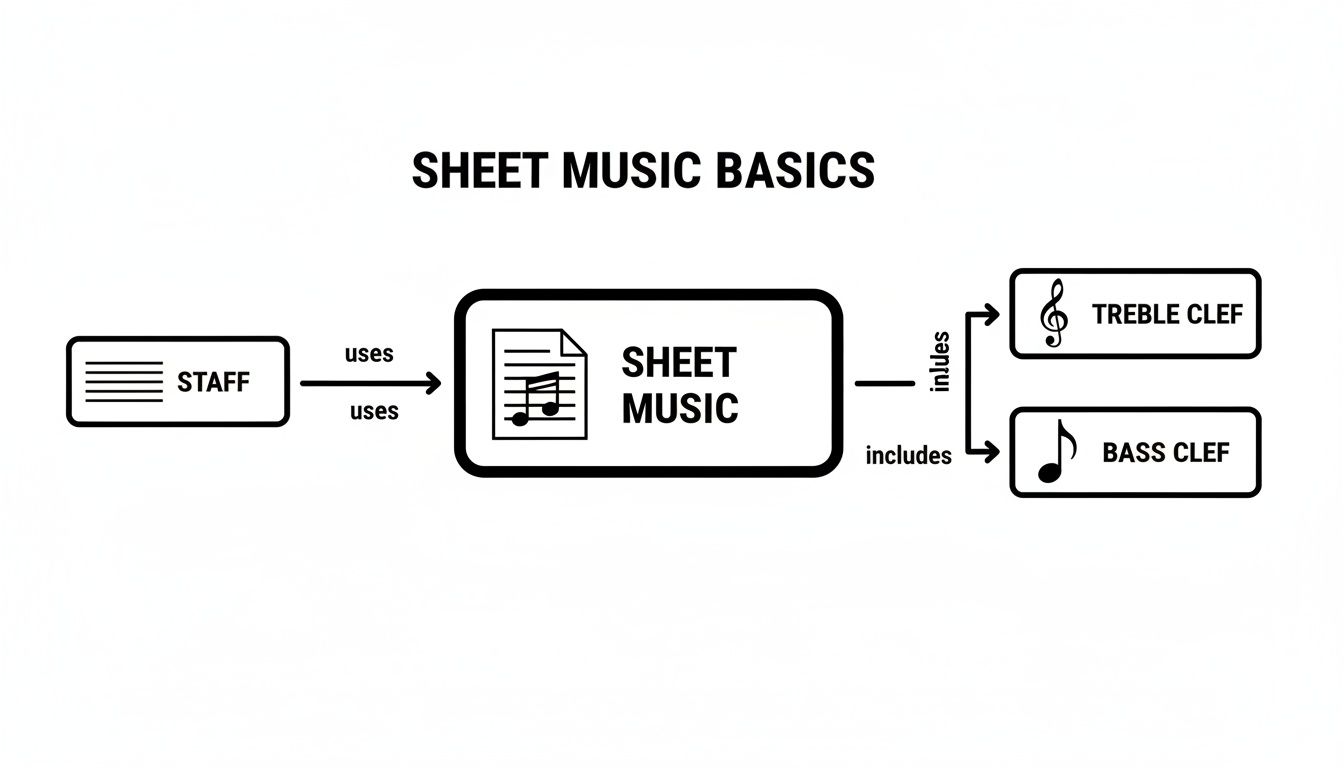
This little map shows you how it all fits together. The staff is your foundation, and the clef is the key that tells you how to read it.
Mastering the Bass Clef Notes
Next up is the Bass Clef (or F-Clef), which is the standard for lower-pitched instruments like the cello, bass guitar, trombone, or the left hand on the piano. It works the same way as the treble clef, just with different note names.
For the five lines in the Bass Clef, starting from the bottom, we have G, B, D, F, A.
- A classic mnemonic for this is: Good Boys Deserve Fudge Always.
And for the four spaces, we have A, C, E, G.
- My personal favorite for this one is: All Cows Eat Grass.
So, for the Bass Clef:
- Lines: G, B, D, F, A (Good Boys Deserve Fudge Always)
- Spaces: A, C, E, G (All Cows Eat Grass)
It might feel like you're learning a new language, and in a way, you are! But trust me, spending just a few minutes a day quizzing yourself with these little phrases will make it second nature. For a more detailed breakdown of why notes are where they are, check out our guide on music theory lessons for beginners .
Reaching Beyond the Staff with Ledger Lines
So what happens when the music goes really high or really low—higher or lower than the five lines on the staff can contain? That's where ledger lines come in.
Ledger lines are just short, extra lines drawn above or below the staff to extend its range. Think of them as temporary little ladder rungs. The pattern of note names just keeps going.
Pro Tip: Don't let ledger lines scare you! The first one to get to know is Middle C. It's the note that connects the two clefs. You'll find it sitting on one ledger line just below the Treble Clef staff, or on one ledger line just above the Bass Clef staff. It's the same exact pitch in both places.
Here's how it works in practice:
Above the Treble Staff: We know the top line is F. The space right above it is G. The very next note, sitting on the first ledger line, is A.
Below the Bass Staff: The bottom line is G. The space right below it is F. The note on the first ledger line below that is E.
Learning to read ledger lines opens up a whole new world of notes. My advice? Get really solid with the notes on the staff first. Once you've got those down, start practicing with the notes just one or two ledger lines away. Before you know it, you'll be able to tackle any melody thrown your way.
Finding the Rhythm and Timing
If you’ve figured out which notes to play, you’re halfway there. But the real magic, the thing that makes you want to tap your foot or dance, is rhythm. It’s the timing and duration of those notes that gives music its soul—its energy, its peace, its excitement.
Music isn't just a string of pitches; it's a precisely timed event. The symbols on the page tell you exactly how long to hold a note and, just as importantly, when to be silent. Getting a feel for this is a game-changer, whether you're practicing at home in Lehi or taking your very first lesson.
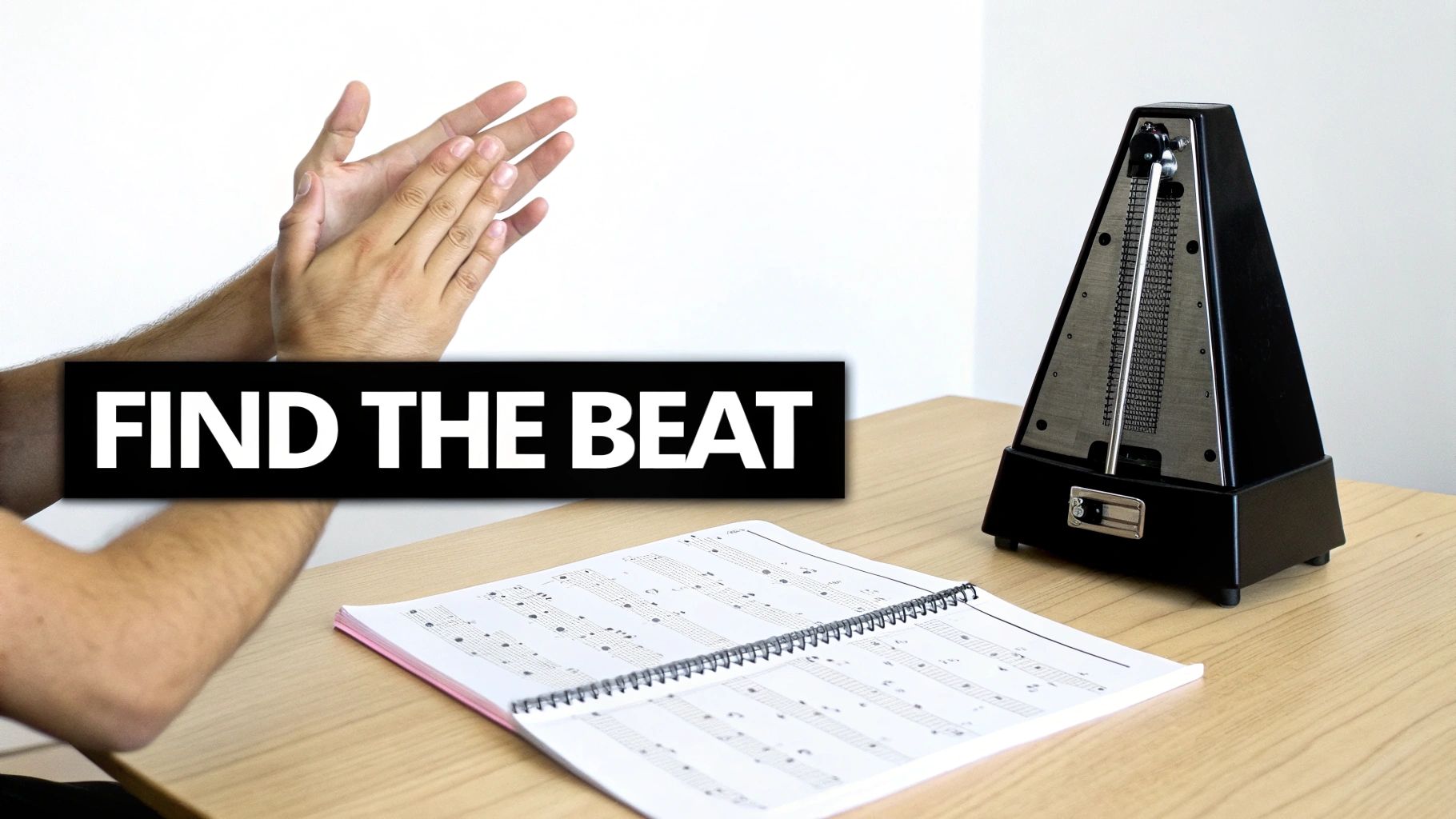
Let's break down the symbols that control the pulse of the music. Once you understand them, a static page of dots and lines transforms into a living, breathing performance.
Understanding Note Durations
The way a note looks is a direct instruction for its duration—how long you should hold it. Think of it as a simple system of fractions, where each type of note is worth a certain number of beats.
These are the most common note values you'll run into:
- Whole Note: An open oval with no stem. This is the longest standard note, typically held for four beats.
- Half Note: An open oval with a stem. It’s held for half the time of a whole note, meaning it gets two beats.
- Quarter Note: A solid black note head with a stem. This is often the foundational pulse of a song, getting one beat.
- Eighth Note: Looks like a quarter note but has a little flag on the stem. It’s worth half a beat, so two of them fit neatly into one beat.
It's all about division. One whole note is the same length as two half notes. One half note is the same as two quarter notes. This logical framework is the backbone of rhythm in all Western music.
The Importance of Silence: Rests
Music is as much about the notes you don't play as the ones you do. These moments of intentional silence are called rests, and they are essential for creating phrasing, building tension, and giving the music space to breathe.
For every note value, there's a corresponding rest that tells you to be silent for the same amount of time.
- A whole rest is a small rectangle that hangs down from the fourth line of the staff, indicating four beats of silence.
- A half rest is also a rectangle, but it sits on top of the third line. It calls for two beats of silence.
- A quarter rest is that familiar squiggly mark, which means you stay quiet for one beat.
Rests aren't just empty space; they're an active part of the music. A perfectly timed rest can have more impact than the loudest note. Learning to count your way through the silences is just as crucial as playing the notes themselves.
Setting the Pulse with Time Signatures
At the start of every piece of music, right after the clef, you’ll see two numbers stacked like a fraction. This is the time signature, and it’s the rhythmic road map for the entire piece.
The top number tells you how many beats are in each measure (the boxes sectioned off by vertical lines). The bottom number tells you which kind of note gets one beat.
By far the most common time signature you'll see is 4/4, often called "common time."
- The top 4 means there are four beats in every measure.
- The bottom 4 means a quarter note (1/4) gets one beat.
Another popular one is 3/4, the signature of almost every waltz. It means there are three beats per measure, and the quarter note still gets the beat. You’d feel this as a "ONE-two-three, ONE-two-three" pulse.
Feeling this underlying beat is everything. A fantastic way to internalize it is to clap the rhythm of a simple song while counting the beats out loud. This physical connection makes rhythm click in a way that just reading can't. It’s a foundational exercise we use in our beginner piano lessons at Encore Academy to build a rock-solid sense of time right from the start.
Adding Emotion with Musical Symbols
You've got the notes and timing down, which is fantastic. That’s the skeleton of the music. Now, let’s add the heart and soul—the symbols that turn a string of notes into a real, moving performance. These markings are the composer's way of telling you how to play, adding color, feeling, and life to the piece.
This is where the magic happens. It's the difference between a computer playing notes and a musician telling a story. Think of a great actor—they don't just say the words; they whisper, they shout, they pause. That's what these symbols help you do with music.
Setting the Mood with Key Signatures and Accidentals
Ever wonder why one song feels bright and sunny while another sounds somber or mysterious? That distinct character often comes from the key signature. You'll find it tucked right after the clef, and it's simply a collection of sharp (♯) or flat (♭) signs.
These symbols are a global instruction: they tell you that certain notes need to be played a half-step higher (sharp) or lower (flat) for the entire song. For instance, if you see one sharp on the top line of the treble clef, every F you play should actually be an F-sharp.
But what if the composer wants to break that rule for just a moment? That’s what accidentals are for. They are temporary changes.
- Sharp (♯): Bumps a note up by one half-step.
- Flat (♭): Drops a note down by one half-step.
- Natural (♮): Cancels a sharp or flat from the key signature, but only until the end of the measure.
The key signature sets the stage, while accidentals add little twists and turns, creating tension and surprise along the way.
Controlling Volume with Dynamics
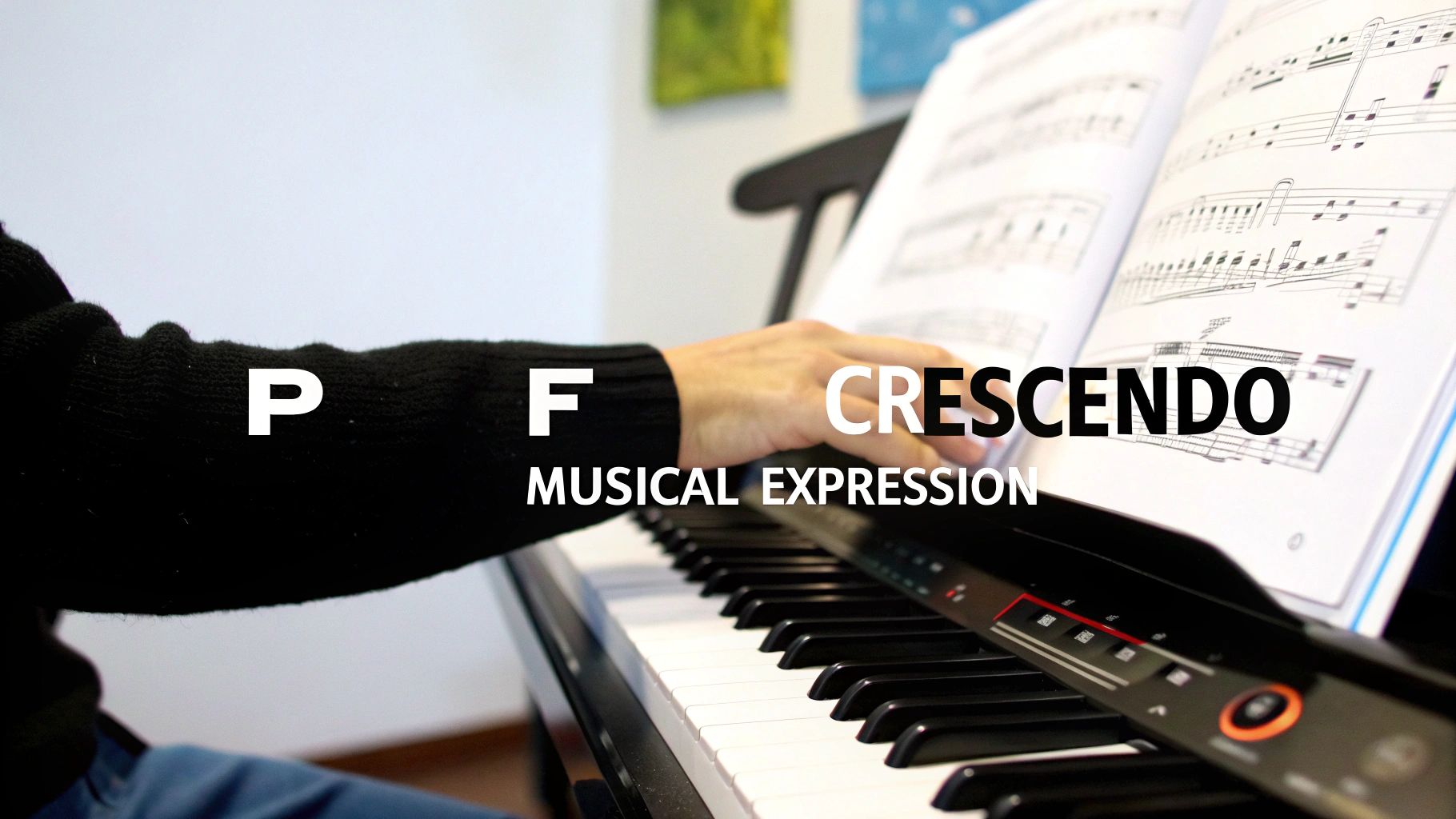
Music almost never stays at one volume level. The emotional journey of a piece is often built on the push and pull between loud and soft moments. These instructions for volume are called dynamics, and you’ll usually see them written below the staff using some traditional Italian terms.
Here are the most common ones you’ll encounter:
| Pianissimo | pp | Very Soft |
|---|---|---|
| Piano | p | Soft |
| Mezzo Piano | mp | Moderately Soft |
| Mezzo Forte | mf | Moderately Loud |
| Forte | f | Loud |
| Fortissimo | ff | Very Loud |
You'll also find symbols that show a gradual change:
- Crescendo (<): Gradually get louder.
- Decrescendo / Diminuendo (>): Gradually get softer.
These are your cues to make the music swell with passion or fade into a whisper. Mastering dynamics is just as critical as hitting the right notes.
Shaping Notes with Articulations
Beyond what note to play and how loudly, you need to know how to play it. Should the note be short and punchy? Smooth and flowing? Articulations are the little symbols that give you these playing instructions.
Articulations are the punctuation of music. They define the texture and character of a musical phrase, much like commas and exclamation points shape a sentence.
Here are a few essential ones to know:
- Staccato: A small dot above or below the note head. It means to play the note short and detached—think of a quick, light tap.
- Legato: Shown with a curved line (a slur) over a group of notes. This tells you to play them smoothly connected, with no audible space in between.
- Accent (>): A little wedge above or below a note. This is your signal to give that note a bit more oomph or emphasis than the ones around it.
Learning these expressive markings is a huge step toward real musicality. It’s also a skill that builds a strong foundation for a lifetime of music. While research shows that 75.61% of skilled musicians started learning between the ages of 4 and 8, dedicated practice can help anyone develop this musical "superpower."
Once you can read and interpret what a composer intended, you're not far from creating your own musical ideas. It’s a skill we love to help students from Sandy and the surrounding areas discover in our composition classes at Encore Academy .
Building a Smart Practice Routine
Knowing the rules of sheet music is one thing, but making sense of them on the fly is where the real magic happens. That’s the gap a smart, consistent practice routine is designed to bridge. It’s what turns the intellectual exercise of identifying a quarter note into the physical act of feeling that rhythm in your hands.
The goal isn't to log marathon hours. It’s to build a sustainable habit that slowly but surely makes reading music feel as natural as reading this sentence.
Consistency Over Cramming
Lots of beginners fall into the trap of thinking that long, grueling practice sessions are the fastest way to get good. My experience has shown me the exact opposite is true. Shorter, focused, and frequent sessions are far more powerful for a skill like this. Your brain thrives on repetition, not exhaustion.
Think about it like learning a new language. You wouldn't study Spanish for six hours on a Saturday and then drop it for two weeks. You’d probably spend 15-20 minutes on it every single day. Music works the same way. Daily exposure keeps the symbols and patterns fresh in your mind, building the neural pathways that make recognition faster and more automatic over time.
Daily practice isn't about hitting a home run every time you sit down. It's about getting a single base hit, day after day. Those small wins are what add up to major progress over the long haul.
Instrument-Specific Practice Strategies
The way you approach reading music will feel a little different depending on what you play. By tailoring your practice, you can directly address the unique challenges of your instrument and connect the dots on the page to the physical movements required.
Here are a few tips I give my own students:
- For Pianists: Don't try to conquer both the treble and bass clefs at the same time in the beginning. It's a recipe for frustration. Instead, practice hands separately. Spend five minutes just reading and playing the right-hand part, then switch to the left hand. This isolates the task and keeps you from feeling overwhelmed. For more piano-specific exercises, check out our guide on how to improve sight-reading on the piano .
- For Guitarists: The biggest hurdle is often translating a note on the staff to a specific fret on the neck. My advice? Keep a fretboard diagram handy and do drills where you just find specific notes. Start with the first position and get really comfortable reading everything in that range before you even think about moving up the neck.
- For Vocalists and Wind Players: Your breath is your instrument. From day one, practice sight-singing or playing simple tunes while paying close attention to the dynamics and articulations marked on the page. A metronome is your best friend here—it will keep your rhythm honest and precise.
To help you get started, here is a simple weekly schedule you can adapt. The key is consistency, even if it's just for a few minutes each day.
Your First Weekly Practice Schedule
This sample routine is designed to build consistent habits and improve your sight-reading skills one step at a time.
| Monday | Note Identification (Treble Clef) | Quickly name 10 random notes on the staff and ledger lines. |
|---|---|---|
| Tuesday | Note Identification (Bass Clef) | Quickly name 10 random notes on the staff and ledger lines. |
| Wednesday | Rhythm Clapping | Clap or tap the rhythms of 4-8 bars of a simple piece. |
| Thursday | Simple Melody (One Hand/Clef) | Sight-read a very basic 4-bar melody. Don't worry about mistakes. |
| Friday | Interval Recognition | Identify intervals (2nds, 3rds, 4ths, 5ths) in a simple piece. |
| Saturday | Review & Play | Revisit Thursday's melody and try to play it more smoothly. |
| Sunday | Rest or Fun Play | Rest or simply play something you enjoy, without the pressure of reading. |
Remember, this is just a template! Adjust it to fit your instrument and your current skill level. The most important thing is to show up each day.
The Power of Chunking
As you get more comfortable, something amazing starts to happen. You’ll stop seeing individual notes and start recognizing entire patterns at a glance. This is a technique called chunking, and it’s an absolute game-changer for your reading speed. Instead of spelling out C-E-G, your brain will simply see a "C major chord."
Start training your eyes to look for these common patterns:
Intervals: Practice recognizing the distance between two notes. Is it a step (from a line to the very next space) or a skip (from a line to the next line)?
Scales: Keep an eye out for notes that move up or down in a neat, orderly line. If you see a cascade of notes going straight up the staff, it’s a safe bet it's part of a scale.
Chords and Arpeggios: Look for notes stacked vertically (chords) or notes that outline a chord one by one (arpeggios).
This is a core method our instructors at Encore Academy of Music use to help students from Bluffdale and nearby Herriman make confident, rapid progress. It's how reading music goes from a slow, letter-by-letter chore to a fluid, intuitive skill.
Building this kind of fluency takes time. With consistent practice, most beginners start to feel proficient within 18 months to two years. While some dedicated learners might get there faster, the journey is a marathon, not a sprint. With the right routine and a little patience, you'll see steady, encouraging results week after week.
Common Questions About Reading Sheet Music
As you start this journey, a few questions are bound to bubble up. It's totally normal. Let's tackle some of the most common hurdles and worries I hear from new students. Getting these out of the way can really build your confidence and keep you on track.
How Long Does It Really Take to Get Good at This?
There's no single answer, but it's not a complete mystery either. If you can put in a solid 15-20 minutes of focused practice each day, you'll likely start recognizing notes and basic rhythms within a few weeks. Getting to the point where you can comfortably sight-read simple tunes? That usually takes several months to a year.
The real secret isn't cramming for hours on a weekend; it's consistency. A student from Riverton taking weekly lessons often gets ahead faster simply because they have that built-in, guided routine. Little and often is the key.
Am I Too Old to Learn How to Read Sheet Music?
Absolutely not. That’s one of the biggest myths I have to bust. While it’s true that many musicians start young, adults have their own set of superpowers: discipline, focus, and a much better understanding of how they learn. The building blocks of music are the same whether you're 8 or 80.
I've seen so many adult learners in communities like Draper and Herriman discover a huge sense of accomplishment from finally cracking the code. It's all about finding the right teacher or method that resonates with how your brain works now.
Don't see age as a barrier—see it as an advantage. Adult learners often bring a motivation and focus that can lead to surprisingly quick progress once they find a consistent routine.
Do I Need to Learn Both the Treble and Bass Clefs?
This one comes down to your instrument. For pianists, the answer is a hard yes. You need both, period. Your hands live on two different staves, and that's the nature of the instrument.
For everyone else, it's a bit more specialized.
- High-Pitched Instruments: Violin, flute, and trumpet players will spend nearly all their time in the treble clef.
- Low-Pitched Instruments: Cellists, bass guitarists, and tuba players will be camped out in the bass clef.
That being said, knowing both clefs gives you the full picture. It's a massive advantage if you ever want to compose, arrange music, or just understand theory on a deeper level. Even if your instrument only uses one, understanding the other helps you see how all the pieces of a band or orchestra fit together.
Hopefully, clearing up these common questions helps demystify the process. With a little patience and the right mindset, anyone can learn to turn those dots and lines into music.
At Encore Academy for the Performing Arts, we know every musician's path is different. Our instructors in Bluffdale are here to give you the personalized guidance you need to succeed, whether you're reading your first note or polishing advanced pieces. Book a trial lesson today and let's get started.