
8 Fun and Effective Preschool Music Movement Activities for 2026
Welcome to the vibrant world where rhythm meets play! For parents and educators in communities from Riverton to Herriman, finding enriching activities that genuinely captivate a preschooler's attention is a top priority. Preschool music movement activities are not just about burning off energy; they are a powerful, research-backed method for accelerating cognitive, social, and physical development.
This isn't just theory; it's a dynamic process where every clap, stomp, and song builds a stronger, more confident learner. Whether you're a parent in Lehi looking for at-home ideas or a teacher in Sandy seeking fresh classroom inspiration, this guide is your comprehensive resource. We will explore eight distinct, developmentally-appropriate activities that transform abstract musical concepts into tangible, joyful experiences.
Inside this comprehensive list, you will discover actionable methods that go beyond simple song and dance. We will break down the 'why' behind each activity, provide clear step-by-step instructions, and offer practical tips to ensure success for every child. Many of these foundational techniques are woven into the fabric of our early childhood programs right here at Encore Academy in Bluffdale, designed to give your young artist the best possible start on their creative journey. Let's dive in and discover how to make learning an unforgettable adventure.
1. Kindermusik-Inspired Movement & Music Classes
Kindermusik is a globally recognized, research-based music and movement program for young children, from newborns to age seven. Its core philosophy is that children learn best through multisensory, play-based experiences. These classes are not just about singing songs; they are carefully structured preschool music movement activities that integrate singing, instrument exploration, and purposeful movement to foster whole-child development.
Movement is the key that unlocks musical understanding for preschoolers. In a Kindermusik-inspired class, a child doesn't just hear a crescendo; they might physically "grow" from a small seed on the floor into a tall, waving tree. This connection between physical action and musical concept helps encode learning deeply and joyfully.
How It Works: A Multisensory Approach
Kindermusik-inspired classes use a rich variety of activities to engage children. Each session builds on familiar routines while introducing new concepts.
- Singing and Vocal Play: Call-and-response songs, chants, and rhymes build language skills and auditory discrimination.
- Instrument Exploration: Children use age-appropriate instruments like shakers, drums, and rhythm sticks to explore tempo, rhythm, and timbre.
- Coordinated Movement: Activities involve both fine motor skills (fingerplays) and gross motor skills (galloping, jumping, swaying), often with props like scarves or hoops.
- Storytelling: Music and narrative are woven together, enhancing imagination and comprehension.
Practical Tips for Implementation
For parents and educators in areas like Herriman or Draper looking to bring this method home or into the classroom, start simple.
Key Insight: The goal is process, not performance. Focus on joyful participation rather than perfect execution. Repetition is crucial, as it builds confidence and allows children to anticipate and lead activities.
- Use Flowing Props: Scarves and ribbons are perfect for preschoolers. They provide immediate visual feedback for movements like flowing, spinning, and zig-zagging, making abstract concepts like melody tangible.
- Incorporate "Free Dance": While structured movement is important, always include time for improvisation. Put on an expressive piece of music and let children interpret it freely.
- Repeat, Repeat, Repeat: Use the same welcome and goodbye song each week. This routine provides comfort and helps children feel secure and ready to participate.
This foundational approach prepares children beautifully for more structured learning later on. Exploring the best dance classes for toddlers is a natural next step for children who show a love for these early creative movement experiences. Find out more about toddler dance programs that build on these principles.
2. Orff Schulwerk Method (Movement & Percussion Integration)
The Orff Schulwerk method, developed by composer Carl Orff, is an elemental approach to music education that begins with what children do naturally: play. It views speech, movement, and music as an inseparable trio, using them to build a strong musical foundation from the inside out. This method is one of the most dynamic preschool music movement activities because it empowers children to become active creators, not just passive listeners.
At its core, the Orff approach believes that rhythm is the fundamental element connecting music and movement. A child first experiences rhythm through language patterns and body movements like clapping, stomping, and patting. Only after internalizing these rhythmic feelings do they transfer them to specially designed percussion instruments like xylophones, metallophones, and glockenspiels, making music an accessible and joyful group activity.
How It Works: A Play-Based Ensemble Approach
Orff-inspired activities are structured to be process-oriented, focusing on exploration, improvisation, and ensemble participation. The learning path is logical and child-centered, moving from simple to complex concepts.
- Speech and Chants: Rhythmic learning begins with the natural cadence of nursery rhymes and chants.
- Body Percussion: Children use their bodies as instruments (clapping, snapping, stomping) to internalize rhythmic patterns before touching an instrument.
- Instrument Play: Using barred instruments, drums, and shakers, children create melodies and harmonies together, often improvising within a simple framework.
- Movement and Dramatization: Gross motor movements are used to express musical elements like tempo, dynamics, and melody, often through creative storytelling.
Practical Tips for Implementation
For parents and educators in areas like Bluffdale or Riverton looking to introduce this collaborative method, the key is to build skills sequentially.
Key Insight: The Orff method is non-competitive and inclusive. It values each child's unique contribution to the group, making it perfect for mixed-age or mixed-ability classrooms where everyone can participate successfully.
- Start with Body Percussion: Before introducing mallets, explore a song's rhythm using claps for the melody and stomps for the steady beat. This grounds the rhythm in the body first.
- Use Repetitive Songs: Simple folk songs or chants with repetitive structures allow children to anticipate patterns and confidently layer in instrumental or movement parts.
- Assign Instrument "Jobs": Give each child or small group a specific instrument to play at a specific time. This sense of ownership and responsibility boosts engagement and teaches ensemble skills.
- Mirror the Melody: Use movement to make melodic contour visible. Have children raise their hands high for high notes and crouch low for low notes, physically mapping the music.
This method excels at building rhythmic competence and confidence, which are crucial for any future musical study. Exploring our comprehensive programs can be a great next step. Learn more about our music programs at Encore Academy and see how these foundational principles are applied.
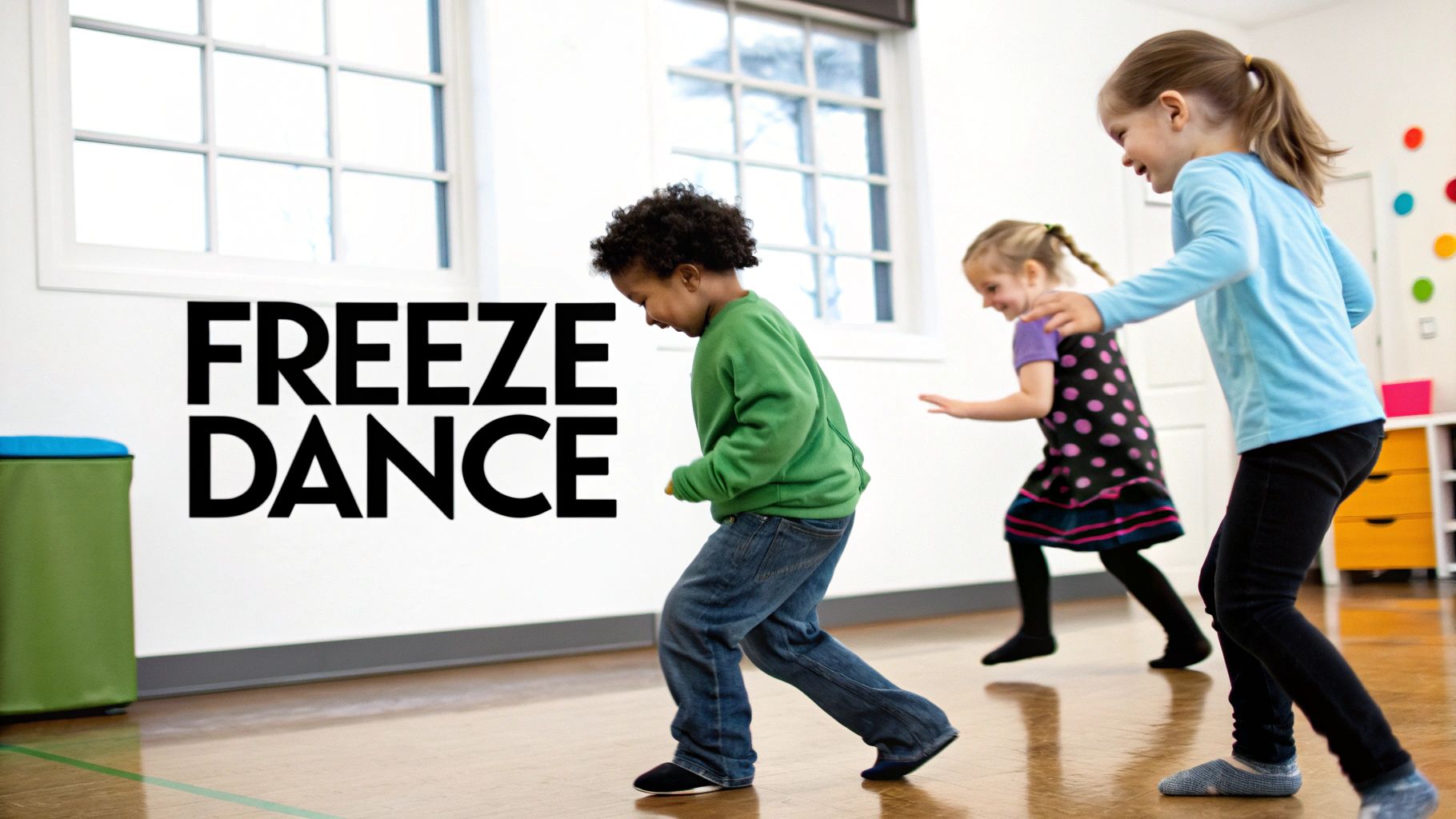
3. Freeze Dance & Rhythm Pattern Recognition
Freeze dance is far more than just a party game; it’s a dynamic and structured activity that builds crucial developmental skills. This classic among preschool music movement activities involves children moving freely to music and then freezing in place the moment the music stops. This simple premise is a powerful tool for developing listening skills, impulse control, body awareness, and coordination.
The core educational value of freeze dance lies in its ability to teach children to respond to auditory cues and control their bodies in response. By varying the music's tempo, style, and stopping patterns, it evolves from a simple game into a sophisticated exercise for understanding musical structure, rhythm, and meter.
How It Works: Building Auditory Skills
The game's progression challenges children to listen more intently and anticipate changes. It starts with a simple stop-and-go format and can be layered with complexity to keep it engaging and educational.
- Active Listening: Children must pay close attention to the music, distinguishing between sound and silence.
- Impulse Control: The act of stopping abruptly on command is a significant exercise in self-regulation, a key executive function skill.
- Body Awareness: Holding a "frozen" pose helps children understand their physical position in space and improves balance.
- Rhythm Recognition: Introducing patterns, like freezing on a specific beat or after a certain number of counts, helps internalize musical meter.
Practical Tips for Implementation
For educators and parents in communities like Sandy and Lehi, elevating freeze dance from a simple game to a learning tool is easy with a few creative tweaks.
Key Insight: The silence is as important as the sound. The moment of the "freeze" is where children practice focus, balance, and rapid response, turning playful energy into a moment of controlled stillness.
- Vary the Music: Use a diverse playlist featuring different genres like classical, jazz, world music, and pop. This exposes children to varied tempos, moods, and rhythmic styles.
- Introduce Visual & Auditory Cues: Instead of just stopping the music, add a visual cue (like raising a hand) or a sound cue (like ringing a bell) to signal the freeze. This adds another layer of listening and observation.
- Incorporate Themes: Add imaginative prompts to the game. Ask children to "freeze like a superhero," "freeze like a melting ice cream cone," or "freeze in a ballet pose."
- Add Rhythm Patterns: Make the game more complex by asking children to freeze only when they hear a specific instrument or a pattern of three claps.
This activity is a fantastic way to introduce concepts of rhythm and self-control in a fun, high-energy format. As children develop these skills, they build a strong foundation for more formal instruction. To see how these foundational skills translate into structured learning, you can explore the creative dance programs available at Encore Academy. Learn more about the variety of dance classes that build on these playful beginnings.
4. Scarves & Ribbons Movement Exploration
Scarves and ribbons are classic tools in early childhood education for a reason. These simple, flowing props transform abstract musical concepts into tangible, visual experiences, making them a cornerstone of effective preschool music movement activities. This tactile, sensory-rich activity helps children physically interpret the music they hear, linking their own movements to rhythm, melody, and dynamics in an intuitive and joyful way.
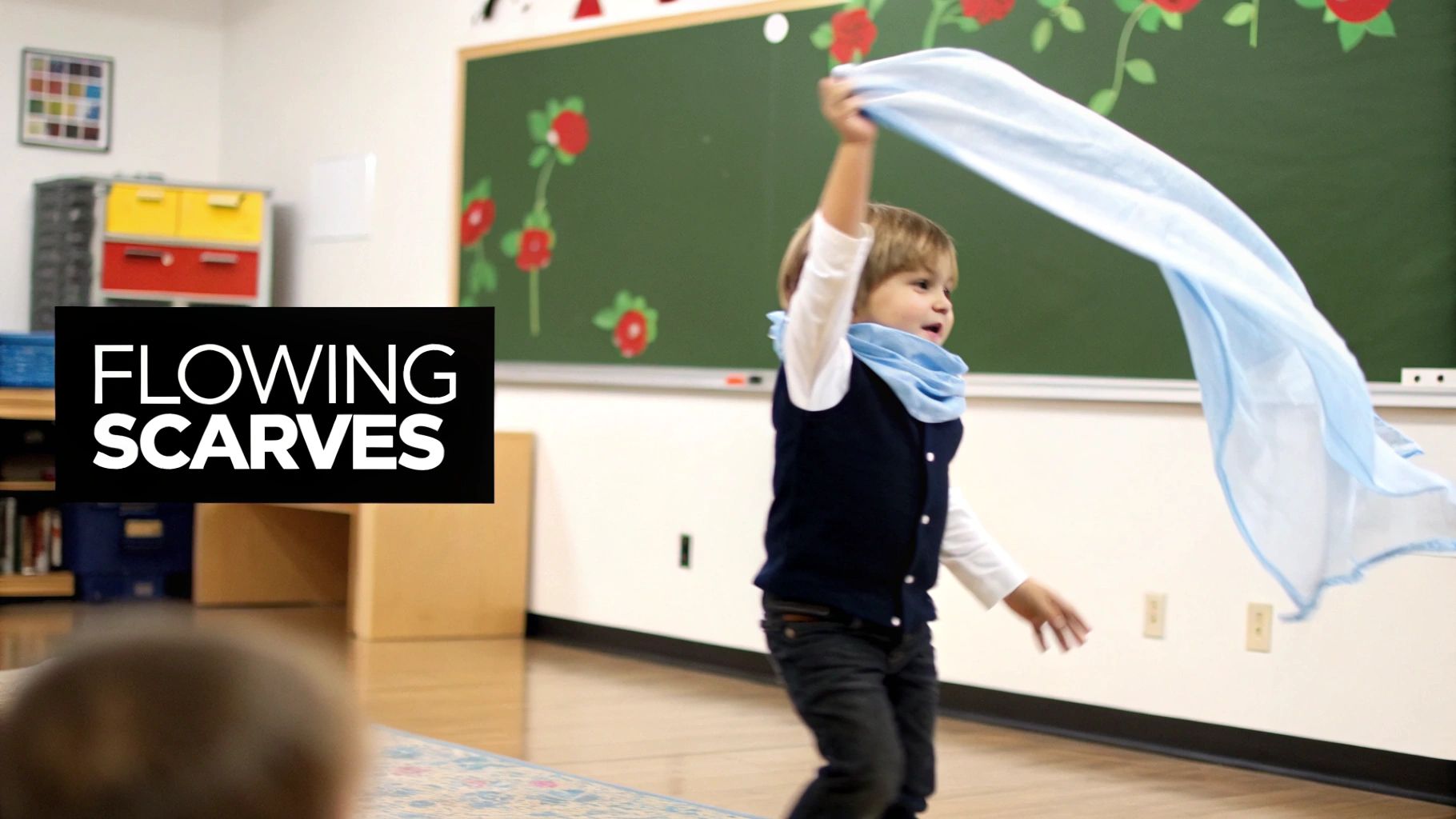
The magic of a scarf is in its immediate visual feedback. When a child makes a fast, sharp movement, the scarf follows; when they make a slow, flowing movement, the scarf floats gracefully. This direct cause-and-effect relationship helps a child connect their physical expression to the music's character, whether it's the staccato notes of a playful tune or the legato phrases of a gentle lullaby.
How It Works: A Visual-Kinesthetic Approach
Using scarves and ribbons helps children explore space, energy, and time through creative expression. The activities are easily adaptable, making them perfect for various skill levels and learning objectives.
- Musical Interpretation: Children use the scarves to "paint" the music in the air, creating high and low pathways for melody, big and small shapes for dynamics (loud/soft), and fast or slow movements for tempo.
- Spatial Awareness: Navigating a space while manipulating a scarf encourages children to become more aware of their personal and general space, avoiding collisions and developing body control.
- Gross Motor Skills: Activities involve large arm movements, spinning, and traveling across the floor, which builds coordination, balance, and strength.
- Creative Expression: Beyond guided movements, scarves become props for imaginative play- wings for a butterfly, a tail for a horse, or waves in the ocean.
Practical Tips for Implementation
For parents in Bluffdale or educators in nearby Riverton looking to introduce this activity, the key is to allow for exploration while providing gentle structure.
Key Insight: The scarf is not just a prop; it's an extension of the child's body. Encourage them to lead the scarf through space, exploring how their movements affect its path and flow.
- Select Appropriate Music: Choose a variety of musical styles. Try classical pieces with clear dynamic shifts like "The Swan" or upbeat folk music for energetic movements.
- Introduce One Concept at a Time: Start by focusing on a single movement concept. Ask children to make zig-zags, then circles, then waves. Once they are comfortable, you can combine movements.
- Create Partner Activities: Have children face a partner and mirror each other’s scarf movements. This builds social skills, observation, and non-verbal communication.
- Incorporate into Storytelling: Use scarves to represent elements in a story, like a flowing river, a gust of wind, or a magical cloak, enhancing narrative engagement.
This activity is a fantastic way to develop both physical literacy and musical sensitivity. The skills gained from these playful explorations are directly applicable to more formal dance instruction, such as the creative movement classes designed for young learners. Explore dance classes for preschoolers that build on this foundational love of movement.
5. Rhythm Sticks & Body Percussion Coordination
Rhythm sticks and body percussion provide a dynamic, hands-on way for preschoolers to internalize rhythm. This layered approach uses simple instruments, like wooden dowels, and the child's own body to create patterns, synchronize movement with sound, and build a foundational understanding of beat and tempo. It’s a powerful method that transforms abstract musical concepts into tangible, physical experiences.
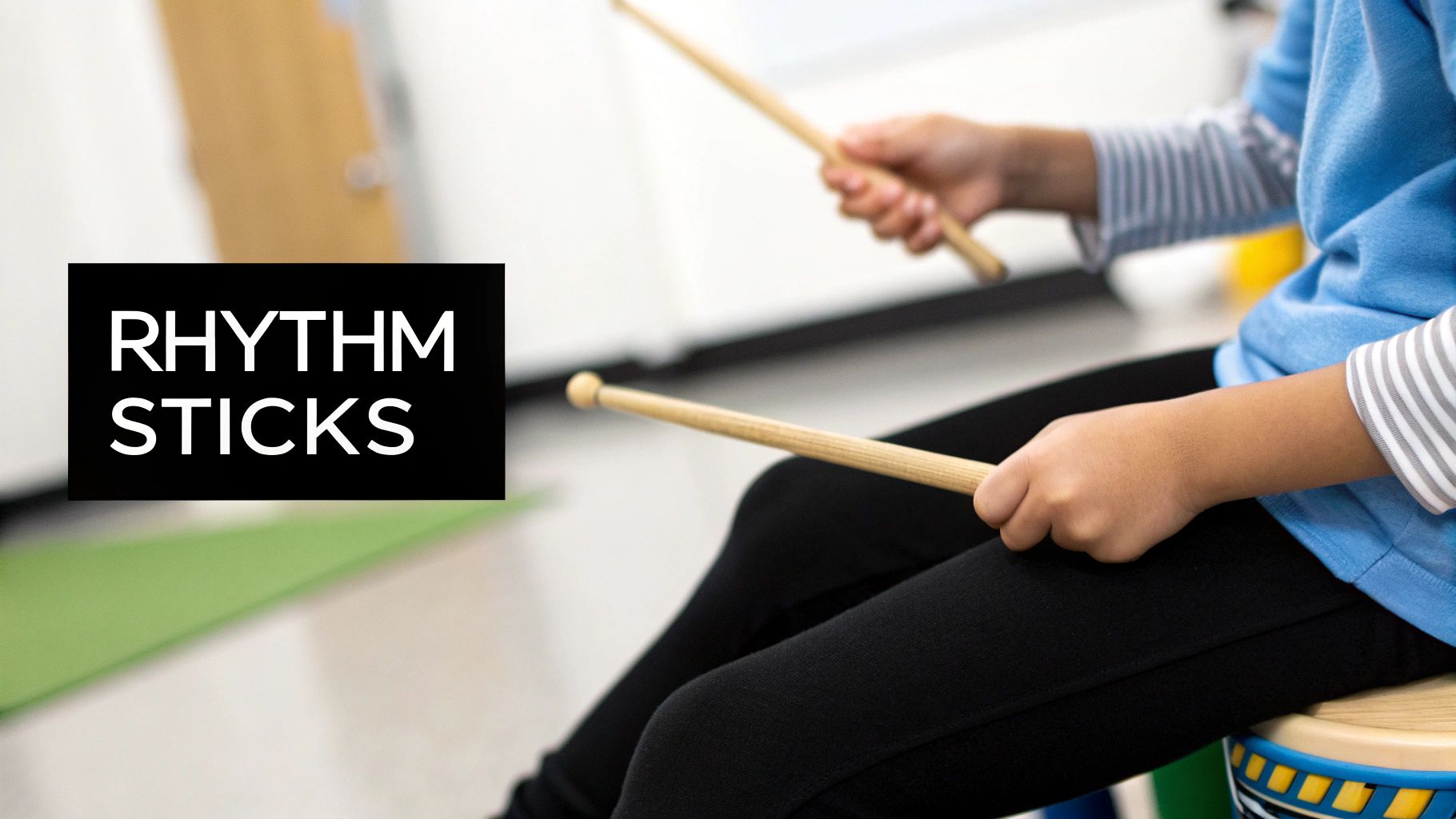
The connection between making a sound (tapping sticks) and feeling the vibration or movement (patting their lap) creates a strong neural pathway. This multisensory feedback helps preschoolers develop temporal awareness, fine motor control, and the collaborative skills needed to play in a group. These preschool music movement activities are a staple in music education because they are simple, effective, and endlessly engaging.
How It Works: A Multisensory Approach
This technique layers simple actions to build complex rhythmic understanding. It starts with the body as the primary instrument and then extends that learning to an external tool, the rhythm sticks.
- Body Percussion First: Children learn to feel the beat by clapping, stomping, patting their legs, or snapping their fingers. This establishes an internal clock.
- Introducing the Sticks: Once comfortable with body percussion, rhythm sticks are introduced. Children learn to tap them together, on the floor, or against a parent's sticks.
- Pattern Building: Simple rhythmic patterns are taught, often through call-and-response. For example, the teacher plays "tap-tap-shhh-shhh" and the children echo it.
- Ensemble Playing: The group works together to keep a steady beat while singing a familiar song, developing focus and listening skills.
Practical Tips for Implementation
For educators and parents in communities like Draper or Herriman, integrating rhythm sticks is straightforward and highly rewarding.
Key Insight: Safety is the first step. Always establish clear rules for using the sticks as "instruments, not weapons" before beginning any activity. Start with slow, simple patterns to build confidence.
- Create Visual Cues: Use simple picture cards (e.g., two hands for clapping, two sticks for tapping) to help children "read" and remember rhythmic patterns.
- Use Familiar Songs: Have children keep the beat with their sticks or body percussion while singing songs they already know and love. This connects the new skill to a comfortable activity.
- Partner Up: Encourage children to tap sticks with a partner. This promotes social interaction, listening, and the need to synchronize with another person, a key musical skill.
The coordination and timing learned here are essential precursors to more complex musical and dance education. Understanding how rhythm translates into physical expression is central to the art of dance and instrumental training.
6. Story-Based Movement & Musical Narration
Story-based movement transforms a classic children's tale into an immersive, interactive experience. This method combines the power of narrative with synchronized music and expressive movement, allowing preschoolers to embody the story. Children don't just listen to a story like "The Three Little Pigs"; they become the pigs, the wolf, and even the houses, moving their bodies to music that reflects the story’s drama and emotion.
This approach is one of the most effective preschool music movement activities because it naturally integrates literacy, music, theater, and physical education. By acting out a "Journey Through the Forest," a child connects movement with narrative sequence, musical cues with emotional context, and physical expression with character development, creating a rich, holistic learning environment.
How It Works: A Theatrical Approach
Story-based movement activities turn the classroom into a stage where every child has a role. The process is scaffolded to build from simple actions to a complete musical narrative.
- Narrative Foundation: A familiar or simple story provides the structure. Classics like Prokofiev's Peter and the Wolf are perfect examples where each character is represented by a specific musical theme and instrument.
- Musical Storytelling: Music is selected or composed to match the story’s pacing and mood. A sneaky theme for the wolf, a playful tune for the pigs, and a dramatic crescendo for the huffing and puffing.
- Character Movement: Children explore how different characters would move. How does a pig skip? How does a wolf creep? This develops gross motor skills and creative thinking.
- Prop Integration: Simple props like blue ribbons for a flowing river or brown scarves for rustling trees make the imaginary world tangible and enhance sensory engagement.
Practical Tips for Implementation
For educators in Lehi or Bluffdale looking to stage these musical stories, the key is to make the experience accessible and engaging for all children.
Key Insight: Focus on embodying the story's emotional journey rather than achieving perfect choreography. The goal is to help children connect their movements to the narrative and music, fostering both empathy and artistic expression.
- Assign Inclusive Roles: Use a "chorus" approach. Not every child needs to be a main character; they can be the wind, the rustling leaves, or the bubbling stream. This allows shy children to participate fully without the pressure of a solo role.
- Break It Down: Teach the movements for each character or story part separately before putting it all together. Practice being "strong like a brick house" or "wobbly like a straw house" before adding the wolf's entrance music.
- Use Familiar Tales: Start with stories children already know and love. This reduces the cognitive load of learning a new plot, allowing them to focus entirely on the music and movement.
This method builds a strong foundation in creative expression and physical storytelling, preparing children for the more structured narratives found in our theater and musical theater programs. Explore our musical theater classes to see how these foundational skills blossom on stage.
7. Musical Games & Movement Challenges (Simon Says, Musical Statues, Follow the Leader)
Classic games like "Musical Statues," "Follow the Leader," and "Simon Says" are powerful preschool music movement activities that go far beyond simple fun. These structured games masterfully combine rule-based play with creative expression, teaching crucial developmental skills in a playful, low-pressure environment. By integrating music, these games enhance a child's ability to listen, respond to auditory cues, and control their impulses.
Movement in these games is not random; it is a direct response to a musical or verbal cue. When the music stops in "Musical Statues," a child practices body control and auditory processing. When they mirror a leader's movements, they develop social awareness, observation skills, and motor planning. This structured play provides a safe framework for preschoolers to experiment with movement while learning to follow directions.
How It Works: A Multisensory Approach
These well-known games are built on a simple premise: listen, process, and move (or freeze). The addition of music adds a dynamic layer that engages children's auditory senses and rhythmic sensibilities.
- Listening and Impulse Control: Games like "Musical Statues" and "Musical Simon Says" require children to listen intently for a signal (music stopping, a specific phrase) and react quickly, strengthening their executive function skills.
- Social Awareness and Mirroring: "Follow the Leader" encourages children to observe a peer's actions and replicate them, building nonverbal communication skills, empathy, and body awareness.
- Rhythmic Response: Using varied music with different tempos and styles encourages children to adapt their movements, from slow, flowing sways to fast, energetic jumps, connecting their bodies to the rhythm.
- Turn-Taking and Leadership: These games provide natural opportunities for children to take turns being the leader, fostering confidence and self-esteem.
Practical Tips for Implementation
Parents and educators in communities like Riverton and Bluffdale can easily adapt these games for home or classroom settings to create dynamic learning experiences.
Key Insight: Modify elimination to maintain engagement. Instead of a child being "out" in Musical Statues, they can become a "judge" who helps spot the next person who moves, keeping everyone involved and focused.
- Use Clear Signals: Before starting, establish clear visual or auditory cues. For example, ring a small bell when the music stops or hold up a red card to signal "freeze." This helps young children process the rules more easily.
- Vary the Music: Don't stick to one type of song. Use a playlist with fast and slow songs, classical and pop music, and songs with abrupt stops. This keeps the game exciting and challenges children's listening skills.
- Rotate Leadership Roles: Ensure every child gets a chance to be "Simon" or the "Leader." This builds confidence and allows children to experience both leading and following, which are important social skills.
These games are excellent tools for assessing a child's development in a natural setting, observing who responds on the beat and who mirrors movements accurately. You can discover even more fun ways to incorporate these classic activities by exploring music and movement games for preschoolers. Learn more about music and movement games for preschoolers to keep the learning and laughter going.
8. Dalcroze Eurythmics (Beat & Meter Embodiment Through Movement)
Dalcroze Eurythmics is a powerful method developed by Swiss educator Emile Jaques-Dalcroze that teaches music through the body's natural movement. The core philosophy is that students must first experience musical concepts kinesthetically before they can fully understand them intellectually. It’s a foundational approach where children physically become the music, embodying the beat, meter, and melodic contour through coordinated, whole-body actions.
This method transforms abstract ideas like tempo changes or rhythm patterns into tangible experiences. A child doesn't just hear a "fast" or "slow" tempo; they walk, run, or tiptoe to internalize the difference. By connecting sound with physical response, Dalcroze Eurythmics builds a deep, intuitive musicality that serves as a powerful foundation for formal instrument training and other preschool music movement activities.
How It Works: A Multisensory Approach
Dalcroze Eurythmics uses a series of carefully designed games and exercises to make learning feel like play. The teacher often improvises music on the piano, and students respond with spontaneous or guided movement.
- Beat and Meter: Children learn to feel the difference between 2/4, 3/4, and 4/4 time by physically stepping the strong and weak beats.
- Rhythm Patterns: Students might clap, step, or jump complex rhythm patterns, translating auditory information directly into physical action.
- Melodic Contour: Movement follows the direction of the melody. As the music goes up in pitch, children might reach for the sky; as it descends, they might crouch toward the floor.
- Improvisation: A key element is creative response. The teacher provides a musical framework, and students interpret it through their own unique movements.
Practical Tips for Implementation
For parents in Bluffdale or Riverton looking to supplement their child’s piano lessons, these principles can be adapted at home. The goal is to create a physical "shortcut" to musical understanding.
Key Insight: In Dalcroze, the body is the first instrument. The physical experience of rhythm and melody builds the neural pathways necessary for musical proficiency and expressive performance later on.
- Start with Beat Walking: Play a simple piece of music with a clear, steady beat on the piano or a speaker. Have your child walk around the room, making sure their footsteps land exactly on the beat. Vary the tempo to challenge their listening skills.
- Use Directional Movement: To teach melodic contour, use a scarf or ribbon. Have your child move the scarf up high when they hear high notes and sweep it low for low notes.
- Integrate Body Percussion: Reinforce rhythmic learning by adding stomps, claps, and snaps. For example, have them stomp on beat one and clap on beats two and three in 3/4 time.
This method is exceptionally effective for preparing a child's mind and body for the discipline required in more formal music education, such as the piano or violin lessons offered to students from Herriman to Lehi.
8-Point Comparison: Preschool Music Movement
| Kindermusik-Inspired Movement & Music Classes | Moderate — structured curriculum, parent involvement, instructor training useful | Moderate — varied instruments/props, possible licensing/training | ⭐⭐⭐⭐ — cognitive, language, motor skills; strong parent-child bonding | Parent-and-me classes, preschool enrichment, developmental support | Research-based multisensory framework that engages multiple learning styles |
|---|---|---|---|---|---|
| Orff Schulwerk Method (Movement & Percussion Integration) | Moderate–High — ensemble layering, improvisation, classroom management | High — Orff instruments, storage, instructor training/certification | ⭐⭐⭐⭐ — rhythmic literacy, ensemble awareness, creativity | Mixed-age groups, general music, special education, community programs | Inclusive pentatonic instruments; promotes improvisation and social skills |
| Freeze Dance & Rhythm Pattern Recognition | Low — simple rules, scalable, easy to run | Very low — music source, optional props, clear space | ⭐⭐⭐ — listening, impulse control, basic rhythmic awareness | Warm-ups, energizers, transitions, large-group management | Extremely low cost, high engagement, quick to implement and adapt |
| Scarves & Ribbons Movement Exploration | Low — straightforward activities, requires prop management | Low — lightweight scarves, storage, hygiene considerations | ⭐⭐⭐ — spatial awareness, bilateral coordination, expressive movement | Creative movement, calming exercises, visualizing musical shape | Highly accessible visual feedback; low cost and calming for children |
| Rhythm Sticks & Body Percussion Coordination | Low–Moderate — safety rules and progressive pattern teaching | Low — sticks/dowels, rhythm cards, minimal setup | ⭐⭐⭐⭐ — rhythm internalization, motor coordination, ensemble timing | Orff classrooms, percussion intro, rhythm-reading practice | Very effective for rhythm literacy; directly transferable to instruments |
| Story-Based Movement & Musical Narration | Moderate–High — narrative planning, choreography, role assignment | Moderate — music selection, simple props/costumes, rehearsal time | ⭐⭐⭐⭐ — creativity, emotional expression, integrated literacy | Theater-music integration, performances, cross-disciplinary classes | Highly motivating; builds confidence and memorable learning experiences |
| Musical Games & Movement Challenges (Simon Says, etc.) | Low — rule-based, flexible, quick to administer | Very low — music, clear signals, minimal props | ⭐⭐⭐ — listening discrimination, impulse control, social awareness | Transitions, informal assessment, team-building, large groups | Fun, motivating, easy to assess participation and listening skills |
| Dalcroze Eurythmics (Beat & Meter Embodiment) | High — systematic progression, improvisation, specialized pedagogy | High — certified instructor, live piano/accompaniment, large space | ⭐⭐⭐⭐⭐ — deep rhythmic internalization, musical fluency, coordination | Piano/strings prep, advanced rhythmic training, private instruction | Powerful embodied method that accelerates musical reading and interpretation |
Bringing It All Together: Your Next Step in Musical Discovery
As we've journeyed through this comprehensive list of preschool music movement activities, a powerful theme has emerged: music and movement are not just fun pastimes for young children; they are fundamental languages of learning and development. They are the tools through which preschoolers make sense of their world, express their emotions, and build critical cognitive and physical skills. From the structured, percussive explorations of the Orff Schulwerk method to the free-flowing creativity of dancing with scarves and ribbons, each activity offers a unique portal into your child’s growth.
You are now equipped with a diverse toolkit of ideas, from the stop-and-go excitement of Freeze Dance that sharpens listening skills to the imaginative narratives of story-based movement that foster creativity. We've explored how simple rhythm sticks can teach complex patterns and how methods like Dalcroze Eurythmics can help a child physically embody the very pulse of music. The beauty of these activities lies in their accessibility. You don’t need to be a professional musician or dancer to lead your child through a rhythmic adventure right in your Herriman living room or a classroom in Sandy.
Key Takeaways for Immediate Application
The true value of these preschool music movement activities is realized through consistent and joyful implementation. Remember these core principles as you begin:
- Process Over Performance: The goal is not a perfect dance or a flawless rhythm. The magic happens in the trying, the laughing, the experimenting, and the discovery along the way. Celebrate the effort, not just the outcome.
- Adaptability is Key: A single activity can be adapted for various ages and skill levels. Is Freeze Dance too simple? Add a rule that children must freeze in the shape of an animal. Are rhythm sticks too challenging? Start with simple body percussion like clapping and stomping.
- Child-Led Exploration: While structured activities provide a great foundation, always leave room for your child to take the lead. If they want to use a rhythm stick as a magic wand or a scarf as a superhero cape during a musical game, embrace it! This fosters creativity and ownership over their learning.
The ultimate impact of integrating these practices extends far beyond the playroom. When a child learns to match their movements to a beat, they are developing timing and coordination essential for sports and even handwriting. When they listen for musical cues in a game of Musical Statues, they are honing their auditory processing and focus, skills vital for academic success. For families across the Salt Lake Valley, from Lehi to Draper, these simple activities are laying a profound foundation for a well-rounded, confident, and capable child.
Cultivating a Lifelong Love for the Arts
Your role as a parent or educator is that of a guide, introducing possibilities and creating a safe, encouraging space for exploration. The most significant gift you can give is a positive and joyful association with music and movement. By turning on a song and dancing with abandon, by tapping out rhythms on pillows, or by creating silly movement stories, you are showing your child that the arts are a source of connection, expression, and happiness. This early exposure is what cultivates a lifelong appreciation that can lead to more formal training in dance, music, or theater down the road.
You now have the knowledge and the tools to transform any day into a dynamic learning experience. The next step is simply to begin. Choose one activity from this list, gather your simple materials, and invite your child to play. Observe what captures their interest, and don't be afraid to modify the rules. The journey of musical discovery is not a linear path but a wonderful, winding adventure, and it starts with a single, joyful step.
Ready to see these powerful concepts brought to life in a professional, nurturing environment? At Encore Academy for the Performing Arts, our early childhood programs are specifically designed to integrate these foundational preschool music movement activities to help every young artist in the Bluffdale area find their rhythm and voice. Book a trial class today and watch your child’s creative journey begin with us