
Master how to memorize piano pieces: quick methods for flawless performances
Memorizing a piano piece isn't about brute force. It's really about building a deep, layered understanding of the music itself. The whole process starts by creating a mental blueprint—analyzing the score for patterns, harmony, and structure—before you get bogged down in the physical practice. This is how you build a memory that's not just reliable, but expressive too.
Build Your Musical Blueprint Before You Play
I can't stress this enough: real memorization begins long before your fingers ever touch the keys.
It’s so tempting to just dive in and start playing, hoping that sheer repetition will hammer the notes into your memory. We've all done it. But that approach usually just builds "muscle memory," which is incredibly fragile and notorious for failing under the slightest bit of pressure.
A much smarter, more durable method is to create a mental map of the music first. Think of yourself as an architect studying a building's blueprints before the first brick is laid. You have to understand the structure, the foundation, and how every little part fits together to create the whole.
Analyze the Musical Architecture
Before you play a single note, spend some real quality time just studying the score. Look for the "bones" of the piece—that underlying framework that gives it its shape and direction. This analytical phase is what separates a shaky, physical memory from one that's deeply intellectual and emotional.
- Spot Repeating Patterns: Composers are creatures of habit. They reuse melodic fragments, rhythmic ideas, and even entire sections. When you spot these repetitions, it's a huge win. You're essentially getting a "buy one, get one free" deal on learning—master one idea, and you've already conquered several parts of the piece.
- Map Harmonic Progressions: Understanding the chord structure gives you a logical roadmap for your musical journey. Instead of a random jumble of notes, you'll start to see a clear progression, like a C major chord naturally moving to a G7. This harmonic awareness helps you anticipate what’s coming next, almost like you're predicting the future.
- Identify Core Melodic Themes: Every piece tells a story, and the melodies are the main characters. Can you sing the main theme? Can you spot where it pops up again, maybe in a different key or with a clever little twist? Internalizing these themes forges a powerful auditory memory that's hard to break.
By deconstructing the music first, you transform what looks like a terrifyingly long list of notes into a series of logical, memorable chunks. This foundation makes the rest of the process so much faster and more secure.
The four main ways we remember music can be broken down into distinct categories. Getting a handle on each of these is key to building a truly bulletproof memory for any piece.
The Four Pillars of Piano Memorization
Here's a quick overview of the essential memory types pianists use. Mastering these pillars creates a multi-layered and secure learning process.
| Kinesthetic | Muscle memory; the physical feeling of playing the notes. | Slow, deliberate practice; consistent fingering. |
|---|---|---|
| Aural | Auditory memory; hearing the music in your head. | Singing melodies; listening to recordings; transcribing. |
| Visual | Remembering what the score looks like or the pattern of keys. | Score study away from the piano; visualizing your hands. |
| Conceptual | The intellectual understanding of the music's structure. | Harmonic analysis; identifying forms and patterns. |
Leaning on just one of these pillars, especially muscle memory, is like building a house on a single support beam. By developing all four, you create a robust support system that won't let you down, even when the nerves kick in.
Establish Your Fingering Immediately
This might be one of the most critical steps in building your blueprint: decide on your fingering from day one.
Inconsistent fingering creates conflicting signals for your muscle memory, and it's one of the top reasons for stumbles and mistakes during a performance.
Once you find fingering that feels comfortable and works for a passage, write it directly into your score and treat it like law. This discipline ensures that every single time you practice, you're reinforcing the exact same physical pathway. For students traveling from nearby areas like Riverton or Draper to our Bluffdale studio, locking in this consistency makes all that at-home practice incredibly more effective.
Think of it this way: this non-negotiable step turns your hands into reliable partners that know exactly what to do. You can explore our guide for more on the fundamentals of music theory lessons for beginners to really deepen this understanding of musical structure.
With your musical roadmap in hand, it’s time to break the piece down. Don't try to eat the whole elephant at once. We're going to tackle it in small, logical bites—a technique often called chunking.
This isn't just about randomly picking a few measures to practice. The key is to be strategic. A "chunk" should be a complete musical thought, not just an arbitrary slice of the score.
For instance, if you're working on Beethoven's 'Für Elise,' your first chunk is almost certainly that iconic eight-measure opening theme. It’s a self-contained musical sentence. By focusing on just that phrase, your brain can process and store it far more effectively than if you tried to push through the first thirty measures in one go.
How To Define Your Practice Chunks
So, how do you find these natural divisions in a piece? You have to listen with a composer's ear.
- Look for Musical Phrases: Where would a singer take a breath? That's almost always the end of a musical phrase and a perfect boundary for a chunk.
- Listen for Harmonic Shifts: When the whole mood changes because the underlying chords take a new direction, that’s a great place to draw a line. It marks the start of a new section.
- Isolate the Tricky Bits: That lightning-fast scale run or a tangled arpeggio section? That’s its own chunk. Give it the focused attention it deserves, master it in isolation, and then fold it back into the larger piece later.
This simple diagram shows how we approach learning new music from the very beginning.
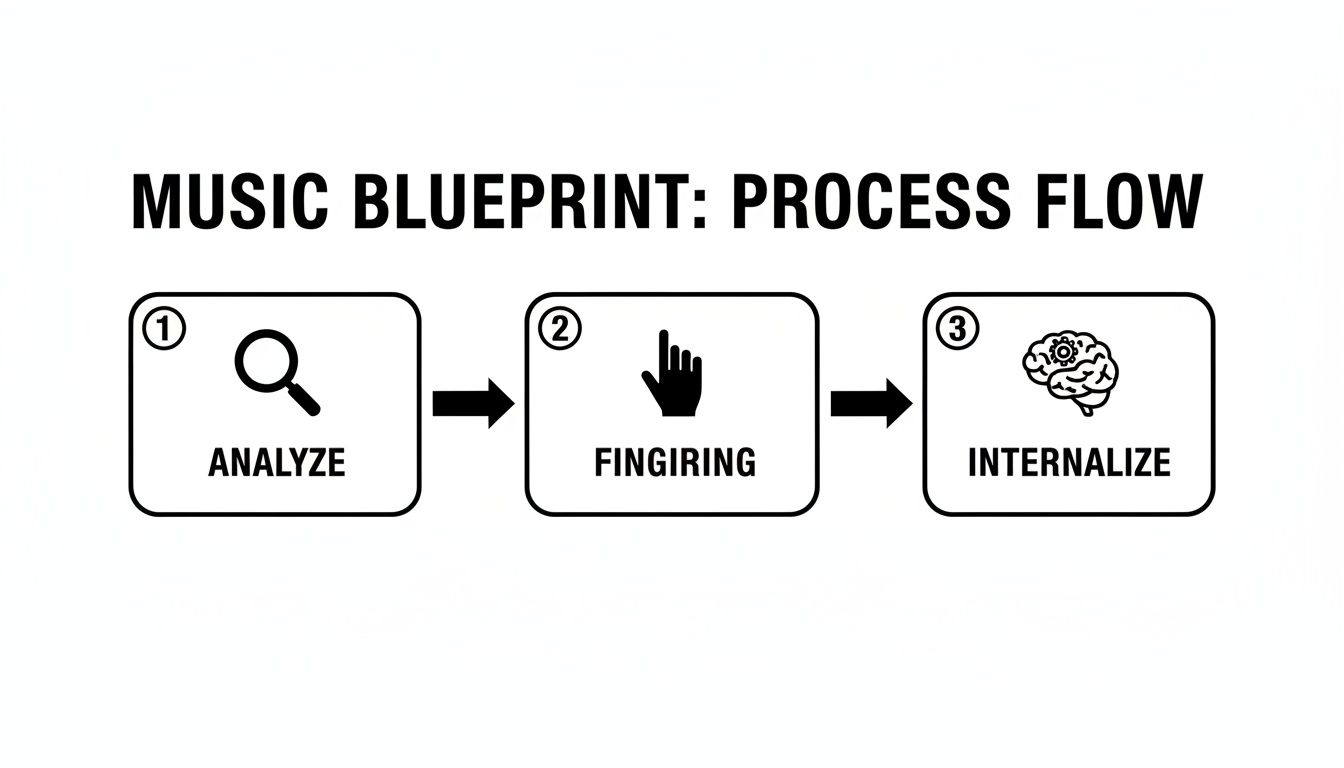
As you can see, you can't just jump into memorizing chunks. You first need to analyze the music and lock in your fingering before you can truly internalize anything.
The Magic of Spaced Repetition
Now, here's a crucial tip that many students miss. Hammering away at a chunk 50 times in a single practice session is not the best way to make it stick. You’ll get much better results with spaced repetition.
The idea is brilliantly simple: you deliberately space out your review sessions over time. This forces your brain to work a little harder to recall the information, which in turn builds much stronger, more reliable neural pathways. It's the difference between cramming for a test and truly learning the material.
Instead of playing a section 30 times today and hoping for the best, try a schedule like this:
Play it 10 times today.
Come back in two days and review it 5 times.
Revisit it a few more times next week.
This approach directly combats the "forgetting curve"—our natural tendency to lose information over time. By revisiting the music right when you're about to forget it, you interrupt that process and drive the memory deep into long-term storage.
This isn't just a hunch; it's backed by research. A recent study of piano majors pinpointed four key strategies for rock-solid memorization: practicing hands separately, using spaced repetition, singing the melodies, and active listening. It confirms what experienced teachers have known for years: a multi-layered approach works best. You can read more in this in-depth research on piano memorization strategies .
Combining smart chunking with spaced repetition is how you build the kind of confidence that holds up under pressure. To get even more out of every minute at the bench, take a look at our guide on how to practice piano effectively .
Using Your Ears and Eyes to Lock In the Music
Memorizing a piece of music isn't just about muscle memory. If you only rely on your fingers, you're setting yourself up for a potential blank-out under pressure. True, unshakable memorization happens when you bring your ears and eyes into the process, creating a rich, multi-layered understanding of the music that goes far beyond just hitting the right notes.
This is how you move from simply playing the music to truly knowing it.
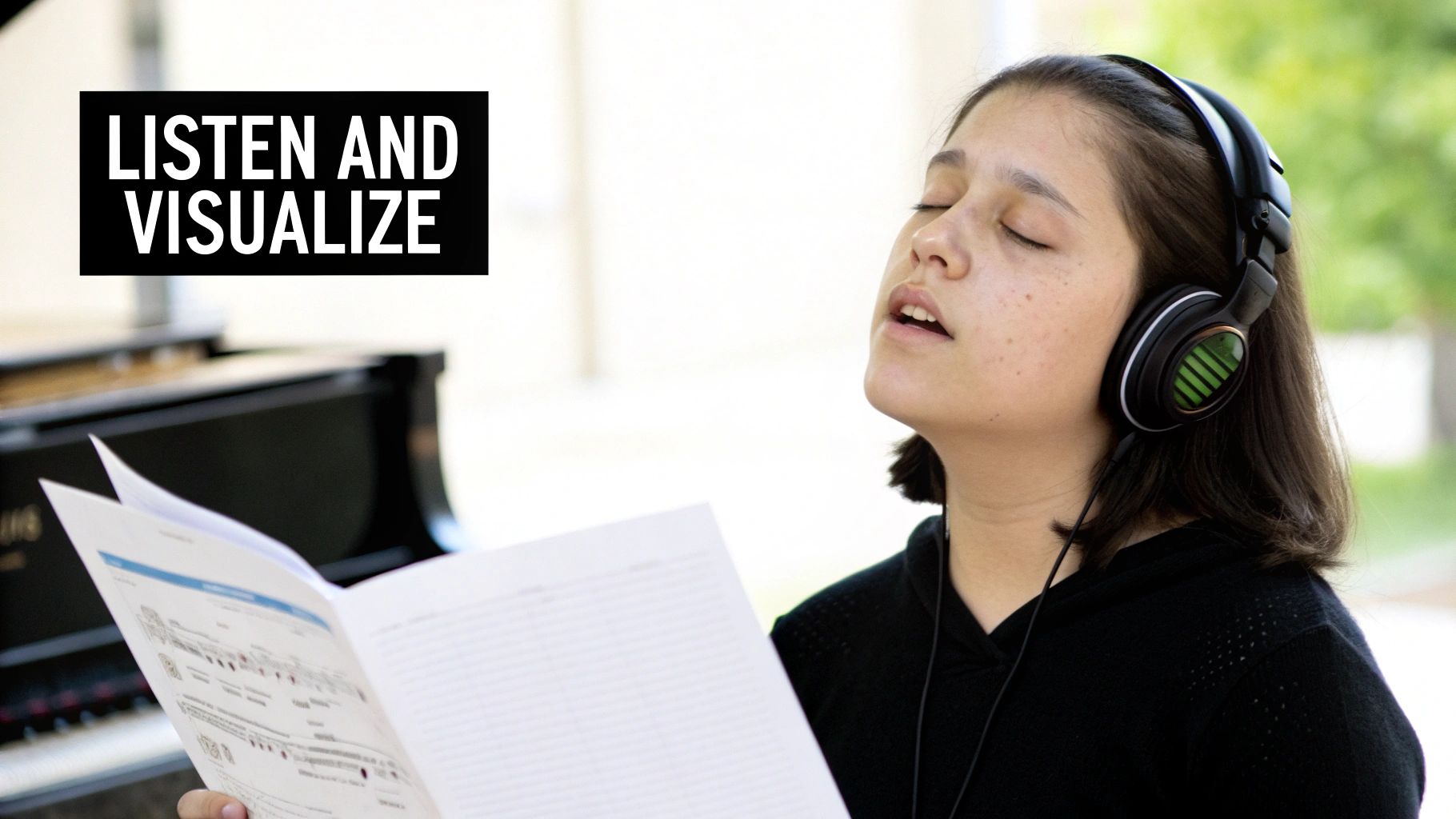
Connect Your Voice to Your Fingers
One of the most powerful—and surprisingly underused—memorization tools is your own voice. I often tell my students to sing their part as they play it. You don't need to be a trained vocalist for this to work. The idea is to connect the physical feeling of playing with the sound of the melody.
When you sing a line while your fingers play it, your brain has to process the music on a whole new level. It solidifies your grasp of the rhythm, the shape of the phrases, and the exact intervals between notes. It’s a technique that works wonders for my students all over the Salt Lake Valley, from Herriman to Sandy.
Become an Active Listener
Most students listen to recordings of their pieces. But are you listening actively or passively? There's a huge difference. Don’t just have it on as background music. Carve out some time to sit down with your score and really listen—like a detective looking for clues.
Follow along with the sheet music and pay close attention to the professional's interpretation:
- Dynamics: Where exactly do they begin a crescendo? How soft do they get in that pianissimo section?
- Phrasing: Listen to how they shape the musical lines. Where do they "breathe"?
- Articulation: Can you hear the crisp staccato notes versus the flowing legato passages?
- Emotional Color: What story are they telling? How are they using touch and timing to create that feeling?
This kind of focused listening builds a high-fidelity audio blueprint in your mind. This mental recording becomes your north star during practice, guiding your own musical choices.
By studying how professionals interpret the music, you're not just copying them—you're absorbing the musical language. This creates a rich auditory memory that supports and informs your own playing, making your memorized performance more authentic and expressive.
Visualize the Music Away from the Piano
For visual learners, this is an absolute game-changer. The goal is to develop a mental picture of the music so clear you can "see" it with your eyes closed. This works in two ways.
First, practice visualizing the score itself. Can you picture the key signature? Can you see the notes on the staff for the opening of the second section? This skill is deeply intertwined with sight-reading. Our guide on how to improve sight-reading piano has some great exercises that will help strengthen this very connection.
Second, visualize your hands on the keyboard. Close your eyes and imagine them moving through a difficult passage. See the shapes they form and the leaps they make. This isn't just a mental trick; it has a real impact. For instance, a 2022 study showed that after just a 12-week piano program, young students' short-term visual memory scores jumped from an average of 13.11 to 14.17. You can check out the full study on visual memory and piano to see the data for yourself.
How to Practice Piano Without a Piano
Believe it or not, some of the most crucial work you'll do to memorize a piece happens far away from the keyboard. It sounds strange, but mental practice—the art of playing through a piece flawlessly in your mind—is a secret weapon used by concert pianists to forge a memory that won't crack under pressure.
This isn't just wishful thinking; there's real science to back it up. Neuroscience studies show that when you vividly imagine playing, your brain lights up the very same neural pathways it uses during physical practice. This means you can essentially double your practice time, cementing your memory on the bus, during a lunch break, or even on the commute from Draper to our Bluffdale studio.
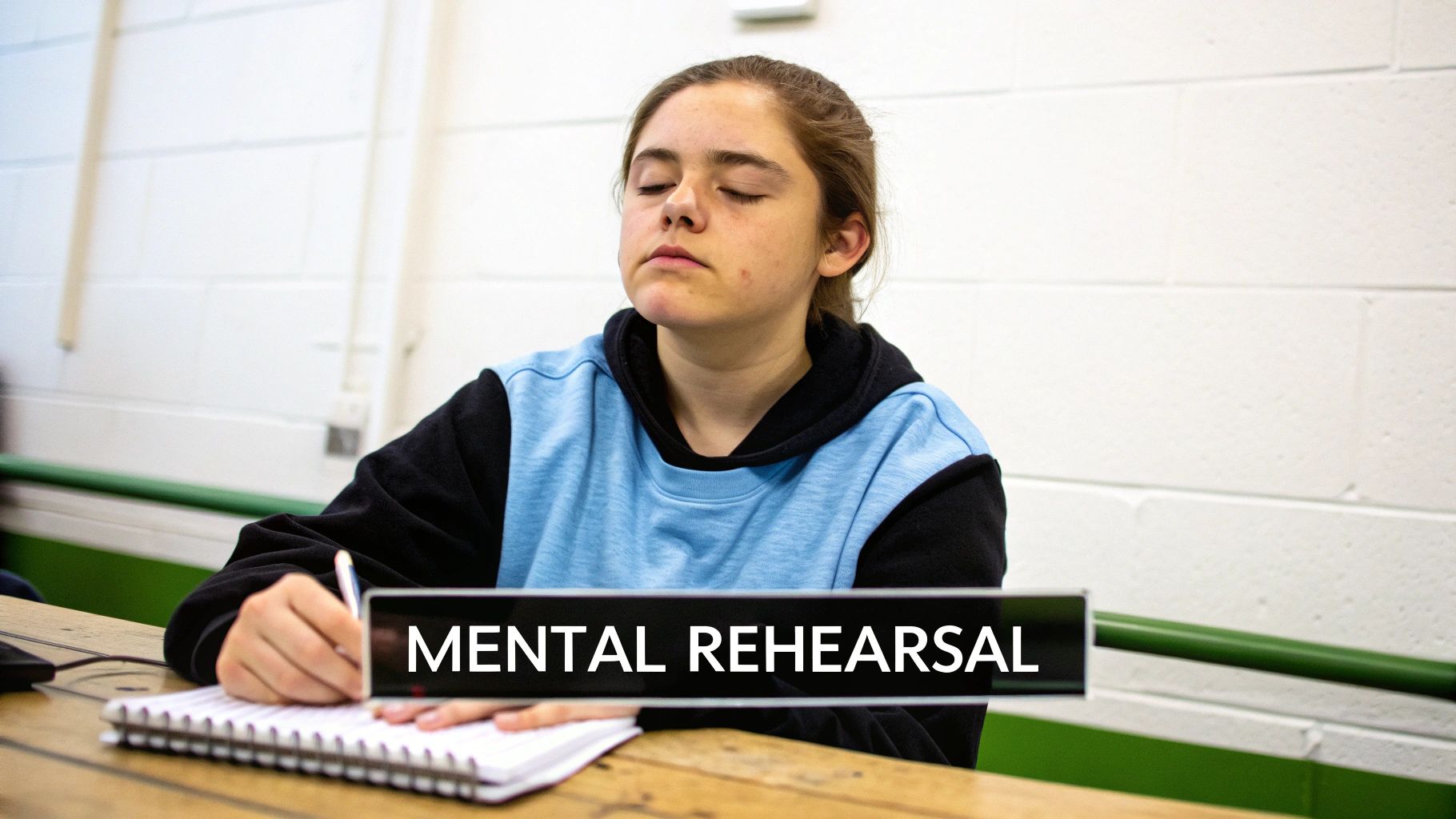
Mastering Mental Rehearsal
Effective mental rehearsal is far more than just humming the melody. It's a focused, structured activity that requires your full attention.
To begin, find a quiet spot where you won't be interrupted. Close your eyes and truly "see" your hands on the keyboard. Try to imagine the physical sensation of the keys depressing, the exact sound of each note, and the emotional arc of the music.
Drill down into the details:
- Hear the Music Internally: Can you "audiate" the melody, harmony, and rhythm in your head, just as they should sound?
- Feel the Movements: Mentally walk through the choreography of your hands. Picture the leaps across the keyboard, the subtle shifts in hand position, and the specific fingering you’ve decided on.
- Read the Score in Your Mind: Visualize the sheet music itself. See the notes on the staff, the key signature, and all the dynamic markings. If that mental image is fuzzy, our guide on how to read sheet music for beginners can help build that foundational skill.
The goal is to create a multi-sensory mental performance that is just as rich and detailed as a physical one. If you hit a "wrong note" or get stuck in your mind, you've just found a weak spot that needs attention back at the piano.
Simulate Real Performance Pressure
Once the piece feels solid both in your mind and under your fingers, it’s time to see if it can withstand a little pressure. The performance environment adds a shot of adrenaline and a host of distractions that simply don't exist in the comfort of your practice room.
The best way to build mental toughness is to create low-stakes "mock recitals" to get accustomed to the feeling of being watched.
Start with a small, supportive audience, like family or friends. The simple act of having someone else listen changes the entire dynamic and will quickly reveal any shaky sections in your memory.
Another great trick is to record yourself. Just setting up your phone and hitting "record" can mimic the pressure of a live audience. Plus, listening back gives you invaluable, objective feedback on your performance.
Finally, try practicing with intentional distractions. Play with the TV on quietly in the next room, or ask a family member to walk through while you're playing. Learning to maintain your focus through small interruptions is fantastic training for the unpredictable nature of a real performance.
Testing Your Memory to Make It Unforgettable
Getting a piece into your memory is a fantastic milestone, but the work isn't quite done. The real goal is to make that memory stick—to transform it from something you just learned into something you know cold. This means shifting away from simple repetition and toward actively testing your recall.
This is a powerful idea from cognitive psychology called retrieval practice. Instead of just playing a piece from beginning to end to "strengthen" it, you force your brain to pull the information out from scratch. It’s a subtle change in mindset, but it makes a world of difference for long-term retention.
Think about it: while you can get to 95% accuracy with standard run-throughs, it's the act of testing that forges the strong neural pathways you need under pressure. This is precisely why a pianist can play a piece perfectly at home but blank on stage a day later. They haven't built and tested those retrieval pathways. You can dig deeper into how retrieval practice enhances piano melody memorization through published research on the topic.
Putting Your Memory to the Test
Don't think of these as pass/fail exams. Treat them as diagnostic tools. They’re designed to instantly show you the weak links in the chain. A student from Lehi might feel completely secure playing a sonata, but these targeted exercises will pinpoint exactly which transition or thorny passage needs shoring up before the recital.
Here are a few of my favorite memory stress tests to work into your practice time:
- Start from Random Measures: Can you start playing cleanly from the beginning of the third line on page two? How about right at the start of the development section? Pick random spots and try to jump right in without fumbling.
- Play Sections Backward: This doesn't mean playing the notes in reverse! Start by playing the very last phrase of the piece. Then, play the second-to-last phrase and connect it to the end. Keep working your way backward, chunk by chunk. This breaks your reliance on muscle memory and forces you to know each section on its own terms.
- Write It Out by Hand: This one is tough but incredibly revealing. Try to write out a difficult passage of the score from memory. Even if it's not perfect, the act of trying will immediately highlight what you truly know versus what you're just glossing over.
By intentionally trying to "break" your memory in the safety of your practice room, you build a much stronger, more flexible recall that can withstand the pressure of a live audience.
Creating a Repertoire Maintenance Schedule
Once a piece is memorized and battle-tested, it needs a good maintenance plan to stay in shape. Even the most securely learned music will fade over time if you neglect it. The idea is to keep your repertoire performance-ready so you don't have to constantly re-learn pieces from scratch.
A simple maintenance schedule is all you need. Here's what it might look like:
Weekly Review: Play through each of your memorized pieces at least once a week. This doesn’t have to be an intense, note-by-note practice session—a simple run-through is often enough to keep it fresh.
Monthly Deep Dive: Once a month, choose an older piece from your repertoire and put it back into heavy rotation for a few days. Run your memory tests, polish the details, and treat it as if you were preparing it for a performance.
Performance Simulation: Find low-stakes opportunities to play your pieces for others. Whether you're taking advanced piano lessons and play for your teacher, or you just perform for friends and family, it keeps the music alive and builds your confidence.
This kind of structured approach ensures that all your hard work pays off for years to come. Before you know it, you'll have a growing library of music you can play by heart at a moment's notice.
Answering Your Top Questions About Memorizing Piano Music
Even with a great game plan, you're bound to run into some questions along the way. Let's dig into a few of the most common hurdles I see pianists face, so you can move forward with confidence.
How Long Does It Take to Memorize a Piano Piece?
This is the big one, isn't it? But the honest answer is: it depends. There’s no magic number. A short, simple piece might click after a week of focused practice. On the other hand, a complex multi-movement sonata? That could easily take several months to feel truly secure.
The real goal isn't just about speed; it's about building a security and reliability that holds up under pressure. Rushing through the notes will only give you a fragile memory. A much better approach is to use the multi-layered techniques we've discussed—getting into the analysis, the sound, the look, and the feel—to create a memory that's rock-solid.
What Should I Do If I Have a Memory Slip in a Performance?
First things first: take a breath and know that it happens to everyone, even the pros. The trick isn't avoiding slips altogether, but having a solid recovery plan baked into your practice. This is something we drill constantly with our students at our Bluffdale studio—giving them the tools to navigate performance jitters.
A memory slip feels like a disaster, but a well-practiced recovery is a mark of true professionalism. The audience will remember your graceful continuation, not the brief hesitation.
We teach students to map out "emergency exits" in their music. These are just logical places you can jump to if you get lost—like the beginning of a new section or a strong cadence. By practicing these jumps at home, you train yourself to stay calm, find your spot, and carry on without missing a beat.
Should I Memorize With or Without the Sheet Music?
You need to do both! Think of it as a gradual process. You start with the map (the score) to learn the territory, and eventually, you know the way by heart.
Always begin with the sheet music in front of you. This is where you build that crucial analytical and visual foundation. As you start working on small chunks, test yourself by looking away from the page for longer and longer stretches.
Once a section feels memorized, practice it mostly without the music. But—and this is important—make a habit of going back to the score regularly. This is your quality control. It’s how you catch any little inaccuracies in dynamics, articulation, or phrasing that might have crept in, ensuring your performance stays true to the composer's vision.
At Encore Academy for the Performing Arts, we guide students through every step of their musical journey, from building a solid foundation to performing with confidence. Book a trial class with us today and discover how our expert instructors can help you master your favorite pieces.