
How to Practice Piano Effectively: Simple Techniques for Consistent Progress
If you want to get better at piano, the secret isn't locking yourself away for hours. It’s all about consistency over duration. A focused 20-minute session every day builds more skill than a marathon practice once a week. Why? Because you’re creating durable neural pathways and muscle memory, turning practice from a chore into a powerful, manageable habit.
Building a Practice Routine That Actually Works
Let's be real—the biggest hurdle in learning piano is just getting yourself to the bench consistently. So many aspiring players think they need to carve out huge chunks of time to see any progress, but the truth is far simpler and, frankly, more encouraging. Effective piano practice isn't about the hours you put in; it's about building a positive habit that actually fits your life.
Whether you're in a busy Bluffdale home or a quiet apartment in Lehi, a routine you can stick with is the bedrock of your progress. It's all about quality, not quantity. Short, focused, daily practice sessions are scientifically proven to build skills faster than long, irregular ones.
The Power of Consistent, Short Sessions
Think of it like learning a new language. You wouldn't expect to become fluent by studying for eight hours one Saturday a month. You’d practice for a little while every single day. Piano is no different. Those short, daily interactions with the keys are what truly reinforce learning and lock in muscle memory.
And this isn't just a hunch; the data backs it up. A 2023 survey of 645 music teachers revealed that students practicing just 15-30 minutes daily showed far better progress than those practicing sporadically for longer periods. In fact, students with a short, regular routine advanced 40% faster in technique and mastering their pieces.
The goal is to make practice an automatic part of your day, like brushing your teeth. Once the habit is set, you stop needing so much motivation to get started, and progress just starts to happen on its own.
Designing Your Ideal Practice Environment
Your surroundings have a massive impact on your ability to focus. Set up a dedicated practice space, even if it's just a quiet corner of a room. This spot needs to be free of distractions. That means putting your phone on silent and out of reach, turning off the TV, and letting your family know you need some uninterrupted time.
For families in Riverton or Draper with bustling households, noise-canceling headphones can be a total game-changer for anyone playing a digital piano. The idea is to create a little bubble where you can fully immerse yourself in the music. Having your sheet music, a pencil, and a metronome ready to go also cuts down on friction, making it that much easier to sit down and just play.
This simple flow is a fantastic visual for structuring a daily practice session that works.
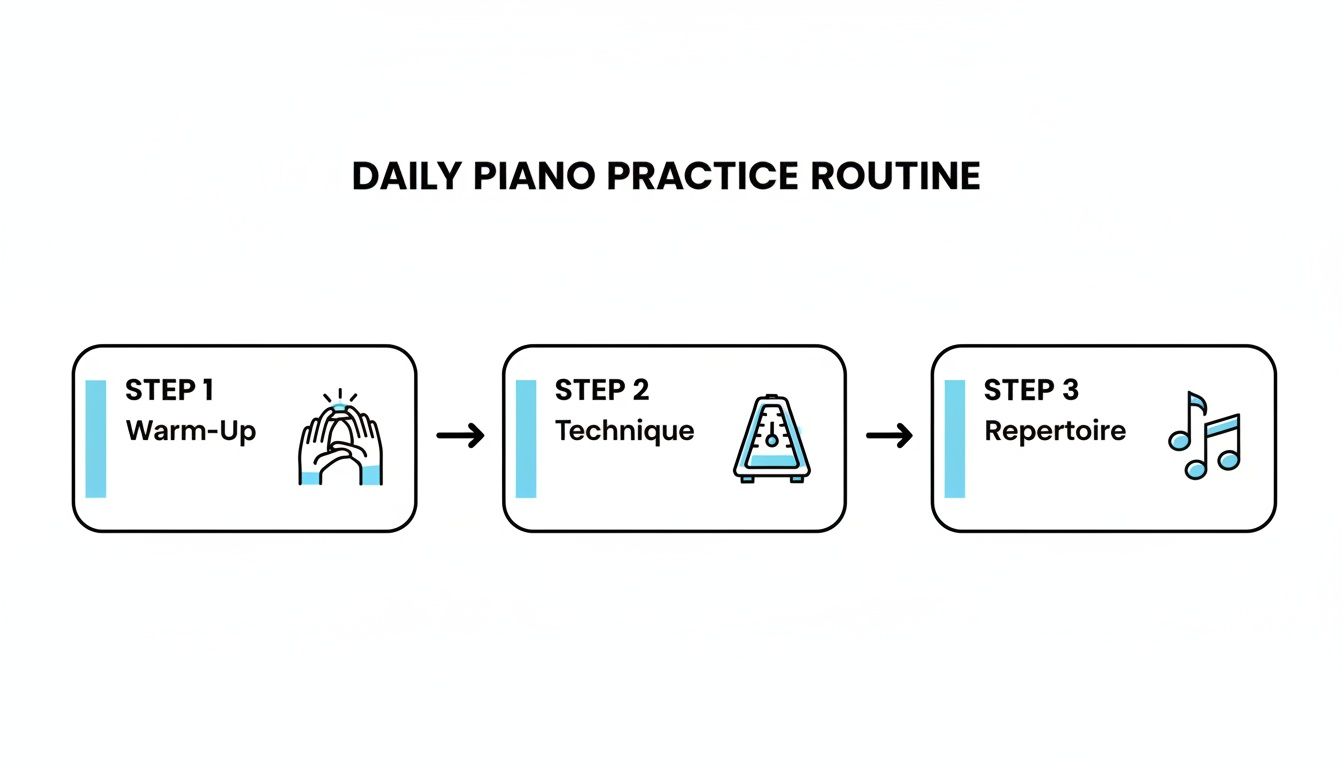
As you can see, a balanced practice isn't just about playing songs. It's about including the crucial prep work and skill-building that lead to real improvement.
Your Daily 30-Minute Practice Blueprint
Here's a sample schedule you can use to structure a short, high-impact practice session. Breaking your time into focused activities like this ensures you're building well-rounded skills every single day.
| Warm-Up | 5 | Getting fingers loose and ready with scales, arpeggios, or Hanon exercises. |
|---|---|---|
| Technique | 10 | Isolating a specific technical challenge—like trills, hand independence, or a tricky passage. |
| Repertoire | 10 | Working on your current pieces. Focus on tough spots, not just playing from the top. |
| Sight-Reading/Fun | 5 | Reading a simple new piece or just improvising. End on a high note! |
This structured approach guarantees that every minute you spend at the piano is time well spent.
The Core Components of Every Session
A well-rounded practice session always includes a few key elements. This is the exact foundation our Encore Academy students use to build confidence right from the start. By hitting each area, you make sure no part of your musicality gets left behind.
- Warm-ups (5 minutes): Don't skip this! Start with simple scales, arpeggios, or other finger exercises. This gets your hands ready to play and your mind focused.
- Technique (10 minutes): This is where the real growth happens. Dedicate this block of time to a specific technical goal. Maybe you're working on smoothing out your trills, improving hand independence, or using a metronome to clean up a difficult passage.
- Repertoire (10 minutes): Now, work on the pieces you’re actually learning. The key here is to avoid just playing them from start to finish. Instead, isolate the sections that give you trouble and practice them slowly and deliberately.
- Sight-Reading/Fun (5 minutes): Always end your session with something you enjoy. Try sight-reading a brand new, super simple piece, or just mess around and improvise. This rewards your hard work and makes you want to come back tomorrow.
By building a consistent habit and following a balanced routine like this one, you'll see real, tangible progress that keeps you motivated and inspired. If you're looking for more structured guidance, check out our piano lesson programs , which are designed to build these effective habits from day one.
How to Build Real Technique (Without the Boring Drills)
Let's be honest, the word "technique" can conjure up some pretty dreary images. Most of us immediately think of endless, robotic drills—scales and exercises that feel more like a chore than a creative pursuit.
But real piano technique isn't about becoming a machine. It's about building the physical skill you need to play with freedom, control, and musicality. It’s what lets you play without getting hurt and allows your passion to shine through.
When we practice smart, those exercises stop being a grind and become a mindful process of honing our craft. The secret is to connect every scale, arpeggio, and finger drill to a real, tangible musical goal.
Give Every Exercise a Mission
Instead of just mindlessly running up and down the keys, give each repetition a specific job to do. I’ve seen students in Draper get more out of five minutes of focused scales than others get from an hour of zoned-out playing. It’s all about intention.
Here’s how you can give your technical work a clear purpose:
- Hunt for an Even Tone: Play a simple C major scale, but really listen. Is your thumb booming out louder than your pinky? Your mission is to make every single note sound perfectly consistent.
- Build Finger Independence: Try a basic five-finger pattern, but consciously focus on keeping the fingers you aren't using completely relaxed and still. This is crucial for playing clean, articulate passages later on.
- Find Your Fluid Wrist: As you practice arpeggios, focus on a loose, flowing wrist that guides your hand. Imagine it’s a paintbrush gliding across the keys. This is the key to preventing tension and achieving a beautiful tone.
When you attach a "why" to what you're doing, you transform a rote exercise into a powerful tool. You’re no longer just playing notes; you’re sharpening the skills you need to actually make music.
Technique is the bridge that lets your musical ideas travel from your mind to the keys. Without a strong foundation, even the most beautiful interpretations get stuck in a traffic jam of fumbling fingers and uneven sound.
One of the most famous—and sometimes controversial—names in the world of piano technique is Charles-Louis Hanon. His book, The Virtuoso Pianist, has been a go-to for generations of pianists.
This is the composer behind the exercises that have built finger strength and dexterity for countless players. While some teachers debate his methods today, Hanon's work highlights the long-held belief that targeted drills are essential for building a solid technical base.
Make the Metronome Your Friend, Not Your Enemy
So many students, especially younger learners I've worked with in Sandy, see the metronome as a nagging critic. But that's not its job! Think of it as a helpful guide for developing a rock-solid internal pulse. It’s a tool for diagnosis, not just a speed trap.
Start your exercises at a tempo so slow it feels almost silly—a speed where you literally can't make a mistake. This is where your brain and muscles learn the correct movements perfectly.
Then, slowly, bump the speed up one click at a time. Make sure your playing is still precise and even at each new tempo before moving on. This methodical approach builds accuracy that won’t fall apart when you tackle fast, complex music.
Ultimately, a strong technical foundation goes hand-in-hand with understanding the music you’re playing. When you grasp why a chord progression works or how a scale is built, the physical act of playing it becomes far more intuitive. For a deeper dive, our guide on music theory lessons for beginners can help illuminate the "why" behind the notes, turning your physical practice into a truly musical experience.
Learning New Pieces Without the Frustration
We’ve all been there. You sit down at the piano, a brand-new piece of sheet music in front of you, buzzing with excitement. But that excitement can quickly sour into frustration when you try to play from beginning to end and get tangled in a mess of wrong notes and shaky rhythms.
The secret isn't more brute force—it's having a smarter plan. The best pianists don't see a whole song; they see a collection of small, bite-sized puzzles waiting to be solved. This simple shift in perspective is what separates progress from burnout.
Break It Down Before You Burn Out
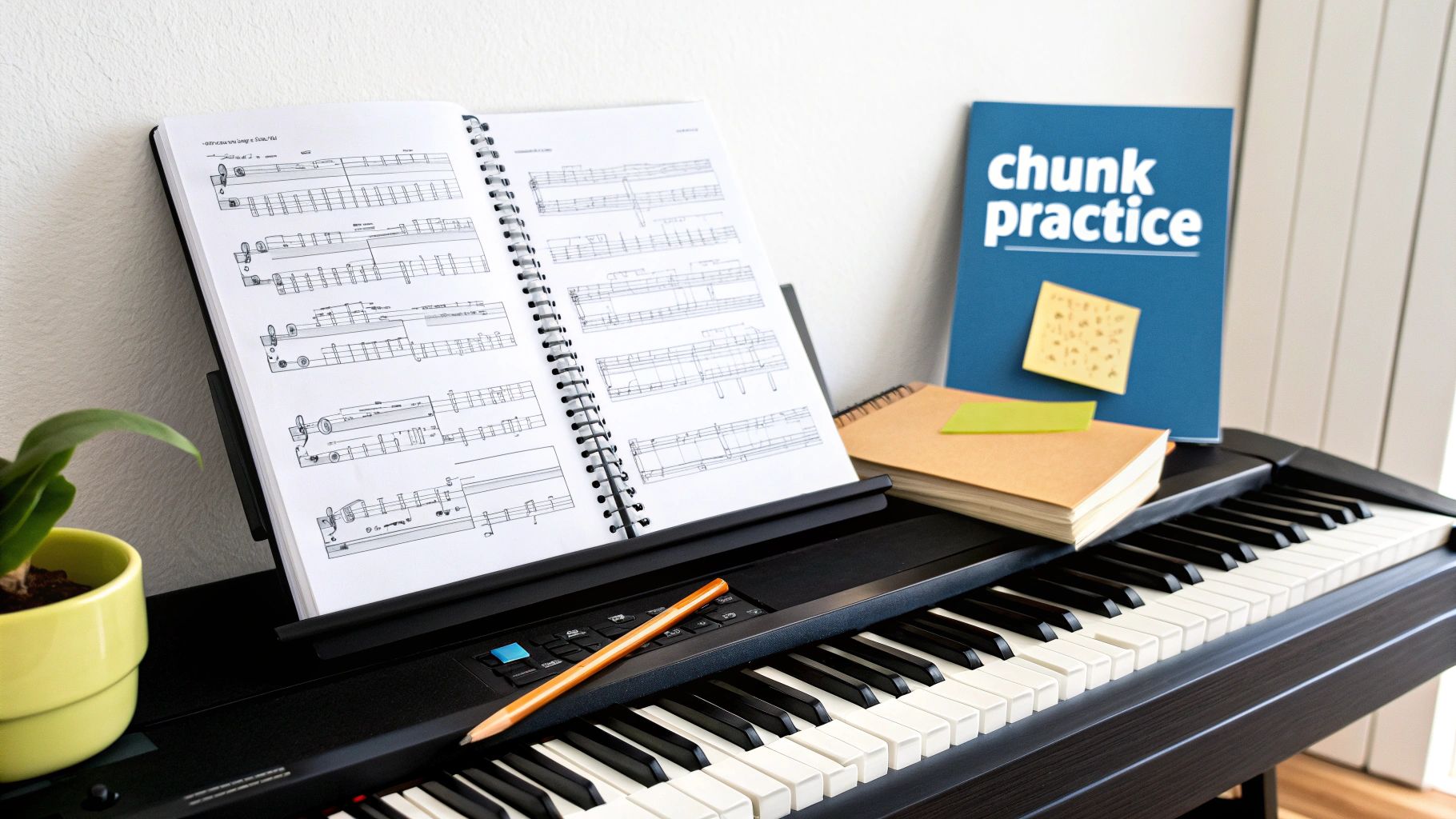
If you take away only one thing, let it be this: chunking. Never, ever try to swallow a new piece whole. It’s the fastest way to feel overwhelmed. Your brain simply can't process that much new information at once.
Instead of staring down two pages of music, just look at the first measure. Maybe the first two, if they look simple. The goal isn't immediate perfection; it's just to understand what’s on the page. I see students from Herriman to Lehi have breakthrough moments when they finally adopt this approach.
Here’s how you can put this into practice today:
- Analyze before you play. Don't touch the keys yet. Scan the first couple of measures. What’s the key signature? Time signature? Any surprise sharps or flats?
- Divide and conquer. Work on just one small chunk, one hand at a time. Get the right hand solid, then the left. Only after both are confident and clean should you even think about putting them together.
- Connect the chunks. Once measure one is locked in, learn measure two the same way. Now, and only now, connect them by playing measures one and two together. This methodical process builds a rock-solid foundation.
It feels slow at first, I know. But trust me, this deliberate pace saves you dozens of hours of un-learning bad habits down the road.
The most effective pianists don't just play; they plan. Research shows that top performers spend a significant portion of their practice time—up to 24%—in 'non-playing' activities like score study, analysis, and strategic planning before ever touching the keys.
Slow Practice Is Your Secret Weapon
Once you have your small chunk, your next job is to practice it slowly. And I mean painfully slow. So slow that it feels physically impossible to make a mistake.
Every time you play a wrong note, you're reinforcing that mistake in your muscle memory. By slowing down to a tempo where you have 100% accuracy, you're building the correct neural pathways from the very first repetition. Grab a metronome to keep yourself honest, and only bump up the speed one or two clicks at a time.
Think of a student at our Bluffdale studio learning a blistering fast run. They don't just go for it at full speed. They treat it like an athlete training for a sprint—breaking down the movement, perfecting their form slowly, and only then building speed. Your fingers deserve that same careful training.
Look Beyond the Notes for True Artistry
Getting the right notes at the right time is just the start. The real music—the artistry—happens when you dig deeper into what the composer wrote.
Once you have a basic handle on a section, start asking the right questions:
- What are the dynamics? Find those piano (soft) and forte (loud) markings and exaggerate them.
- How should it be phrased? Look for the long, curved lines over notes (slurs) that group them into musical sentences.
- Are there any patterns? Spotting a repeating rhythm or melodic shape makes the music click into place much faster.
This kind of analysis turns your playing from robotic to expressive. It’s where technique meets interpretation, and having strong sight-reading skills makes it all possible. To sharpen that skill, dive into our guide on how to improve sight-reading on the piano .
Combine these strategies, and you'll find yourself learning new music faster and with far more enjoyment than ever before.
Setting Goals That Keep You Motivated
There’s no better fuel for motivation than seeing actual progress. You can sit at the bench for hours, but if you don't feel like you're getting anywhere, that initial spark will eventually fizzle out. This is exactly why vague goals like "get better at piano" are so self-defeating—there’s no finish line, no way to measure how far you've come.
To really practice effectively, you need a solid framework for setting goals. Think of it as creating a roadmap for your musical journey, dotted with clear milestones that prove you’re moving forward. When you can point to tangible proof of your hard work, the desire to keep going takes care of itself.
Moving From Vague Hopes to Concrete Goals
The first order of business is to break down your big ambitions into small, manageable steps. Instead of a colossal goal like "mastering the piano," you need to set targets you can actually hit and measure within a reasonable timeframe. This creates a powerful cycle of accomplishment that builds its own momentum.
For example, a student here in Sandy who sets a goal to "play a song for the family holiday party" has a clear target and a deadline. That’s infinitely more motivating than a fuzzy wish to just "improve."
Here’s how to turn those vague ideas into specific, actionable goals:
- Instead of: "I want to get better at scales."
- Try: "I will master all 12 major scales, hands separately, at 80 BPM by the end of this month."
- Instead of: "I want to learn more songs."
- Try: "I will learn and memorize the first page of Debussy's Clair de Lune in the next six weeks."
- Instead of: "My rhythm is sloppy."
- Try: "I will practice the tricky rhythm in measure 16 of my piece with a metronome for 10 minutes every day."
These kinds of specific goals give your practice sessions purpose. You're no longer just putting in the time; you're actively working toward a tangible outcome.
The Power of Tracking Your Journey
Once you’ve set your goals, you need a way to track them. This isn't about nitpicking your playing. It's about creating a living record of your growth that you can look back on. This kind of self-assessment is a game-changer for spotting weaknesses and—more importantly—celebrating your wins.
We see this every single day with our students from Herriman to Riverton. When they listen back to a recording of themselves from just a month ago, the improvement is often undeniable. That "aha!" moment is pure motivational gold.
Tracking your progress doesn't have to be complicated. A few simple methods work wonders:
- Keep a Practice Journal: Grab a simple notebook. At the end of each session, jot down what you worked on, what felt good, and what was a struggle. Note your metronome speed on scales or the measure number of a passage you finally smoothed out.
- Record Yourself Regularly: Use your phone to record yourself playing a piece or exercise once a week. Listening back gives you an objective ear you simply don't have while playing. You'll hear the nuances of your dynamics, rhythm, and tone in a completely new light.
- Create a "Done" List: Keep a running list of the pieces you've learned and polished. Watching that list grow over time is an incredible confidence booster and a concrete reminder of your dedication.
The Self-Reflection Loop
This cycle of setting and tracking goals creates a powerful feedback loop. The more you track, the more you understand your own playing. The better you understand your playing, the smarter you can be about setting your next goal.
This whole process is a cornerstone of what separates good practice from great practice. Studies on expert musicians have found that top performers spend a huge chunk of their practice time—up to 24%—on non-playing activities like analyzing the score, planning their sessions, and reflecting on their progress.
This reflection helps you pinpoint exactly where you need to focus. Maybe your recordings reveal that your left hand is consistently quieter than your right. Boom—your next goal could be to spend five minutes each day on left-hand-only exercises to build its strength and control. It’s this kind of targeted approach that ensures every minute at the piano is pushing you forward.
Turn Practice Into Performance and Watch Yourself Soar
Practice is where you lay the bricks, but performance is where you build the house. There's nothing quite like having a recital, a casual showcase for friends, or even a self-imposed recording date circled on your calendar to sharpen your focus. That little bit of positive pressure can completely transform how you approach your time at the piano.
Suddenly, practice isn't just about repetition; it's about preparation. Every run-through has a clear purpose. You're not just trying to fix a clunky passage for your own sake—you're polishing it to share with others. This simple shift in mindset is the secret engine that drives rapid improvement and builds real, lasting confidence.
Why a Deadline Makes You a Better Pianist
Having a performance date on the horizon forces you to move beyond just "working on" a piece and into the crucial stage of actually "finishing" it. It kicks off a natural, powerful cycle of learning that’s essential for mastering any skill.
Think about it in three parts:
Preparation: This is your focused, goal-driven practice. You hunt down weak spots, smooth out awkward transitions, and start making real artistic choices about dynamics and phrasing.
Execution: You perform the piece. This is the moment of truth, the ultimate test that reveals what you've truly mastered and what still needs attention under the pressure of the moment.
Reflection: Afterward, you and your teacher talk about how it went. You celebrate the wins and identify what could be stronger, which gives you a crystal-clear roadmap for your next practice sessions.
This cycle—practice, perform, get feedback—is at the heart of how we teach. We’ve seen it time and time again with our students from Herriman and Bluffdale; when they have a performance to aim for, their progress just takes off.
Having a performance on the horizon changes the entire dynamic of your practice sessions. It introduces a healthy sense of urgency that makes you practice more deliberately and efficiently, ensuring every minute at the piano counts.
Taming the Butterflies
Of course, the thought of performing can bring on a case of the nerves. That's completely normal! The trick is to learn how to reframe that jolt of adrenaline not as fear, but as energy you can pour directly into your music.
Your body is just getting excited and trying to help you focus. Instead of fighting that feeling, embrace it. Use that energy to bring more passion and life to your playing. Here are a few practical ways to get comfortable with it:
- Do a "Dress Rehearsal": A week or two before the real deal, play your piece for family or friends. Getting used to having an audience, even a small and friendly one, makes a huge difference.
- Breathe It Out: Right before you walk out or press "record," take three slow, deep breaths. It’s a simple trick, but it works wonders to slow your heart rate and clear your head.
- Get Lost in the Music: Focus on the story you’re telling with the notes. When you’re completely absorbed in creating sound, there’s not much mental space left to worry about what anyone else is thinking.
Performance opportunities are a non-negotiable part of a great music education. In fact, a 2023 global survey of music teachers revealed that studios offering regular recitals saw 35-50% higher student retention and skill gains. This just confirms what great teachers have always known: performance-based learning is directly tied to student success.
The Gift of Feedback
After you take your bow, the learning isn’t over—it’s just getting started. This is where getting constructive feedback from your teacher becomes one of the most valuable parts of the whole experience. A good teacher doesn't just list your mistakes; they help you understand why they happened and give you concrete things to work on.
That outside perspective is priceless. It helps you hear your own playing in a new light and gives you an actionable plan for your next practice sessions. Whether you're getting ready for a festival or one of our own showcases, which you can read about on our Encore Academy events page , this feedback loop is what turns a single performance into a launchpad for incredible growth.
Common Questions About Piano Practice
Starting piano lessons, whether for yourself or your child, always sparks a few questions. From how long to sit at the bench to what to do when motivation dips, you're not alone in wondering how to make the most of practice time. We hear these questions all the time from families right here in Bluffdale, so we've put together some straightforward answers based on years of experience.
Think of this as your go-to guide for building a practice routine that actually works, helping you or your young musician stay on track and find real joy in the journey.
How Long Should I Practice Every Day?
This is easily the most common question we get, and the answer often surprises people. It's not about logging hours; it's about being consistent. Consistency is always more important than duration.
A focused 20-minute session every day will build skill far more effectively than a marathon two-hour practice once a week. For the little ones (ages 4-7), just 10-15 minutes is a perfect starting point. Older kids and teens should aim for 20-30 minutes, and adult beginners will see fantastic progress with that same 30-minute daily commitment.
The real goal is to make piano practice a non-negotiable part of the daily routine, just like brushing your teeth. Once that habit is locked in, the progress will follow naturally.
What Should I Do If My Child Refuses to Practice?
Ah, the practice standoff. It’s a classic challenge many parents, from Lehi to Herriman, know all too well. The first thing to remember is that this is completely normal. The trick is to reframe the situation from a power struggle into a team effort.
Take a look at the setup first. Is the piano in an inviting, well-lit space? Are they being asked to practice when they're hungry or exhausted after a long day?
Here are a few strategies that can turn things around:
- Try a "When/Then" approach: "When you finish your 15 minutes of piano, then we can start our game night."
- Keep them company: You don't have to be a piano expert. Just sitting nearby shows your support and helps them stay focused. Your presence alone can make a huge difference.
- Incentivize with games or rewards: For younger children, something as simple as a sticker chart that leads to a small treat or choosing the family movie can work wonders.
- Loop in their teacher: Your instructor is your best ally. They can find music that genuinely excites your child and offer personalized advice.
The goal isn't perfection; it's participation. Fostering a positive, happy connection with the piano is far more valuable than winning a daily argument. A little bit of joyful practice is always better than a lot of tearful practice.
Is It Better to Practice in the Morning or Evening?
Honestly, the best time to practice is whenever you can do it consistently and with full attention. There is no single "magic hour" that works for every student.
Some people feel most alert and ready to learn first thing in the morning. Others find that sitting down at the piano after school or dinner is a great way to de-stress and refocus. It really comes down to your family's unique rhythm.
Experiment for a week or two. A student in Riverton who is booked solid with after-school sports might discover that 15 minutes right before heading out the door in the morning is the only reliable slot. The key is to find that window of time and guard it.
Once you find a time that clicks, try to make it a routine. That repetition helps make practice an automatic and expected part of the day.
How Do I Know If I Am Practicing Correctly?
This is a fantastic question. Practicing "correctly" simply means you’re practicing with a purpose, not just playing on autopilot. It’s the difference between mindlessly running through a song and actively working to make it better.
Are you truly listening to the sounds you're making? Are you focused on solving a specific problem, like a clunky rhythm in measure five or an uneven run of notes?
Here’s a quick mental checklist for a great practice session:
- Did you start with a short warm-up?
- Are you using a metronome for at least part of the time to check your rhythm?
- Are you isolating the tricky spots and repeating them, instead of just playing the whole piece from the beginning over and over?
- Are you paying attention to the details the composer wrote, like dynamics (loud/soft) and articulation (smooth/choppy)?
A huge part of effective practice is also understanding the music on the page. When you can see the patterns and know what you're looking at, your time becomes so much more efficient. If you want to strengthen that skill, our guide on how to read sheet music for beginners is the perfect place to start.
Ready to turn effective practice into inspiring performances? At Encore Academy for the Performing Arts, we provide the expert guidance and supportive community you need to thrive. Book a trial class today and discover how our dedicated instructors in Bluffdale can help you or your child achieve your musical goals.